Google's Gemini 4 Argon Brings 1M-Token Output, but Only Cyber Defenders Can Use It
Google DeepMind announced Gemini 4 Argon on September 30 with a 1M-token output limit and $2/$10 introductory pricing, but access is limited to the Fairwind Program for now.
Google DeepMind announced Gemini 4 Argon on September 30, calling it the start of its "next era of frontier intelligence." The new model raises Gemini's output limit from 64K tokens to 1M tokens and, by Google's own numbers, leads most of a benchmark table that pits it against GPT-6 Astra, Claude Fable 5.1 and Claude Opus 5.5.
There is a catch: almost nobody can use it yet. Argon is rolling out first to a small group of trusted cyber defenders through Google's Fairwind Program, while Google takes part in the U.S. government's voluntary pre-release review. Paid API customers and Google AI Ultra subscribers are next in line, but Google has not given a date.
What Google announced
The announcement came in a Google blog post by Koray Kavukcuoglu, SVP at Google DeepMind and Chief AI Architect at Google. Google says Argon "delivers frontier performance in complex workflows across real-world software engineering, enterprise knowledge work like legal and finance, and cybersecurity defense," and that it was "built to sustain deep reasoning across complex, long-horizon workflows."
The model is not brand new inside Google. According to the post, thousands of Googlers already use it for coding, deeper research and writing.
A 1M-token output limit
The headline spec is output length. Google has expanded Argon's output token limit to what it calls "an industry-leading 1M tokens, up from the previous 64K tokens," and says the model can "generate hundreds of thousands of tokens in a single trajectory."
That is a limit on how much the model can write in one go, not on how much it can read. Google's post does not state Argon's input context window. In practice, a larger output budget matters most for long agentic runs: large code migrations, multi-step investigations and long reports that previously had to be split across many calls.
Pricing: introductory rate first, then double
When Argon opens up, it will start at an introductory price. Google lists:
- $2 per million input tokens
- $10 per million output tokens
- Cached input tokens at 95% off the input price
A footnote adds that "after the introductory period expires, the price of $4 per 1M input tokens and $20 per 1M output tokens will apply." Google does not say how long the introductory period lasts.
Long outputs add up
At the post-introductory rate of $20 per million output tokens, a single response that uses the full 1M-token output limit would cost $20 in output tokens alone, or $10 at the introductory rate.
Benchmarks: leads most rows, not all of them
Google published a comparison table of 19 benchmarks against GPT-6 Astra, Claude Fable 5.1 and Claude Opus 5.5. These are vendor-reported numbers. Among the results Google highlights:
- DeepSWE v1.1 (long-horizon software engineering): 77.9%, which Google calls a new state of the art, ahead of Claude Opus 5.5 at 74.2% and GPT-6 Astra at 74.1%
- Vals Index: 68.9%, against 67.0% for Claude Opus 5.5
- AutomationBench (Zapier): 51.3%, against 42.5% for Claude Opus 5.5 and 41.4% for GPT-6 Astra
- Vals Finance Agent v2: 65.4%, against 58.9% for Claude Fable 5.1
- Harvey's Legal Agent Benchmark: 19.6%, against 6.7% for Claude Fable 5.1
- LVBench (long video): 91.7%, against 87.5% for GPT-6 Astra
- GraphWalks 256k-1M BFS: 84.2%, against 71.8% for GPT-6 Astra
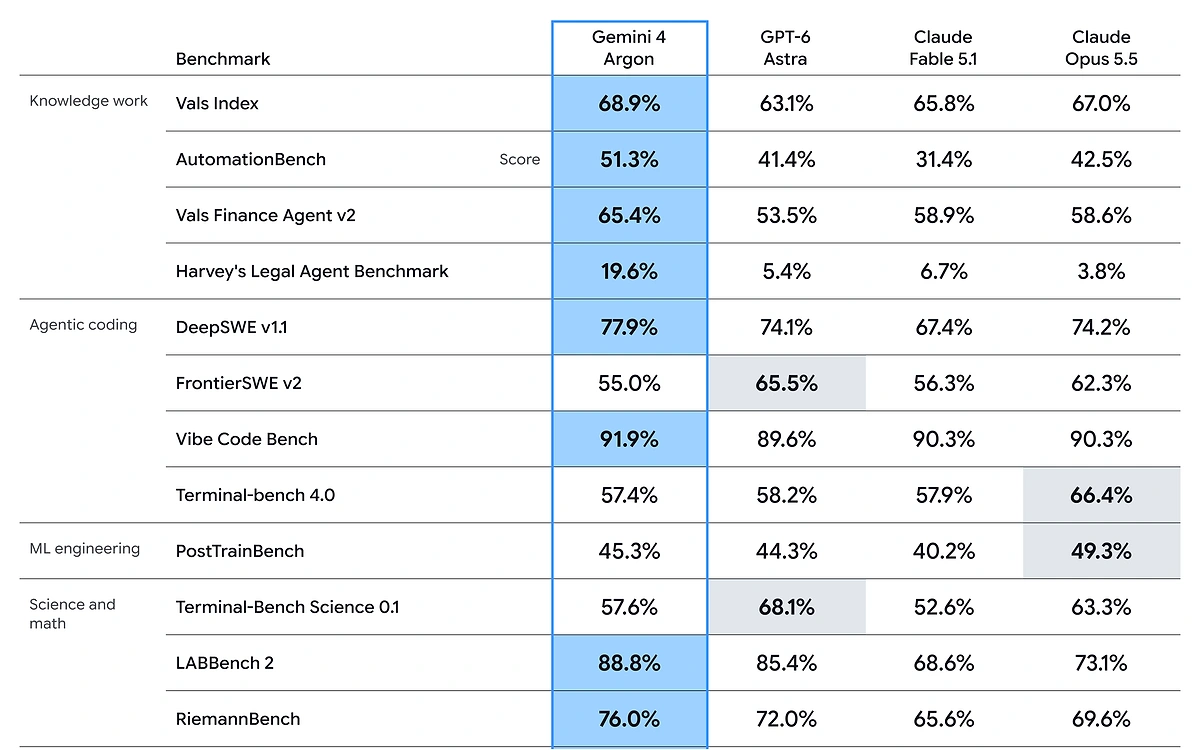
The same table also shows where Argon does not lead:
- FrontierSWE v2: GPT-6 Astra 65.5%, Claude Opus 5.5 62.3%, Argon 55.0%
- Terminal-bench 4.0: Claude Opus 5.5 66.4%, Argon 57.4%
- PostTrainBench: Claude Opus 5.5 49.3%, Argon 45.3%
- Terminal-Bench Science 0.1: GPT-6 Astra 68.1%, Argon 57.6%
- OSWorld-2.0 (offline subset): GPT-6 Astra 72.6%, Argon 69.2%
- CWE-bench v1: a tie with GPT-6 Astra at 68.0%
The pattern is consistent: Argon is strongest on long-horizon agentic work and enterprise knowledge tasks, while Claude Opus 5.5 keeps the lead on terminal-based coding and GPT-6 Astra on FrontierSWE and computer use.
Why cyber defenders get it first
Google's reasoning for the limited rollout is cybersecurity. The company says "Argon can autonomously find, validate, and patch critical software vulnerabilities," and it is putting that capability in the hands of defenders before anyone else.
For that group, the model ships with fewer restrictions. Google writes: "For trusted defenders and our own internal teams at Google, we'll be releasing Argon without cyber guardrails." The wider release is meant to keep those guardrails and refuse cyber and CBRN attack requests.
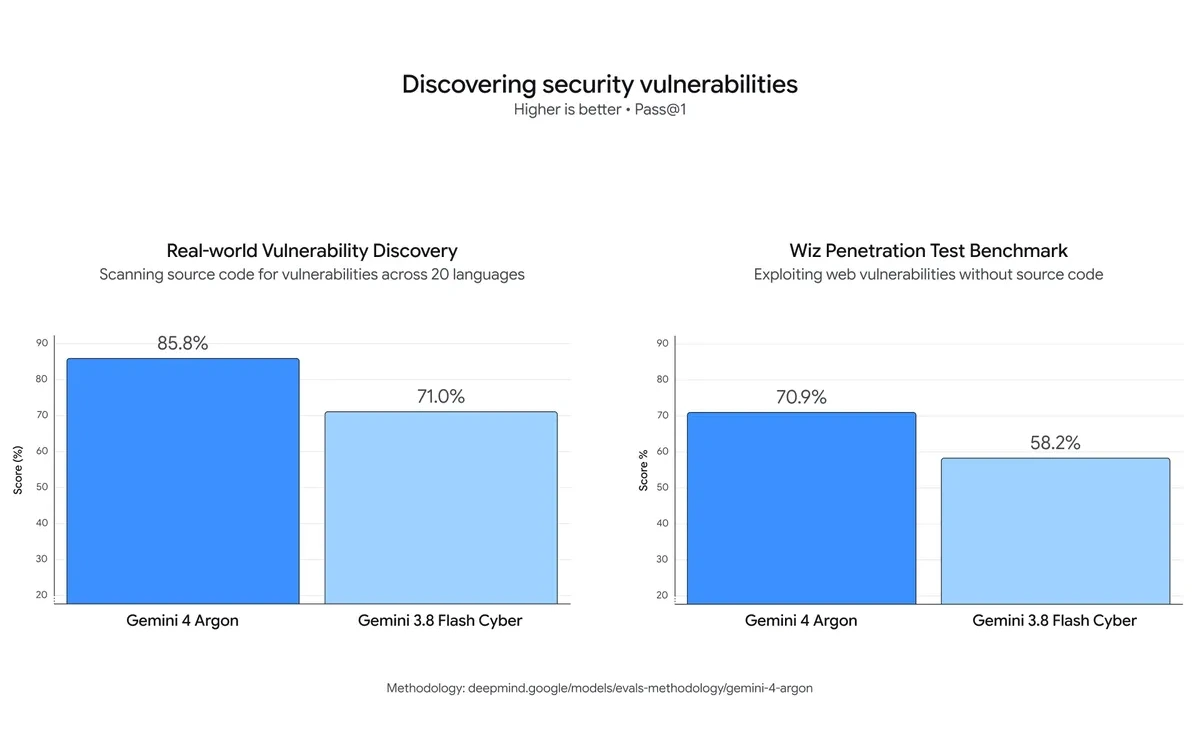
One early user is Wiz, which runs Argon through its Scan for Good initiative, a free program protecting critical public infrastructure. Google says the model "uncovered a critical vulnerability exposing sensitive personal information across healthcare software used by hospitals worldwide," a flaw that previous frontier models had missed. On Wiz's internal black-box penetration-testing benchmark, Argon outperforms Google's earlier 3.8 Flash Cyber model.
What Google says Argon did internally
Google backs its claims with internal results, all reported by the company:
- Quantum algorithms: an optimization that beat the published baseline by 40% "in a matter of minutes."
- Memory savings: Argon agents applied fleet-wide memory optimizations that free up over 300 TiB of memory once rolled out, with an estimated 500 TiB to 1 PiB in total savings.
- Rust migration: moving C and C++ code to Rust, from tens of thousands of lines in projects like re2 and libgav1 up to more than 800K lines for the Fuchsia Zircon kernel, with audits before anything reaches production.
- libgav1: in Google's open-source video decoder, agents replaced 32K lines of SIMD code, producing a memory-safe decoder that is 2.7x faster than the earlier Rust port with identical output.
The libgav1 speedup is measured against the previous Rust port, not the original C++ decoder. Google describes the result as bringing the Rust version closer to the optimized C++.
Safeguards before a broad release
Google lists four areas of work it says must be in place before Argon reaches a wider audience:
- Misuse defenses: refusing cyber and CBRN attack requests under its Frontier Safety Framework, monitoring internal activations and red-teaming the model.
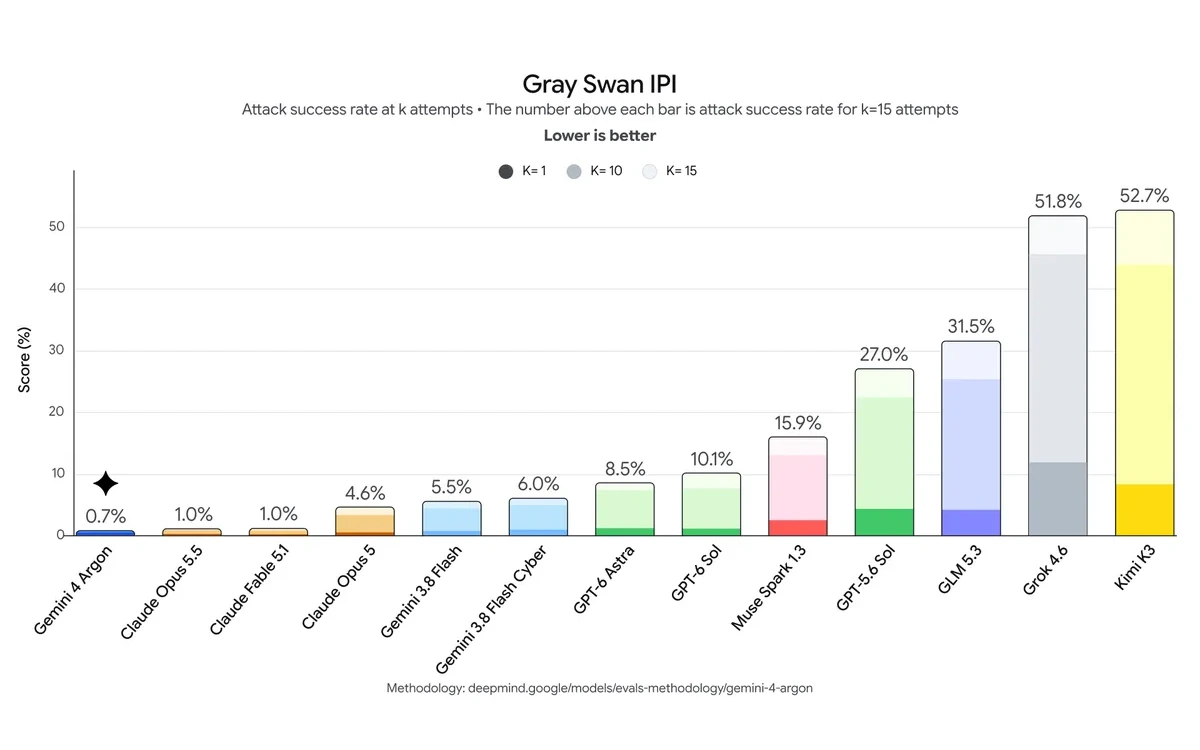
- Prompt injection: Google calls Argon "our most resilient model yet" and says it leads Gray Swan's Indirect Prompt Injection benchmark.
- Misalignment monitoring: watching chain-of-thought and actions, with the ability to stop execution.
- Isolation: hardened, isolated sandboxes for high-risk training and evaluations.
When can you use it?
Not yet, unless you are part of the Fairwind Program or a Google team. Google says it is "actively engaged in the U.S. government's voluntary process for pre-release model access while we gradually expand access," and that broader availability will start "with paid API customers and Google AI Ultra subscribers." The section of the post covering this is titled "Rolling out soon," and Google says it will happen "as soon as possible," but there is no public date.
Source: Google, "Gemini 4 Argon: our next era of frontier intelligence" (September 30, 2026), https://blog.google/innovation-and-ai/models-and-research/gemini-models/gemini-4-argon/
Key takeaways
- Google DeepMind announced Gemini 4 Argon on September 30, 2026.
- The output token limit rises from 64K to 1M tokens; Google did not state the input context window.
- Introductory pricing is $2 input and $10 output per million tokens, rising to $4 and $20 later, with cached input 95% off.
- Google's own table shows Argon leading most benchmarks but trailing on FrontierSWE v2, Terminal-bench 4.0, PostTrainBench, Terminal-Bench Science 0.1 and OSWorld-2.0.
- Access is limited to Fairwind Program cyber defenders and Google teams for now; paid API customers and AI Ultra subscribers come next, with no date given.
More in Tech News
Browse Tech News