Googlebook Goes on Sale: Five Android-Based Laptops From $899 Take On the Chromebook
The first Googlebooks from Acer, ASUS, Dell, HP and Lenovo hit shelves on October 4, priced $899 to $1,299, as Google sets a mid-2034 end date for ChromeOS updates.
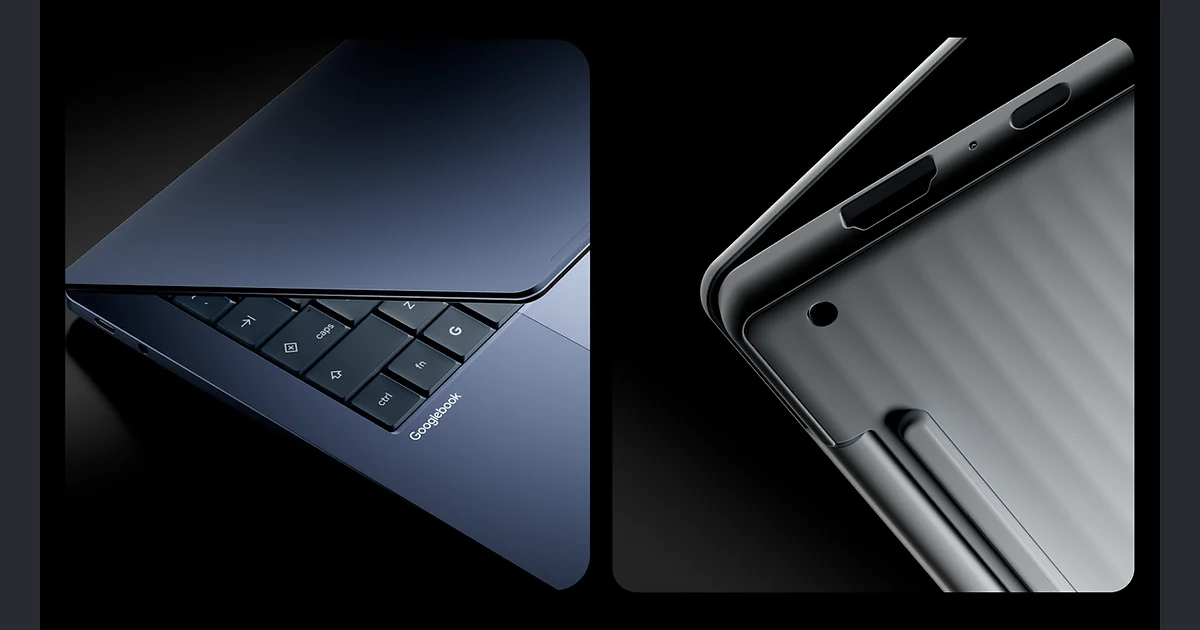
Google's new laptop platform is no longer a keynote promise. The first Googlebooks reached store shelves on October 4 in the US and on October 5 in Canada, the UK, Ireland, France, Germany and Australia, sold through the Google Store, Best Buy and other select retailers.
There are five launch machines, from Acer, ASUS, Dell, HP and Lenovo, priced from $899 to $1,299. All of them run Googlebook OS, an Android-based system that Google positions as the successor to the Chromebook. And because Google confirmed a week earlier that ChromeOS updates end in mid-2034, anyone shopping for a Google laptop now has a real choice to make.
What went on sale
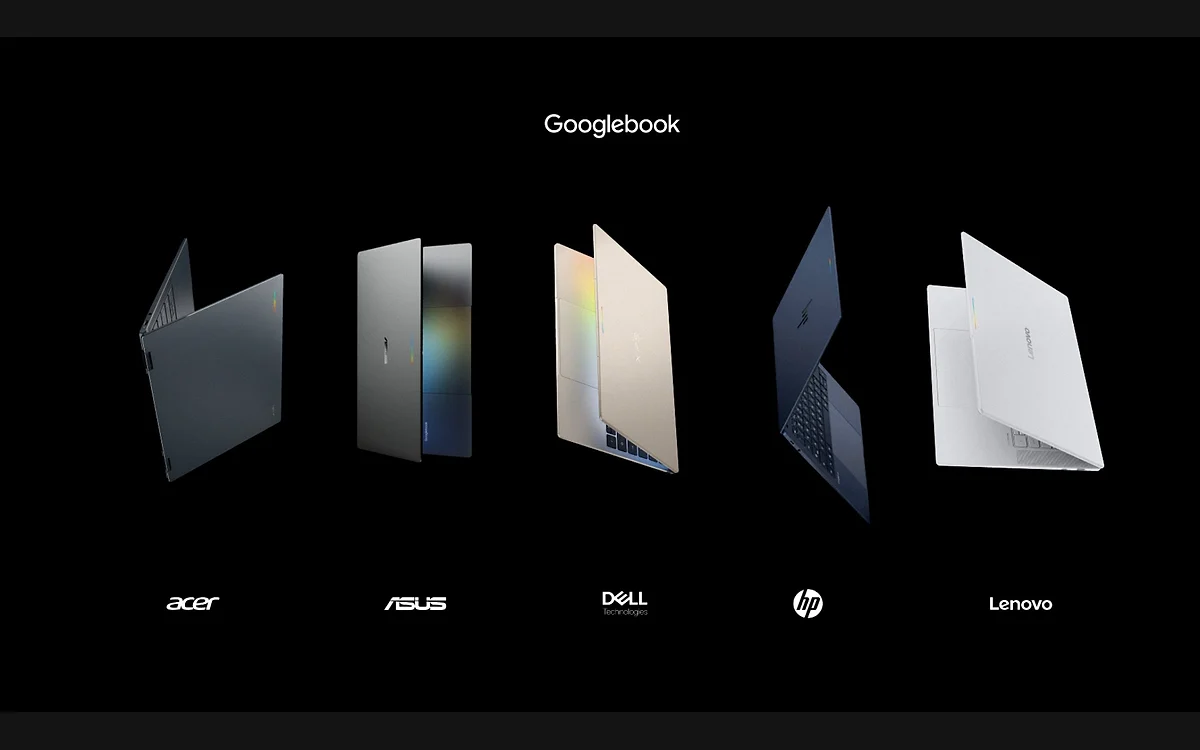
Googlebook was first announced on May 12, 2026, during the Google I/O pre-show, and pre-orders opened on September 21. Google describes the software, Googlebook OS, as "built on the Android technology stack with foundations from Chrome OS". During development it went by the codename Aluminium OS.
Google does not make a Googlebook of its own - at least not yet. The first generation comes only from five PC makers, and Google's Alexander Kuscher has said the machines will "sit at the more premium end of the laptop market" compared with Chromebooks. The prices bear that out: nothing in the lineup costs less than $899.
Launch bundle
Google says every Googlebook includes 12 months of Google AI Pro (5TB of cloud storage and higher Gemini usage limits), plus 3 months of YouTube Premium, Adobe Photoshop and more, and a complimentary year of GeForce NOW for streaming PC games you already own. Best Buy added a free pair of Pixel Buds 2a to Acer Googlebook 14 pre-orders.
The five launch models
All prices below are US starting prices. Google has not published prices for the other launch countries.
- Acer Googlebook 14 - 14-inch 2.8K OLED, Intel Core Ultra 5/7, 16GB RAM, from $899. The cheapest model and the only convertible.
- Dell XPS Googlebook - 13.4-inch 2.5K display, Snapdragon X Elite, 16-32GB RAM, from $1,199.
- HP Googlebook 14 - 14-inch 2.8K OLED, Snapdragon X Elite, 16-32GB RAM, from $1,299.
- ASUS Googlebook 14 - 14-inch 2.8K OLED, Intel Core Ultra 5/7, 16-32GB RAM, from $1,299. The lightest of the five at around 1kg.
- Lenovo Googlebook 15 - 15.3-inch 2.8K OLED, Intel Core Ultra 5, 16GB RAM, from $1,299. The big-screen option aimed at productivity.
The split in chips matters if you plan to run Linux tools or older software: the Dell and HP models use Qualcomm's Arm-based Snapdragon X Elite, while the Acer, ASUS and Lenovo machines use Intel Core Ultra.
What Googlebook OS does differently
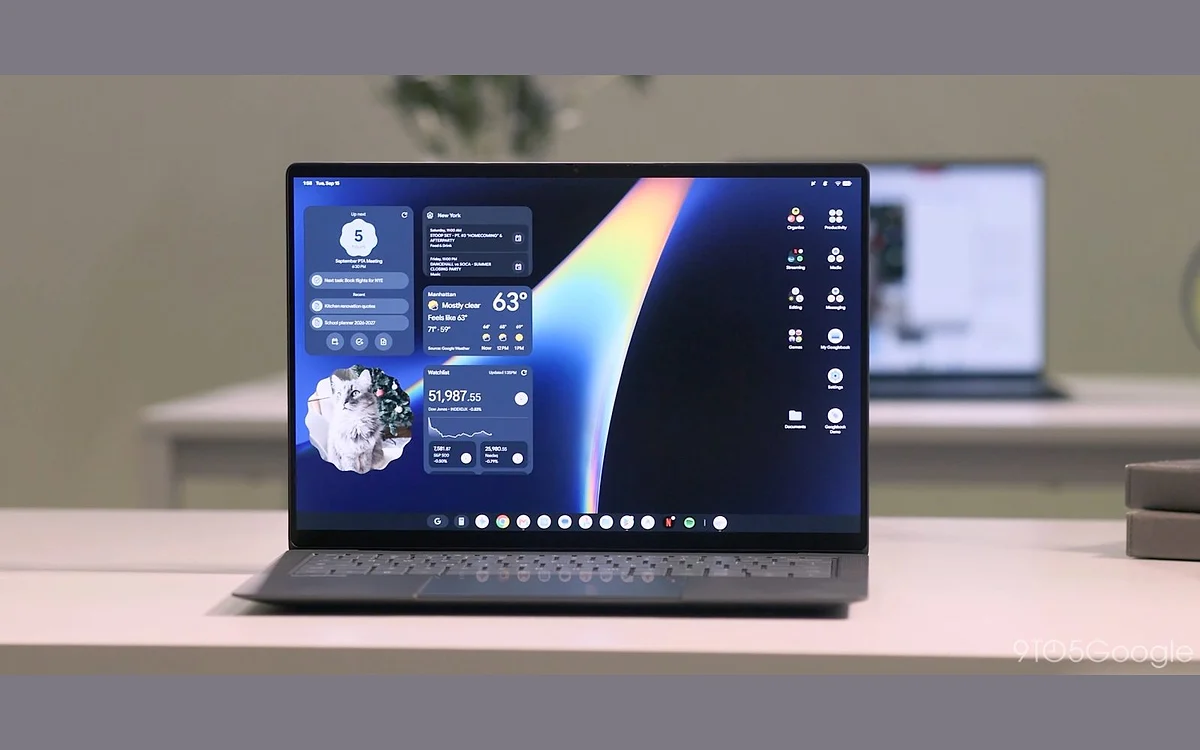
The pitch rests on two things a Chromebook never did well: deep ties to an Android phone, and Gemini built into the desktop itself.
Android phone continuity
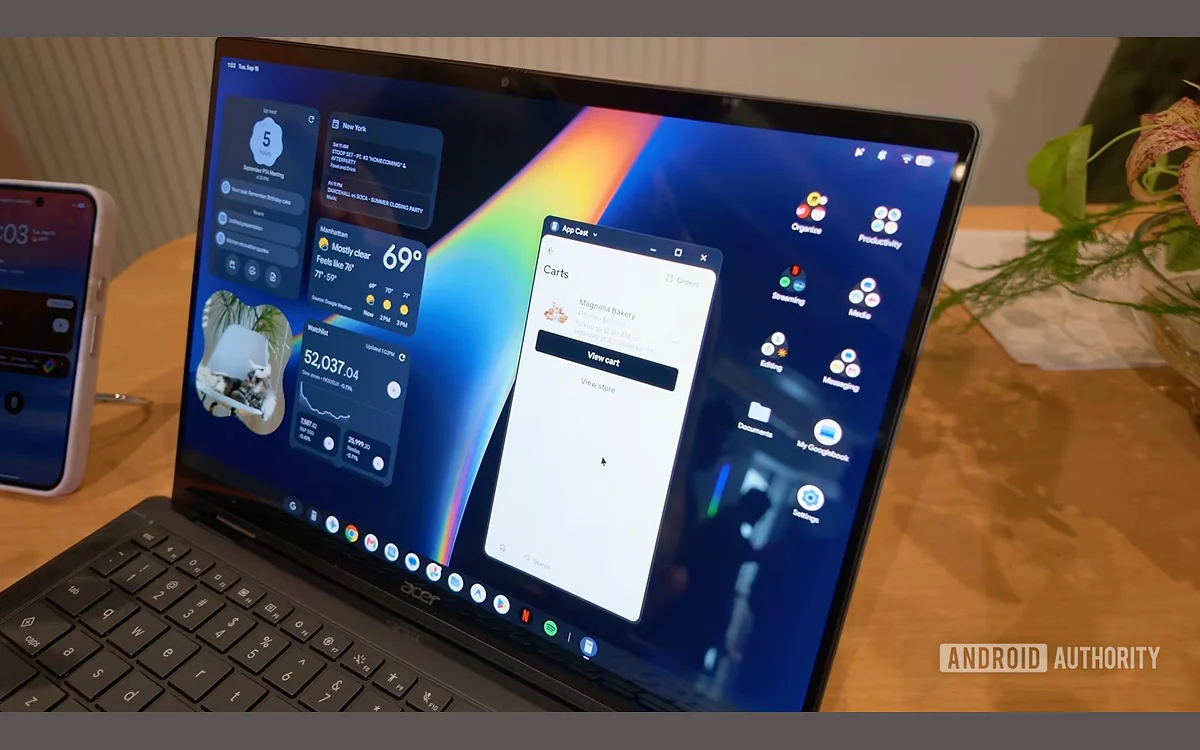
During setup, the phone's settings, saved passwords, Wi-Fi networks and messages move over with end-to-end encryption. After that, Continue On picks up a phone task on the laptop, Files opens the phone's files and photos, Cast My Apps streams a phone app into a desktop window, and Chrome tabs carry across.
Gemini features
- Magic Pointer - wiggle the cursor and Gemini appears over whatever is on screen. Google says it does not constantly watch the screen and only runs when summoned.
- Rambler - turns speech into organized notes, sits next to the Quick Insert key and handles multiple languages.
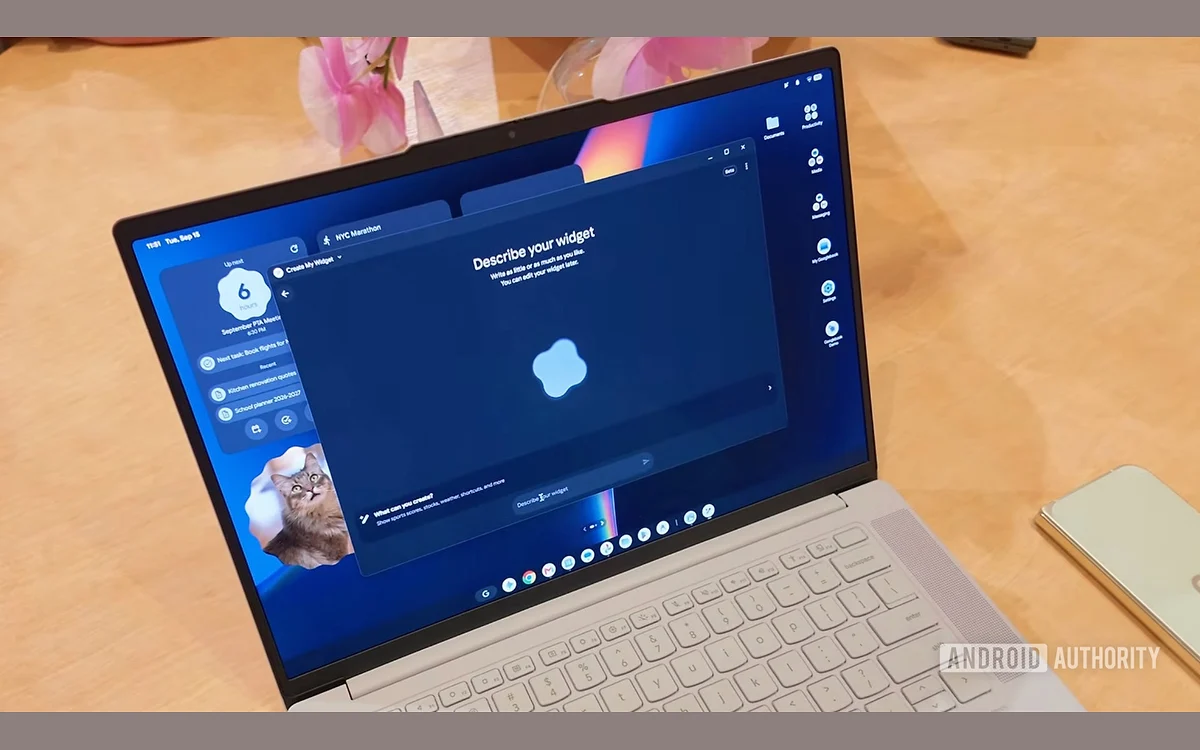
- Create My Widget - describe a widget in plain language and the system builds it.
Apps
Googlebooks run the full Chrome browser with extensions, Android apps from the Play Store (with a curated section for apps optimized for large screens), desktop-optimized apps such as Adobe Photoshop, Lightroom, CapCut, Netflix and HBO Max with offline viewing, a full Linux terminal, and Google's Antigravity AI development environment.
The hardware bar for the Googlebook name
Google sets a floor for any laptop that carries the brand: at least 16GB of RAM (up to 32GB), touchscreens up to 2.8K OLED, aluminum, magnesium alloy or carbon fiber builds, haptic glass trackpads, backlit keyboards, and Intel or Qualcomm chips with NPUs rated at over 45 TOPS. Several models start at 256GB of storage.
Google quotes battery life of up to 14 hours. Android Authority puts that at up to 14 hours of video playback and 16 hours of web browsing. No independent battery tests have been published yet.
Every model also has a Glowbar, a light strip on the outside of the lid that lights up at startup, shows the battery level and animates when you talk to Gemini. Google is opening it to developers.
On security, Googlebook OS keeps the ChromeOS foundations - a Titan hardware root of trust, defense in depth and on-device malware detection - and adds a Level 5 security-certified pKVM hypervisor that isolates the Linux environment. Google promises regular feature drops and updates for up to 10 years.
What it means for Chromebook owners
Chromebooks are not being cut off. On September 28, Google said that "ChromeOS devices will continue to receive regular updates and security patches through mid-2034." That gives ChromeOS a fixed end date for the first time.
Google also said that "many of our newest Chromebook devices will be eligible to transition over to Googlebook OS", mainly newer commercial models, with details promised soon. Not every Chromebook will make the move. For qualifying devices bought today whose 10-year support window runs past 2034, Google says it is "committed to supporting your transition".
Buying advice for now
If you need a laptop under $899, a Chromebook is still the only Google option and will be supported until mid-2034. If you want the Gemini and Android-phone features, the cheapest way in is the $899 Acer Googlebook 14. Hands-on reviews have not been published yet, so there are no independent verdicts on performance or battery life.
Frequently asked questions
How much does a Googlebook cost?
Googlebooks start at $899 in the US. That is the Acer Googlebook 14. The Dell XPS Googlebook starts at $1,199, and the HP, ASUS and Lenovo models start at $1,299.
Where and when can I buy one?
They went on sale on October 4 in the US and October 5 in Canada, the UK, Ireland, France, Germany and Australia, through the Google Store, Best Buy and other select retailers.
Can my Chromebook upgrade to Googlebook OS?
Only some can. Google says many of its newest Chromebooks, mostly commercial models, will be eligible, with details still to come. All ChromeOS devices keep getting updates through mid-2034.
Does Google make its own Googlebook?
No. The first Googlebooks come only from Acer, ASUS, Dell, HP and Lenovo. Google has not announced a Googlebook of its own.
How long will Googlebooks get updates?
Google promises feature drops and updates for up to 10 years under Googlebook OS.
Sources
- Google blog, Googlebook pre-order announcement: https://blog.google/products-and-platforms/devices/googlebook/pre-order-googlebook/
- Android Authority, Googlebook models, features and prices: https://www.androidauthority.com/google-googlebook-laptops-launch-features-models-price-specs-availability-3713215/
- Android Authority, Googlebook availability and freebies: https://www.androidauthority.com/googlebook-availability-release-freebies-3713298/
- 9to5Google, Chromebook updates through 2034: https://9to5google.com/2026/09/28/google-details-chromebook-updates-through-2034-many-models-move-to-googlebook-os/
- Google ChromeOS support policy: https://support.google.com/chrome/a/answer/16634428?hl=en
Key takeaways
- The first Googlebooks went on sale October 4 in the US and October 5 in six more countries.
- Five models from Acer, ASUS, Dell, HP and Lenovo, priced from $899 to $1,299; Google makes none itself.
- Googlebook OS is Android-based, with Gemini features, Android-phone continuity, Play Store apps and a Linux terminal.
- Every model has at least 16GB of RAM and an NPU rated over 45 TOPS, with up to 10 years of updates.
- ChromeOS updates end in mid-2034, and only some newer Chromebooks will be able to move to Googlebook OS.
More in Tech News
Browse Tech News