Meta Releases Muse Spark Open: An 816B Open-Weight Model That Runs on Two Mac Studios
Meta published the weights of Muse Spark Open, an 816B-parameter multimodal model co-optimized with Apple for M5 Ultra Mac Studios. Here is what it can do, where it trails, and what the license demands.
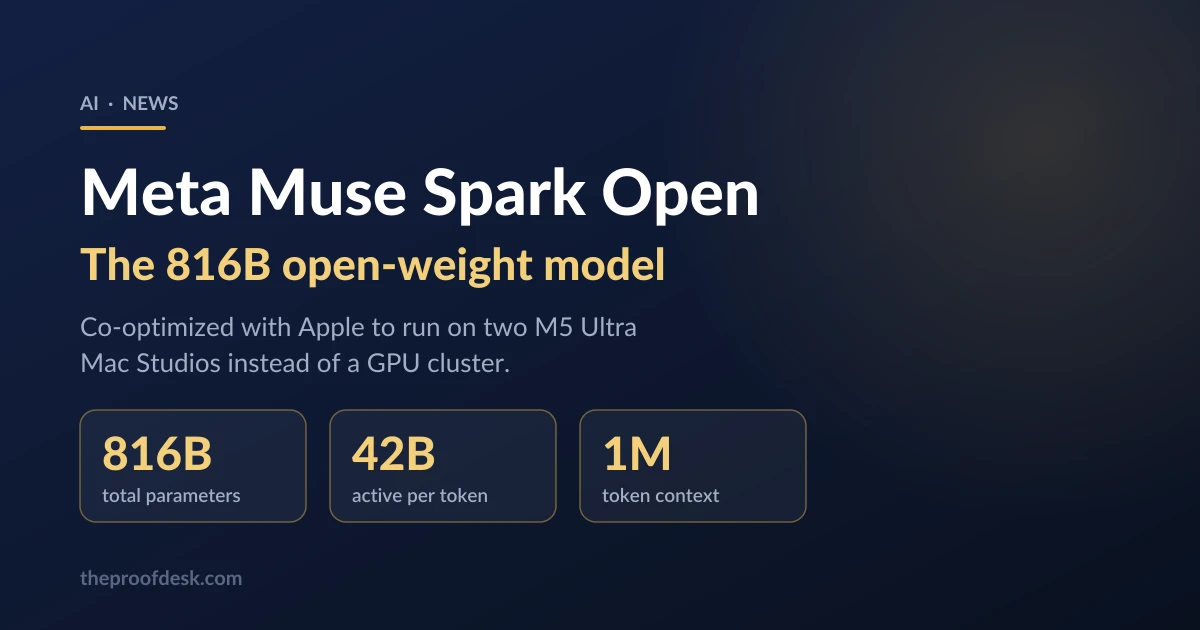
On October 15, 2026, Meta released the weights of Muse Spark Open, an 816-billion-parameter mixture-of-experts model that it calls "the most capable US open-weights model to date". It is natively multimodal, built for coding and agentic work, and shares its base model with Muse Spark 1.3, the closed model Meta serves through its own products.
The headline hook is hardware: Meta worked with Apple so the model runs on a desk, using two M5 Ultra Mac Studios linked over Thunderbolt 5, instead of a rack of data-center GPUs. The fine print matters just as much. It is the top US open-weight model, not the top open-weight model overall; the 512GB Mac Studio it needs has not shipped yet; and the license carries conditions that put it outside the usual meaning of open source.
What Meta released
Muse Spark Open has 816B total parameters with 42B active per token and a context window of 1 million tokens. It accepts text, image, video and audio input and produces text output. Weights are on Hugging Face under the repo meta-models/Muse-Spark-Open-816B-A42B, released under the new Muse Model License.
It builds on Muse Spark, the closed model Meta launched in August 2026. According to the PyTorch blog post, the open-weights version gets "additional safety post-training to make it more robust against misuse as a standalone model without system guardrails" - a recognition that once weights are public, Meta's own server-side filters no longer stand between the model and its users.
Meta trained it as an agent rather than a chatbot. The model plans, acts, observes and self-corrects over long tasks, browses the web (including multimodal browsing), spawns and coordinates subagents, and handles computer use across desktop, mobile and browser. Before it acts, it emits separate commentary stating what it intends to do. Reasoning effort can be set to low, medium, high or xhigh, with xhigh as the default.
Meta's demos leaned on that agent training: the model shipped real iOS changes to Ice Cubes, an open-source Mastodon client, including the build, and drove DaVinci Resolve end to end with frame-by-frame video review and cropping.
Architecture and download sizes
The model card describes a mixture-of-experts design with 62 layers and 256 experts, of which 8 are active per token. Other published details:
- Hidden dimension 8192, with 128 query heads and 16 KV heads (grouped-query attention)
- Vocabulary of 202,048 tokens and training data spanning more than 100 languages
- A separate 1.8B-parameter Perception Encoder with 50 layers handles vision input
- Meta-produced weights in BF16 (about 1.6 TB) and NVFP4 (about 530 GB, experts only)
- Partner quantizations: FP8 from AMD, MXFP4 from AMD and Intel, INT4 GPTQ from Intel, and GGUF files down to roughly 2-bit from Unsloth
On GPUs, the model card asks for at least 700GB of VRAM for NVFP4 and at least 2TB for BF16. The Hugging Face page lists the model at 822B parameters because its metadata counts the vision encoder and other tensors; Meta's own figure for the language model is 816B.
Running it on Mac Studio
Meta bills Muse Spark Open as "the first model in its class to run on your desktop using two Apple M5 Ultra Mac Studios with the latest MLX framework." Each M5 Ultra Mac Studio supports up to 512GB of unified memory, and Meta says two of them act as "one supercomputer with a terabyte of unified memory" with "1.2 TB/s of memory bandwidth".
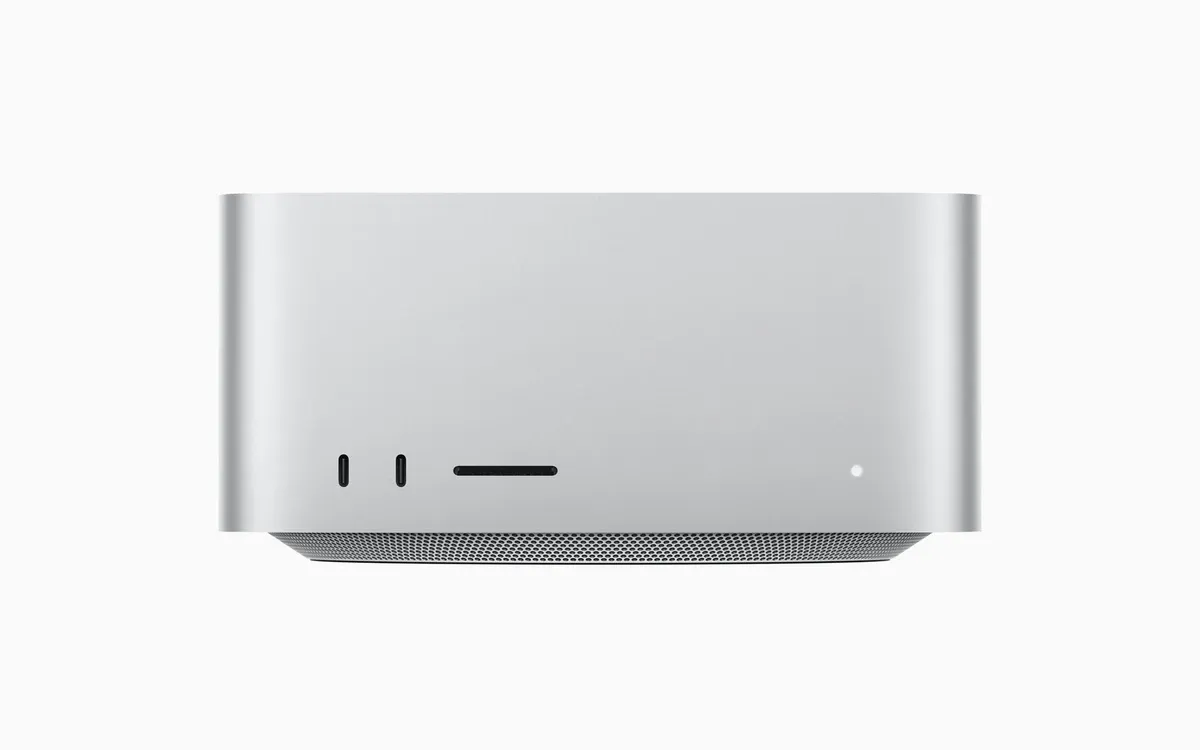
Meta's developer post lists two supported Mac configurations, both linked with Thunderbolt 5 and RDMA and running MLX:
- Two Mac Studios with M5 Ultra and 512GB of unified memory each
- Four Mac Studios with M5 Ultra and 256GB of unified memory each
The catch
According to MacRumors, the 512GB M5 Ultra Mac Studio has not been released yet and is expected later in October 2026. Until then, the only supported desktop route is four 256GB machines, each of which costs over $10,000. Meta has not published tokens-per-second figures for either Mac setup.
Apple CEO John Ternus welcomed the launch, saying, as quoted by MacRumors, that it was "amazing to run a model of Muse Spark Open's caliber and scale this efficiently, right from your desk," adding: "Mac Studio keeps pushing the boundaries of on-device AI!"
Benchmarks: the best US open model, not the best open model
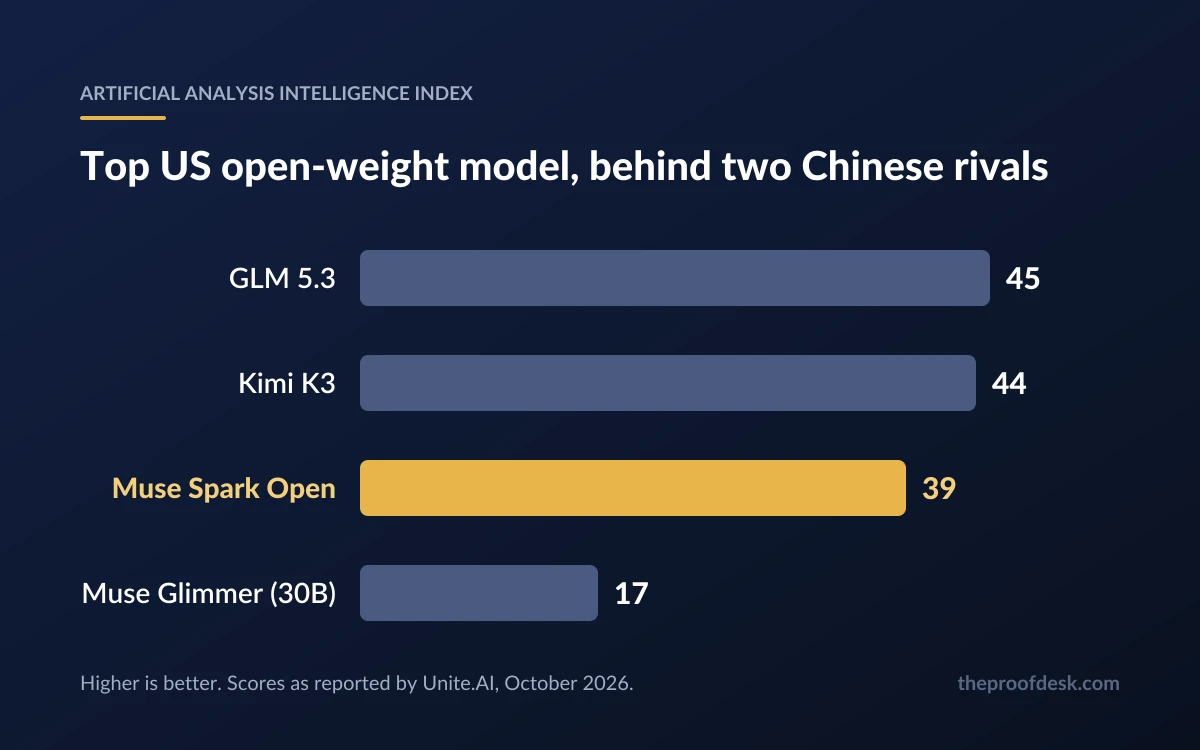
Meta's own wording is precise, and it is worth keeping that precision. On the Artificial Analysis Intelligence Index, Muse Spark Open scores 39, which makes it the highest-scoring US open-weights model. Two Chinese open models score higher overall: GLM 5.3 at 45 and Kimi K3 at 44. For context, Meta's earlier small dense open model, the 30B Muse Glimmer, scored 17.
The model card compares Muse Spark Open with Kimi K3, Qwen3.8 and GLM 5.3. Scores are listed in that order:
- GPQA Diamond: 89.0 / 93.5 / 93.5 / 91.7
- SciCode: 58.5 / 59.5 / 54.1 / 59.0
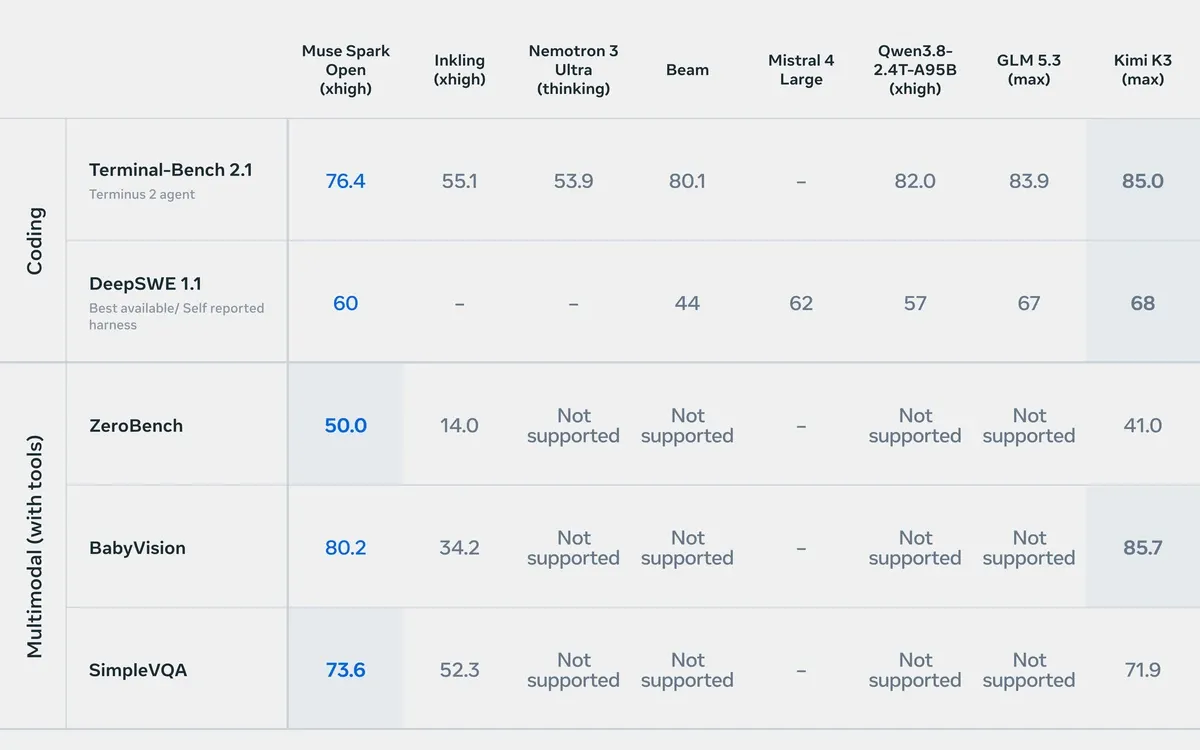
- Terminal-Bench 2.1: 76.4 / 85.0 / 82.0 / 83.9
- DeepSWE 1.1: 60 / 68 / 57 / 67
- JobBench: 61.8 / 54.3 / 52.7 / 61.4
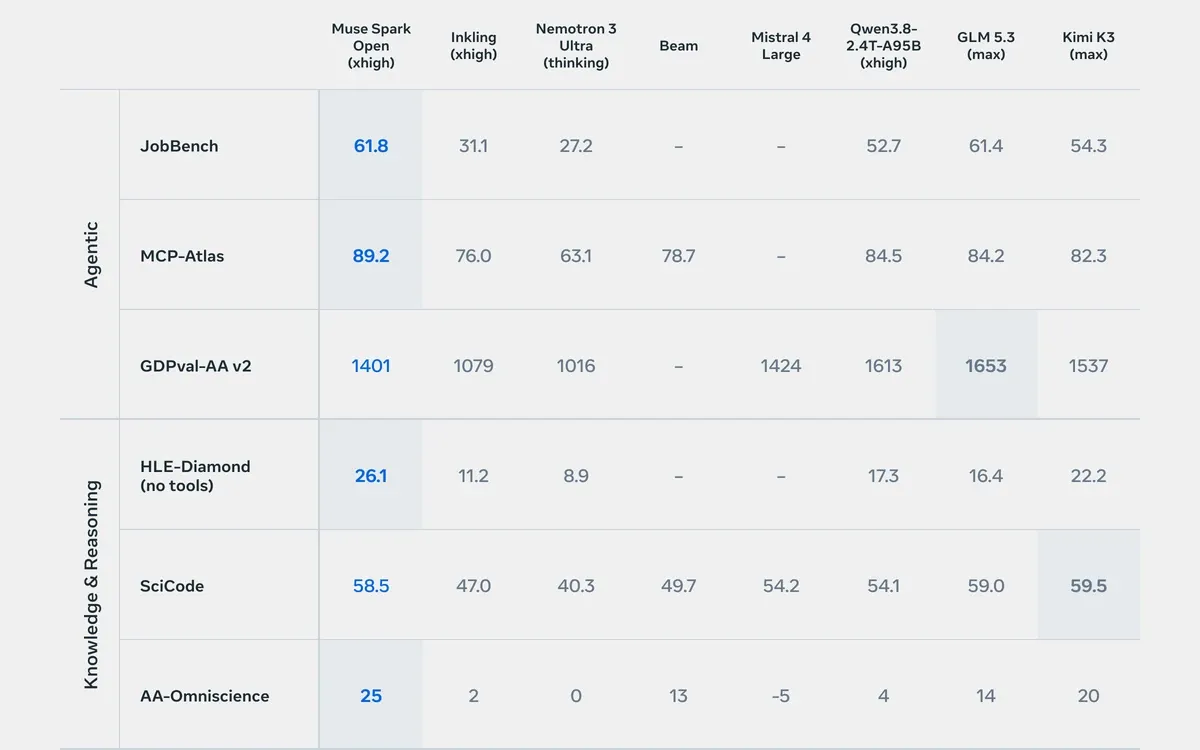
Muse Spark Open leads the group on JobBench and posts the highest MCP-Atlas score among the listed models at 89.2, which fits Meta's pitch around tool use. It trails Kimi K3 on most coding and vision tests: SWE-Atlas-QnA 58 vs 66, BabyVision 80.2 vs 85.7 and VideoMMEv2 61.5 vs 65.4. Other reported scores include SimpleVQA 73.6 and ZeroBench 50.0.
Early partner feedback focuses on the same strengths. Zimu Li of Factory said the model "consistently selected the right next tool and kept its responses compact", and Dong Chen of Ollama said it "performs particularly well on tool calling and long context".
Safety claims, as Meta reports them
Meta says the model passed the release thresholds of its Superintelligence Scaling Framework, and that a full evaluation report will be "available soon". Until that report is out, the following figures are Meta's own:
- Jailbreak refusal of 94.8% on an aggregate of PolyGuard, RedCode and CyberBench, against 70.2% for Kimi K3
- 99.2% on an internal cyber evaluation set
- 98.1% on the MASK honesty benchmark
- 0% on Meta's agentic misalignment test
Open weights, not open source
The Muse Model License, dated October 15, 2026, is broad: it grants rights to "use, copy, modify (including fine-tune), create derivative works, distill, merge, publish, distribute, sublicense, and/or sell" the model, and Meta claims no ownership of outputs. It is still not an OSI-style open-source license, because of three conditions:
- Attribution: "Built with Muse Spark Open" must be displayed prominently in the product UI, documentation, website or settings.
- Large hosts: companies offering the model as a service with more than $20 million in revenue in any consecutive 12-month period need a separate written agreement with Meta.
- Acceptable use: the policy bans uses including malware creation, military and weapons use, and disinformation.
For most developers and companies fine-tuning or self-hosting the model, the attribution requirement is the clause they will actually run into. The revenue threshold is aimed at cloud and API providers.
Where to run it
Meta lined up broad day-one support. Inference engines include SGLang, vLLM, TensorRT-LLM, Hugging Face Transformers, Apple MLX, llama.cpp and Unsloth, with verified hardware from NVIDIA (Blackwell), AMD (MI350X and MI355X), Intel (Crescent Island) and Apple silicon.
Hosted APIs are available from Baseten, Fireworks AI, Groq, Modal, Nebius, OpenRouter and Together AI, and the weights are in Amazon SageMaker AI, Google Cloud Model Garden, Hugging Face and Microsoft Foundry Models. Meta did not publish per-token pricing; each provider sets its own.
For self-hosters, Meta points to speculative decoding: DFlash V2 in SGLang delivers "3.7× throughput for a single request on AMD MI355X", and DSpark in vLLM gives "2.9× at 16 concurrent requests". The model also ships with PyTorch Helion kernels for operations such as RoPE, RMSNorm and quantization, which PyTorch says deliver speedups of 1.03x to 3.95x over hardware-specific kernels on NVIDIA GB300 and a 3% end-to-end throughput gain on AMD MI350. TorchTitan supports fine-tuning with SFT, LoRA and reinforcement learning through TitanRL.
Sources
- Meta research blog: https://research.meta.ai/blog/muse-spark-open
- Meta developer blog: https://dev.meta.ai/resources/blog/build-with-muse-spark-open
- PyTorch blog: https://pytorch.org/blog/muse-spark-open/
- Hugging Face model card: https://huggingface.co/meta-models/Muse-Spark-Open-816B-A42B
- Muse Model License: https://huggingface.co/meta-models/Muse-Spark-Open-816B-A42B/blob/main/LICENSE.md
- MacRumors: https://www.macrumors.com/2026/10/15/meta-muse-spark-open-mac-studio/
- 9to5Mac: https://9to5mac.com/2026/10/15/meta-launches-new-muse-spark-open-model-optimized-to-run-on-mac-studio/
- Unite.AI: https://www.unite.ai/metas-816b-parameter-muse-spark-open-weights-are-now-public/
Key takeaways
- Muse Spark Open is an 816B-parameter (42B active) multimodal MoE model with a 1M-token context, released as open weights on October 15, 2026.
- It is the top US open-weights model on the Artificial Analysis index (39), but Chinese models GLM 5.3 (45) and Kimi K3 (44) score higher and beat it on most coding and vision benchmarks.
- It leads on agentic and tool-use tests such as JobBench (61.8) and MCP-Atlas (89.2).
- Running it on a desk needs two 512GB M5 Ultra Mac Studios, which have not shipped yet, or four 256GB machines at over $10,000 each.
- The license allows commercial use and fine-tuning but requires "Built with Muse Spark Open" attribution and a separate deal for model-as-a-service providers above $20 million in annual revenue.
More in Tech News
Browse Tech News