Microsoft's $2,599 Surface Laptop Ultra Bets Windows on Local AI Agents
Microsoft and NVIDIA opened preorders for the RTX Spark-powered Surface Laptop Ultra, made MXC agent sandboxing generally available and laid out hybrid AI for Windows.
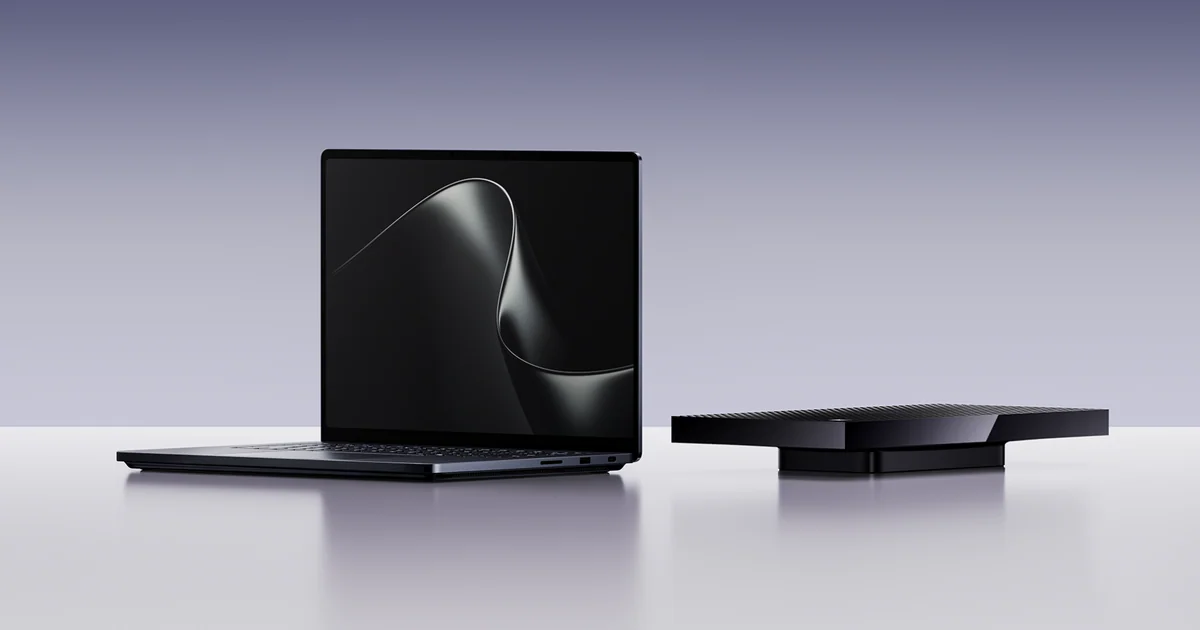
Microsoft wants the Windows PC to be the place AI agents run. At a joint event with NVIDIA in San Francisco on Wednesday, October 7, it opened preorders for the $2,599 Surface Laptop Ultra, its most powerful Surface yet, built on NVIDIA's new RTX Spark superchip with up to 128 GB of unified memory and enough AI compute to run 120B-plus parameter models on the laptop itself.
The hardware came with two software pieces that explain why it exists. "Hybrid intelligence" routes AI work between local models and the cloud to save tokens, and Microsoft Execution Containers (MXC), now generally available on Windows 11, is the sandbox meant to keep local agents from granting themselves access they were never given.
Surface Laptop Ultra: price, specs and ship date
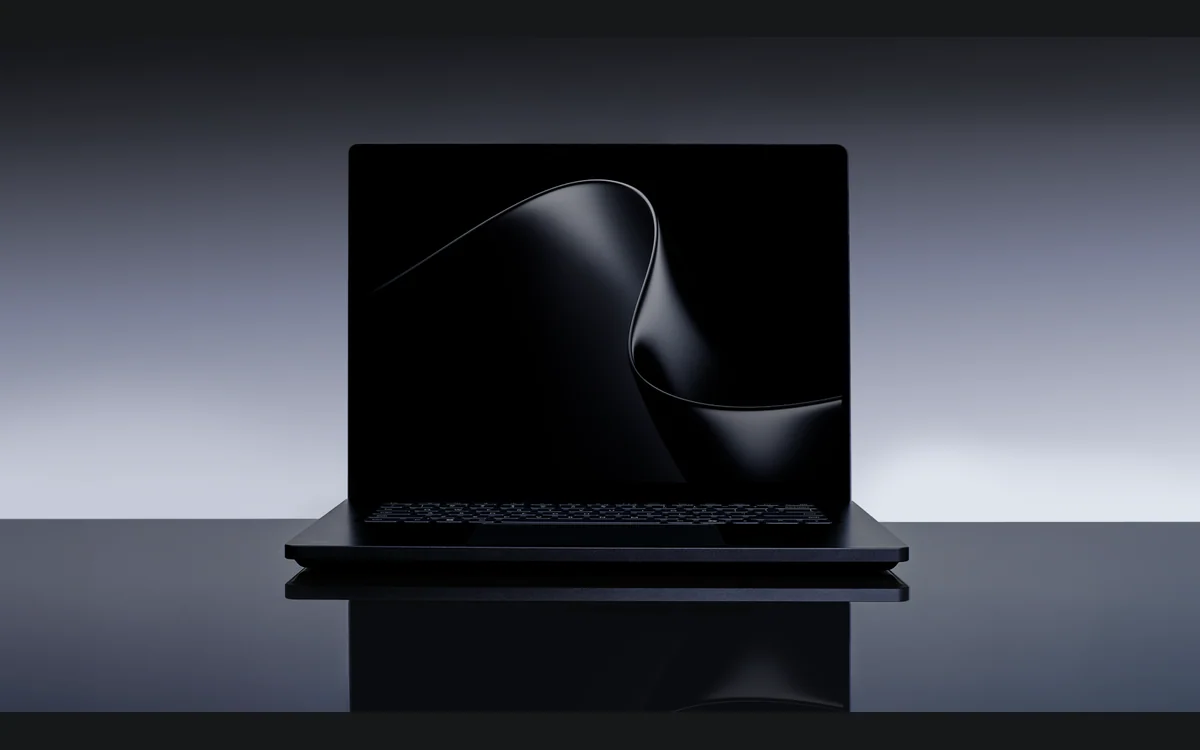
Microsoft calls the Surface Laptop Ultra and its desktop sibling "our most powerful Surface devices ever." Preorders opened on October 7 at a starting MSRP of $2,599 from Microsoft.com and select retailers worldwide, with availability beginning October 16.
The machine is built on NVIDIA RTX Spark, a superchip that pairs an NVIDIA Blackwell RTX GPU with up to 6,144 cores and an NVIDIA Grace CPU with up to 20 cores, connected at 600 GB/s. It ships with up to 128 GB of unified memory and, by Microsoft's count, up to 1 petaflop of AI performance - enough to run AI models exceeding 120B parameters locally. Microsoft's own footnotes add two caveats: the petaflop figure is theoretical FP4 with sparsity, and the 128 GB is shared between CPU and GPU, so the GPU can address less than the total.
"We built Surface Laptop Ultra around NVIDIA RTX Spark," Pavan Davuluri, EVP of Windows and Devices, said on stage. "With up to 128 gigs of unified memory and up to a petaflop of AI compute, you can run models on this laptop that simply don't fit on a traditional machine."
Display, design and ports
- Display: a 15-inch PixelSense Ultra touchscreen with 2,000 nits peak HDR (10% window), 120 Hz, 100% DCI-P3 and Dolby Vision IQ. Microsoft claims the brightest peak HDR of any laptop and up to 25% brighter peak HDR than the MacBook Pro M5 Pro. It is touch only; Surface Pen is not supported.
- Thermals and size: a new thermal architecture with up to 2.5x more thermal power capacity than current Surface Laptops, in a chassis under 18 mm thin and under 4.5 lb. Colors are Platinum and Nightfall.
- Input and storage: a touchpad 30% larger than the Surface Laptop 8th Edition's, with advanced haptics, and a user-removable SSD of up to 2 TB.
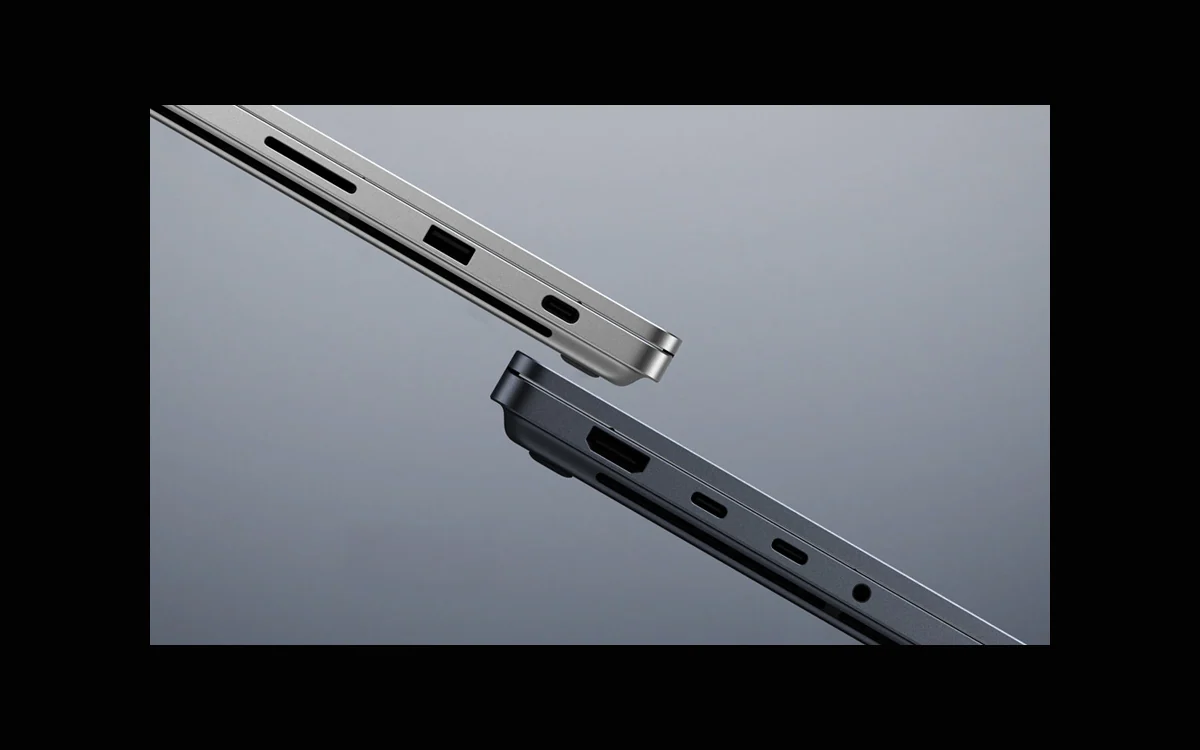
- Ports: Magnetic Connect, which Microsoft calls the world's first built-in magnetic USB-C charging on a laptop - the cable snaps onto the right-side USB-C port, which still carries data and video. There are two more USB-C ports, HDMI, USB-A, an SD card reader and a 3.5 mm jack, and the laptop drives up to three 4K displays.
Surface RTX Spark Dev Box and the wider RTX Spark lineup
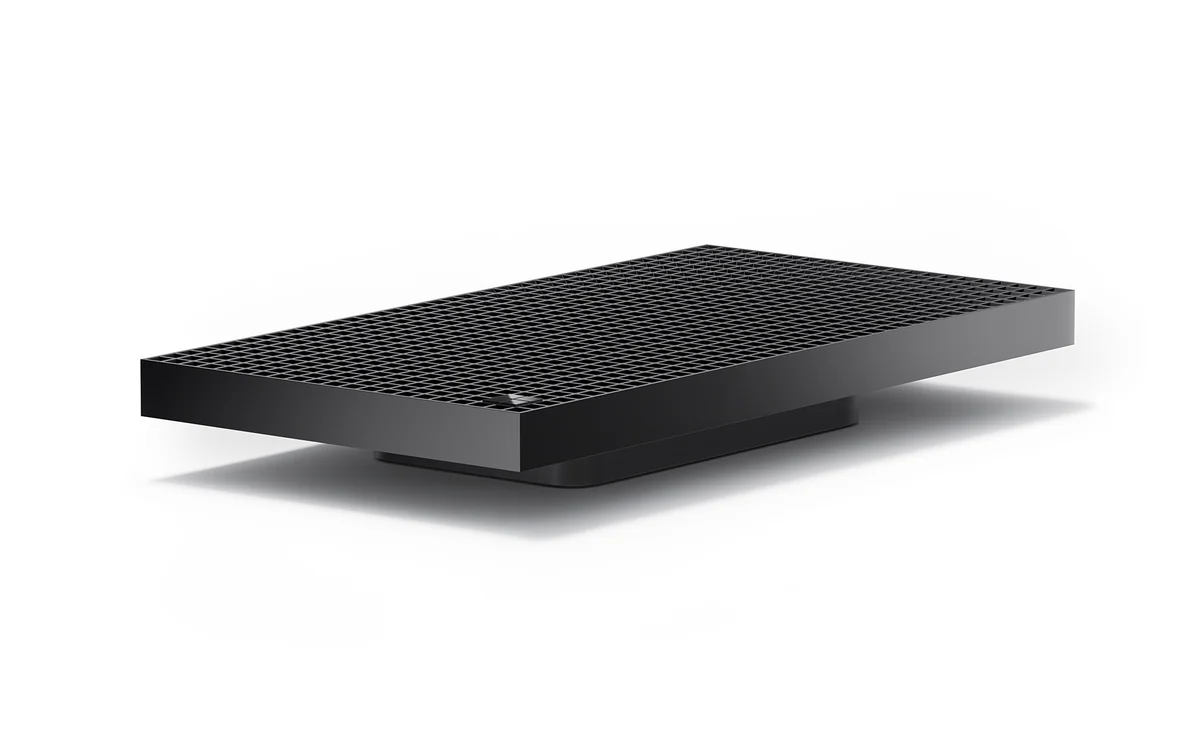
Alongside the laptop, Microsoft announced the Surface RTX Spark Dev Box, a small-form-factor desktop on the same RTX Spark chip with up to 1 petaflop and 128 GB of unified memory. Part of what Microsoft calls the Project Zenith family, it comes preloaded with VS Code, Git, GitHub CLI, GitHub Copilot, WSL, Python and Node. It is on preorder at $5,999 MSRP, only on Microsoft.com in the US, and ships in November.
Surface is not the only RTX Spark machine. Microsoft says these laptops were available to preorder on October 7 and ship October 16:
- ASUS ProArt P16 and P14
- Dell XPS 16 Creator Edition, the first XPS laptop powered by NVIDIA RTX Spark
- HP OmniBook Ultra 16
- Lenovo Yoga 9n 2-in-1
- MSI Prestige N16 Flip AI+
- Microsoft Surface Laptop Ultra
RTX Spark dev boxes and mini desktops from partners come "later this year", with NVIDIA saying compact desktops go on sale in November. NVIDIA also says the chip runs the full CUDA platform, has 5th-gen Tensor Cores with NVFP4 and can run AAA games at 1440p above 100 fps with DLSS 5. Gears of War: E-Day was the gaming showcase, and Microsoft said that in 2027, Call of Duty will be coming to RTX Spark.
Vendor benchmarks, not independent tests
Microsoft and NVIDIA compared preproduction 64 GB RTX Spark PCs with a 64 GB MacBook Pro 16-inch M5 Pro in September 2026 and reported up to 2.1x faster time to first token (llama.cpp, Qwen3.5 27B), 4.3x faster AI image generation (FLUX.2 Klein 4B) and 6.2x faster AI video generation (LTX 2.3 22B). Treat these as vendor claims until retail units are tested.
Hybrid intelligence: splitting AI work between the PC and the cloud
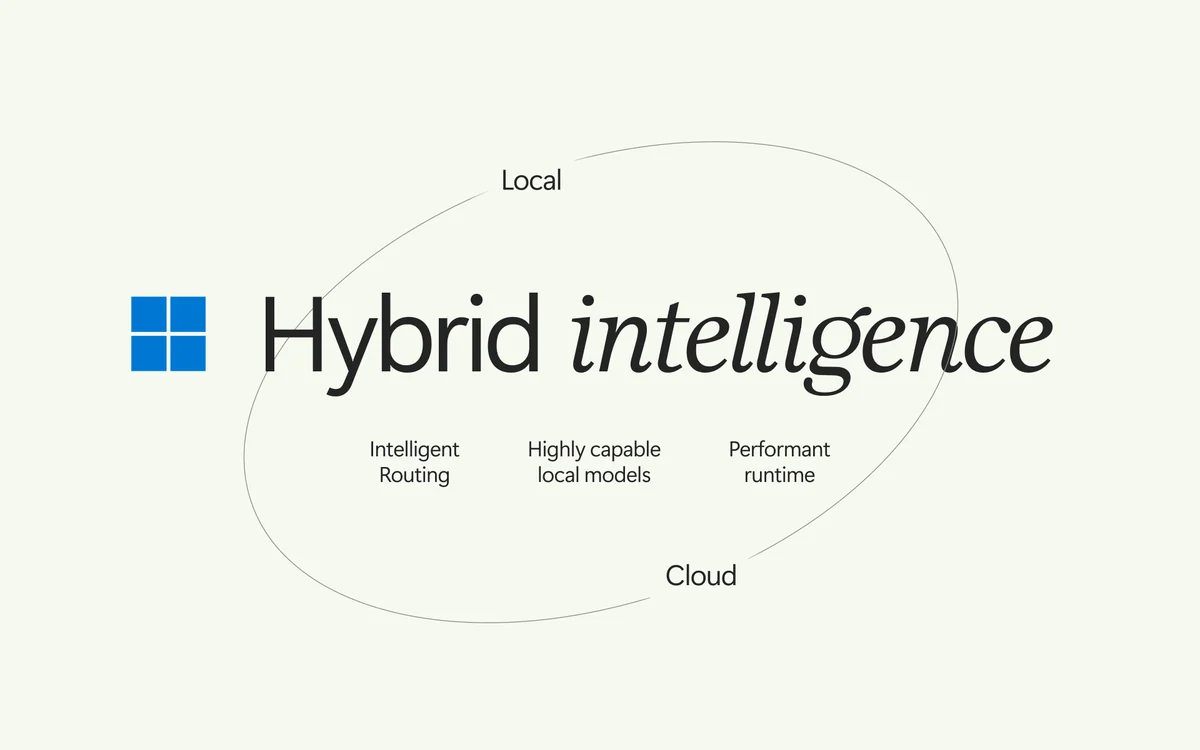
The hardware exists to serve a strategy Microsoft calls "hybrid intelligence": running local and cloud AI together so customers can "make every AI token count." The idea is that routine or private work stays on the PC's own model, and only tasks that need a frontier model go to the cloud.
- MAI Code 1.1 Flash, Microsoft's coding model introduced at Build (137B total, 6.8B active parameters), now runs on-device at 3-bit precision. Microsoft says that cuts the model's size by nearly 80% while keeping a 256K context window locally.
- Coming to RTX Spark: an upcoming NVIDIA Nemotron model with 70B+ parameters at 2-bit, needing just over 20 GB of memory, and DeepSeek V4 Flash, a 284B-parameter model.
- GitHub HydraFusion, which routes each task to the right cloud model, will be able to route to local on-device models on Windows. It arrives in the GitHub Copilot app, Copilot CLI and VS Code as an experimental preview later in October.
- Windows ML gains llama.cpp support.
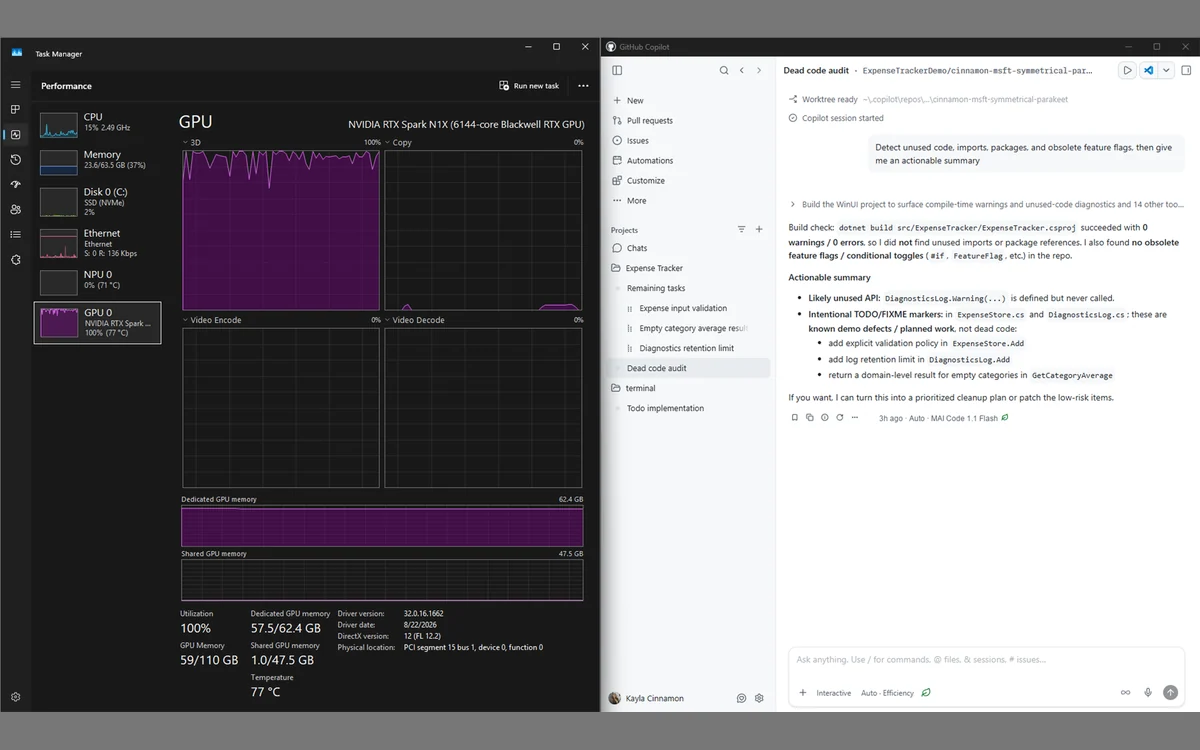
This builds on the Copilot relaunch we covered in late September. Copilot on Copilot+ PCs will gain three local capabilities across its Home, Code and Autopilot experiences: local context (with permission), local actions and local models. Microsoft says the rollout is expected to begin in the coming months. It also says more than 40% of laptops built for business are now Copilot+ PCs and that more than 2 trillion inferences already run locally each month.
Windows Search on the taskbar is getting "thousands of new actions", such as "switch to dark mode", "mute", "arrange my windows" or "Text Elisa I'll be there soon". It started rolling out to Windows Insiders in the experimental channel on October 7, with opt-in Copilot integration in Search coming to select markets later this year.
Microsoft Execution Containers: a sandbox agents cannot talk their way out of
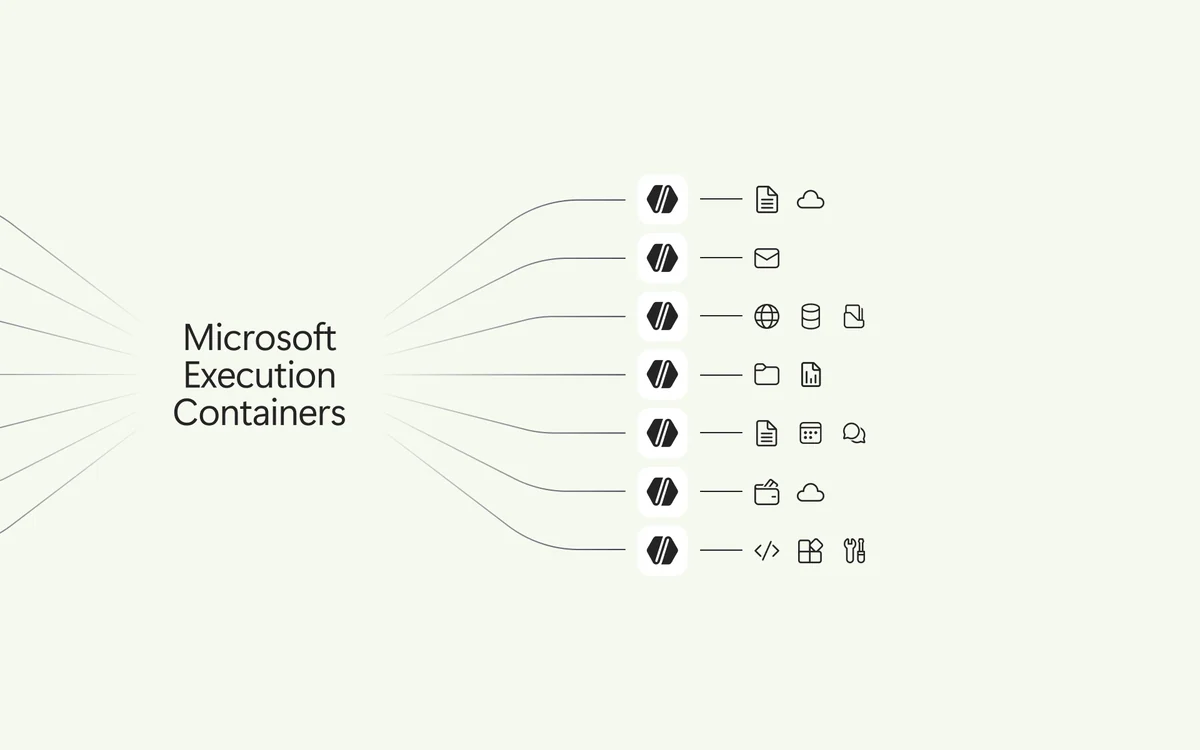
Always-on agents that read files and run code on a PC are a security problem, and Microsoft's answer became generally available on Windows 11 on October 7. Microsoft Execution Containers (MXC) is "a policy-driven execution layer for untrusted code or dynamically generated workloads." Developers or IT declare which files and network destinations an agent may use, and MXC enforces that at runtime.
The key design point is that "the policy remains outside the agent workload's control", so an agent cannot grant itself extra access, even if a prompt injection tells it to. Containment options range from process and session isolation up to WSLc, full virtual machines and Windows 365 for Agents.
Agents that already support MXC include OpenAI Codex, GitHub Copilot, OpenClaw, Replit, LM Studio, NVIDIA OpenShell and Unsloth AI. Support is coming from Anthropic Claude Code, Box, Egnyte, Heidi Health, Hermes Agent from Nous Research, Manus, Perplexity, Raycast and Simular. Meta's Muse for Windows personal agent is "coming soon" as a native app with MXC integration.
MXC is the containment layer of a three-part model. Identity comes from Microsoft Entra, which will distinguish agent activity from the user's own, and manageability from Agent 365 and Intune. Those identity and management pieces are still upcoming. "We needed to make the desktop the most secure place for agents to execute," Satya Nadella said. Jensen Huang went further: "Just as Windows and DirectX revolutionized how applications were built, MXC is going to revolutionize how agents are built and deployed."
What ships when
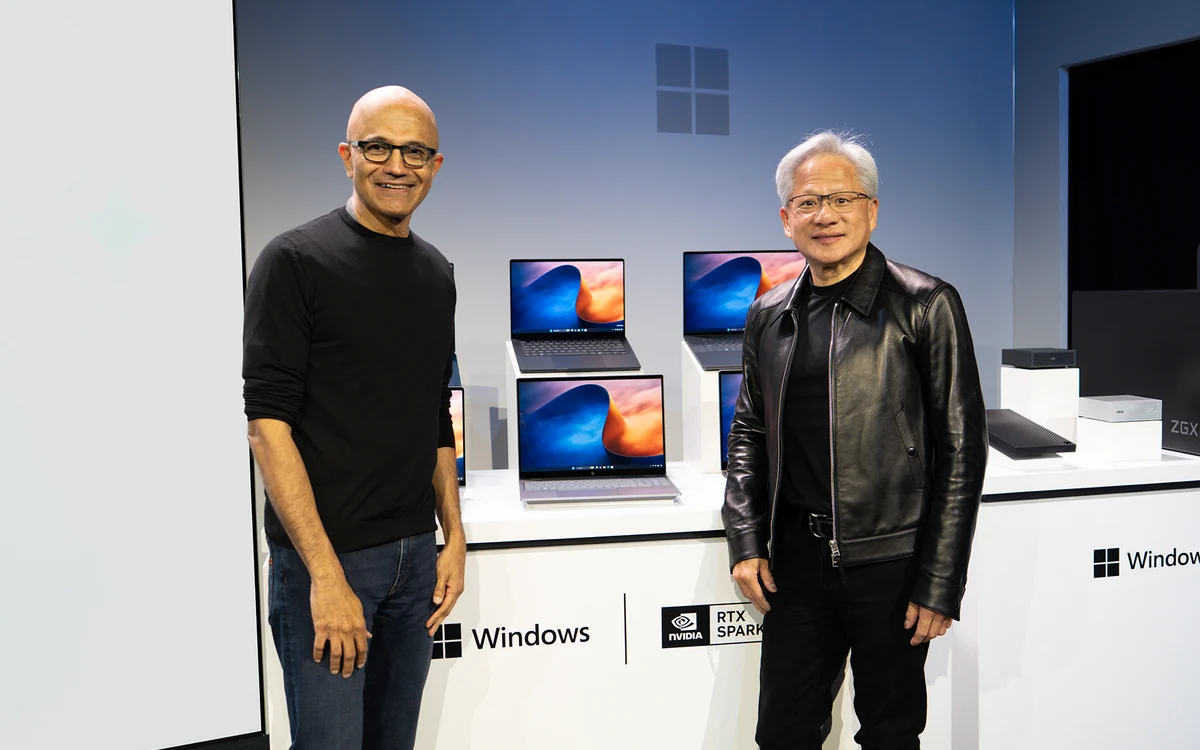
The announcements came at Microsoft's Windows AI and Surface event on Wednesday, October 7, 2026, at Dogpatch Studios in San Francisco. Nadella opened, Davuluri presented the Windows updates, and Huang and Nadella closed with a fireside chat hosted by Sriram Krishnan, a former senior White House policy advisor on AI. This was not a Windows 12 launch, and most of the software is staged:
- Available now: MXC on Windows 11; preorders for Surface Laptop Ultra and the partner RTX Spark laptops.
- October 16: Surface Laptop Ultra and partner RTX Spark laptops ship.
- Later in October: HydraFusion local-model routing in experimental preview.
- November: Surface RTX Spark Dev Box ships (US only); NVIDIA says compact RTX Spark desktops go on sale.
- Later this year: DGX Station for Windows in preview, with NVIDIA's GB300 Grace Blackwell Ultra Desktop Superchip, up to 748 GB of coherent memory, up to 20 petaflops FP4 and support for models up to roughly 1 trillion parameters. Named systems are the Dell Pro Precision with GB300 and the HP ZGX Fury AI Station; no price has been given.
- Coming months: Copilot local context, actions and models on Copilot+ PCs; Entra agent identity and Agent 365 on-device controls.
Frequently asked questions
How much does the Surface Laptop Ultra cost?
It starts at $2,599 MSRP. Windows Central lists higher tiers at $3,699.99 (32 GB, 1 TB) and $5,899.99 (128 GB, 1 TB).
When does the Surface Laptop Ultra ship?
Availability begins October 16, 2026. Preorders opened October 7 on Microsoft.com and at select retailers worldwide.
Can it really run 120B-parameter models offline?
Microsoft says yes, on the higher-memory configurations. The 128 GB is shared between CPU and GPU, and the 1 petaflop figure is theoretical FP4 with sparsity, so real-world speed will depend on the model and quantization.
Does the Surface Laptop Ultra support Surface Pen?
No. The 15-inch PixelSense Ultra display is a touchscreen, but Microsoft says Surface Pen is not supported.
Do I need RTX Spark hardware to use MXC?
No. MXC is generally available on Windows 11 as an OS-level sandbox for agents; it is not tied to the new hardware. Each agent has to add support, and some, such as Claude Code and Perplexity, have only announced it.
Is the MacBook trade-in offer available everywhere?
No. The up to $1,000 cash back for an eligible MacBook Pro runs October 7 to November 23, 2026, through the Microsoft Store online in the US and Canada only.
Sources
- Microsoft event roundup: https://news.microsoft.com/windows-surface-october-2026-news/
- Windows Experience Blog: https://blogs.windows.com/windowsexperience/?p=180474
- Surface blog (Brett Ostrum, CVP, Surface): https://blogs.windows.com/devices/?p=263949
- Windows Developer Blog on MXC: https://blogs.windows.com/windowsdeveloper/?p=57951
- NVIDIA blog: https://blogs.nvidia.com/blog/local-ai-rtx-spark-microsoft-windows-event/
- Surface Laptop Ultra product page: https://www.microsoft.com/en-us/surface/devices/surface-laptop-ultra
- Windows Central configuration breakdown: https://www.windowscentral.com/hardware/surface/surface-laptop-ultra-preorders-live
Key takeaways
- Surface Laptop Ultra starts at $2,599, is on preorder now and ships October 16; it is built on NVIDIA RTX Spark with up to 128 GB of unified memory.
- The $5,999 Surface RTX Spark Dev Box ships in November, US only. RTX Spark laptops from ASUS, Dell, HP, Lenovo and MSI also ship October 16.
- Hybrid intelligence splits AI work between on-device and cloud models; MAI Code 1.1 Flash now runs locally at 3-bit precision.
- MXC is generally available on Windows 11 and enforces file and network policies that agents cannot change themselves.
- Performance figures and benchmark multipliers come from Microsoft and NVIDIA, not independent testing; much of the software is still preview or "coming months".
More in Tech News
Browse Tech News