Reflection AI unveils Beam, a 501B open-weight model that bets on efficiency
Reflection AI's first frontier model, Beam, is a 501B-parameter mixture-of-experts with 23B active parameters. It claims GLM-5.2-level reasoning on 3-4x less compute, but the weights are not out yet and the benchmarks are unverified.
Reflection AI, the Brooklyn lab founded by two former Google DeepMind researchers, announced Beam on October 5, 2026. It is the company's first frontier-scale open-weight model, which Reflection describes as "built for coding, reasoning, and agentic workloads."
Beam is a 501-billion-parameter mixture-of-experts model that activates 23 billion parameters per token. Reflection's headline claim is efficiency rather than raw leadership: it says Beam matches GLM-5.2 on advanced reasoning while using 3-4x less inference compute. The catch is that nobody outside the company can check that yet. The weights are promised for later this month, access today is a waitlist, and every benchmark number comes from Reflection itself.
What Beam is
Beam is a sparse mixture-of-experts (MoE) model with 501 billion total parameters, 23 billion of them active for any given token, spread across 52 layers. It handles text only - there is no image or audio input.
- Total parameters: 501 billion
- Active parameters per token: 23 billion
- Layers: 52
- Pretraining data: 23.8 trillion tokens from web and proprietary licensed datasets
- Context: 1 million tokens effective context after midtraining
- Modality: text only
- Planned license: Apache 2.0
The small active-parameter count is the point. An MoE model only routes each token through a fraction of its weights, so a model with half a trillion parameters can cost far less to run than its size suggests. Reflection is betting that this trade lets Beam compete with much larger models on quality while staying cheaper to serve.
The efficiency claim
Reflection says Beam reaches scores comparable to GLM-5.2 on advanced reasoning with "3-4x less inference compute," and that the gap is "even more pronounced" against 2-trillion-plus-parameter models such as Qwen 3.8-Max. For scale, SiliconANGLE describes GLM-5.2 as a 750-billion-parameter model.
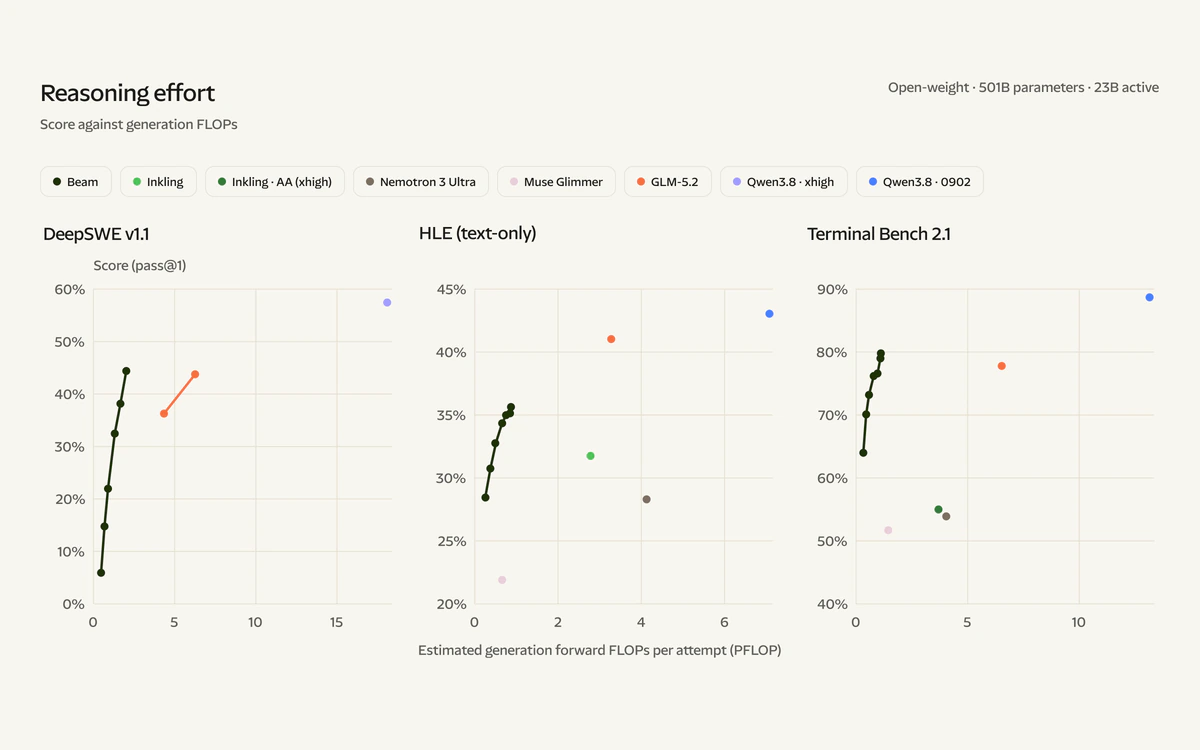
The company's charts plot benchmark scores against generation compute and against the number of tokens generated. In both views, Beam's curve sits to the left of its rivals: Reflection's figures show it reaching its scores with roughly 20,000 to 45,000 generated tokens where GLM-5.2 uses around 55,000 to 80,000. If that holds up, it matters for anyone paying per token or running agents that make many long calls.
Where Beam leads and where it trails
Reflection's own benchmark table is more mixed than the launch framing suggests. Beam is competitive with GLM-5.2, but it does not top the newer Chinese open models across the board.
Coding and agents
- SWE-Bench Verified: Beam 80.9
- SWE-Bench Pro v1: Beam 65.5, GLM 5.2 62.1, Qwen 3.8 Max 67.7
- SWE-Bench Multilingual: Beam 78.0
- Terminal Bench v2.1: Beam 80.1, GLM 5.2 81.0, GLM 5.3 88.2, Kimi K3 88.3, Qwen 3.8 Max 86.6, DeepSeek V4.1 Flash 90.6
- MCP Atlas: Beam 78.7, GLM 5.2 77.8, GLM 5.3 84.2, Kimi K3 82.3, Qwen 3.8 Max 84.5
- BrowseComp (with context management): Beam 77.4, Kimi K3 91.2
Reasoning and general
- AIME 2026: Beam 97.8, GLM 5.2 99.2
- GPQA Diamond: Beam 90.5, GLM 5.2 91.2, GLM 5.3 91.7, Kimi K3 93.5, Qwen 3.8 Max 92.6, DeepSeek V4.1 Flash 90.9
- HLE (no tools): Beam 36.2, GLM 5.2 40.5, GLM 5.3 42.3, Kimi K3 46.9, Qwen 3.8 Max 43.6, DeepSeek V4.1 Flash 39.1
- IFBench: Beam 79.7, GLM 5.2 73.3, Qwen 3.8 Max 82.8
- LongBench v2: Beam 65.5, GLM 5.2 64.0, Qwen 3.8 Max 66.3
Read plainly, Beam edges GLM-5.2 on SWE-Bench Pro, MCP Atlas, IFBench and LongBench v2, and trails GLM 5.3, Kimi K3, Qwen 3.8 Max and DeepSeek V4.1 Flash on Terminal Bench, GPQA Diamond and HLE. Reflection also says Beam outscores Inkling on four coding tests.
Unverified numbers
All of these scores are Reflection's own. TechCrunch notes that the benchmark claims have not been independently verified, and they cannot be until the weights ship.
How Reflection trained it
Pretraining ran on 6,144 NVIDIA GB300 NVL72 GPUs for under four weeks, with 92.3% goodput near the end of the run. Reinforcement learning then used about 10,500 GB300 GPUs for another four weeks.
- More than 100 million RL rollouts
- About 1.3 billion sandboxes and around 1 million coding, agentic and STEM environments
- An average of 110,000 concurrent rollouts and up to 170,000 concurrent sandboxes
- 71 inference incidents handled without stopping the training job, with an 8-minute median capacity recovery
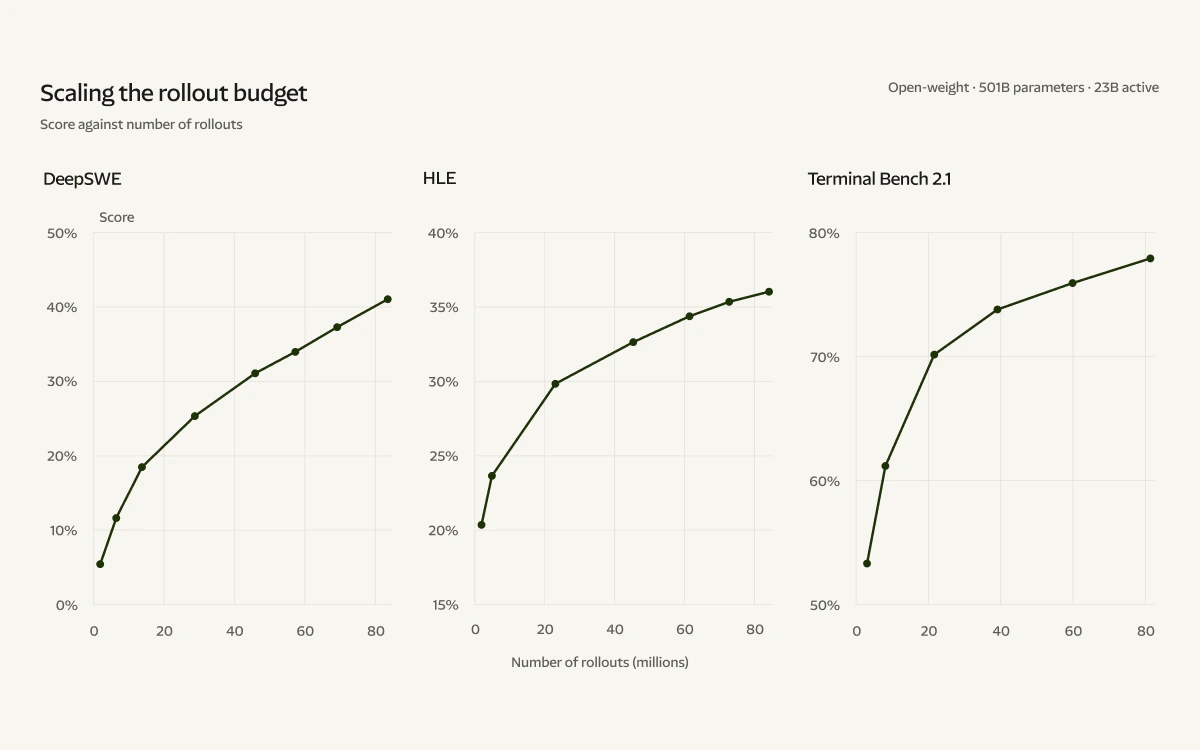
Reflection calls it "one of the largest scale RL runs conducted by any open lab to date" and says it "built nearly the entire infrastructure stack in-house." On safety, the company lists multi-teacher on-policy distillation (MOPD), a separate SFT and RL safety pipeline, and deliberative alignment.
Availability: a waitlist, not a download
Beam cannot be downloaded yet. Reflection says it will "release the weights under an Apache 2.0 license, along with documentation," with the weights, technical report, model card and developer artifacts due later in October 2026.
Until then, access is through an early-access waitlist at platform.reflection.ai, with a developer portal at developers.reflection.ai. No pricing has been announced. TechCrunch reports that Reflection plans to distribute Beam through hyperscalers and neoclouds and to have it integrated into open-source libraries at launch.
Who is behind Reflection
Reflection was founded in 2024 by Misha Laskin and Ioannis Antonoglou, both former Google DeepMind researchers. It has raised about $4.7 billion in total, most recently at a $25 billion pre-money valuation, from backers including Nvidia, Sequoia Capital and Lightspeed Venture Partners.
It has also locked in more than $7 billion of compute through 2029: a SpaceX deal that TechCrunch puts at more than $6 billion and SiliconANGLE at $6.3 billion for Nvidia GB300 NVL72 capacity, plus $1 billion with Nebius.
Commercially, Reflection is aiming at enterprises, the public sector and developers with what it calls an "AI factory": customizable local AI systems trained on a customer's own data. South Korea's Shinsegae Group is a pilot partner.
Why it matters
The strongest open-weight models of the past year have mostly come from Chinese labs - GLM, Kimi, Qwen and DeepSeek. Reflection is positioning Beam as a Western alternative, and a permissive Apache 2.0 license would make it easy for companies to adopt and fine-tune.
But the case rests on claims that cannot be tested yet. The things to watch when the weights land are whether independent evaluations reproduce the 3-4x efficiency figure, how Beam performs on hardware outside Reflection's own stack, and whether the license arrives as promised.
Sources
- Reflection, Introducing Beam: https://reflection.ai/blog/introducing-beam
- TechCrunch: https://techcrunch.com/2026/10/05/reflection-debuts-beam-a-open-weight-ai-model-to-rival-chinese-models-at-lower-compute-cost/
- SiliconANGLE: https://siliconangle.com/2026/10/05/reflection-ai-debuts-open-source-beam-model-with-501b-parameters/
Key takeaways
- Beam is a 501B-parameter MoE model with 23B active parameters, a 1 million token context and text-only input.
- Reflection's main claim is GLM-5.2-level reasoning on 3-4x less inference compute, not across-the-board leadership.
- On Reflection's own table, Beam trails GLM 5.3, Kimi K3, Qwen 3.8 Max and DeepSeek V4.1 Flash on several benchmarks.
- Weights are promised under Apache 2.0 later in October 2026; today there is only an early-access waitlist and no pricing.
- All benchmark figures come from Reflection and have not been independently verified.
More in Tech News
Browse Tech News