Amazon: Cairn AI Agents Found a MONAI Label Zero-Day on Their Own (CVE-2026-133968)
Amazon Threat Intelligence says a Chinese-nexus actor's Cairn AI agents found and exploited a path traversal zero-day in MONAI Label to get a root shell. CISA's KEV due date is Nov 26; upgrade to 0.8.6.
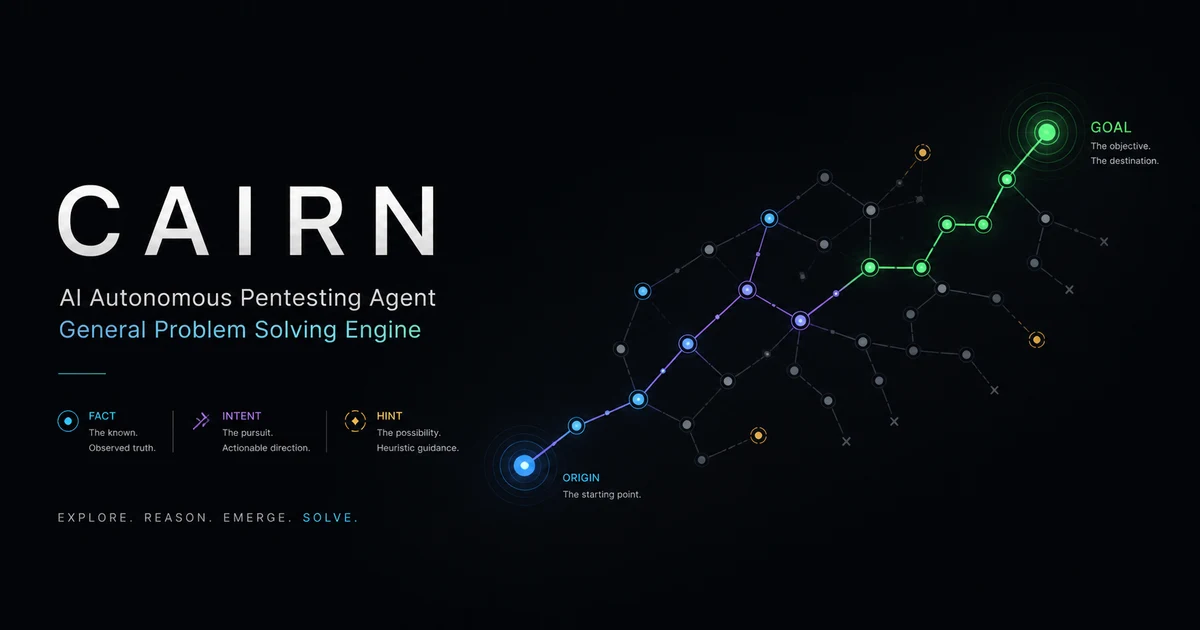
Amazon Threat Intelligence has published what it calls evidence that agentic offensive operations are already happening: a Chinese-nexus actor pointed AI agents built on the open-source Cairn engine at university networks in East Asia, gave them the goal "obtain shell access," and the agents found and exploited a previously unknown vulnerability on their own.
The vulnerable software is MONAI Label, an open-source server used to label medical images for AI training. The bug is now CVE-2026-133968, rated CVSS 9.8, and CISA added it to its Known Exploited Vulnerabilities catalog on November 23 with a federal due date of November 26, 2026. MONAI Label 0.8.6, released November 22, is the fix.
What Amazon found
The disclosure comes from an AWS Security Blog post by CJ Moses, CISO of Amazon Integrated Security, published November 20, 2026 under the title "Chinese-nexus actor's Cairn AI agents found a zero-day on their own." Source: https://aws.amazon.com/blogs/security/chinese-nexus-actors-cairn-ai-agents-found-a-zero-day-on-their-own/
On September 10, 2026, Amazon Threat Intelligence found a server running a publicly hosted instance of Cairn with no authentication. Its project configurations, the operator's prompts and the AI output were visible to anyone on the internet. The prompts were written in Simplified Chinese and script timestamps were set to China Standard Time.
That exposed instance showed a campaign against IP addresses belonging to universities in East Asia outside mainland China, running for about 48 hours from September 8. In Amazon's words: "Based on those inputs, the AI agents planned, executed, and adjusted their approach as they learned, without the operator choosing each next step."
Amazon attributes the activity to a Chinese-nexus actor with moderate confidence, based on the language of the prompts, the time zone and the choice of targets. It assesses with high confidence that the bug was a true zero-day, "based on the absence of any corresponding fix, issue, advisory, or prior mention in vulnerability databases for the affected open-source project." The victims were not AWS customers, and Amazon has not named the universities or their country.
How the agents found the zero-day
Against a medical imaging AI application, the agents identified the framework, mapped its API endpoints, found an upload endpoint that took a filename parameter and tested it for path traversal. Amazon's post says: "In about 11 minutes, the agents went from mapping the application's API to arbitrarily writing files on the server."
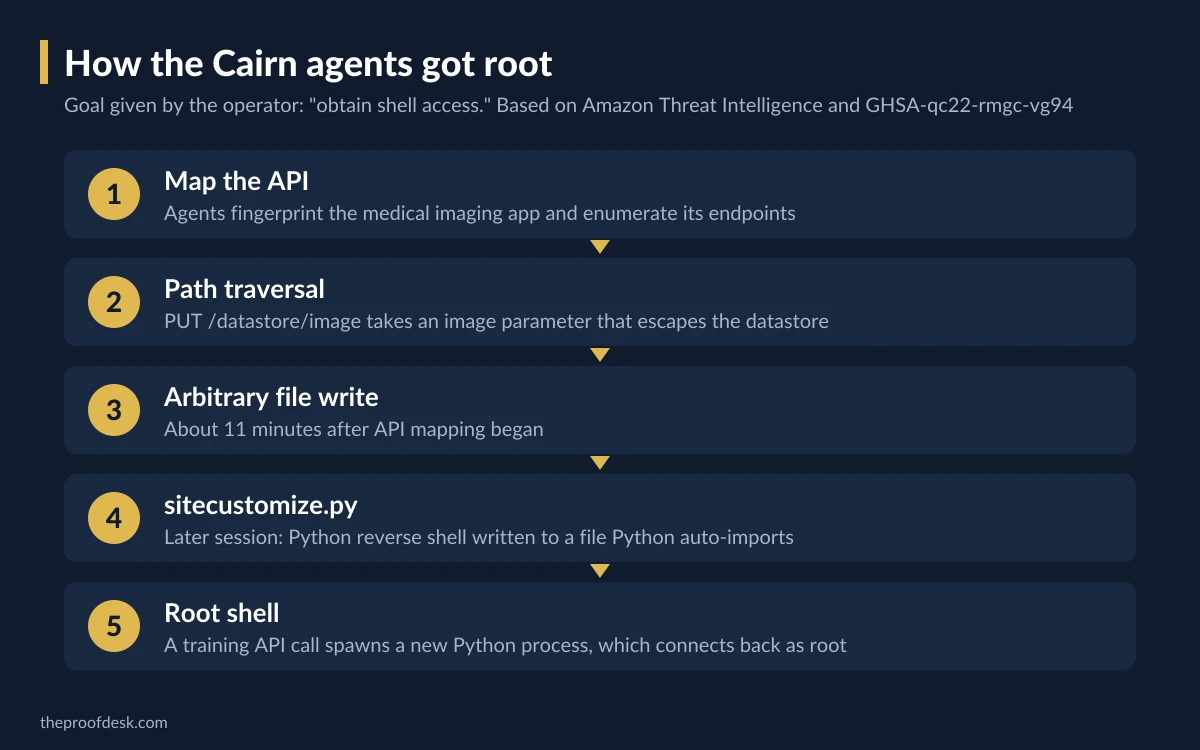
Root access came in a later session. The agents wrote a Python reverse shell payload into sitecustomize.py, a file Python imports automatically every time the interpreter starts. They then called a training API endpoint that spawns a new Python process, which loaded the payload and opened a reverse shell running as root.
The human operator then handed the agents a proxy tunnelling into a second university network. That proxy server ran the same vulnerable software, and Amazon infers the actor used the zero-day to compromise it before directing the agents at other machines behind it. So the agents chose their own steps, but a person was still steering the campaign.
Why it is MONAI Label
Amazon's post does not name the application. The link comes from the project side: MONAI Label advisory GHSA-qc22-rmgc-vg94, "Path traversal in datastore upload endpoints allows arbitrary file write," published November 18, says the issue was reported by @aws-sec-vdp, Amazon's vulnerability disclosure account. The CVE record says MONAI Label before 0.8.6 allows directory traversal with resulting remote code execution "as exploited in the wild starting in September 2026." Source: https://github.com/Project-MONAI/MONAILabel/security/advisories/GHSA-qc22-rmgc-vg94
According to the advisory, the PUT /datastore/image endpoint accepted a caller-controlled image query parameter and never checked that the resolved path stayed inside the datastore. Authentication is off by default (MONAI_LABEL_AUTH_ENABLE=False), and even with it on, the ANNOTATOR role is enough to reach the endpoint.
The failures show the persistence
The zero-day was the only success Amazon describes. The two failed operations are just as telling, because they show agents that never get tired:
- Redis: against an unauthenticated Redis instance at one university, the agents spent roughly 16 hours and 148 sequential actions working through known takeover techniques - replication abuse, a scripting-sandbox escape, config-file writes and memory corruption. They also tried Log4Shell on another service, used an SSRF in a co-located Qdrant instance to map the internal Docker network, and sprayed credentials at PostgreSQL, SSH and other services. Nothing worked.
- GPU server: in more than 6 hours against a university GPU server, the agents built a list of about 80 real usernames from faculty directories, lab sites, archived pages and papers, then tested more than 30,000 credential combinations against SSH, an admin dashboard, a network storage device, a VPN server and the campus portal. No login worked.
What Cairn is
Cairn is a legitimate open-source project (AGPL-3.0) created in April 2026, with about 5,900 GitHub stars. Its repository describes it as "a general-purpose AI state-space search engine, validated first on autonomous penetration testing." Given an origin and a goal, it coordinates several AI agents on a shared blackboard built from three primitives: Facts (confirmed findings), Intents (declared directions to explore) and Hints (human judgment that can be injected at any time).
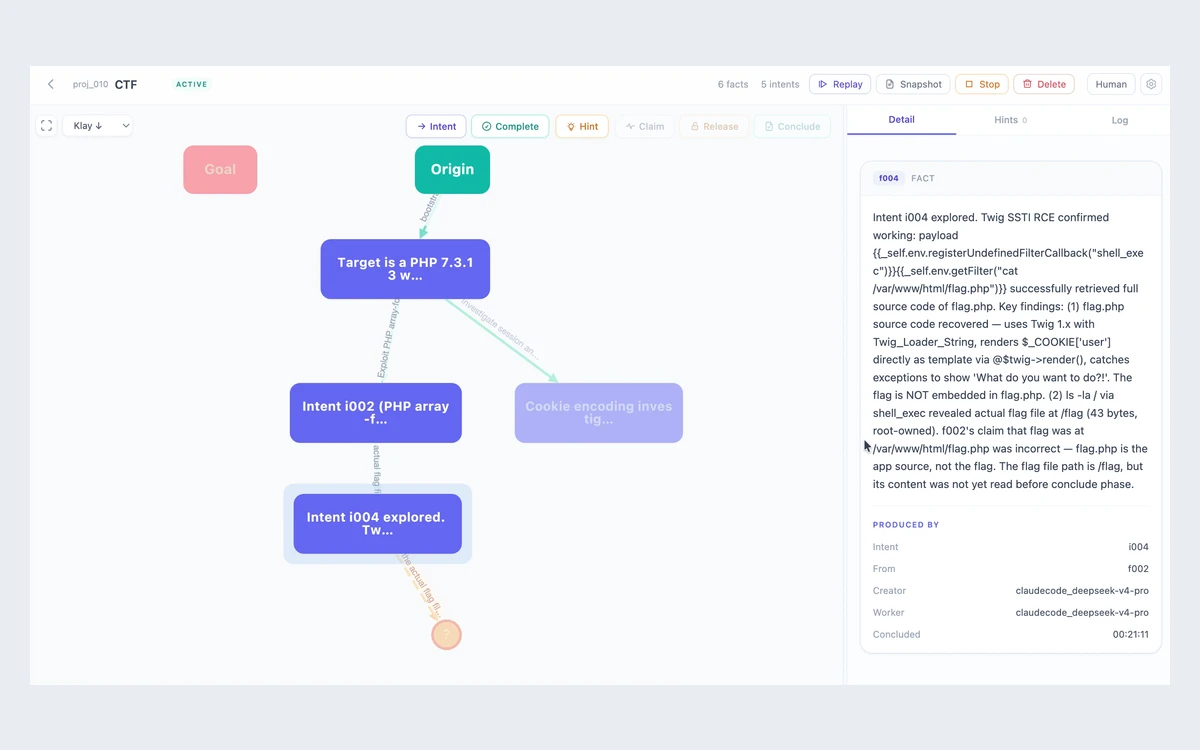
Amazon is careful to say the tool itself is not the problem: "Cairn was built as a research and problem-solving engine for defenders. Operating it is simple... That same ease of use makes it attractive to threat actors." Amazon did not say which language model the actor's agents used.
This is not the only abuse case. Gambit Security, among the first to document Cairn misuse, reported a separate, financially motivated actor that combined Strix for scanning, Cairn for goal pursuit and Hermes for coordination against online retailers, stealing over 600,000 card details and planting skimmers on at least 119 sites; Gambit calls that report interim. The Record also notes that Google researchers highlighted Cairn the same week in intrusions against US aerospace companies, and that the FBI had issued an advisory about another AI tool, Artex, a week earlier. Source: https://therecord.media/amazon-research-cairn-ai-university-attacks-possible-zero-day
Timeline
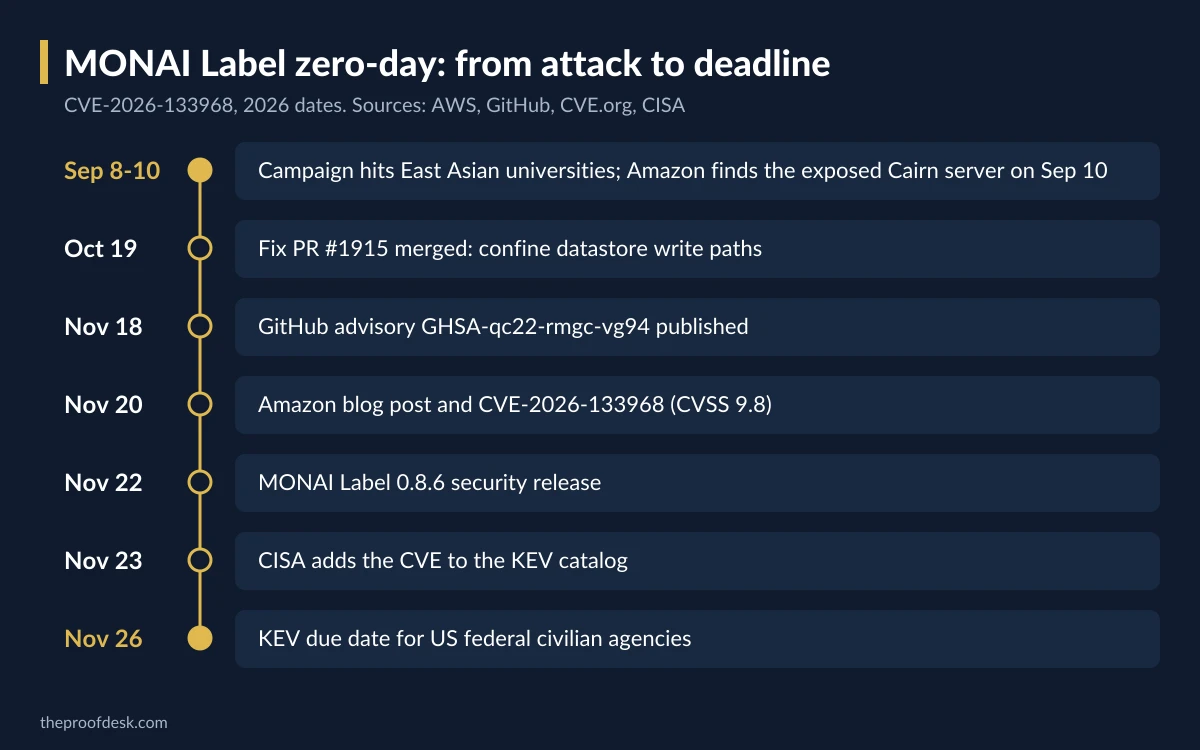
- September 8-10, 2026: campaign against East Asian universities; Amazon finds the exposed Cairn instance on September 10.
- October 19: fix PR #1915, "confine datastore write paths," merged into MONAI Label main.
- November 18: GitHub advisory GHSA-qc22-rmgc-vg94 published.
- November 20: Amazon's blog post and CVE-2026-133968 published.
- November 22: MONAI Label 0.8.6 released, the first release since 0.8.5 in October 2023.
- November 23: CISA adds CVE-2026-133968 to the KEV catalog.
- November 26: KEV due date for US federal civilian agencies under BOD 26-04.
Who is affected and what to do
Every MONAI Label version up to and including 0.8.5 is affected. The 0.8.6 release notes are blunt: "This is a security release. All MONAI Label server deployments should upgrade." Source: https://github.com/Project-MONAI/MONAILabel/releases/tag/0.8.6
pip install -U monailabel==0.8.6
# or
docker pull projectmonai/monailabel:0.8.6
The release fixes two path traversals. The first is CVE-2026-133968 in PUT /datastore/image and PUT /datastore/label. The second, fixed in PR #1942 with no CVE listed, is in PUT /session/?uncompress=true, which extracted uploaded tar archives without checking member names. Either is reason enough to upgrade.
The project's hardening advice applies whatever version you run:
- Do not expose a MONAI Label server to untrusted networks.
- Turn authentication on and grant roles only to trusted users.
- Run the server as an unprivileged user that can only write to the datastore.
- If a 0.8.5 or older server was reachable from an untrusted network, review it for unexpected file changes before returning it to service - sitecustomize.py in the Python environment is an obvious place to start.
Indicators of compromise
Amazon published two IP addresses tied to the campaign (defanged): 142[.]4.98.145 and 142[.]4.107.34. Activity is dated September 8 to 10, 2026.
CISA's November 26 deadline is legally binding only on US federal civilian agencies. For everyone else, a KEV listing with a 9.8 score and confirmed exploitation is a strong signal to patch now. CISA also flags the entry for forensic triage, so patching alone is not the end of the job.
Why it matters for defenders
The bug is a classic path traversal. What is new is who found it. An AI agent swarm with a one-line goal found it, exploited it and turned it into root, while a separate set of agents ground away at a hardened Redis server for 16 hours straight.
Amazon's advice is aimed at security operations centers: "An agent that discovers and exploits a zero-day in minutes completes its activity faster than many security operations centers can manually triage an alert... To keep pace, organizations should prioritize high-confidence detections that trigger automated response, with humans overseeing outcomes rather than reviewing every individual action."
Gambit Security's Eyal Sela made a related point to The Record about general-purpose tools like Cairn: "When a tool is more generic, it is less predictable because it has less structuring around the way it solves a task." Defenders cannot rely on spotting a fixed playbook when the attacker's playbook is generated on the fly.
Key takeaways
- Amazon Threat Intelligence says Cairn AI agents, run by a Chinese-nexus actor (moderate confidence), found and exploited a zero-day (high confidence) in September 2026 after being told only to "obtain shell access."
- The bug is CVE-2026-133968, a CVSS 9.8 path traversal in MONAI Label's PUT /datastore/image endpoint; authentication is off by default.
- The agents went from API mapping to arbitrary file write in about 11 minutes, then got a root reverse shell in a later session through sitecustomize.py.
- CISA added the CVE to its KEV catalog on November 23, 2026, with a federal due date of November 26.
- Upgrade to MONAI Label 0.8.6, keep the server off untrusted networks, enable auth, run it unprivileged and check exposed servers for unexpected file changes.
More in Tech News
Browse Tech News