Nvidia Reinstates Jensen Huang as CEO 11 Days After He Resigned
Nvidia's board unanimously reinstated Jensen Huang as president, CEO and director on Nov 23, citing U.S. government input that his return poses no national security risk. Shares closed up 31%, the investigation continues, and Huang testifies to the Senate on Dec 3.
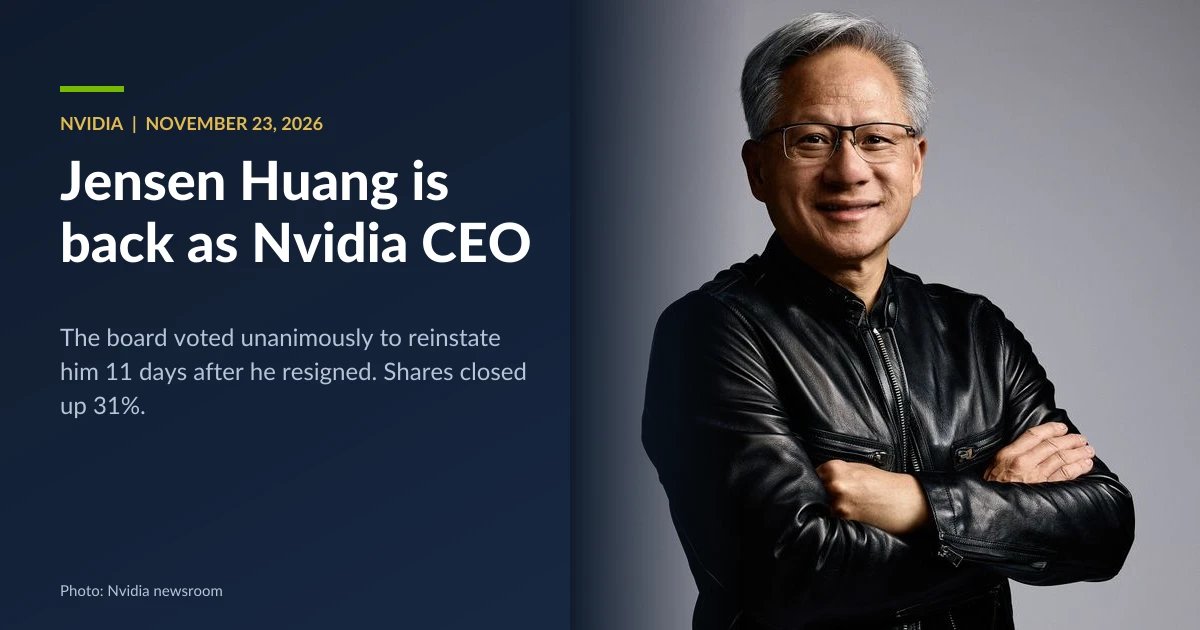
Nvidia's board voted unanimously on November 23, 2026 to reinstate Jensen Huang as president, chief executive and board director, effective immediately. The decision came 11 days after Huang resigned on November 12, and less than a week after the board said it did not intend to bring him back.
The board said it acted after discussions with Huang and after receiving input from "senior levels of the United States government" that his return "poses no national security risk". Shares closed up 31% on the day. The reinstatement comes with conditions: the independent investigation keeps running, a new export-control committee has been formed, and Huang faces Congress in early December.
What Nvidia's board announced
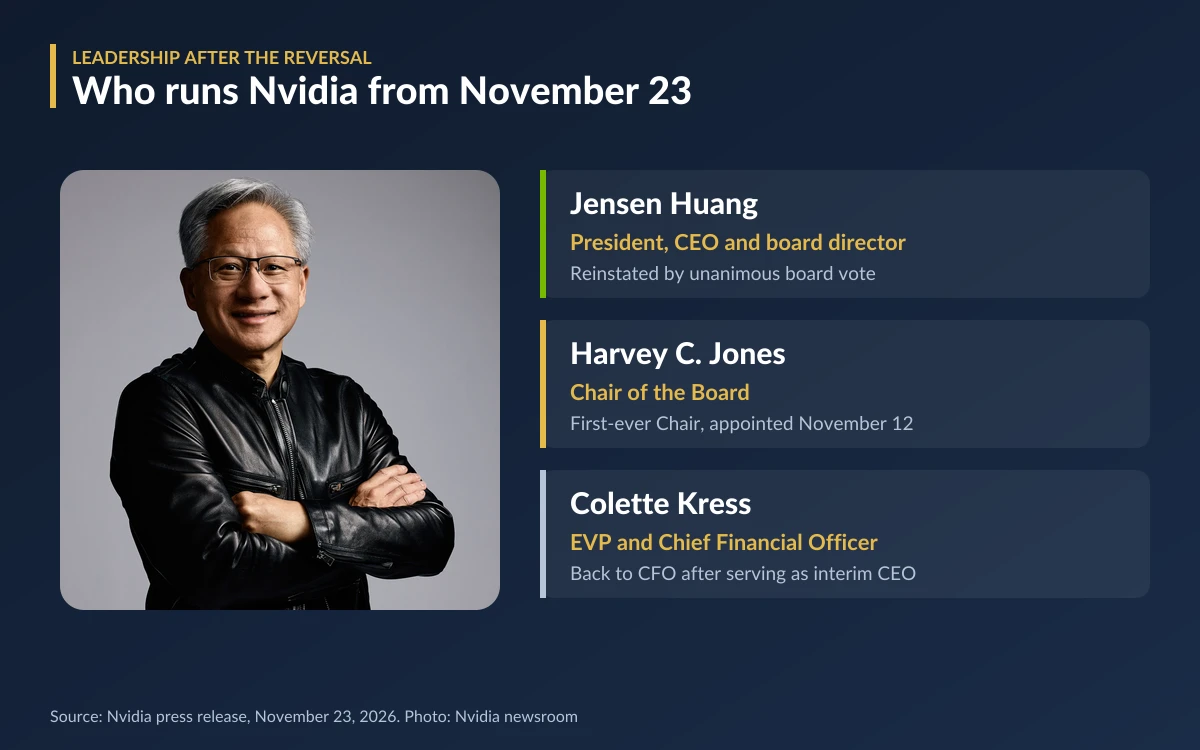
In a release on November 23, Nvidia said the board was satisfied with Huang's candor and his ability to lead the company. Harvey C. Jones, who was appointed Nvidia's first-ever Chair of the Board on November 12, stays in that role.
"We have every confidence in Jensen and look forward to working with him as he resumes his leadership of the Company," Jones said. Huang said in the same release: "I take this responsibility with the greatest humility and renewed commitment."
Colette Kress, who served as interim CEO while also remaining CFO, goes back to her role as executive vice president and chief financial officer. The board thanked her for leading the company during the transition, and an SEC filing cited by CNBC confirms she continues as CFO.
Why the board reversed itself in a week
The reversal is sharp. As recently as the November 17 earnings call, Jones said the board had unanimously accepted Huang's resignation and did not intend to reinstate him. Kress repeated that position on CNBC on November 18. Hours before the earnings call, Huang had posted on X that he would be honoured to return if the board decided it served shareholders, employees, the company and America.
According to CNBC's sources, senior U.S. officials briefed the board late last week that no national security laws had been violated. Huang and the board then held their first conversations since his departure over the weekend, and the board made its decision at a second meeting on Sunday, November 22. Nvidia announced it the next morning.
How the story unfolded
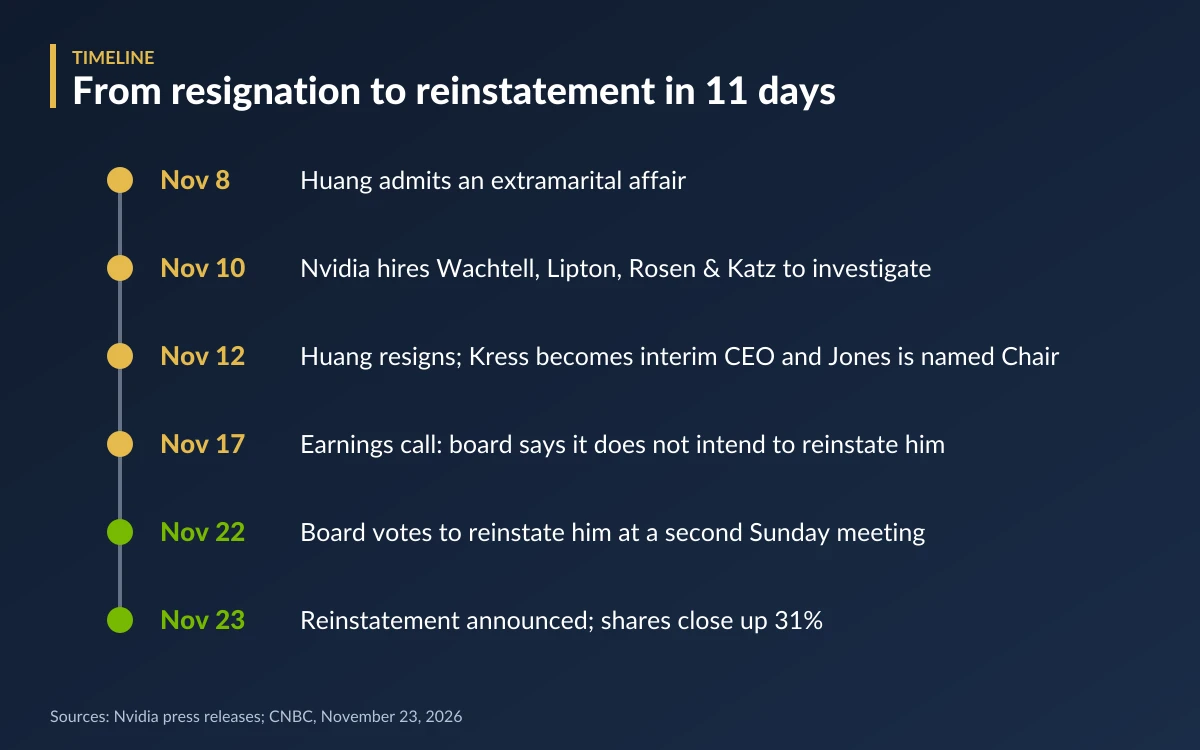
- November 8: Huang admitted to an extramarital affair. The woman involved is someone U.S. intelligence sources reportedly believe has ties to China's Ministry of State Security. Nvidia itself has only said Huang was the target of a foreign intelligence effort.
- November 10: Nvidia hired the law firm Wachtell, Lipton, Rosen & Katz to investigate.
- November 12: Huang resigned as president, CEO and director. Kress became interim CEO and Jones became Chair.
- November 17: at the earnings call, the board said it did not plan to bring Huang back.
- November 22: the board voted to reinstate him at a Sunday meeting.
- November 23: Nvidia announced the reinstatement.
Our November 16 article, "Nvidia's CEO Search Has No Search Firm Yet" (/nvidia-ceo-search-jensen-huang-resigns-colette-kress-interim), covers the resignation and the search for a successor that has now been called off.
The investigation continues, with new oversight
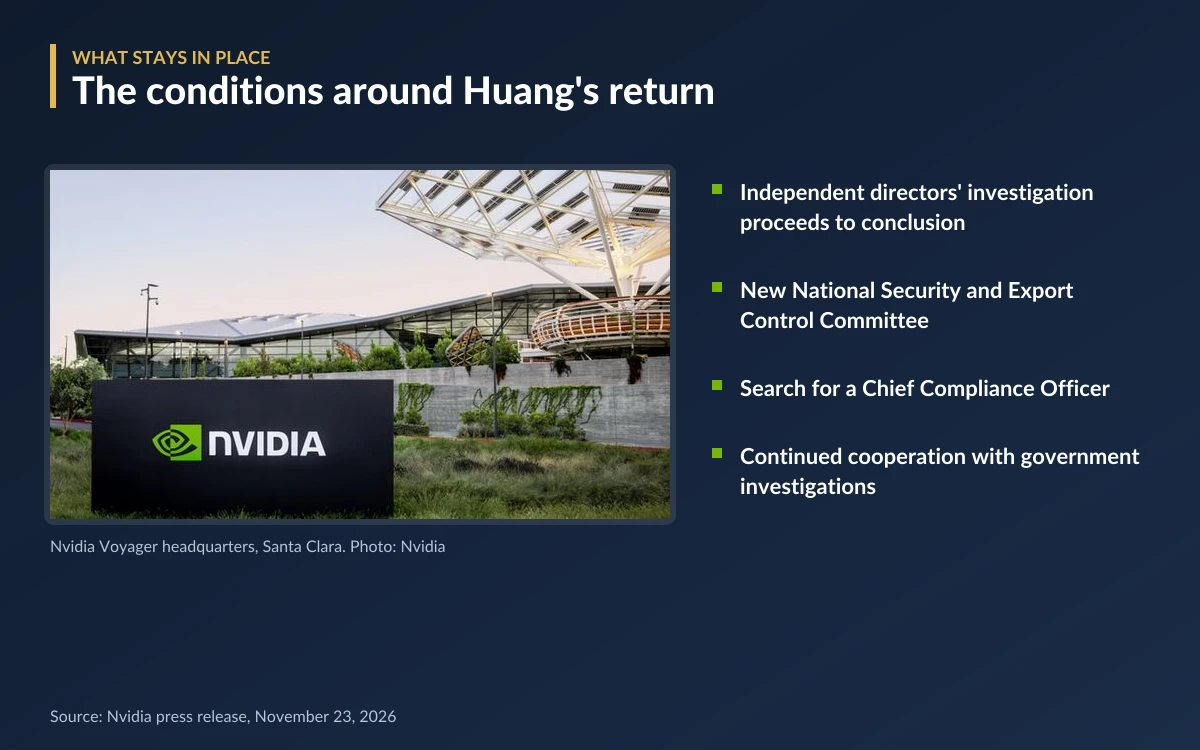
Huang's return does not close the inquiry. After reports that he was the target of a foreign intelligence effort, the board set up a committee of all independent directors, which hired independent counsel. Nvidia said "the committee's investigation will proceed to conclusion" and that Huang supports it and will cooperate.
The board also announced two governance changes:
- A new National Security and Export Control Committee made up of independent directors.
- A search for a Chief Compliance Officer who will report to the board's Nominating and Corporate Governance Committee.
Nvidia said it will keep cooperating with government investigations. No wrongdoing by Huang has been found, and the company has not published any findings from its internal review.
Shares recover most of the slide
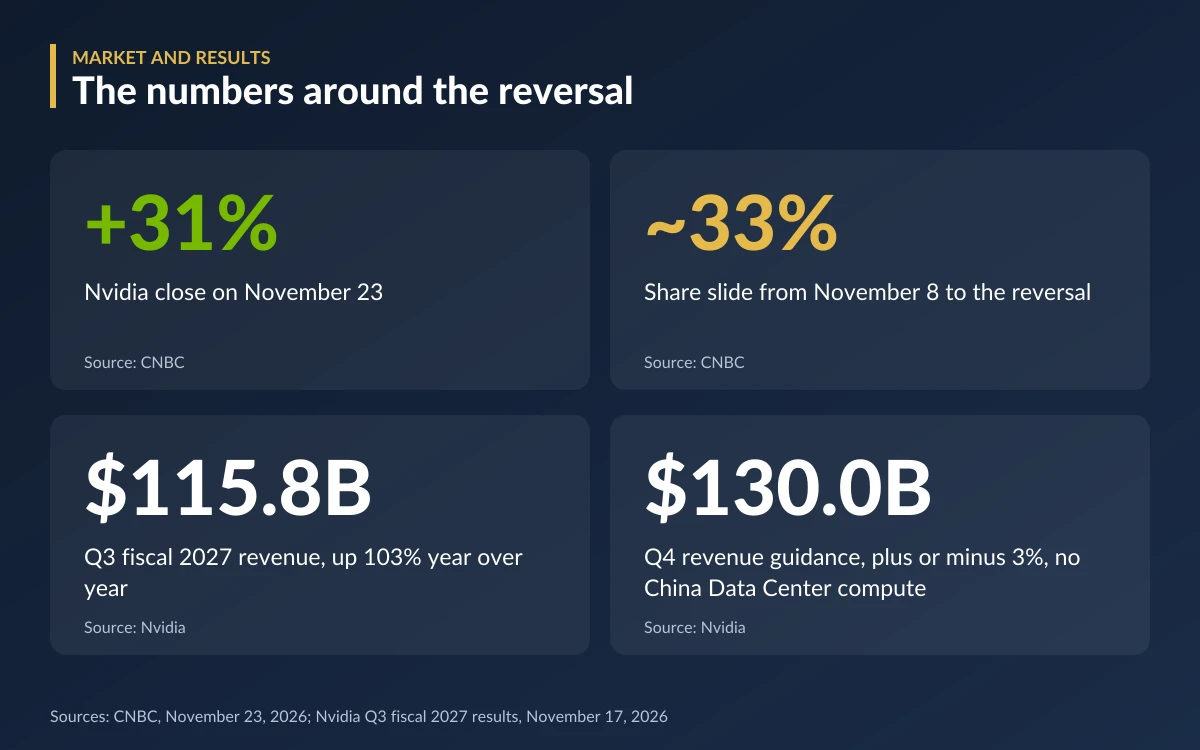
Nvidia shares closed up 31% on November 23, CNBC reported, after falling nearly 33% from November 8, when Huang admitted the affair. CNN reported a gain of 31.48%, the stock's best day since 2003, adding about $950 billion in market value. Yahoo described it as nearly $1 trillion.
The business underneath did not stall during the turmoil. For the third quarter of fiscal 2027, reported on November 17, Nvidia posted revenue of $115.8 billion, up 103% year over year, with Data Center revenue of $107.6 billion. It guided fourth-quarter revenue to $130.0 billion, plus or minus 3%, assuming no Data Center compute revenue from China.
Washington splits on the decision
President Trump said he had spoken with the board "directly and indirectly" and with Huang on Sunday, and that Huang "did nothing wrong". On Truth Social he called the reinstatement "the correct and proper decision" and said the government "does not possess evidence" of unlawful conduct by Huang. Attorney General Todd Blanche also said the government has no evidence of unlawful conduct.
Critics questioned what the government's assurance was based on. Sen. Elizabeth Warren, the ranking Democrat on the Senate Banking Committee, called the decision reckless and asked which administration officials gave the board its assurances. Sen. Andy Kim said: "Americans deserve answers about what NVIDIA and the Trump administration knew, when they knew it." Republican Sen. John Cornyn of Texas asked: "No national security risk? Based on what?"
Elon Musk welcomed the move, saying the board's mistake had been corrected.
What comes next: Congress in December
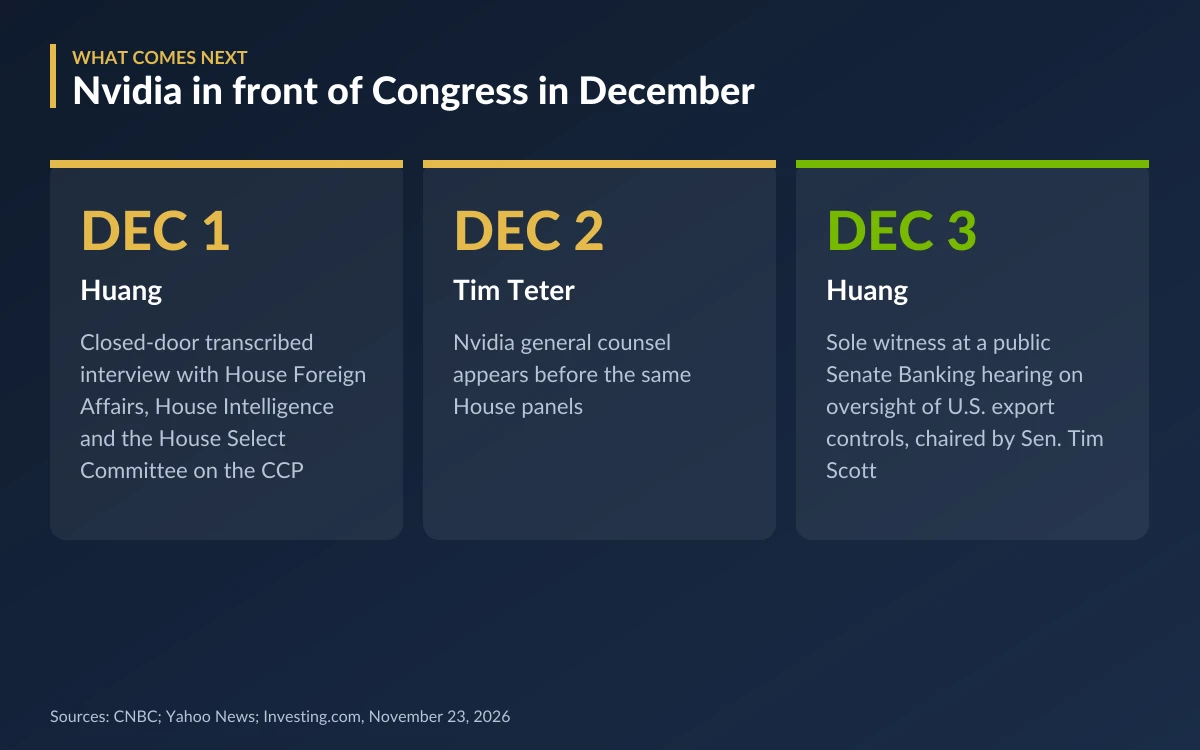
- December 1: Huang sits for a closed-door transcribed interview with the House Foreign Affairs Committee, the House Intelligence Committee and the House Select Committee on the Chinese Communist Party.
- December 2: Nvidia general counsel Tim Teter appears before the same House panels.
- December 3: Huang is the sole witness at a public Senate Banking Committee hearing chaired by Sen. Tim Scott, titled "Protecting America's AI Advantage: Oversight of U.S. Export Controls".
The Senate hearing will be the first time Huang answers questions in public since the scandal. Export controls on AI chips to China are the stated subject, and the board's new export-control committee is likely to come up. The outcome of the independent investigation is still pending.
Sources
- Nvidia newsroom: NVIDIA Board Reinstates Jensen Huang as President, CEO and Board Director - https://nvidianews.nvidia.com/news/nvidia-board-reinstates-jensen-huang-as-president-ceo-and-board-director
- Nvidia investor relations: NVIDIA Announces CEO Transition (November 12, 2026) - https://investor.nvidia.com/news/press-release-details/2026/NVIDIA-Announces-CEO-Transition/
- Nvidia investor relations: Financial Results for Third Quarter Fiscal 2027 - https://investor.nvidia.com/news/press-release-details/2026/NVIDIA-Announces-Financial-Results-for-Third-Quarter-Fiscal-2027/
- CNBC: Nvidia reinstates Jensen Huang as CEO - https://www.cnbc.com/2026/11/23/nvidia-jensen-huang-ceo.html
- Investing.com: Nvidia's Huang to testify before U.S. Senate on Dec 3 - https://uk.investing.com/news/stock-market-news/nvidias-huang-to-testify-before-us-senate-on-dec-3-4999970
Key takeaways
- Nvidia's board unanimously reinstated Jensen Huang as president, CEO and director on November 23, 2026, 11 days after he resigned.
- The board cited input from senior U.S. government officials that his return poses no national security risk.
- Colette Kress returns to EVP and CFO; Harvey C. Jones stays as Chair of the Board.
- The independent investigation continues, and Nvidia added a National Security and Export Control Committee and a Chief Compliance Officer search.
- Shares closed up 31% on the news; Huang faces House interviews on December 1 and a public Senate Banking hearing on December 3.
More in Tech News
Browse Tech News