Cloudflare Turns HTTP 402 Into a Paywall for AI Agents With Monetization Gateway
Cloudflare's Monetization Gateway closed beta lets websites, APIs and MCP tools charge AI agents per request over HTTP 402 and x402, settled in USDC on Base.

Cloudflare wants AI agents to start paying for what they consume. On September 30, 2026, the company opened a closed beta of Monetization Gateway, a network-level service that lets domain owners charge agents for access to websites, APIs, MCP tools and datasets, priced per request, per search query or per token. The payment request travels inside an HTTP 402 Payment Required response, a status code that has gone largely unused since the early days of the web.
The launch came alongside a broader Cloudflare post on the agentic web, which says that for the first time this year more than half of the traffic on its network was not human, and that daily requests from AI agents grew by more than 1,700% over the past year. A companion product, Pay Per Use, also entered beta to let verified AI buyers pay publishers when their content is actually used.
What Cloudflare launched
Monetization Gateway sits in front of a seller's resources on Cloudflare's network. When an agent requests a paid resource, Cloudflare answers with HTTP 402 and the payment instructions, instead of redirecting to a checkout page or requiring a separate payment API. Once the agent pays, the resource is delivered in the same exchange.
The service is built on x402, an open payments protocol from Coinbase, and uses Coinbase's x402 Facilitator. Cloudflare says it takes care of x402 compliance, payment verification, settlement, retries on failure and analytics, so sellers do not have to run any of that themselves. According to Fortune, payments settle in USDC, the dollar-pegged stablecoin issued by Circle, on Base, Coinbase's blockchain network.
Availability
Monetization Gateway is a closed beta for U.S.-based sellers and buyers only. Cloudflare says more regions are planned, and customers apply through the Cloudflare dashboard.
How the HTTP 402 payment flow works
- The seller sets payment requirements for a resource in Cloudflare.
- An agent requests the resource and receives a 402 response carrying the payment instructions.
- The agent signs a payment authorization.
- Cloudflare verifies and settles the payment, then the resource is delivered.
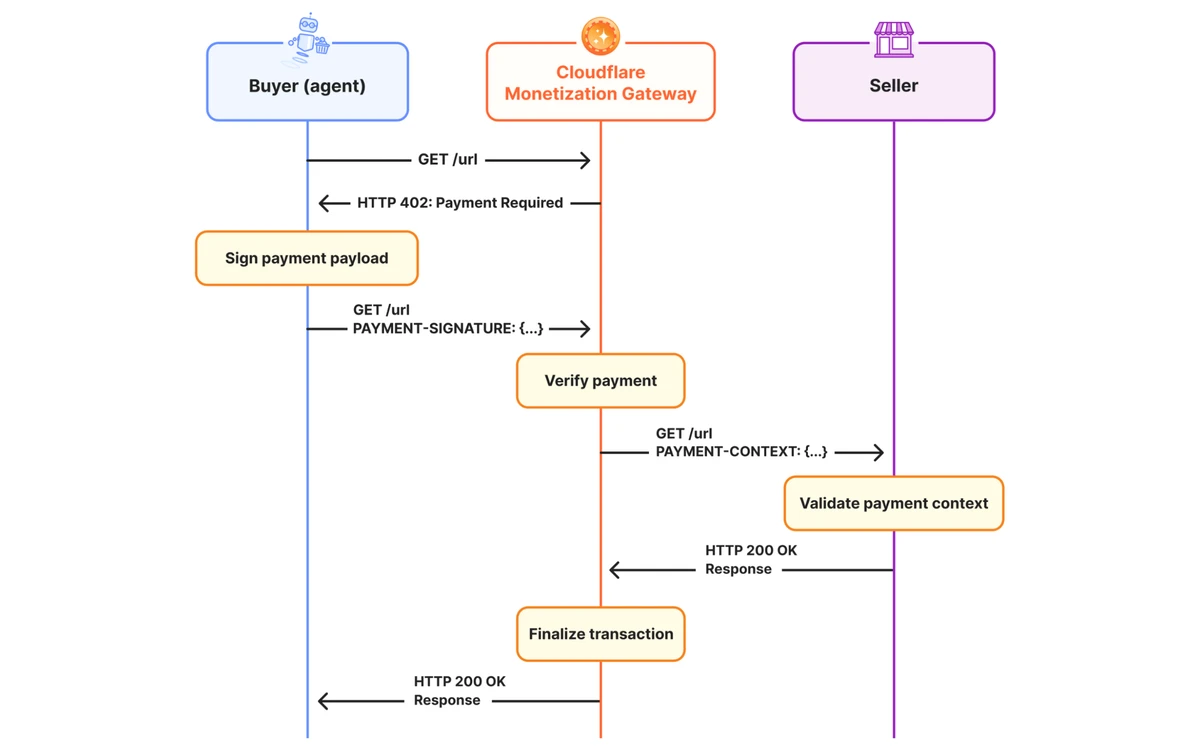
Sellers decide what to charge with rules that match parts of a request, such as the URL, headers or query parameters. Both fixed and variable pricing are supported. For more complex billing, an origin-controlled option lets the seller's own server set the price for each request, and Cloudflare demonstrates it with its own AI Gateway.
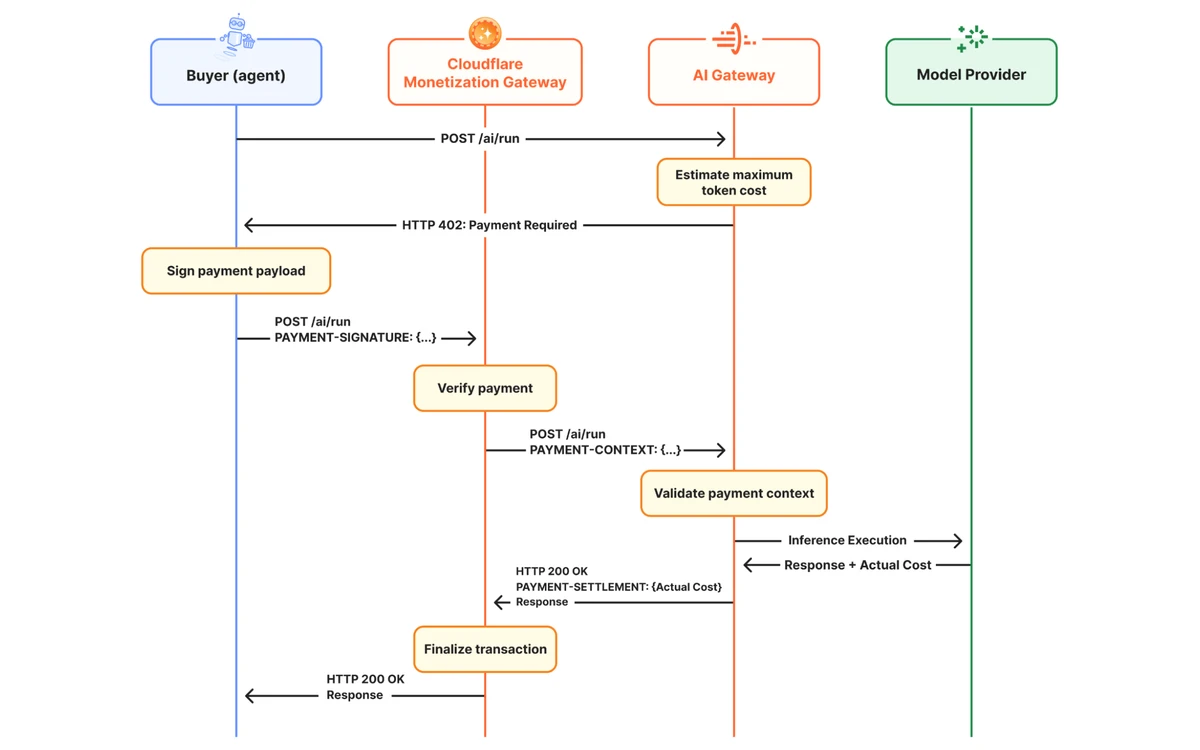
Early users
Cloudflare names Ceramic.ai, Stocktwits and API2PDF as early users, alongside its own AI Gateway. API2PDF saw conversion drop by more than 50% when it introduced a credit-card requirement, and it now uses variable pricing over HTTP 402 instead.
In Cloudflare's announcement, Ceramic.ai founder Dr. Anna Patterson argued that the web was built around a human buyer, and that agents need to be able to pay in order to act independently. Stocktwits CEO Howard Lindzon said agents fundamentally change how data is consumed, which makes charging for individual requests possible.
Pay Per Use for publishers
Pay Per Use, now in beta, works from the other direction. AI buyers offer prices for specific uses of content, and publishers see those offers and opt in or out. Verified crawlers report when content is actually used. Cloudflare verifies those reports, bills the buyer and pays the publisher, who can see what was used and when.
Cloudflare first described Pay Per Use on July 1, 2026, when it was still in development and testing with partners. At the time, co-founder and CEO Matthew Prince said: "Last year we provided site owners with transparency and control over what bots access their content, and we are thrilled with the benefits it has had to the ecosystem."
Why now: the Internet's second audience
Cloudflare's September 30 post, titled "The Internet has a second audience", frames the launches around how much of its traffic now comes from machines. These figures are Cloudflare's measurements of its own network:
- More than half of traffic on Cloudflare's network was not human, for the first time this year.
- Daily requests from AI agents grew by more than 1,700% over the past year.
- The network handles about 115 million HTTP requests per second, up from 63 million at the end of 2024, with peaks above 150 million.
- Web Bot Auth, which cryptographically verifies bot requests, processes more than 500 billion verified bot requests each week.
The payment products build on earlier controls. In July 2025 Cloudflare began blocking AI training crawlers by default for new domains. Its Disallow AI Training setting shipped on September 15, 2026, letting sites stay indexed for search while restricting training use, and Search, Agent and Training controls have been available on every plan, including Free, since July. Fortune also points to cloudflare.pay, rolled out in August, which lets agents prove they act on a user's behalf and spend from linked wallets.
What is not known yet
Cloudflare has not disclosed its fee or take rate, any price points, transaction volumes, or which AI companies have signed on as buyers. Nor is there a date for general availability. Rohin Lohe, a product manager at Cloudflare, told Fortune: "We'll be ramping up features and users through the rest of the year, with plans to be widely available by early 2027."
Frequently asked questions
What is HTTP 402?
It is the Payment Required status code, reserved in the HTTP standard but rarely used in practice. Monetization Gateway uses it to tell an agent that a resource costs money and how to pay, inside the normal request and response.
Can any Cloudflare customer use Monetization Gateway today?
No. It is a closed beta limited to U.S.-based sellers and buyers, and access is by application in the Cloudflare dashboard. A Cloudflare product manager told Fortune the aim is wide availability by early 2027.
How do AI agents pay?
In USDC on the Base network, through the open x402 protocol and Coinbase's x402 Facilitator. After receiving the 402 response, the agent signs a payment authorization and gets the resource once the payment settles.
How much does Cloudflare charge sellers?
Cloudflare has not said. No fee, take rate or price examples were published with the beta.
How is Pay Per Use different from Monetization Gateway?
Monetization Gateway charges at the moment of access, per request, query or token. Pay Per Use pays publishers after verified AI buyers report that content was actually used, at prices buyers offer and publishers accept.
Sources
- Cloudflare: Monetization Gateway beta, charge AI agents for consumption with HTTP 402 ↗
- Cloudflare: The Internet has a second audience ↗
- Cloudflare: Content Independence Day, one year on ↗
- Cloudflare press release, July 1, 2026 ↗
- Fortune: Cloudflare tool lets businesses charge AI agents in stablecoins ↗
Key takeaways
- Cloudflare's Monetization Gateway lets sites, APIs, MCP tools and datasets charge AI agents per request, per query or per token.
- Payment is requested inline with HTTP 402 over the x402 protocol and settles in USDC on Base.
- It is a closed beta for U.S. sellers and buyers only, with wide availability targeted for early 2027.
- Pay Per Use, also in beta, pays publishers when verified AI buyers actually use their content.
- Cloudflare has not disclosed fees, prices, volumes or which AI companies will pay.
More in Tech News
Browse Tech News