Palo Alto Networks to buy Applied Compute for $4.5 billion in stock to sell secure open-weight AI
Palo Alto Networks agreed to acquire Applied Compute, an 18-month-old open-weight AI post-training and inference platform founded by ex-OpenAI researchers, in an all-stock deal valued at $4.5 billion. It landed alongside a record fiscal Q1 with revenue up 39%.
Palo Alto Networks has agreed to buy Applied Compute, a platform for post-training and running open-weight AI models, in an all-stock deal valued at $4.5 billion, subject to adjustments. The company announced it on Wednesday, November 18, the same day it reported a record fiscal first quarter.
The price is the headline. Applied Compute launched publicly less than 18 months ago, and about two weeks before the deal it raised $350 million at a $3.25 billion valuation. Palo Alto is paying about 38% more than that round to own a company that lets enterprises train and serve their own models, and to sell those models with its security built in.
What Palo Alto is buying, and on what terms
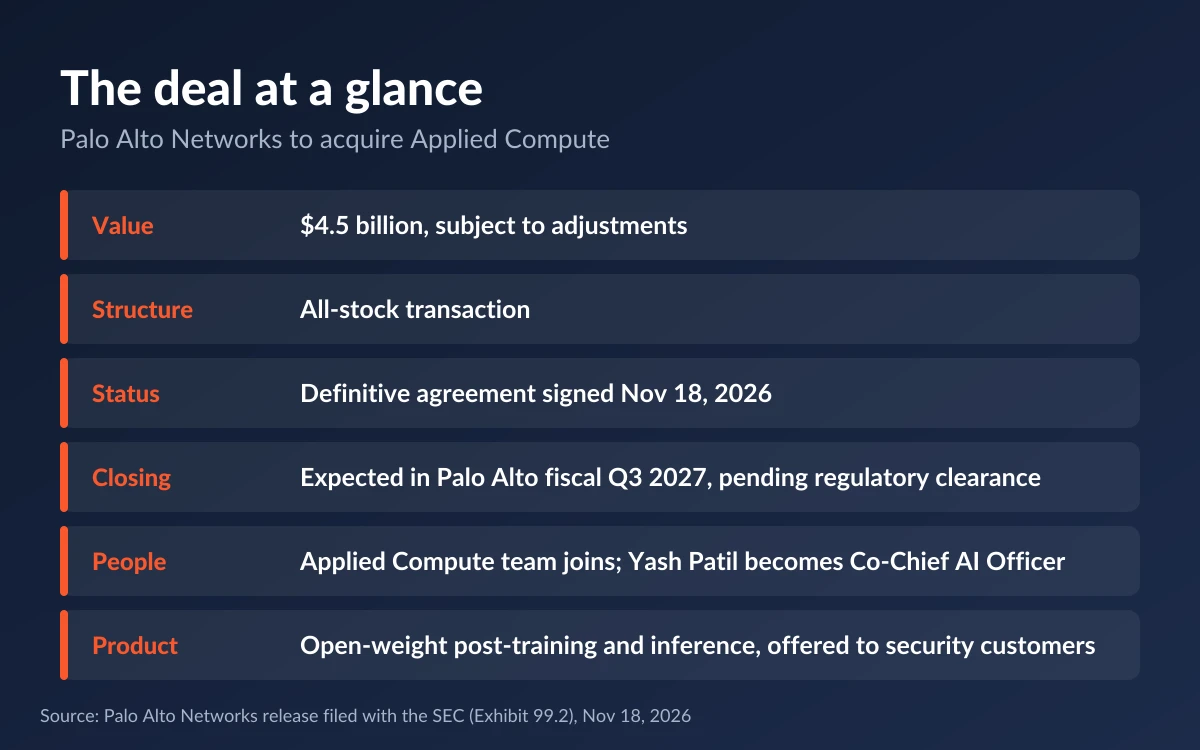
According to the release Palo Alto filed with the SEC, the two companies signed a definitive agreement. The deal is paid entirely in Palo Alto stock and is valued at $4.5 billion, subject to adjustments. It still needs customary closing conditions, including regulatory clearance, and is expected to close in Palo Alto's fiscal third quarter of 2027. Palo Alto's fiscal year ends July 31, so that is roughly February to April 2027 on the calendar.
- Structure: all stock, no cash component disclosed.
- Value: $4.5 billion, subject to adjustments.
- Timing: expected to close in fiscal Q3 2027, pending regulatory clearance.
- People: the Applied Compute team joins Palo Alto, and co-founder and CEO Yash Patil becomes Palo Alto's Co-Chief AI Officer once the deal closes.
Applied Compute runs a platform for post-training and inference of open-weight models. Enterprises use it to train, adapt and deploy those models, with security built in, in public clouds or in sovereign environments. Palo Alto says Applied Compute will keep serving its existing mix of AI-native companies, digital natives and large enterprises.
Why a security company wants an AI training platform
Nikesh Arora, Palo Alto's chairman and CEO, framed the deal around one bet: "Every enterprise is going to run a mix of open and closed models, and every one of those models needs to be secured."
Closed models from the large labs are delivered as an API, so a security vendor can only wrap controls around the calls. Open-weight models are different: a company downloads the weights, fine-tunes them on its own data and runs them on infrastructure it picks. That puts the whole lifecycle, from training data to the serving endpoint, inside the customer's perimeter, and that is the part Palo Alto now wants to sell.
Palo Alto plans to offer the platform to its security customers, according to SecurityWeek, and Applied Compute's research team will also help train Palo Alto's own proprietary models. The relationship started on the buying side: Palo Alto first looked at Applied Compute as a prospective customer, and its Unit 42 threat research team assessed the platform's security before the acquisition talks.
Arora was blunt about the appeal, as Yahoo Finance reported: "Applied Compute has built the best post-training and inference platform we've seen, and its research team is exceptional."
Open-weight, in one line
An open-weight model publishes its trained parameters, so anyone can download, fine-tune and host it. Applied Compute sells the tooling to do that post-training and serving at enterprise scale.
Who Applied Compute is
The company was founded by three former OpenAI researchers. In its October 2025 launch post, Applied Compute described CEO Yash Patil as a key member of the agentic software engineering effort behind Codex, Rhythm Garg as a core contributor to o1, the first RL-trained reasoning model, and Linden Li as a core contributor on ML systems and infrastructure for RL training.
It launched with about $80 million from Benchmark, Sequoia, Lux, Elad Gil and others, and named Cognition, DoorDash and Mercor as early customers. Its AC2 platform is pitched as one place to "train, serve, and continuously improve models you own", alongside a built-in AI assistant, the Shift-1 model router, an autoscaling engine and online reinforcement learning.
Patil wrote on X that the three founded the company on the belief "that every company should own its intelligence", and that it grew from zero revenue to over $100 million in annualized revenue run-rate. In the deal release he said: "We built Applied Compute with an exceptional team of AI researchers and engineers to make it easy for any company to train, serve, and improve proprietary models." He added that joining Palo Alto puts security at the center of its products and speeds its reach into large organizations.
From $3.25 billion to $4.5 billion in about two weeks
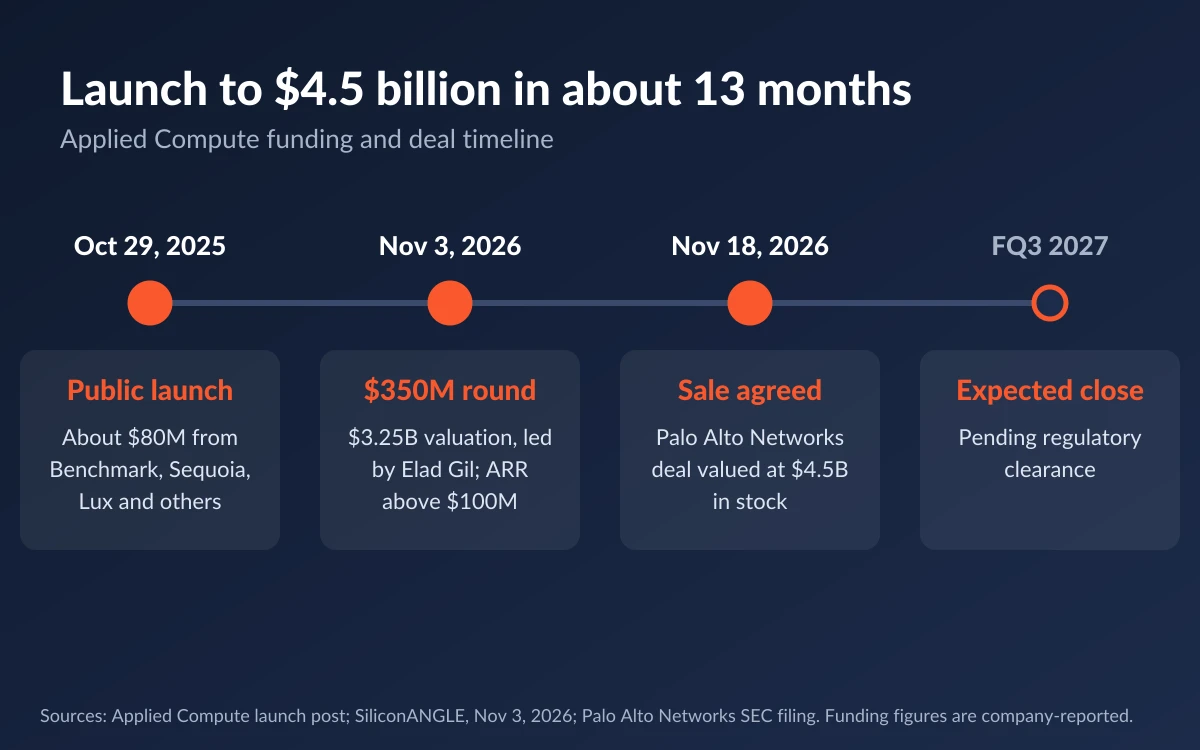
On November 3, SiliconANGLE reported that Applied Compute had raised $350 million at a $3.25 billion valuation in a round led by Elad Gil, with Nvidia, Shopify Ventures, HubSpot Ventures and more than a dozen others taking part. The company said then that its annualized recurring revenue had topped $100 million and named Microsoft and DoorDash as customers.
Fifteen days later Palo Alto agreed to pay $4.5 billion in stock. The revenue and valuation figures come from the company and press reports rather than audited filings, but the gap shows how much buyers now pay for teams that can post-train frontier-class open models.
It also fits a pattern. Palo Alto completed its roughly $25 billion acquisition of identity security firm CyberArk in February 2026, according to Yahoo Finance and SecurityWeek, and in September 2026 bought Console, described as an AI-native platform for building agentic workflows, for an undisclosed sum.
The quarter it was announced with
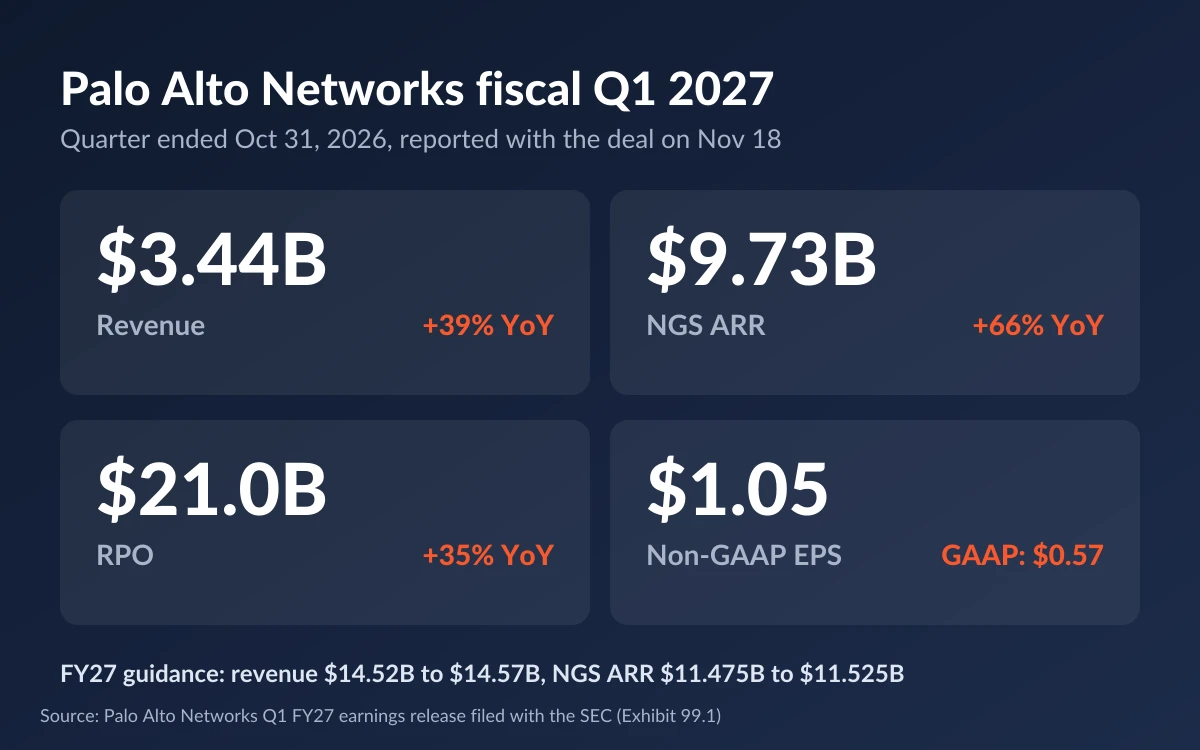
Palo Alto paired the deal with results for its fiscal first quarter of 2027, which ended October 31. Arora called it "a strong start to the year with a record Q1" and "one of our highest NGS ARR beats ever".
- Revenue: $3.44 billion, up 39% year over year.
- Next-Generation Security ARR: $9.73 billion, up 66%.
- Remaining performance obligation: $21.0 billion, up 35%.
- GAAP net income: $482 million, or $0.57 per diluted share. Non-GAAP EPS: $1.05.
For fiscal Q2 2027 the company guided to revenue of $3.530 billion to $3.550 billion, up 36% to 37%, NGS ARR of $10.20 billion to $10.22 billion and non-GAAP EPS of $1.01 to $1.03. For the full fiscal year it expects revenue of $14.52 billion to $14.57 billion, NGS ARR of $11.475 billion to $11.525 billion and non-GAAP EPS of $4.26 to $4.30.
What to watch before the deal closes
- Regulatory clearance. The deal is not done; it needs approval and is expected to close in fiscal Q3 2027.
- Existing customers. Palo Alto says Applied Compute will keep serving AI-native companies and enterprises, including firms that are not Palo Alto security customers today.
- Packaging. How the platform shows up inside Palo Alto's product lineup, and at what price, has not been announced.
- Palo Alto's own models. Applied Compute's researchers will help train proprietary models for Palo Alto, a sign the company wants its own AI stack rather than relying only on outside labs.
Sources
- Palo Alto Networks deal release (SEC filing): https://www.sec.gov/Archives/edgar/data/0001327567/000132756726000030/ex992pressrelease_november.htm
- Palo Alto Networks Q1 FY27 earnings release (SEC filing): https://www.sec.gov/Archives/edgar/data/1327567/000132756726000030/ex991q127earningsrelease.htm
- Applied Compute launch post: https://www.appliedcompute.com/company/its-time-to-get-specific
- SiliconANGLE on the $350 million round: https://siliconangle.com/2026/11/03/ai-cloud-startup-applied-compute-raises-350m-after-reaching-key-revenue-milestone/
- SecurityWeek on the acquisition: https://www.securityweek.com/palo-alto-networks-to-buy-ai-startup-applied-compute-for-4-5-billion/
Key takeaways
- Palo Alto Networks agreed to buy Applied Compute in an all-stock deal valued at $4.5 billion, subject to adjustments and regulatory clearance.
- Applied Compute post-trains and serves open-weight models for enterprises, in public clouds or sovereign environments.
- Arora's thesis: every enterprise will run a mix of open and closed models, and each one needs securing.
- The price is about 38% above the $3.25 billion valuation of Applied Compute's November 3 funding round.
- Co-founder Yash Patil becomes Co-Chief AI Officer when the deal closes, expected in fiscal Q3 2027.
- The deal came with a record Q1 FY27: revenue up 39% to $3.44 billion and NGS ARR up 66% to $9.73 billion.
More in Tech News
Browse Tech News