Java4Shell: OpenJDK Base64 Bug Opens a Path to Pre-Auth RCE, Patch Now
CVE-2026-114938, a heap-corruption flaw in OpenJDK's AVX-512 Base64 decoder, was fixed on Nov 17. Who is affected, which builds fix it, and the stopgap JVM flags.
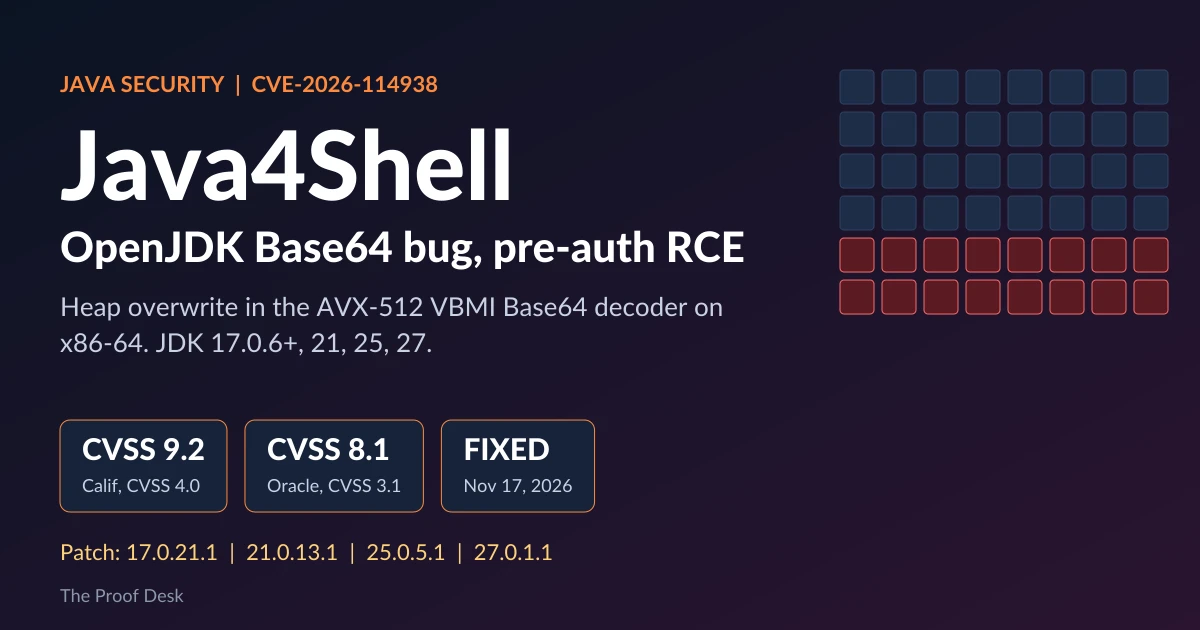
Java's big promise is memory safety, but a hand-written assembly fast path inside OpenJDK just broke it. Security firm Calif disclosed Java4Shell (CVE-2026-114938) on November 17, 2026, describing it as "a memory-corruption vulnerability in OpenJDK's Base64 decoder. A remote attacker with no credentials can overwrite heap memory, read it in the style of Heartbleed, and reach remote code execution."
Oracle and the OpenJDK Vulnerability Group shipped fixes the same day. The bug only fires on x86-64 servers whose CPUs support AVX-512 VBMI, which covers most recent Intel Xeon and AMD EPYC hardware. Some major Linux distributions and JDK builds were still unpatched a day later, so this is a patch-today story.
What was disclosed
Calif published its write-up under the tagline "Write once, RCE everywhere" and scores the flaw 9.2 out of 10 (critical) under CVSS 4.0. Oracle and OpenJDK rate the same bug 8.1 under CVSS 3.1 (AV:N/AC:H/PR:N/UI:N/S:U/C:H/I:H/A:H). Both numbers are correct; they come from different scoring versions.
Oracle's fix arrived in its November 2026 Critical Security Patch Update, released November 17, which carries 655 new security patches across Oracle products. Oracle credits the discovery to Albert Yang and Quang Luong of Calif.io. The OpenJDK advisory dated 2026/11/17 lists the bug in the hotspot/compiler component, alongside nine other OpenJDK CVEs (CVE-2026-114939 through CVE-2026-114947) and one OpenJFX CVE.
According to Orca Security, details had leaked before disclosure, so Calif published on the day the patch went out. The New York Times covered the bug the same day.
How a short Base64 string corrupts the heap
To decode Base64 faster, OpenJDK uses AVX-512 VBMI instructions on supported x86-64 processors. The bug lives in the hand-rolled assembly that handles the last few characters of the input.
Calif's trigger is 64 "A" characters followed by a single "=" (128 "A" characters plus "=" on older OpenJDK 17 builds). For that 65-character input, Java allocates a 50-byte result array. After decoding the first 64 characters, the routine mishandles the stray "=" and calculates a negative output length. "That invalid length becomes a full 64-byte write, sending 62 bytes past the end of the array," Calif writes. Java does reject the input in the end, but by then neighboring objects on the heap may already be corrupted.
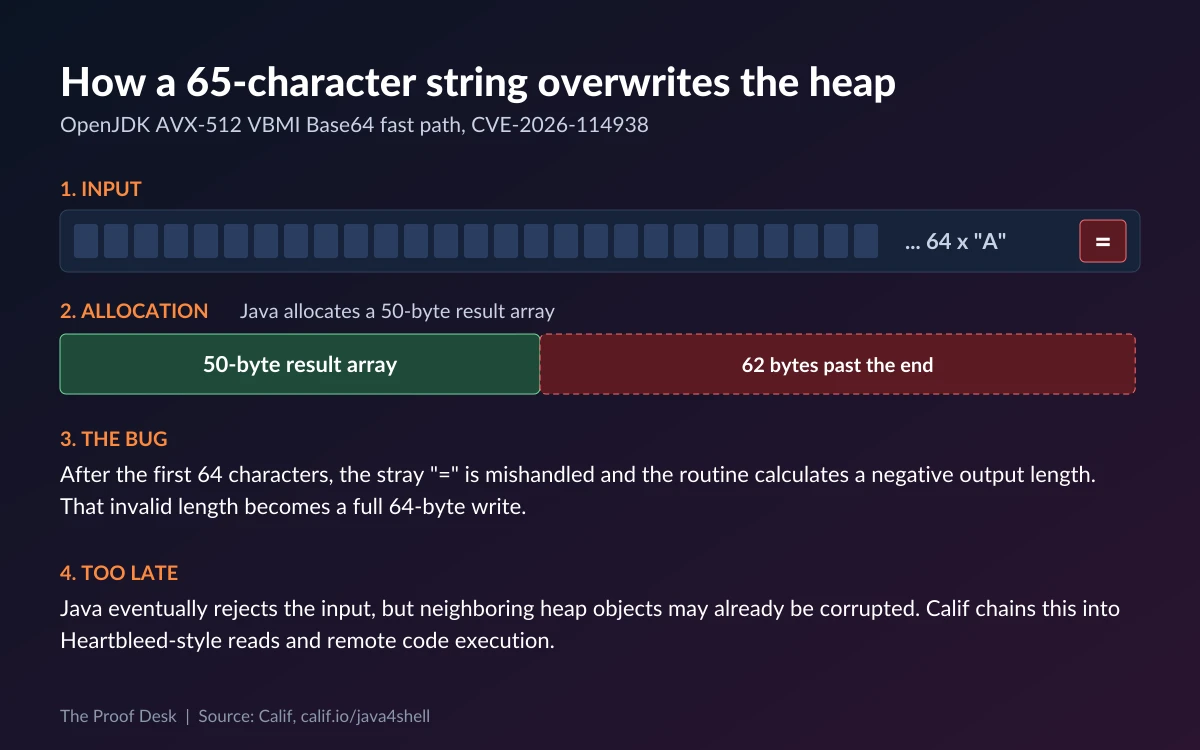
The AVX-512 Base64 intrinsic (JDK-8268276) entered mainline OpenJDK in 2021, first shipped in JDK 18, and was backported to JDK 17.0.6 in January 2023. That is why the bug has been sitting in production Java for close to four years.
Who is affected and who is not
Two conditions have to be true at once: a vulnerable JDK and a CPU with AVX-512 VBMI.
- Affected JDKs: OpenJDK 17.0.6 and later, plus JDK 21, 25 and 27. The OpenJDK advisory marks this CVE for 17, 21, 25 and 27.
- Affected distributions, per Calif: Amazon Corretto, Eclipse Temurin, Microsoft Build of OpenJDK, Azul Zulu, BellSoft Liberica, SAP SapMachine, Red Hat OpenJDK, Oracle OpenJDK, Oracle Java SE and Oracle GraalVM for JDK.
- Oracle also lists the Java 8 Performance Pack (8u511b33-perf) and GraalVM Enterprise Edition 21.3.20.0.3.
- Affected CPUs: Intel Xeon Ice Lake, Sapphire Rapids, Emerald Rapids and Granite Rapids, and AMD EPYC and Ryzen on Zen 4 or newer.
- Not affected: regular Java 8 and Java 11, ARM64 hosts such as AWS Graviton, Ampere and Apple Silicon, and x86 CPUs without AVX-512 VBMI.
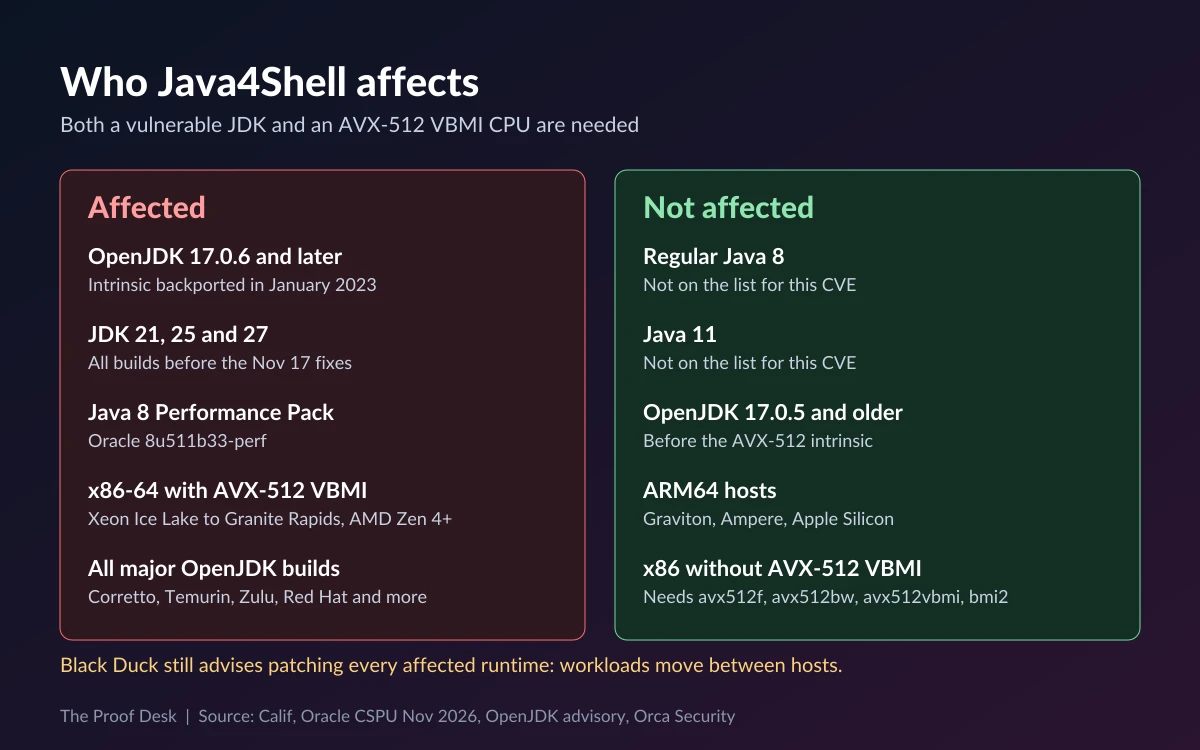
On Linux, Calif says to check /proc/cpuinfo for four flags: avx512f, avx512bw, avx512vbmi and bmi2. All four must be present for the vulnerable code path to run. Black Duck still advises patching every affected runtime regardless of CPU, because workloads move between hosts.
Note on version numbers
The OpenJDK advisory's headline line also names 11.0.33 and 8u512, but those refer to other CVEs fixed in the same release. Black Duck also warns that a circulating "fixed in 17.0.11 / 21.0.3" claim is about an unrelated bug.
What Calif says it could break into
Any server that Base64-decodes attacker-supplied data on an affected host is a candidate, and Calif points out that exposure comes through "ordinary features such as authentication and file uploads."
- Pre-auth RCE in default configurations, per Calif: Keycloak, Atlassian Jira, Atlassian Confluence, JFrog Artifactory, Jenkins and PingFederate.
- Post-auth RCE: Apache Kafka Broker, Apache Solr, Elasticsearch, Gerrit and Spinnaker.
- RCE in sample apps built on Apache Struts and Spring Boot.
- A client-side path from researcher samczsun: a Java program that opens a TLS connection to a malicious server can be compromised even if it runs no service of its own.
Calif calls the lists "non-exhaustive", and they have not been independently reproduced. The exploits are also not point-and-shoot. Oracle calls the bug "difficult to exploit", and Calif says "every target needs a bespoke profile." Its product-specific exploit chains stay private until users have had time to upgrade; the only public code is a safe proof of concept that prints REPRODUCED on an affected JDK.
Request buffering in front of Java apps is not a fix either. nginx buffers request bodies by default, which blocks some grooming techniques, but Calif notes its Elasticsearch chain uses one complete request and that WebSocket frames bypass buffering.
Fixed builds and stopgap flags
Oracle's fixed builds, all released November 17, 2026:
- JDK 27.0.1.1 (27.0.1.1+4)
- JDK 25.0.5.1 (25.0.5.1+4)
- JDK 21.0.13.1 (21.0.13.1+4)
- JDK 17.0.21.1 (17.0.21.1+4)
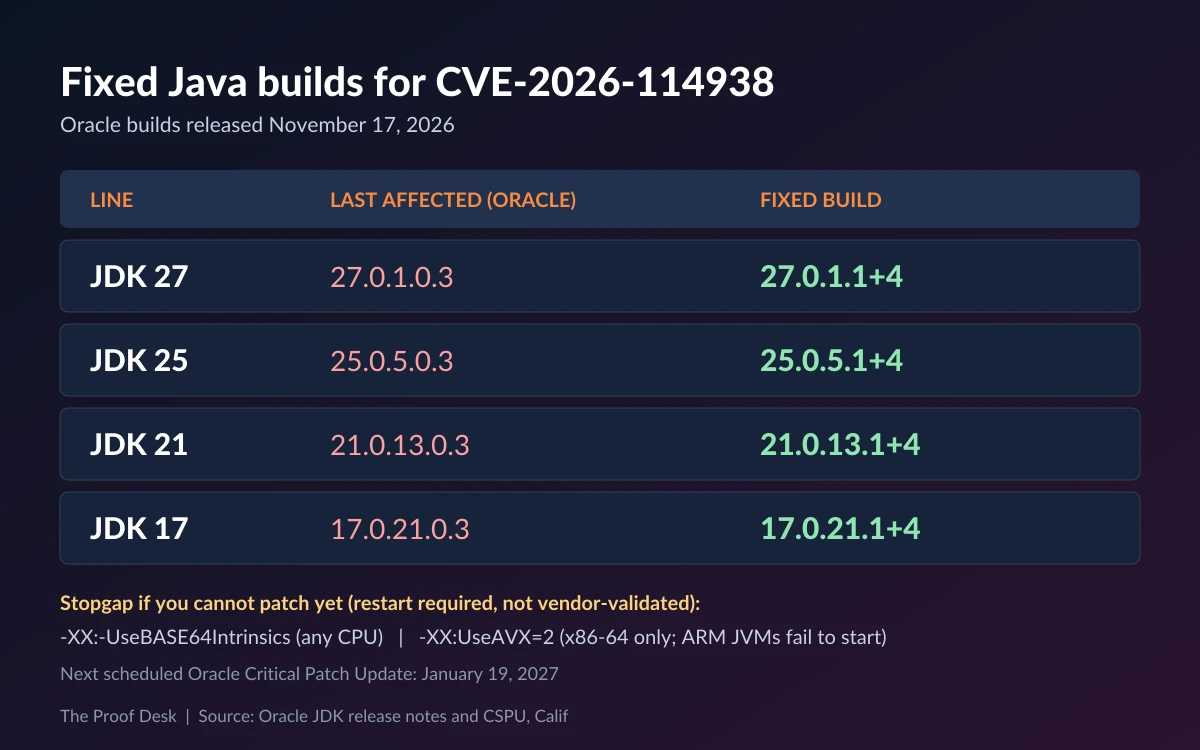
If you cannot upgrade right away, Calif lists two JVM startup flags. Both need a JVM restart, neither is validated by Oracle or OpenJDK, and both may cost some performance.
- -XX:-UseBASE64Intrinsics turns off hardware-accelerated Base64 encoding and decoding. It works on any architecture.
- -XX:UseAVX=2 turns off AVX-512. Use it only on x86-64: an ARM JVM does not recognize it and will fail to start. Orca notes that on Java 21 and later the Base64 intrinsic still has an AVX2 path with this flag.
Patch status across Java distributions
As of November 18, Black Duck reported this status. It is a snapshot and may have changed since.
- Fixed: Oracle, Azul Zulu, Amazon Corretto, Microsoft Build of OpenJDK and Debian unstable.
- Not yet fixed: Eclipse Temurin, Red Hat, Ubuntu and Debian stable.
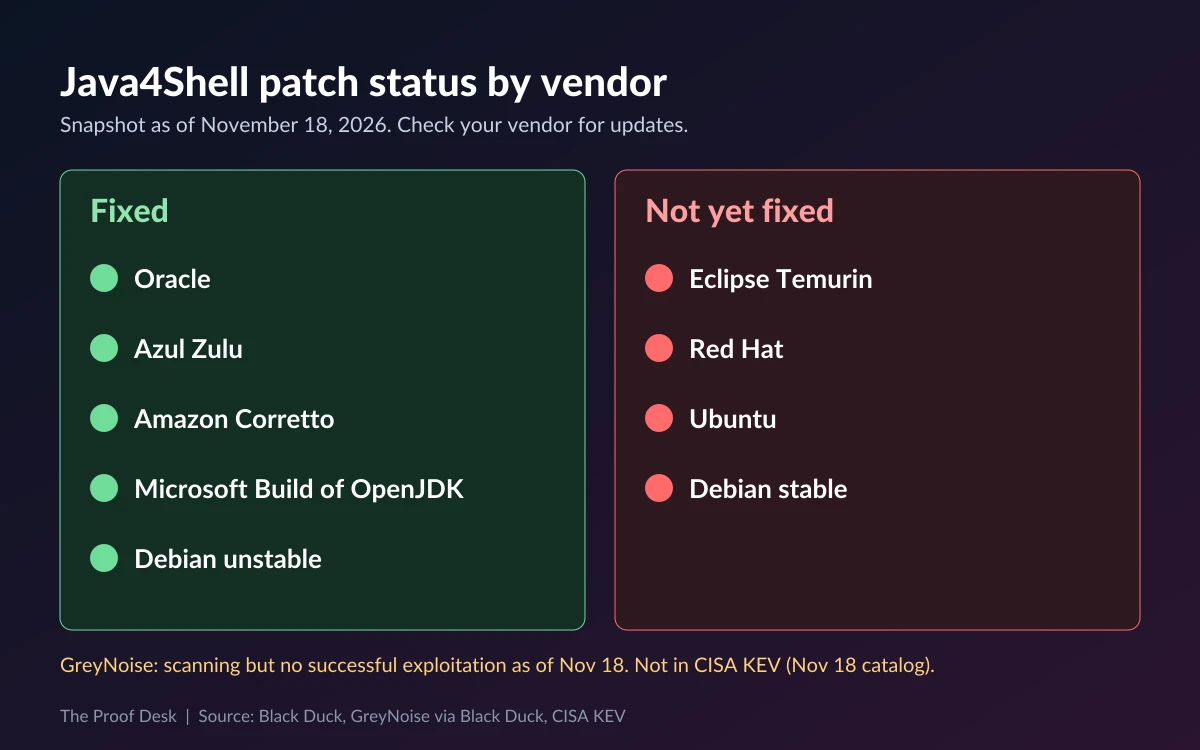
As of November 18, GreyNoise reported scanning activity but no successful exploitation, and no weaponized exploit was public. CVE-2026-114938 was not in CISA's Known Exploited Vulnerabilities catalog as of its November 18 update.
Found in an hour with OpenAI Codex
The discovery is as much of a story as the bug. Quang Luong audited OpenJDK HotSpot with a focus on the JIT compiler, intrinsics, widely used APIs and cryptography. "Well, more precisely, I told Codex to look at those areas," he wrote. Most early Codex results were "slops" until "I just prompted harder," and eventually Codex flagged a memory corruption in the Base64 decoder.
Calif says it took Luong one hour to find the vulnerability and two more hours to build the first working exploit, for less than $200 in tokens. Later exploit chains were "built almost autonomously with AI." Jenish Rakholiya improved the exploit, and samczsun contributed the TLS-client attack.
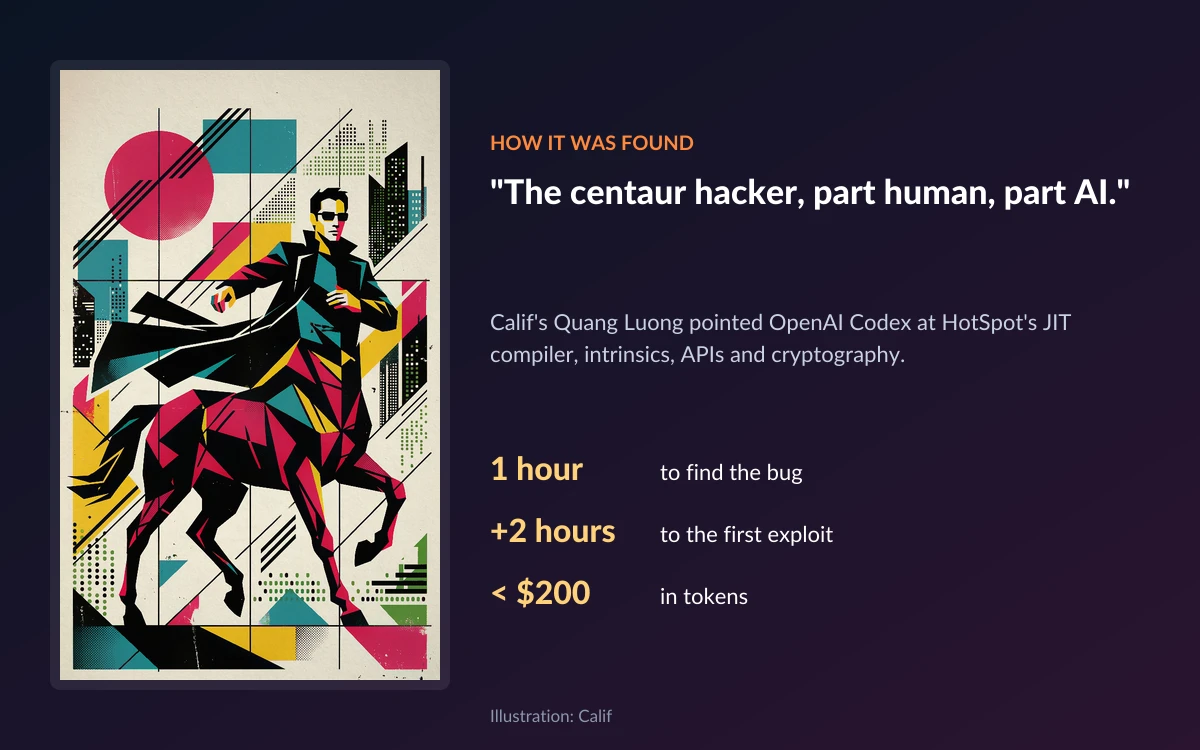
Calif frames it this way: "The best hacker today is neither AI nor human. It is the centaur hacker, part human, part AI." Its suggested response is "vibe-uncoding", meaning removing code you do not need, and asking "What can we delete?" Calif previously disclosed PHP2Shell and Squidbleed, a Squid FTP-module bug dating to 1997.
What admins should do today
- Inventory every Java runtime, including JDKs bundled inside apps such as Jenkins, Elasticsearch, Kafka and Keycloak, and those inside container images. Black Duck warns that running java -version on the host may report the wrong one.
- Upgrade affected runtimes to 17.0.21.1, 21.0.13.1, 25.0.5.1 or 27.0.1.1, or to your vendor's equivalent build once it ships.
- Start with internet-facing identity, build and artifact systems such as Keycloak, PingFederate, Jenkins, Artifactory, Jira and Confluence.
- Where a fixed build is not available yet, restart affected JVMs with -XX:-UseBASE64Intrinsics as a stopgap, and test it first.
- Be wary of "PoC" repositories that appear this week. Black Duck expects fake ones.
Sources
- Calif, Java4Shell write-up: https://calif.io/java4shell
- OpenJDK Vulnerability Advisory 2026/11/17: https://openjdk.org/groups/vulnerability/advisories/2026-11-17
- Oracle Critical Security Patch Update, November 2026: https://www.oracle.com/security-alerts/cspunov2026.html
- Oracle JDK 21.0.13.1 release notes: https://www.oracle.com/java/technologies/javase/21-0-13-1-relnotes.html
- Black Duck analysis: https://www.blackduck.com/blog/java4shell-cve-2026-114938.html
- Orca Security research: https://orca.security/resources/research/java4shell-critical-openjdk-base64-decoder-flaw-could-allow-unauthenticated-remote-code-execution/
- CISA KEV catalog feed: https://www.cisa.gov/sites/default/files/feeds/known_exploited_vulnerabilities.json
Key takeaways
- Java4Shell (CVE-2026-114938) is a heap-corruption bug in OpenJDK's AVX-512 Base64 decoder, rated 9.2 by Calif (CVSS 4.0) and 8.1 by Oracle (CVSS 3.1).
- It affects OpenJDK 17.0.6 and later, 21, 25 and 27 on x86-64 CPUs with AVX-512 VBMI; Java 8, Java 11 and ARM64 are not affected, apart from Oracle's Java 8 Performance Pack.
- Fixed builds shipped November 17: 17.0.21.1, 21.0.13.1, 25.0.5.1 and 27.0.1.1. As of November 18, Temurin, Red Hat, Ubuntu and Debian stable had not shipped fixes.
- -XX:-UseBASE64Intrinsics is a stopgap that needs a restart and is not vendor-validated. Patching is the real fix.
- No confirmed in-the-wild exploitation as of November 18, and the bug is not in CISA KEV.
- A Calif researcher found the bug in about an hour by directing OpenAI Codex, for under $200 in tokens.
More in Tech News
Browse Tech News