Gemini 4 Hydrogen replaces Flash: Argon-level scores, but double 3.8 Flash's price today
Google's new everyday Gemini 4 model edges Argon on Google's own index, runs AI Mode in Search and Antigravity's new Orchestrator, and costs $1.50/$7.50 per million tokens.
Google released Gemini 4 Hydrogen on November 12, 2026, the third member of the Gemini 4 family after Argon and Carbon. Google calls it its "daily driver for agentic workflows": the fast, cheaper model for everyday coding and agent work that sits next to the two frontier models. It also retires a familiar name - this is the tier Google used to call Flash.
The pitch is that speed no longer costs much intelligence. By Google's own numbers, Hydrogen scores 51 on the Artificial Analysis Intelligence Index at its default setting, one point above Gemini 4 Argon, while its API list price is $1.50 per million input tokens against Argon's $4 from December 1. The fine print: the Flash tier got faster and pricier, and Google's own benchmark table shows Hydrogen losing to Claude Sonnet 5.5 on three of ten tests.
What Google launched
The model was announced in a Google blog post by Koray Kavukcuoglu, SVP of Google DeepMind and Chief AI Architect at Google. Its API model ID is gemini-4-hydrogen. It takes up to 1 million tokens of input and can return up to 1 million tokens of output, and it offers four thinking levels: low, medium, high (the default) and xhigh. In Google Antigravity the top level is labelled "Extra".
As 9to5Google pointed out, Google dropped the Flash branding for this tier. Hydrogen follows Gemini 3.8 Flash, which launched in September, and Google bills it as "significant leaps in both speed and intelligence" over that model. Google's claims against 3.8 Flash:
- About 2.5x faster at finishing tasks at the default high thinking level.
- Early-testing partners saw runs 2x to 2.8x faster while using 12% to 23% fewer tokens.
- Canvas output in Google Sheets is more than 30% faster.
- About 5x fewer fabricated claims.
Google has not published a knowledge cutoff for the model.
Where Hydrogen shows up
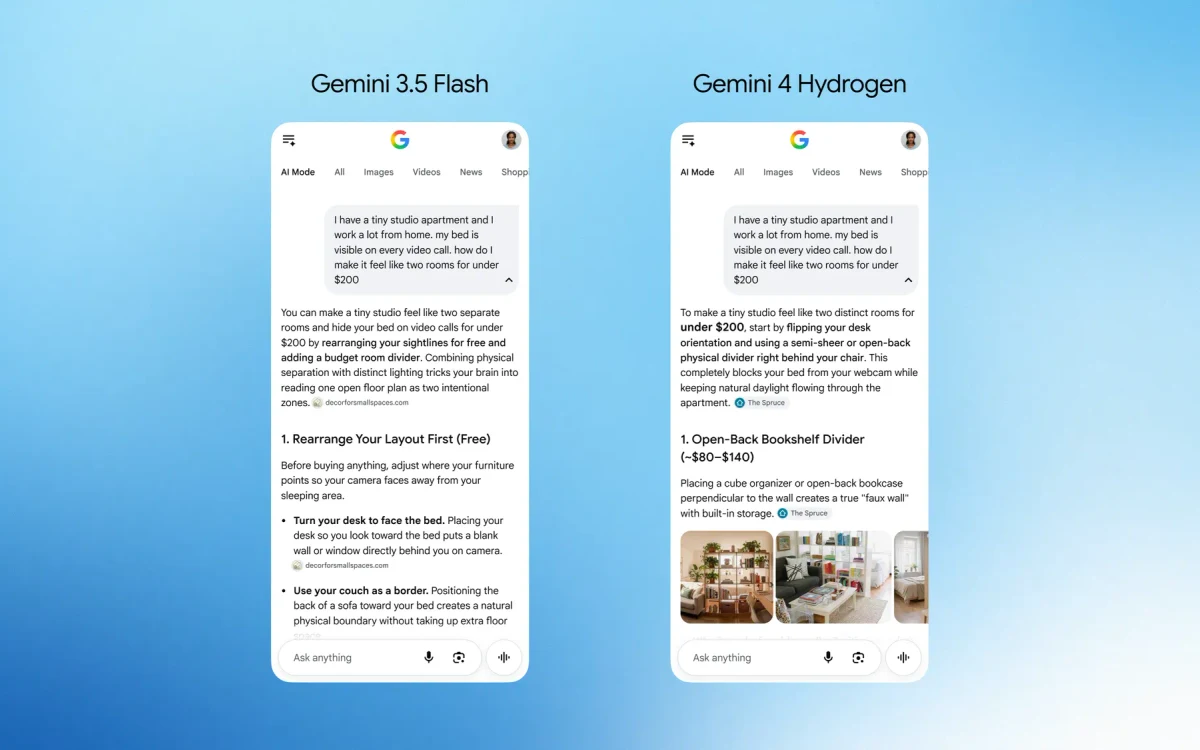
The biggest audience is Search. Hydrogen is now the default model for AI Mode for all users, and Google uses it for "your hardest questions" in AI Overviews.
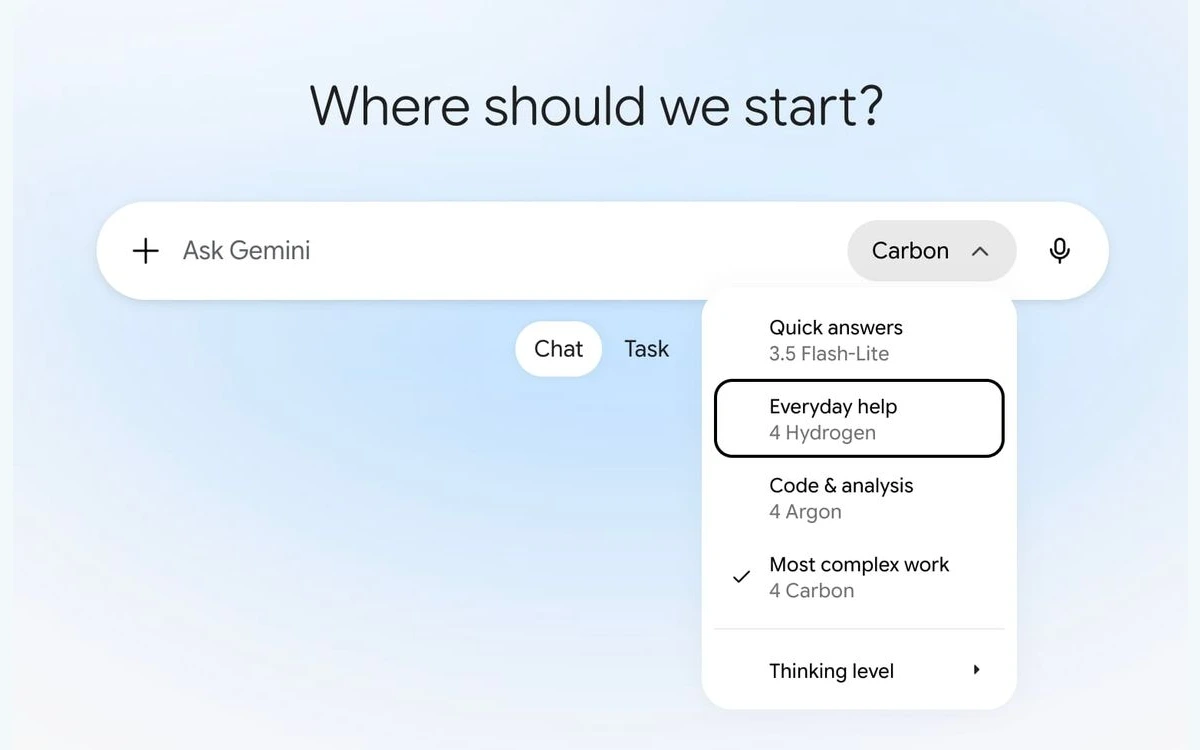
In the Gemini app, the model picker now reads Quick answers (3.5 Flash-Lite), Everyday help (4 Hydrogen), Code & analysis (4 Argon) and Most complex work (4 Carbon), with a thinking level submenu underneath. Free users do not get Hydrogen as a fixed choice: it reaches them through Auto model selection when Google judges it the right model for the prompt.
For developers and businesses, Google lists these surfaces:
- Google AI Studio on all tiers, including the free tier, and the Gemini API.
- Android Studio.
- Gemini Enterprise (Gemini for business), through the API or the model dropdown.
- Google Antigravity, for paid Google AI Pro and Ultra subscribers.
- Gemini in Google Sheets, for eligible business subscriptions and AI Pro and Ultra subscribers.
Vertex AI is not mentioned in Google's announcement, so availability there is unconfirmed.
Pricing: cheaper than Argon, pricier than Flash
On the Gemini API's Standard tier, Hydrogen costs $1.50 per million input tokens and $7.50 per million output tokens, thinking tokens included. The rate is flat across the full 1 million token context, with no long-context tier. Implicit caching costs $0.075 per million tokens, Batch and Flex cost $0.75 in and $3.75 out, and Priority costs $2.70 in and $13.50 out. Unlike Argon and Carbon, Hydrogen is on the free tier.
- Gemini 4 Hydrogen: $1.50 in / $7.50 out per million tokens.
- Gemini 4 Argon and Gemini 4 Carbon: $2.00 in / $10.00 out through November 30, 2026, then $4.00 in / $20.00 out from December 1. Neither is on the free tier.
- Gemini 3.8 Flash: $0.75 in / $3.75 out through December 31, 2026, then $1.50 in / $7.50 out from January 1, 2027.
Against the frontier models, Hydrogen is 25% cheaper than Argon and Carbon today and 62.5% cheaper once their December 1 prices take effect. Against its own predecessor the picture flips: Hydrogen costs exactly double Gemini 3.8 Flash's current promotional rate, and only matches 3.8 Flash once that model's price rises on January 1, 2027. It is also not Google's cheapest model - Gemini 3.5 Flash-Lite still sits below it in the Gemini app.
Do the token savings close the gap?
Not fully. Google says partners used 12% to 23% fewer tokens than with 3.8 Flash. At twice the per-token price, a job that uses 12% to 23% fewer tokens still costs roughly 1.5x to 1.8x as much through December 31, assuming the same mix of input and output. From January 1 the list prices match, and the faster model becomes the cheaper one per task.
Benchmarks, by Google's own numbers
According to Google, Hydrogen scores 51 on the Artificial Analysis Intelligence Index at its default high thinking level, against 50 for Gemini 4 Argon, and 54 at xhigh. Artificial Analysis itself has posted only that Hydrogen nearly ties the top models on its index, so the one-point lead over Argon is Google's figure.
Google's benchmark table compares Hydrogen with Claude Sonnet 5.5 and GPT-6.1 Terra. Scores below are listed as Hydrogen / Sonnet 5.5 / GPT-6.1 Terra:
- SWE-sweep: 13.5% / 3.1% / 5.8%
- Terminal-Bench 4.1 (cheating-adjusted): 57.0% / 63.9% / not reported
- Agents' Last Exam v1.1: 71.6% / 60.4% / 69.8%
- AutomationBench-AA: 76.1% / 71.8% / 60.2%
- Vending-Bench 2 (bank balance): $14,549 / $11,165 / $9,107
- OSWorld-2.1 (offline subset): 77.6% / 83.9% / 74.2%
- MKA (Climb WSR accuracy): 53.4% / 52.0% / 43.8%
- Chartography: 66.6% / 61.6% / 63.2%
- Terminal-Bench-Science 0.1: 51.4% / 59.9% / 58.3%
- HLE-Diamond: 58.8% / 53.3% / 47.3%
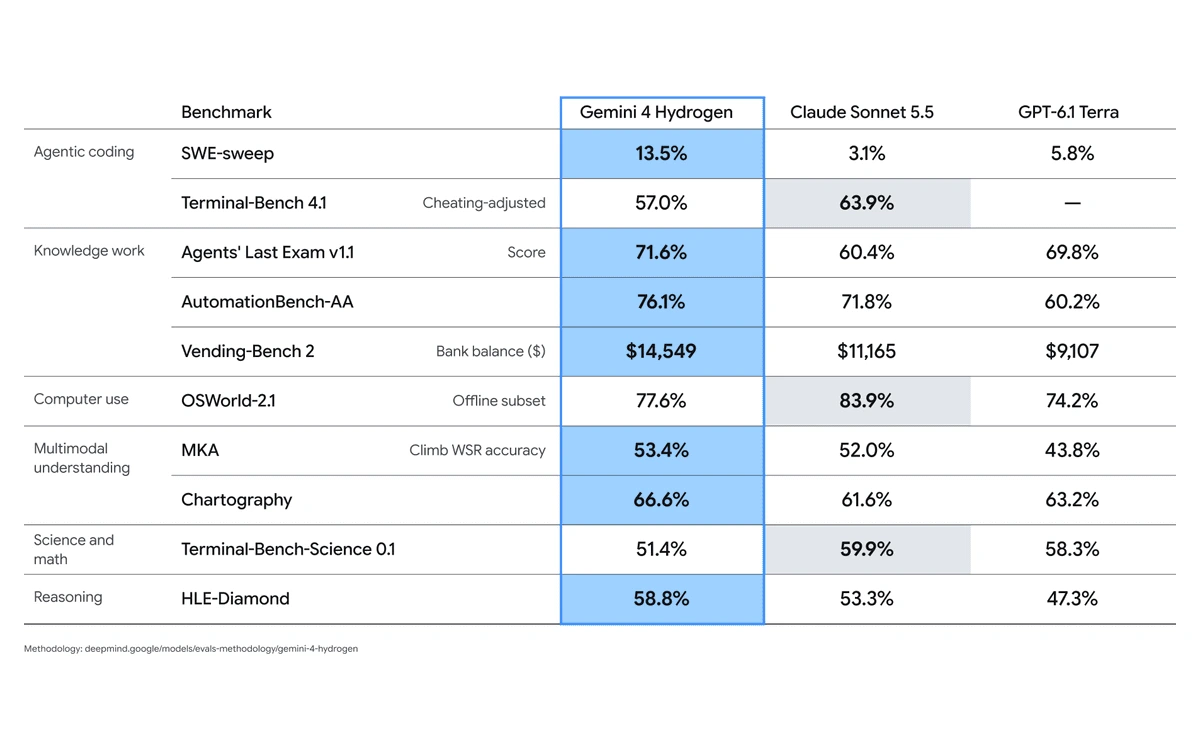
Hydrogen leads on seven rows. Sonnet 5.5 leads on the other three - Terminal-Bench 4.1, OSWorld-2.1 and Terminal-Bench-Science - which are the terminal and computer-use tests closest to the agent work Google is selling Hydrogen for. Google's other claims: 57% on Terminal-Bench 4.1 against 18.2% for Gemini 3.8 Flash, first overall on Vals Tax Agent Bench at 52.3%, tied first on Vals Legal Research Bench at 55.8%, and fifth on Agent Arena.
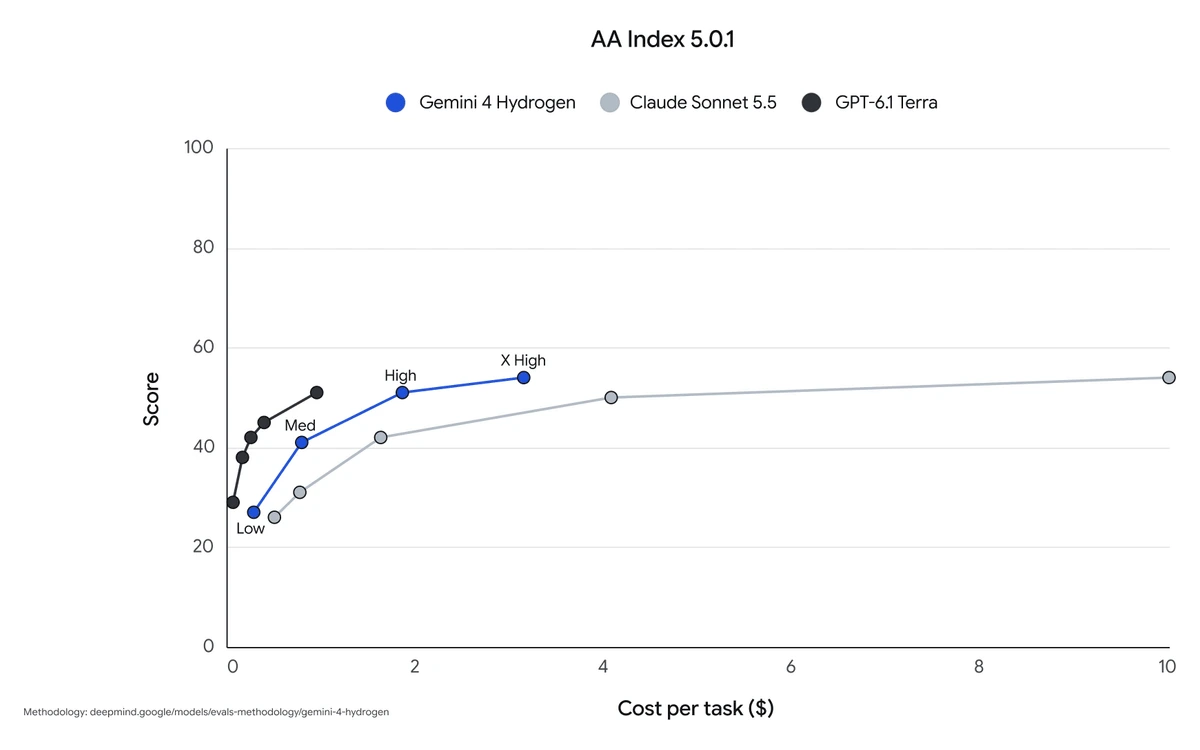
Google's cost chart is the more useful one for buyers. Read off the plotted points, so approximate: Hydrogen scores about 27 at roughly $0.25 per task on low, about 41 at roughly $0.75 on medium, about 51 at roughly $1.85 on high and about 54 at roughly $3.15 on xhigh. Claude Sonnet 5.5 reaches about 54 only at around $10 per task. GPT-6.1 Terra stays under $1 per task and tops out around 51 - so at Hydrogen's default score, OpenAI's model is cheaper per task, while at the top end Hydrogen matches Sonnet 5.5 for roughly a third of the cost.
Antigravity's Orchestrator pairs Hydrogen with Carbon
The most interesting part of the launch is in Google Antigravity, Google's agentic coding app. A new model-dropdown option called Orchestrator "pairs Hydrogen with our strongest models for long-horizon tasks", and the hand-off runs in both directions:
- Carbon (or Argon) starts in a read-only phase, exploring dependencies and building a plan with re-planning triggers.
- Hydrogen executes: it makes the edits, updates packages and runs the tests.
- If Hydrogen runs into trouble, it hands back to Carbon, which inspects the current state, repairs the plan and resumes.
On Terminal-Bench 4.1, Google says Orchestrator reached near-Carbon task success while "consuming 24% less quota and completing 19% faster" on average. That is the practical case for Hydrogen in coding: not replacing the frontier model, but doing most of the typing for it.
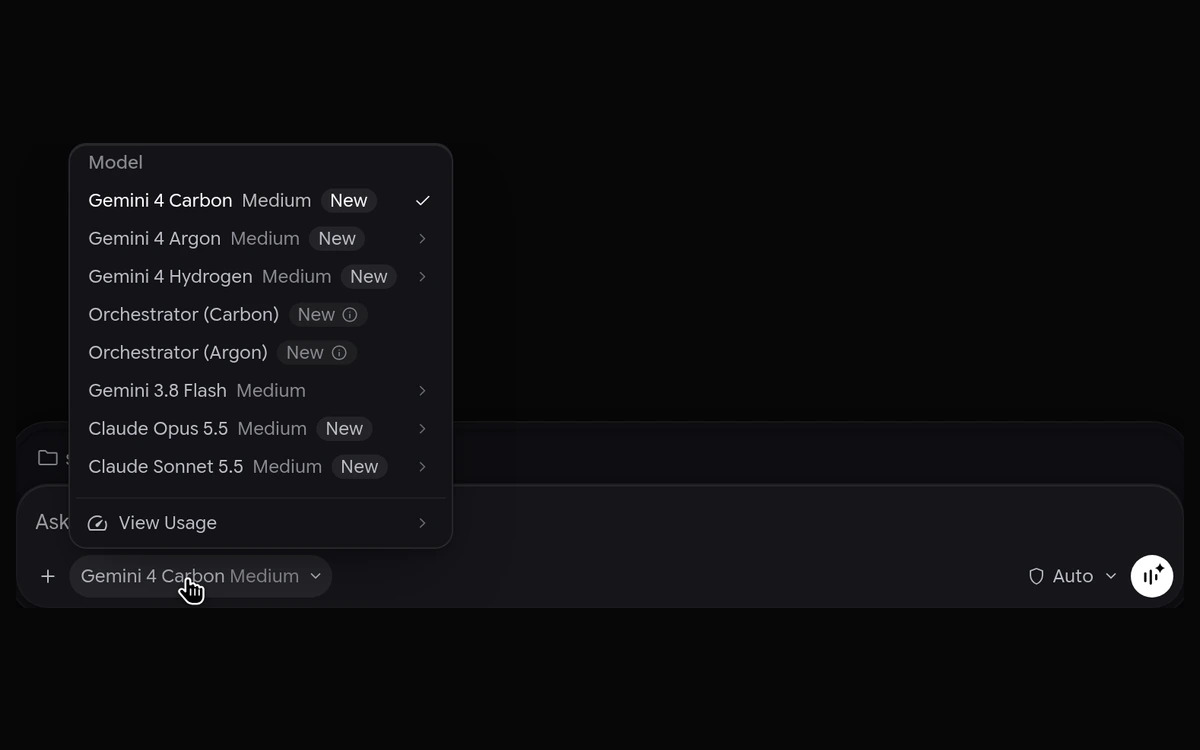
- Hydrogen: paid Google AI Pro and Ultra subscribers.
- Orchestrator (Carbon) and Orchestrator (Argon): Google AI Ultra.
- Orchestrator (Argon) only: paid Google AI Pro.
- Enterprises get both through Gemini for business. Pick Orchestrator in the model dropdown to turn it on.
Safety claims
Google lists these safety results, all from its own or partner evaluations:
- Overreach in agentic tasks cut by up to 81% and under-service by up to 79%.
- 12x fewer misaligned actions.
- 2.3x more resilient to indirect prompt injection on Gray Swan's IPI evaluation.
- A 94% honesty rate on an internal evaluation and 99.9% chain-of-thought legibility.
- Under 0.4% false refusals on HealthBench Pro.
What it means
Hydrogen completes the Gemini 4 lineup we covered with Argon on October 3 and Carbon on October 30, and it is the model most people will actually meet, because it is now behind AI Mode in Search. For developers the decision is narrower. If you run high-volume jobs on Gemini 3.8 Flash, its promotional price holds until December 31 and Hydrogen costs more per token until then. If you are paying Argon or Carbon prices for routine agent work, Hydrogen scores about the same on Google's index for well under half the December price. And if your workload is terminal or computer-use heavy, Google's own table says Claude Sonnet 5.5 is still ahead.
Sources:
- Google: Introducing Gemini 4 Hydrogen - https://blog.google/innovation-and-ai/models-and-research/gemini-models/introducing-gemini-4-hydrogen/
- Google Antigravity: Gemini 4 Hydrogen in Google Antigravity - https://antigravity.google/blog/gemini-4-hydrogen-in-google-antigravity/
- Gemini API pricing - https://aistudio.google.com/docs/pricing
- 9to5Google launch coverage - https://9to5google.com/2026/11/12/gemini-4-hydrogen-launch/
- Artificial Analysis on X - https://x.com/artificialanlys/status/2120941511223185722
- Our Gemini 4 Argon coverage - https://theproofdesk.com/google-gemini-4-argon-1m-output-tokens-fairwind
- Our Gemini 4 Carbon coverage - https://theproofdesk.com/google-gemini-4-carbon-cybersecurity-fairwind
Key takeaways
- Gemini 4 Hydrogen, released November 12, 2026, replaces the Flash tier as Google's fast everyday model for coding and agents.
- Google says it scores 51 on the Artificial Analysis index at default, one point above Gemini 4 Argon, and 54 at xhigh.
- API price is $1.50/$7.50 per million tokens: 62.5% below Argon and Carbon from December 1, but double Gemini 3.8 Flash until that model's price rises on January 1, 2027.
- It is the default model for AI Mode in Google Search and the execution half of Antigravity's new Orchestrator, which pairs it with Carbon or Argon.
- Google's own table shows Claude Sonnet 5.5 ahead on Terminal-Bench 4.1, OSWorld-2.1 and Terminal-Bench-Science.
More in Tech News
Browse Tech News