Microsoft 365 outage: Exchange Online down for nearly a day, Microsoft blames network upgrade
Microsoft apologized for the Nov 12-13 Microsoft 365 outage (MO1550821) that took down Outlook and Exchange-dependent services, and traced it to an issue during an earlier network capacity upgrade. Here is what happened, what was affected and what admins should check.
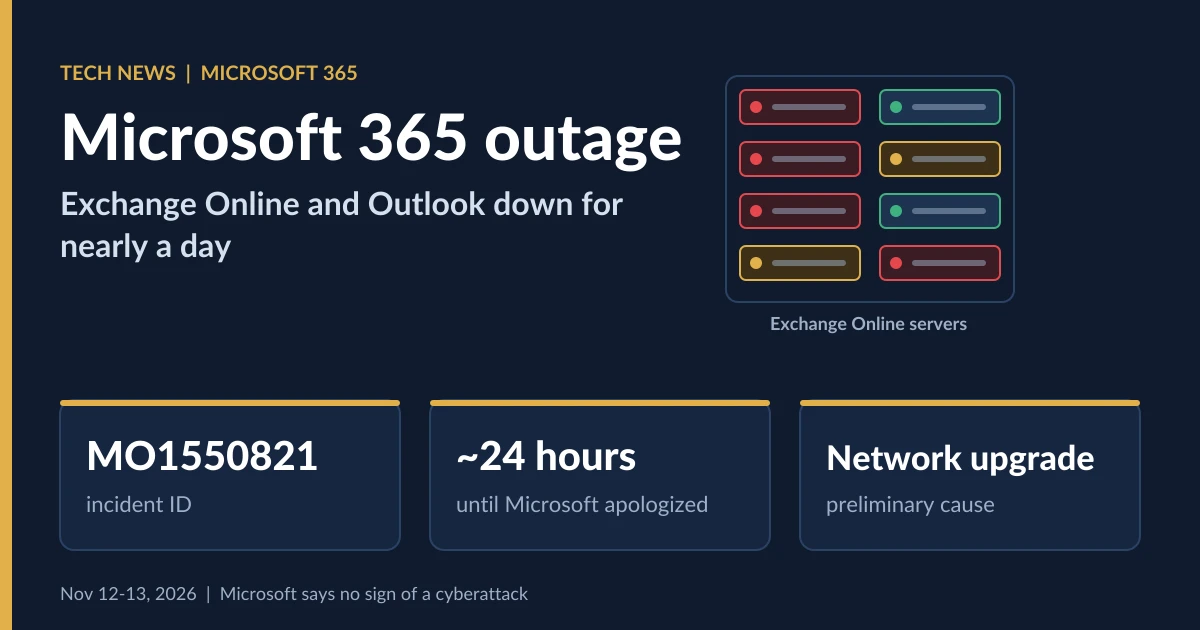
Microsoft has apologized for a Microsoft 365 outage that knocked Exchange Online and Outlook offline for users across the Americas, Europe and Asia Pacific for close to a day. The disruption, tracked as incident MO1550821, began shortly before 1 p.m. ET on Thursday, Nov 12, and dragged into Friday as fix after fix failed to hold.
In a status update at 12:57 PM ET on Nov 13, Microsoft said: "We are deeply sorry for the disruption this incident has caused our customers and partners." The company said the problem stemmed from "an issue during an earlier network capacity upgrade" and that it saw no sign of a cyberattack. A full post-incident report with the root cause is still to come.
What happened
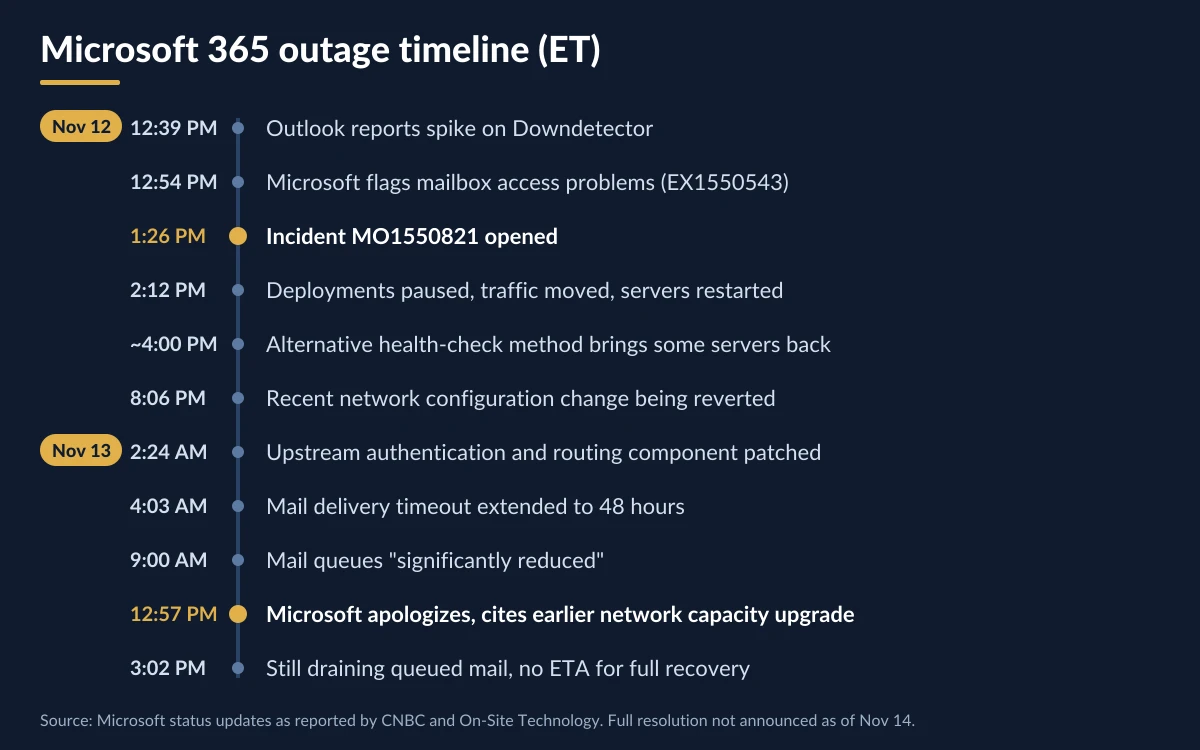
Outlook problem reports on Downdetector started climbing at 12:39 PM ET on Nov 12. At 12:54 PM ET Microsoft posted on X (@MSFT365Status) about incident EX1550543, citing mailbox access problems in the Americas. The main incident, MO1550821, was opened at 1:26 PM ET (18:26 UTC) and classified as a service degradation.
It was not the only Microsoft incident that day. A separate Teams incident, TM1550488, ran from 9:45 to 10:53 AM ET and was resolved before the Exchange trouble began.
Downdetector peaked at nearly 130,000 Outlook reports and more than 38,000 Microsoft 365 reports, according to figures cited by Inquisitr and On-Site Technology. Those are user reports, not a count of affected accounts.
Why Exchange Online kept falling over
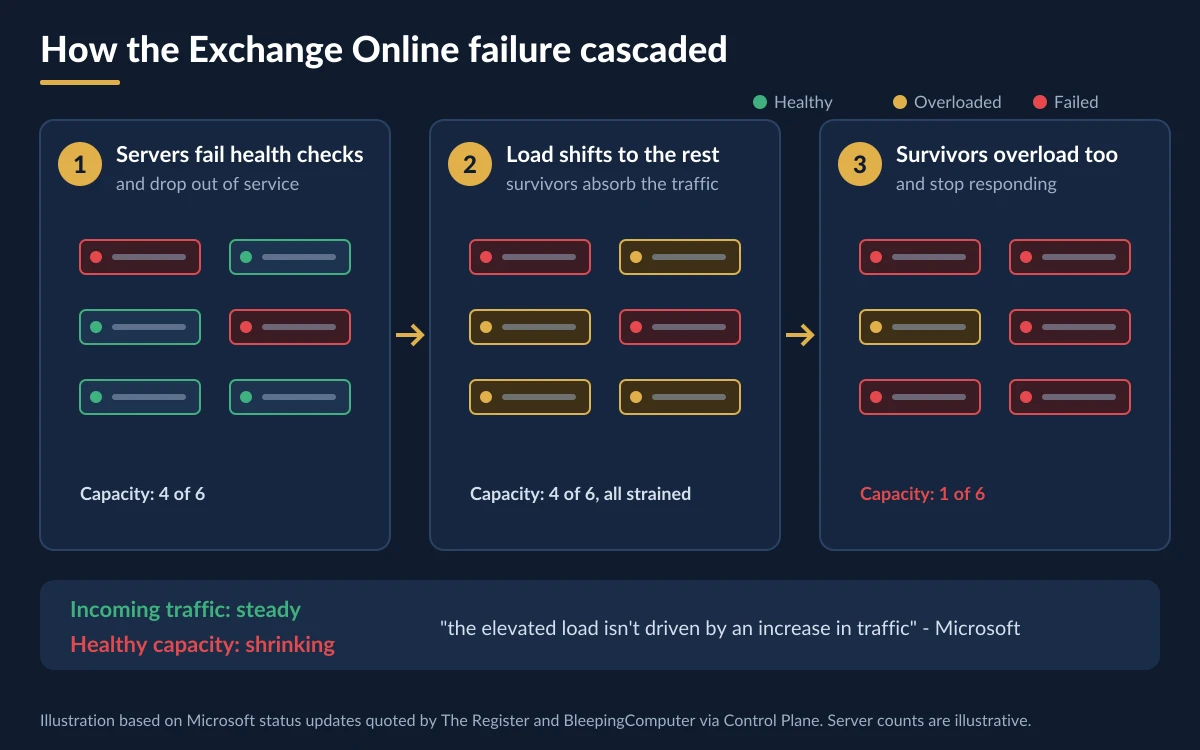
On Thursday Microsoft described "elevated load across multiple regions," caused by a "number of servers being unexpectedly unavailable; straining the remaining infrastructure." It also said "the elevated load isn't driven by an increase in traffic."
The pattern was a cascade. Exchange Online servers failed automated health checks and dropped out of service. The servers left standing absorbed their load and were overwhelmed in turn. According to Microsoft status wording quoted by The Register, the failures "may originate from a specific component that's responsible for processing server health," and "A core process on the affected servers is becoming overwhelmed, which causes the servers to stop responding." Servers that recovered "can become unresponsive again once they begin receiving traffic."
Cause is preliminary
Microsoft's current explanation is "an issue during an earlier network capacity upgrade." Its earlier status messages pointed at a component that processes server health. The full root cause will only be known once Microsoft publishes its post-incident report.
Twenty hours of fixes that did not stick
Microsoft tried several approaches on Nov 12. At 2:12 PM ET it paused all deployments, moved traffic off the affected infrastructure and restarted servers. Around 4 PM it validated an alternative service health check method, which brought some servers back. At 8:06 PM it began reverting a recent network configuration change, and at 9:14 PM it added capacity.
None of it was enough. "Actions taken thus far have not provided the anticipated relief," Microsoft said, describing "machines being stuck in a bad state, preventing our changes from syncing as expected." On X it wrote: "We're opening all available pathways to restore service, as our actions taken thus far have not provided the anticipated relief. We found a core process on affected servers is becoming overwhelmed, causing capacity loss."
The turn came overnight. At 2:24 AM ET on Nov 13 stability improved after Microsoft patched an upstream authentication and routing component. The patch rolled out region by region from 3:09 AM, starting with regions in or entering business hours. At 4:03 AM Microsoft extended the email delivery timeout window to 48 hours to protect queued messages. Parts of Asia Pacific were fully recovered by 6:01 AM, mail queues were "significantly reduced" by 9:00 AM, and at around 10:30 AM Microsoft reported "encouraging recovery progress."
What was affected, and what kept working
This was an Exchange Online outage with a long tail, not a total Microsoft 365 blackout. Microsoft confirmed impact on:
- Exchange Online: Outlook on the web, desktop (MAPI), mobile (ActiveSync) and REST access
- Teams features that depend on Exchange: calendar, Live and Virtual events, private and shared channel changes, contact sync
- Exchange-dependent features in SharePoint Online
- Microsoft 365 Copilot, Microsoft Graph and Microsoft 365 admin center pages
- Security and compliance: Defender XDR, Defender for Office 365, Purview
- Intune, Planner, To Do, Universal Print and the Microsoft 365 Apps admin center
- Power BI and Microsoft Fabric sensitivity-label exports, and Power Apps mobile sign-in
- Some Windows 365 Cloud PCs using Customer Key, and Microsoft 365 Education
Teams chat and meetings, and files stored directly in SharePoint, largely kept working. Some users also reported OneDrive and Azure problems, but Azure's status page showed no issues. AWS and Google users reported outages on Thursday too; AWS said its services were "operating normally" and blamed the reports on an unrelated internet disruption.
Real-world impact
According to CNBC, the UK's National Health Service said some services were affected. Air India temporarily rerouted emails, though flight operations were not hit. Richemont delayed its earnings slightly, and Workhorse Group moved its results from Nov 12 to Nov 16.
Australia's Minister for Home Affairs and Cyber Security, Tony Burke, compared the incident to the CrowdStrike update failure, and U.S. Rep. Josh Gottheimer asked Microsoft for a briefing. Microsoft shares were largely flat.
Not a cyberattack, and not over yet
Microsoft said repeatedly, including in status posts at 04:11 and 05:46 UTC on Nov 13 and again in its apology, that it saw no indication of malicious activity.
"We are seeing broad recovery and stability across our services," Microsoft said on Friday. But at 3:02 PM ET on Nov 13 it was still draining queued mail and rebalancing traffic, gave no estimate for full recovery and promised its next update by 7:00 PM ET. No full-resolution notice had been posted as of Nov 14.
"Our teams are reviewing what happened and how we can prevent similar issues going forward," Microsoft's Charles Lamanna said, as quoted by The Register.
What Microsoft 365 admins should do now
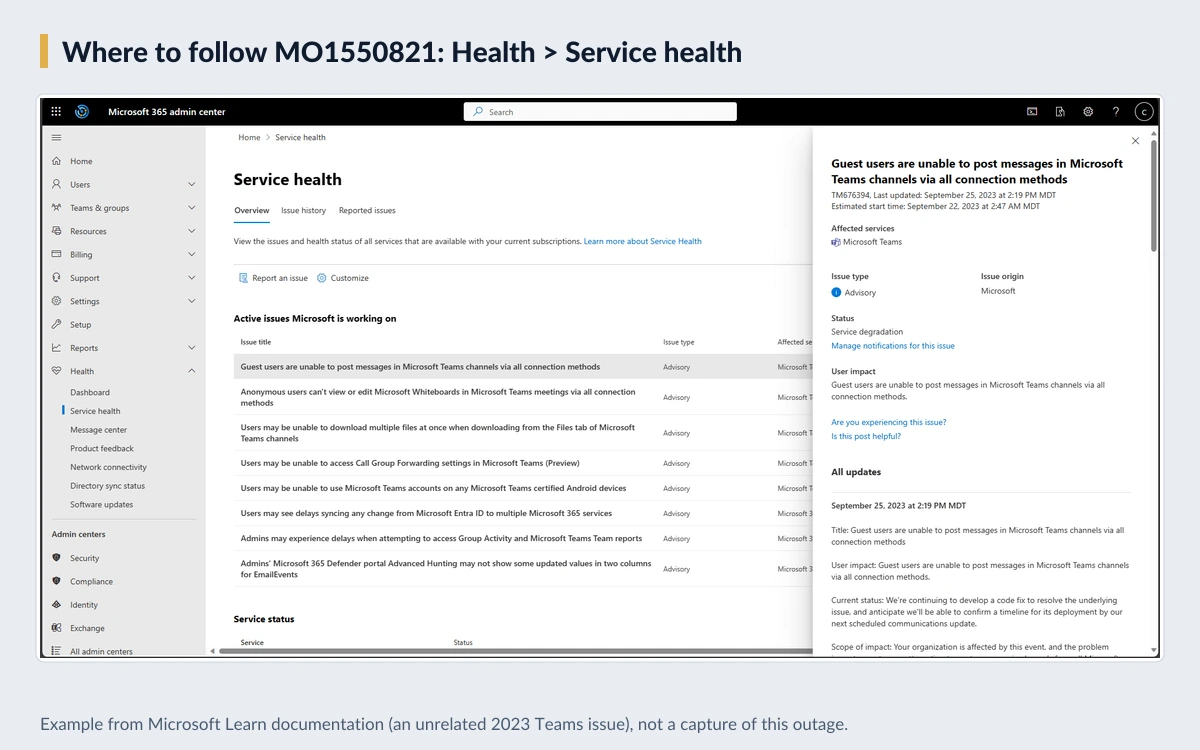
Follow MO1550821 in the Microsoft 365 admin center under Health > Service health. If the admin center will not load, use status.cloud.microsoft and the @MSFT365Status account on X. When Microsoft publishes its findings, the incident status changes to "Post-incident report published," which Microsoft defines as a report "that includes root cause information and next steps to ensure a similar issue doesn't reoccur."
- Let queued mail drain. Microsoft extended the delivery timeout to 48 hours, so do not ask users to resend in bulk.
- Keep Outlook in cached Exchange mode. Recent mail and calendars stay readable offline.
- Do not rebuild Outlook profiles or reinstall Office as a fix. A new profile can wipe the offline copy.
- Log what stopped working and when. You will need it for an SLA claim.
- Warn staff about fake "Microsoft support" calls. Microsoft never needs a user's password to restore its own service.
SLA credits
For Exchange Online and similar services, Microsoft's service level agreement pays a credit of 25% of the monthly fee when uptime falls below 99.9%, 50% below 99% and 100% below 95%. A 30-day month at 99.9% allows only about 43 minutes of downtime, so an outage of this length is well past the first threshold for affected tenants. Claims must be filed by the end of the month after the incident.
Sources
- CNBC: https://www.cnbc.com/2026/11/12/microsoft-outage-outlook-aws-google.html
- Control Plane (citing The Register and BleepingComputer): https://controlplane.com/blog/post/microsoft-365-outage-november-2026-cause
- On-Site Technology: https://www.on-sitetechnology.com/microsoft-365-outage-november-2026/
- Microsoft 365 Status on X: https://x.com/MSFT365Status/status/2121002505911857577
- Microsoft Learn, How to check Microsoft 365 service health: https://learn.microsoft.com/en-us/microsoft-365/enterprise/view-service-health
Key takeaways
- A cascade of Exchange Online servers failing health checks took down Outlook and about 20 Exchange-dependent Microsoft 365 services from Nov 12 to Nov 13.
- Microsoft apologized and blamed "an issue during an earlier network capacity upgrade"; the root cause is preliminary until the post-incident report lands.
- Microsoft says it was not a cyberattack. Teams chat, meetings and SharePoint-stored files largely kept working.
- Admins should track MO1550821 in Service health, let the 48-hour mail queue drain, and document downtime for SLA credits.
More in Tech News
Browse Tech News