Amnezia VPN Review 2026: Free Self-Hosted VPN Built to Beat Censorship
Amnezia VPN review: a free, open-source app that builds your own VPN on a VPS over SSH, plus Premium from $3.3/month. Setup, AmneziaWG 3.1, pricing and privacy fine print.
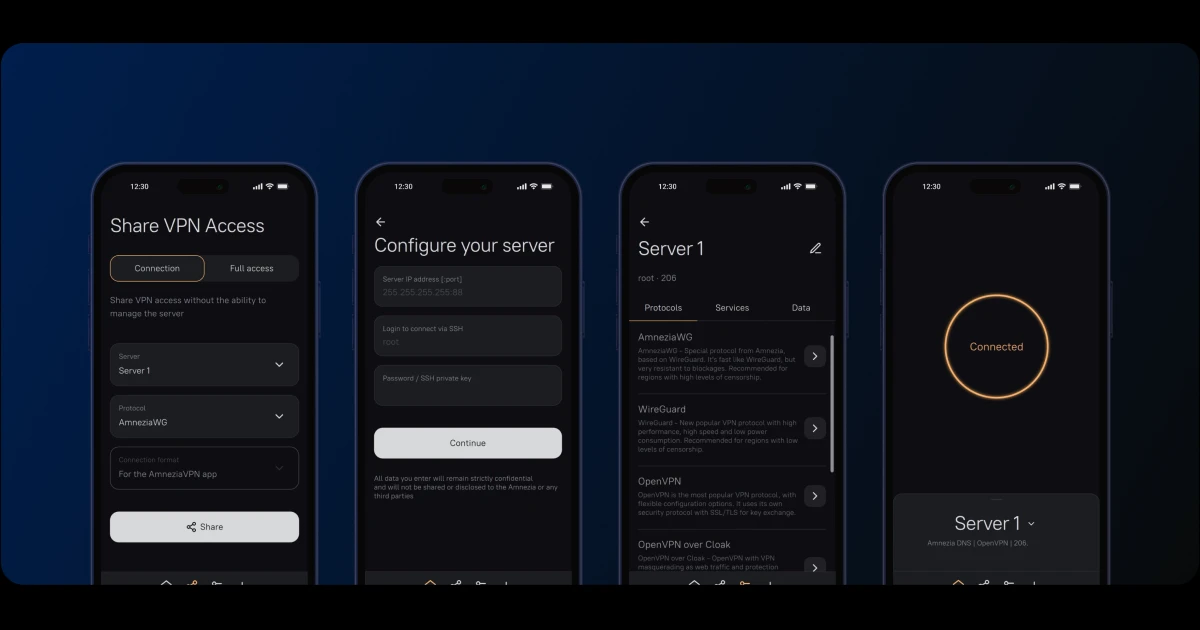
Amnezia VPN is not one product but three. The core is a free, open-source app (GPL-3.0) that logs into a server you rent, installs Docker over SSH and turns it into your own VPN. Around it the same team sells Amnezia Premium, a managed VPN from $3.3 per month, and gives away Amnezia Free, a slow, split-tunnel service meant only for reaching blocked sites.
The project matters more in late 2026 than it did a year ago. Russia ran large-scale VPN blocking in June and July 2026, and Amnezia answered with AmneziaWG 3.1, a WireGuard fork built to look like nothing in particular on the wire. This review covers what the self-hosted path really asks of you, what Premium costs, and the fine print on refunds, logging and audits, where the vendor's own pages contradict each other.
What Amnezia VPN is
The project describes itself as "an open-source VPN client, with a key feature that enables you to deploy your own VPN server on your server." The idea was born in 2020 at the first Demhack hackathon and grew inside Privacy Accelerator. The GitHub organization dates from November 2020, holds 59 public repositories, and the main client repository has about 15,600 stars.
The three offerings share one app:
- Self-hosted: the app is free; you pay only for your own VPS. You get every protocol Amnezia supports and the newest AmneziaWG 3.1.
- Amnezia Premium: a paid, managed VPN with 20 locations, 7 devices per subscription and speeds up to 200 Mbps.
- Amnezia Free: a free service for countries with active content blocking, capped at 8 Mbps, with no location choice and no YouTube.
Clients exist for Windows, macOS, Linux, Android and iOS, plus Android TV and routers running Keenetic or OpenWrt firmware. The latest stable desktop release is 5.0.3.0 (September 18, 2026), with a 5.0.4.2 pre-release published on October 20, 2026. The iOS app needs iOS 16.0 or later, and the release notes say the Android 7 and 8 build is temporarily unavailable. On Google Play the app shows 5M+ downloads and a 4.5-star rating from 20.7K reviews.
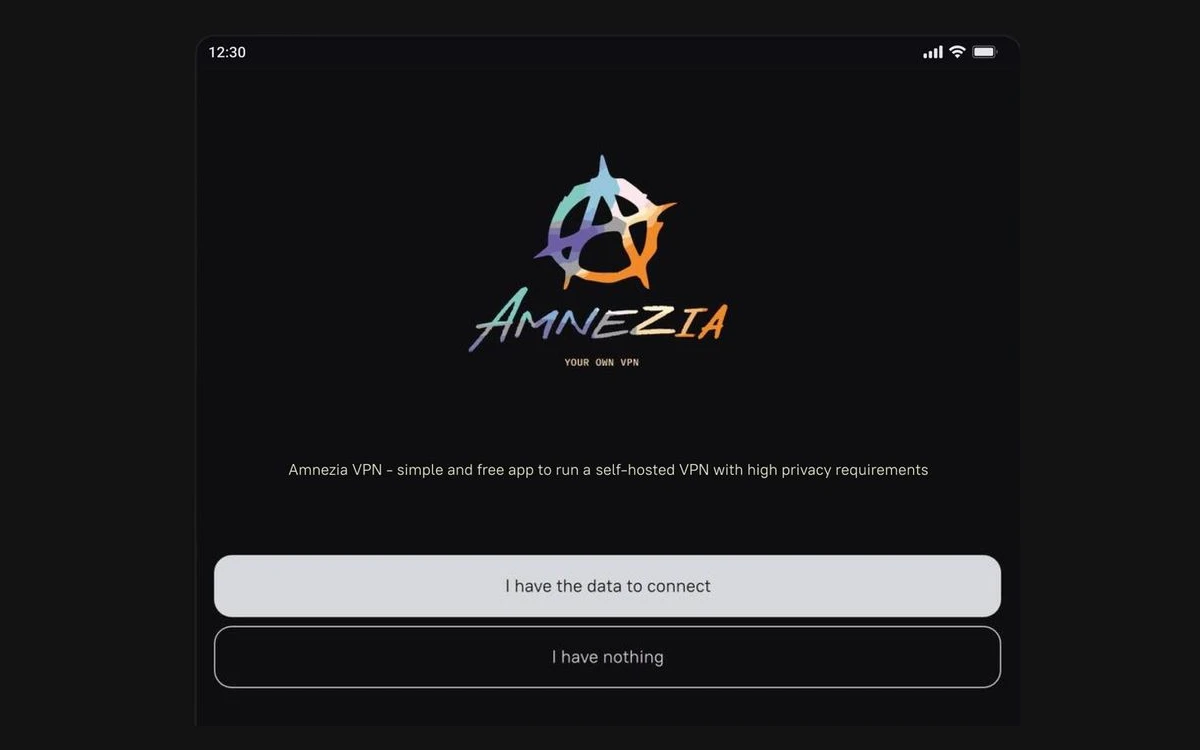
How the self-hosted setup works
This is the part that makes Amnezia different from almost every consumer VPN. You type a server IP, an SSH login and a password or private key into the app. According to the docs, "the application connects to the server via SSH and installs Docker and runs the Amnezia server containers," with a separate container started for each protocol. There is no terminal work and no config files to edit by hand.
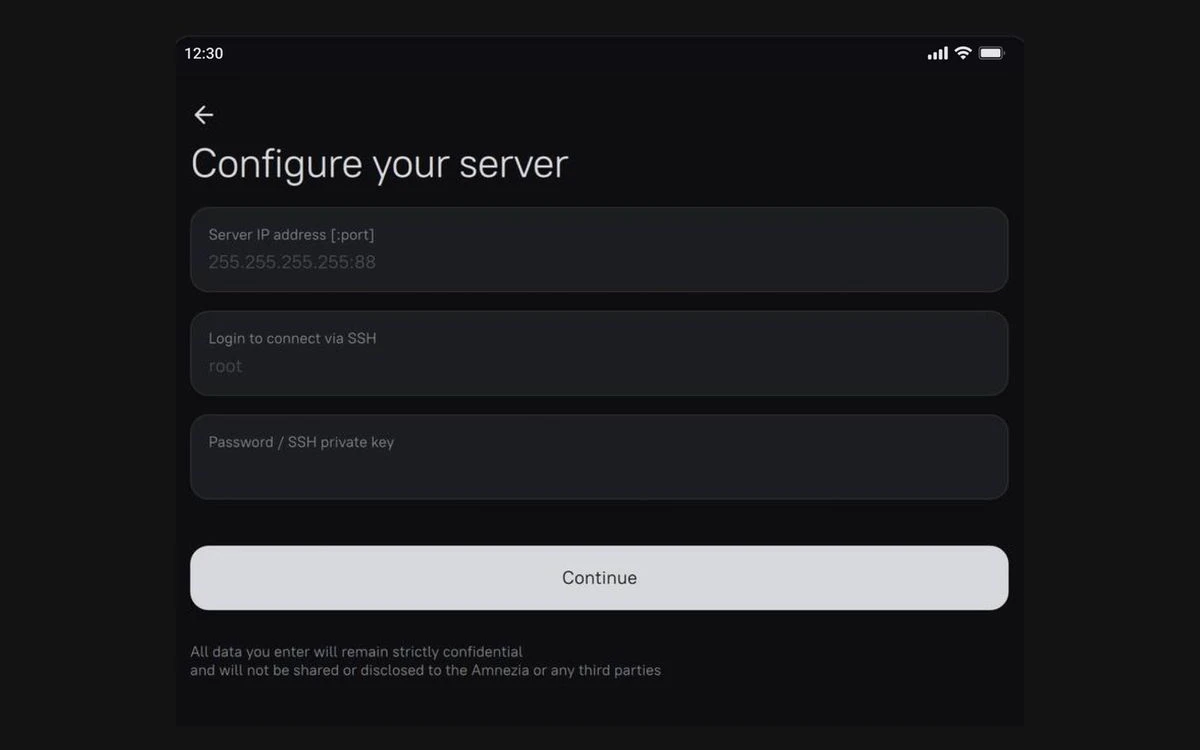
What your VPS needs
The server requirements are strict, and they rule out some popular cheap hosting:
- Operating system: Ubuntu 22.04/24.04 or Debian 12/13 are officially supported. Ubuntu 20.04, Debian 11 and Fedora 42/43 usually work.
- Virtualization: KVM only. "Container virtualization (OpenVZ/LXC) won't work."
- CPU: x86-64 (amd64) only. 32-bit x86 and ARM64 servers will not work, so ARM instances are out.
- Memory and disk: 1 GB RAM and 10 GB SSD at minimum. For 10+ simultaneous connections the docs recommend 2 GB RAM and 2 vCPU.
- Network: IPv6 is not supported.
- Access: root, or a sudo user with passwordless sudo, by password or private key.
The trade-off is worth spelling out. A self-hosted VPN gives you an IP address that nobody else shares, and no VPN company sits between you and your traffic. But that IP is tied to a VPS account in your name, it does not hide you among thousands of other users, and you inherit the hosting provider's logging and jurisdiction. Self-hosting is the right tool for getting around blocks and owning your setup, not for anonymity.
Extra services on the same server
The app can also deploy a few side services to the VPS: your own DNS resolver (AmneziaDNS, which by default resolves through an encrypted connection to Cloudflare DNS), an SFTP server, a SOCKS5 proxy, a Telegram proxy (MTProxy) and a WordPress site on the Tor network.
Protocols: seven named, eight claimed
On your own server the app offers OpenVPN, OpenVPN over Cloak, WireGuard, AmneziaWG, IKEv2, XRay Reality and Shadowsocks. The self-hosted page advertises "Support for 8 protocols", but only these seven are named anywhere we looked.
Each protocol fills a different role. Plain WireGuard and OpenVPN are fast and well understood, but deep packet inspection spots them easily. OpenVPN over Cloak and Shadowsocks hide traffic inside something that looks like ordinary web traffic. XRay Reality impersonates a TLS connection to a real website, and Amnezia says it "works even in places where other VPNs do not, such as China, Iran, and Turkmenistan". That is an undated vendor claim, and censorship systems change often.
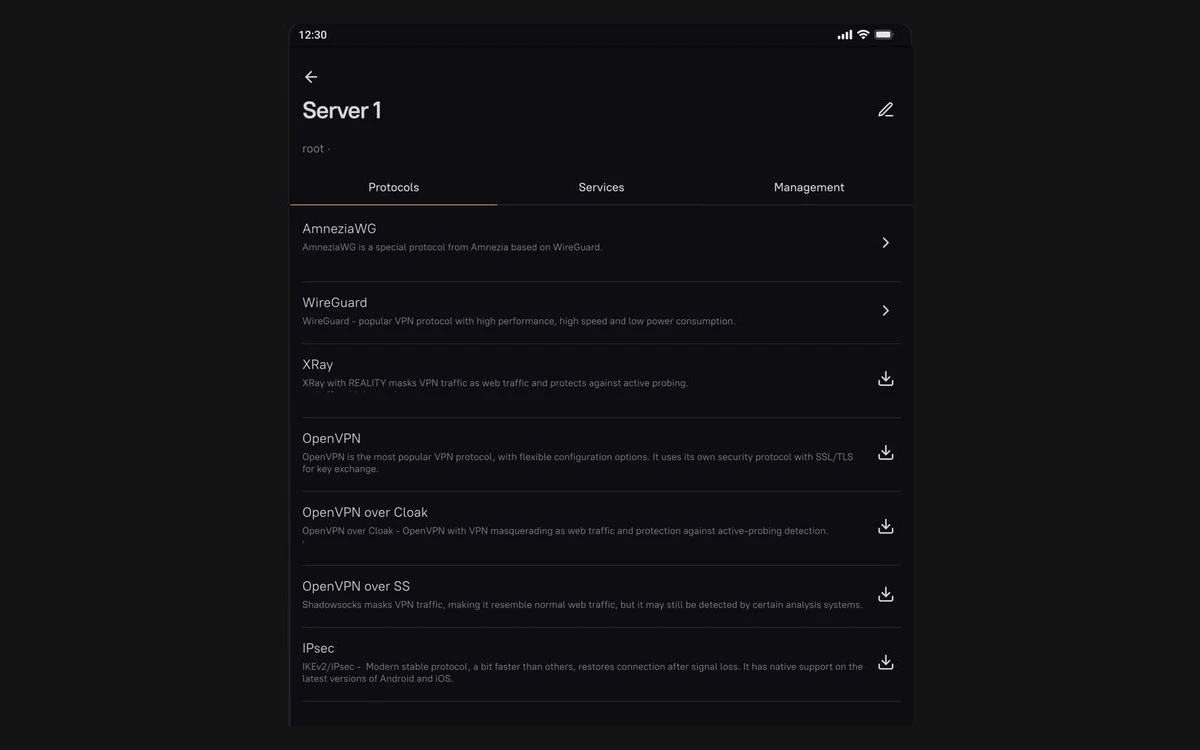
Advanced users can tune each protocol. OpenVPN, for example, exposes the subnet, UDP or TCP transport, port, hash and cipher settings.
AmneziaWG 3.1 and the 2026 blocking wave
AmneziaWG is the project's own protocol: "a fork of WireGuard-Go" that keeps WireGuard's speed "while removing the identifiable network signatures". Version 1.5 could disguise traffic as common UDP protocols such as QUIC or DNS. Version 2.0 moved to full "mimicry", with headers and packet sizes that keep changing.
Version 3.1, according to the docs, "was developed in response to widespread blocking in Russia in June and July 2026". It adds ChaCha20 protection for packet headers and content padding. The vendor's blog headline says AmneziaWG 3.1 "Bypasses AI-Based Blocking". We could not test that claim, and it should be read as marketing.
Who gets which version
Self-hosted users get 3.1. The announcement says Premium and Free users get AmneziaWG 3.0 by default, even though the homepage and Premium page say "Supports AmneziaWG 3.1". You need app version 5.0.1.5 or newer either way.
The knobs, if you want them
- Jc, Jmin and Jmax: the number and length of junk packets sent before the handshake. The recommended Jc range is 4-12, used on the client side only.
- S1-S4: padding added to handshake and data packets. With 3.1 header protection these must be at least 12 bytes.
- H1-H4: dynamic headers, which must not overlap.
- I1-I5: custom packets sent before the handshake to imitate another protocol.
With all masking parameters turned off, an AmneziaWG config is fully compatible with standard WireGuard. TechRadar quotes the vendor's claim that the protocol has been installed more than 15 million times on Windows, based on Microsoft data. We could not verify that figure.
Sharing your server with family or a team
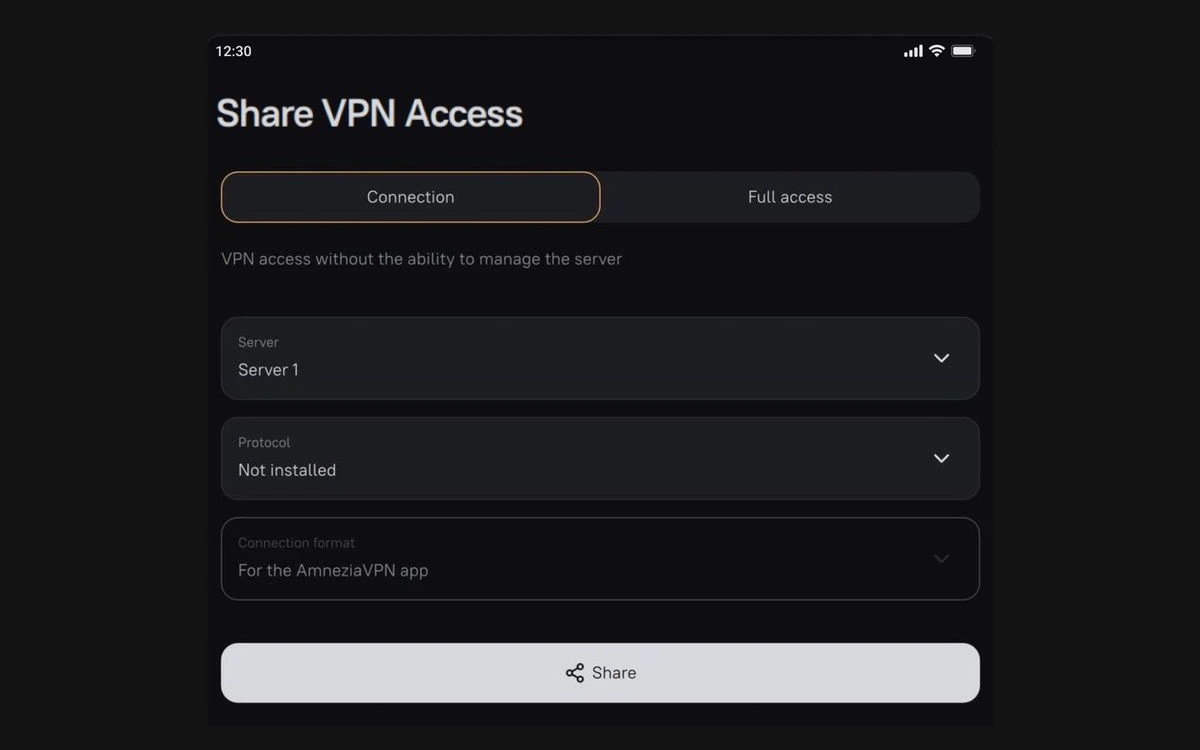
Self-hosting makes more sense when several people share one VPS, and Amnezia handles that with two kinds of connection key.
- Full access gives "full control of the server" on any number of devices. It cannot be revoked or reset.
- Guest access works with one protocol on one device, and "can be revoked at any time."
Hand out guest keys only
A full-access key cannot be revoked. If you give one to someone and later want them off your server, you will have to rebuild the server. For anyone but yourself, use guest connections.
Amnezia Free: what you actually get
Amnezia Free costs nothing, needs no registration and shows no ads, but it is a narrow tool by design. It "only allows access to specific websites in a particular region. All other websites will open without using the VPN." In other words it is a split tunnel that routes only a list of blocked services, such as Instagram, Facebook and X, through the VPN.
- No YouTube.
- Speed limited to 8 Mbps, according to the homepage. The Free page itself promises "High-speed performance".
- No choice of location.
- The key only works in the AmneziaVPN app.
It is a reasonable lifeline for reaching a few blocked social networks. It is not a privacy tool, because most of your traffic never touches the VPN.
Privacy policy, jurisdiction and security audits
Logging: read the whole policy
Marketing copy says Amnezia does not store "browsing history, IP addresses, or session data", and the About page says it does not collect "any data, including logs or analytics". The privacy policy (effective October 13, 2026) is more careful. It does promise not to store browsing history, destinations or traffic content. But it also says that "for connections from locations where additional technical measures are required to maintain service availability and stable operation, the connection IP address may also be retained."
Free and Premium also collect an app-generated device identifier (UUID), the app version and the operating system. The Telegram bot records your Telegram ID, and the website runs Matomo analytics. None of this applies to a self-hosted server, where the logging is whatever you and your hosting provider set up.
Who runs it
Jurisdiction is not simple. The site footer names EUPHORIATECH LIMITED, a company registered in Nicosia, Cyprus (HE 484287). The App Store seller is Privacy Technologies OU. The privacy policy says the company complies only with requests consistent with the laws of Romania and the European Union. TechRadar names Mazay Banzaev as founder. Amnezia publishes no single document that ties these together, so ask before you rely on any one of them.
Audits: two criticals, fixed
The Premium page says 7ASecurity audited the apps and server components in 2022, 2024 and 2025 and found "no critical issues". The Open Technology Fund's summary of the third audit, run over 18 days in December 2024 and January 2025, says otherwise: it found "two critical- and one high-risk vulnerability", including arbitrary remote code execution through OpenVPN config import and config tampering through an exposed admin API. On retest, the auditors found all of them resolved.
That is a good result for an open-source project: independent audits, published reports and confirmed fixes. Still, the vendor's "no critical issues" summary is wrong, and the full 7ASecurity reports are public for anyone who wants to read them.
Availability in Russia and app stores
AmneziaVPN was hidden from the Russian App Store at the request of Roskomnadzor in late October 2024. For Premium, Amnezia points iPhone users in Russia to an alternative app called DefaultVPN, which is still listed there. Android users can install from Google Play or GitHub, and desktop builds come straight from GitHub releases.
If you plan to rely on Amnezia inside a country that blocks VPNs, install the app and save your keys before you travel. App store access is often the first thing to go.
Verdict: who Amnezia VPN is for
Amnezia is the easiest way we know to stand up a private, censorship-resistant VPN on your own server. Point it at a KVM x86-64 VPS and it builds the server for you, with a choice of protocols that commercial VPNs rarely offer. The app is free, open source and independently audited.
Pros
- Free, GPL-3.0 app that sets up your own VPN server over SSH with no command line
- Seven protocols, including AmneziaWG 3.1, XRay Reality and OpenVPN over Cloak
- Revocable guest keys for sharing a server
- Premium is cheap ($3.3 per month on two years), takes crypto and does not auto-renew
- Independent audits, with the findings fixed
Cons
- VPS must be KVM and x86-64, with no IPv6 support
- Premium and Free get AmneziaWG 3.0, not the 3.1 the marketing advertises
- The privacy policy allows keeping connection IPs in some locations
- Contradictory fine print: 7 vs 14-day refunds, and "no critical issues" vs an audit with two
- Unclear corporate structure across Cyprus, Estonia and Romania
Pick self-hosting if you need a VPN that survives blocking and are happy to rent a server. Pick Premium if you want the same anti-censorship protocols without the server, and accept that its privacy promises are softer than the headline. Look elsewhere if you want a large shared-IP network for anonymity or streaming.
Frequently asked questions
Is Amnezia VPN free?
Yes, the app and the self-hosted option are free. You pay only for the VPS you run it on. Amnezia Free is also free but limited to selected blocked sites at up to 8 Mbps, and Premium costs $30 for 6 months, $50 for a year or $80 for two years.
Does Amnezia Premium renew automatically?
No, not when bought on the website. Purchases on pay.amnezia.org are one-time payments, so the plan simply ends. Store purchases follow Apple's or Google's own rules.
What is Amnezia's refund policy?
The Terms give 14 days to withdraw, possibly limited once the service is activated, and refunds are paid minus payment or network fees within 1-5 days. One line on the Premium page says 7 days, so ask for a refund early. App Store and Google Play purchases are refunded by Apple or Google.
Which VPS works with Amnezia self-hosting?
You need a KVM server with an x86-64 CPU running Ubuntu 22.04/24.04 or Debian 12/13, with at least 1 GB RAM and 10 GB SSD. OpenVZ/LXC containers, ARM servers and IPv6-only setups will not work.
Does Amnezia keep logs?
It says it does not log browsing history or traffic content, but the October 2026 privacy policy allows retaining connection IP addresses in some locations. Free and Premium also collect a device UUID, the app version and the OS. On a self-hosted server, Amnezia sees nothing.
Can I use Amnezia for torrents?
On Premium, only on the Switzerland location. On your own server it depends on your hosting provider's terms.
How many devices does Premium cover?
Seven devices per subscription. A Keenetic or OpenWrt router counts as one connection, so a router setup can cover a whole home.
Is there a free trial of Premium?
Only on request. Message Amnezia on Telegram or by email and ask, but the length of the trial is not published.
Key takeaways
- Amnezia's free, open-source app turns your own KVM x86-64 VPS into a VPN over SSH, with seven protocols including AmneziaWG 3.1.
- Premium costs $30 for 6 months, $50 for a year or $80 for two years, covers 7 devices at up to 200 Mbps, and does not auto-renew.
- Self-hosted users get AmneziaWG 3.1; Premium and Free get 3.0 by default.
- The privacy policy allows keeping connection IPs in some locations, and the latest audit found two criticals, all fixed.
- Share your server with revocable guest keys, never full-access keys.
More in Virtual Private Network
Browse Virtual Private Network