Outline VPN Review 2026: Free Software, a US$6 Server and a New Non-Profit Owner
Outline VPN review 2026: free open-source Shadowsocks software, a US$6/month DigitalOcean server, per-key data limits, censorship tools and its new non-profit owner.
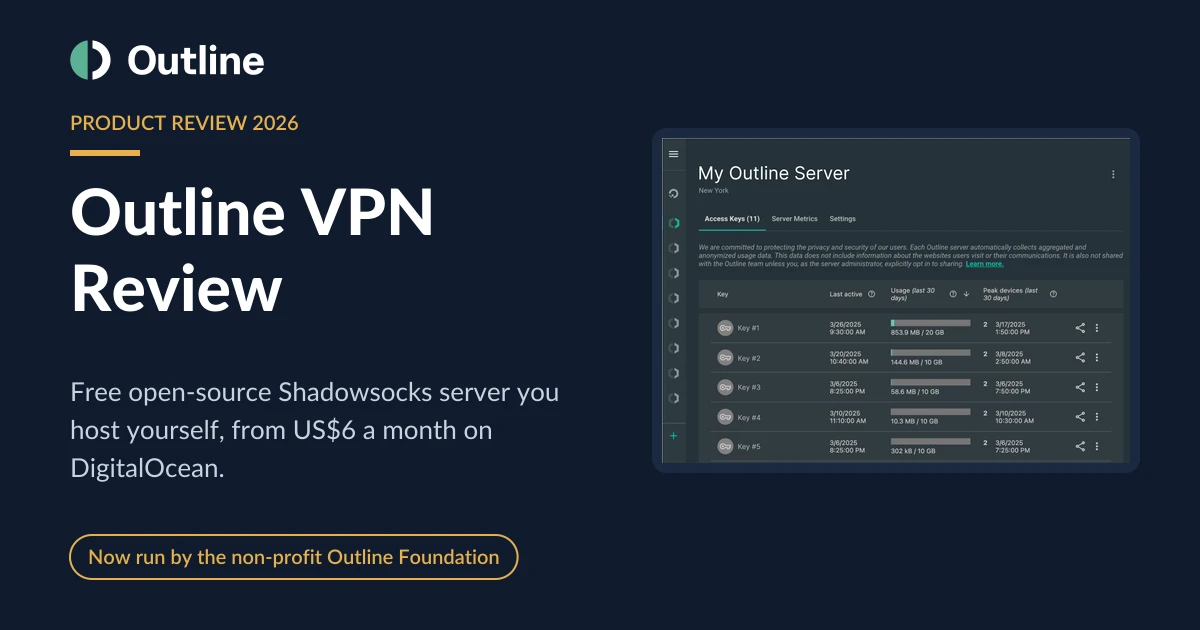
Outline is a free, open-source way to run your own VPN server and hand out access to it. You install Outline Manager on a desktop, point it at a cloud account or any Linux box, and it builds a Shadowsocks server you control. The people you share it with install Outline Client and paste in an access key. There is no subscription, no account and no company sitting between you and your traffic - just you, the server you rent, and the software.
The biggest change in 2026 is who stands behind it. Outline was launched in 2018 by Jigsaw, an incubator within Google, but in 2026 ownership moved to the Outline Foundation, an independent non-profit. The code moved to a new GitHub organisation, the privacy and data-collection policies were rewritten in February and March 2026, and the App Store now lists the Outline Foundation as the seller. This review covers what Outline really costs, what you get for that, how it handles censorship and privacy, and where it falls short.
Not to be confused with Outline the team wiki at getoutline.com - that is an unrelated product. This review is about the VPN at getoutline.org.
What Outline is and who runs it now
Outline is two apps. Outline Manager, in the project's own words, 'makes it easy to create your own VPN server. Set up your own server and share access keys directly from the desktop application.' It runs on Windows, macOS and Linux. Outline Client is the app your users install on their phones and computers to connect with the key you give them.
Under the hood the server speaks Shadowsocks, the encrypted proxy protocol built to look like nothing in particular on the wire. If you want the protocol background, our Shadowsocks review covers it in depth; Outline's contribution is to wrap that protocol in a server you can deploy in a few clicks and a key-management screen that a non-engineer can run.
From Google's Jigsaw to the Outline Foundation
Every page of getoutline.org now carries the same line: 'Outline is owned by the Outline Foundation, an independent non-profit organization. Outline was launched in 2018 by Jigsaw, an incubator within Google.' The FAQ adds that it 'continues to be a free, open-source project that thrives on community contributions.' No primary source gives the exact month of the handover, so treat it as a 2026 event.
The practical signs are visible. The old Jigsaw-Code repositories for the server and apps now redirect to the OutlineFoundation organisation on GitHub, all of it Apache-2.0 licensed and none of it archived. The client repo, the server repo and the Outline SDK all had commits in the last week of October 2026. Some help-centre pages still mention Jigsaw, but those are leftovers rather than a sign that Google still runs the project.
What Outline costs
The software costs nothing. There are no paid plans, no premium tier and no free trial, because there is nothing to upgrade to. What you pay for is the server, and that bill goes to your cloud provider, not to Outline.
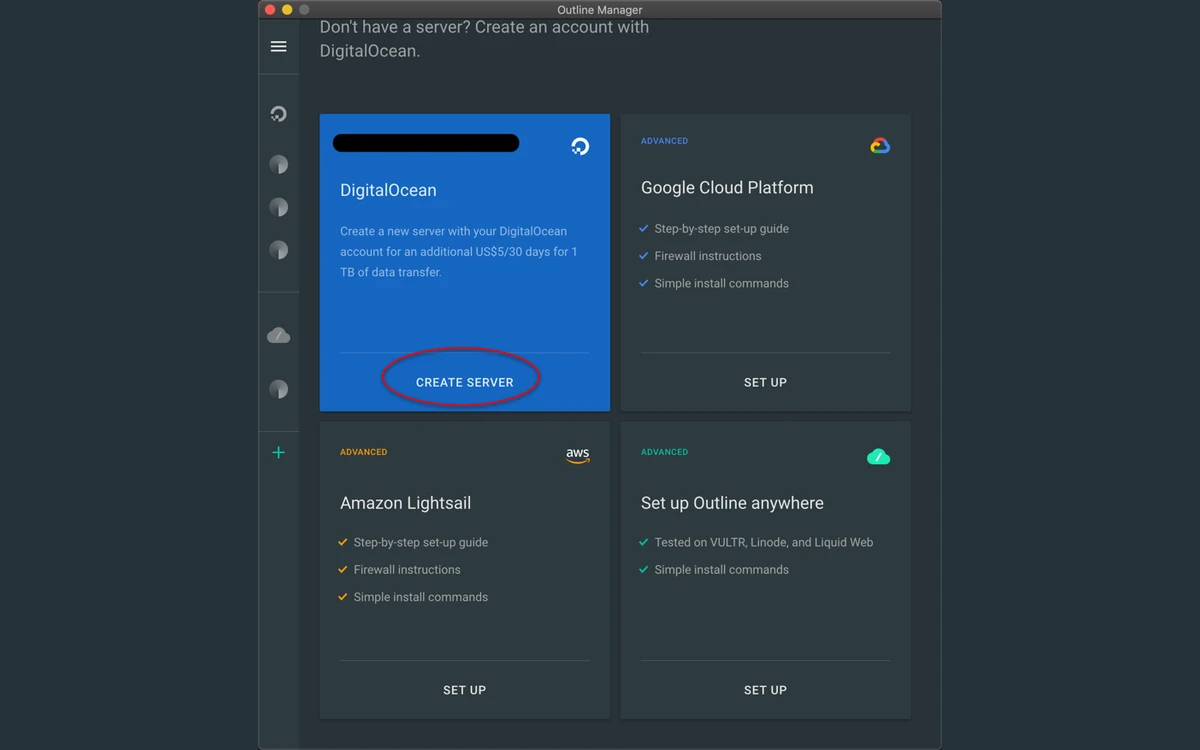
The figure to plan around is the one Outline Manager itself quotes today: creating a server on DigitalOcean costs 'an additional US$6/30 days for 1 TB of data transfer.' For Google Cloud the Manager says 'With Free Tier, your first server starts at US$3/month.' Amazon Lightsail is also offered, billed by Amazon.
- Outline software: free, open source, Apache-2.0.
- DigitalOcean via Outline Manager: US$6 per 30 days, 1 TB of transfer included.
- Google Cloud via Outline Manager: from US$3 a month on the Free Tier for your first server.
- DigitalOcean overage: 'Additional outbound transfer is billed at $0.01 per GiB.'
- Your own Linux server anywhere: whatever that server already costs you.
Why some Outline pages still say $5
Outline's help centre still says a server costs 'about $5 USD per month for 1 terabyte of data transfer allowance', and getoutline.org says 'Many cloud providers offer plans for $5USD a month or less.' The current Manager quotes US$6 for DigitalOcean, so budget on US$6. DigitalOcean does sell a US$4 droplet, but it includes only 500 GiB of transfer and is not the plan Outline Manager creates.
Split across users, the cost is tiny. Outline's own worked example puts a single 1 TB server at about 200 users on roughly 5 GB each per month, which works out to a few cents per person. Heavy streamers will use far more than 5 GB, so the realistic number of people per server depends on how they use it.
Setting up a server
Outline Manager offers four routes: DigitalOcean, Google Cloud, Amazon Lightsail, or 'Set up Outline anywhere' for a machine you already have.
- DigitalOcean is the guided path. Outline says it 'worked with DigitalOcean to offer a more user-friendly, guided installation experience where you can set up your server with a few clicks - no scripts.' You sign in, pick a region, and the Manager creates the droplet.
- Google Cloud is also automated: you sign in with OAuth and the Manager creates a project named 'Outline servers' to hold the instance.
- Amazon Lightsail and other hosts use the manual flow: you create the machine, then run Outline's install script.
- Set up Outline anywhere: on any Linux server you run the install script with sudo, then paste the output it prints back into the Manager. The documented prerequisite is Ubuntu 20.04 LTS or Debian 10.
Once a server is running it keeps itself current. Outline's server runs in a container watched by Watchtower, which is 'configured to check for image updates every hour', so you are not expected to patch it by hand.
New: deploying with an AI agent
Outline's documentation added a third way in 2026: deploying a server 'with the help of an AI agent (such as Claude Code, Codex, or Gemini CLI) using the experimental Outline Skills'. It currently supports DigitalOcean only, and Outline is blunt about its status: 'Outline Skills is experimental. Use at your own risk.' Treat it as a convenience for people who already work that way, not the recommended route.
Managing users, keys and data limits
Each person gets an access key, which is a single ss:// link. In the Manager, 'to the right of each key, there's a share icon you can click to get an invitation.' Outline does not send email for you and has said built-in email sending is unlikely for privacy reasons, so you deliver keys over whatever channel you trust.
Data limits are the main control. Outline Manager can 'set a trailing 30-day data limit on access keys', with a default limit that applies to every key and a custom limit on any key that overrides it. Limits are 'enforced hourly', so a user can run slightly past the cap before being cut off.
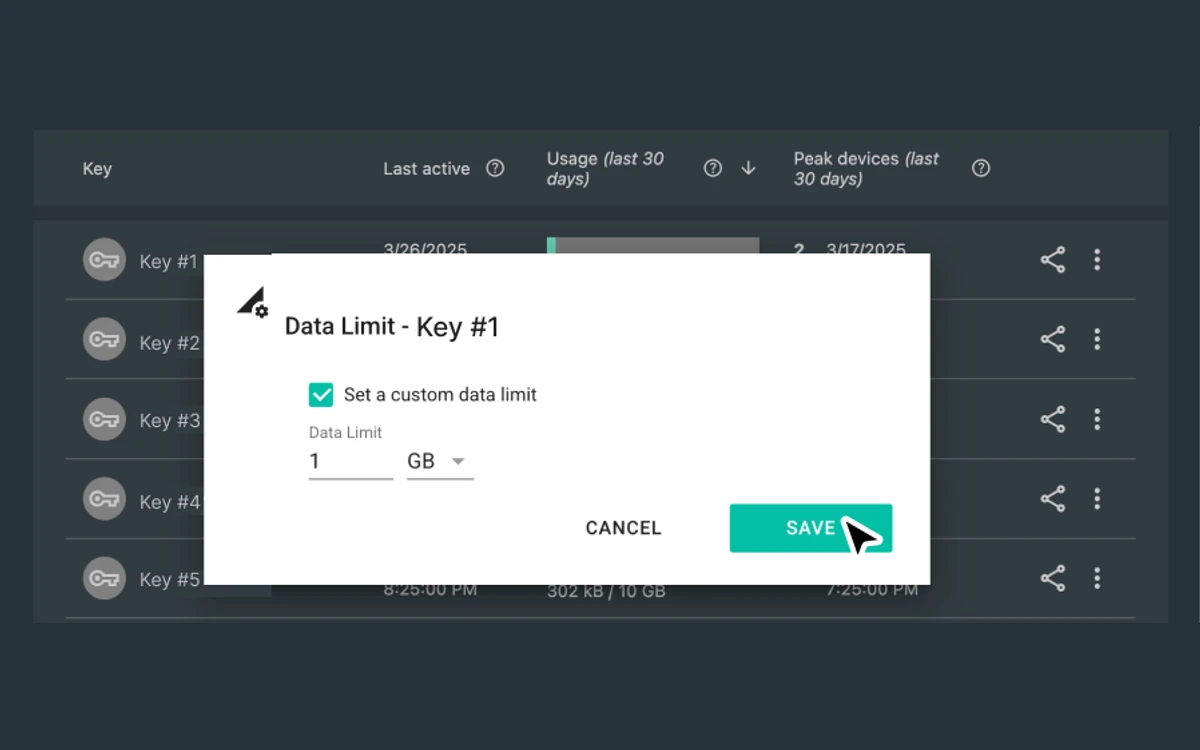
Two gaps are worth knowing before you share a server with a group. Asked whether you can set a server-wide limit such as 1 TB per 30 days, Outline answers 'Not at the moment.' Asked whether users are told when they hit their limit, the answer is the same: 'Not at the moment.' With a 1 TB DigitalOcean plan, per-key limits are therefore your only defence against overage charges.
Metrics and settings
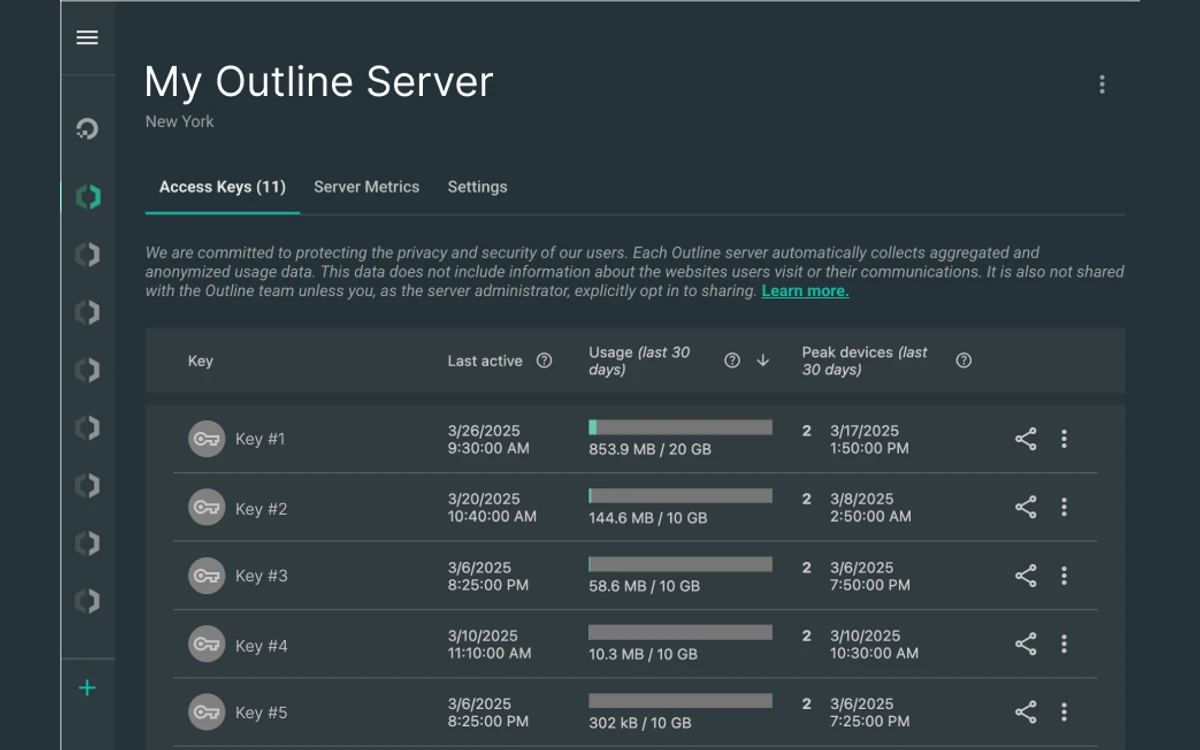
The Server Metrics tab shows total bandwidth, devices connected and total tunnel time over the last 30 days, plus the networks (ASes) using the most bandwidth. The device count is described as a minimum. The Access Keys tab shows each key's last activity, 30-day usage against its limit and peak devices. Settings let you change the hostname and the port used for new keys. Advanced users can also query the server's Prometheus metrics on port 9090 over SSH.
Dynamic access keys
For larger deployments, Outline supports dynamic access keys: you host the configuration at an HTTPS URL and hand out the same address with ssconf:// in place of https://. You can then change servers or settings without reissuing keys. One caveat from the docs matters: 'Deleting the hosted configuration does not revoke access.' To cut someone off you still have to delete their key on the server.
Client apps and requirements
Outline Client runs on Android, iOS, macOS, Windows, Linux and ChromeOS (through the Play Store). Current minimums are Android 10, iOS 16.6, macOS 12.0, Windows 10 and Ubuntu 20.04. The iOS requirement was raised to 16.6 on 29 October 2026, so older iPhones that ran Outline last year may no longer get updates.
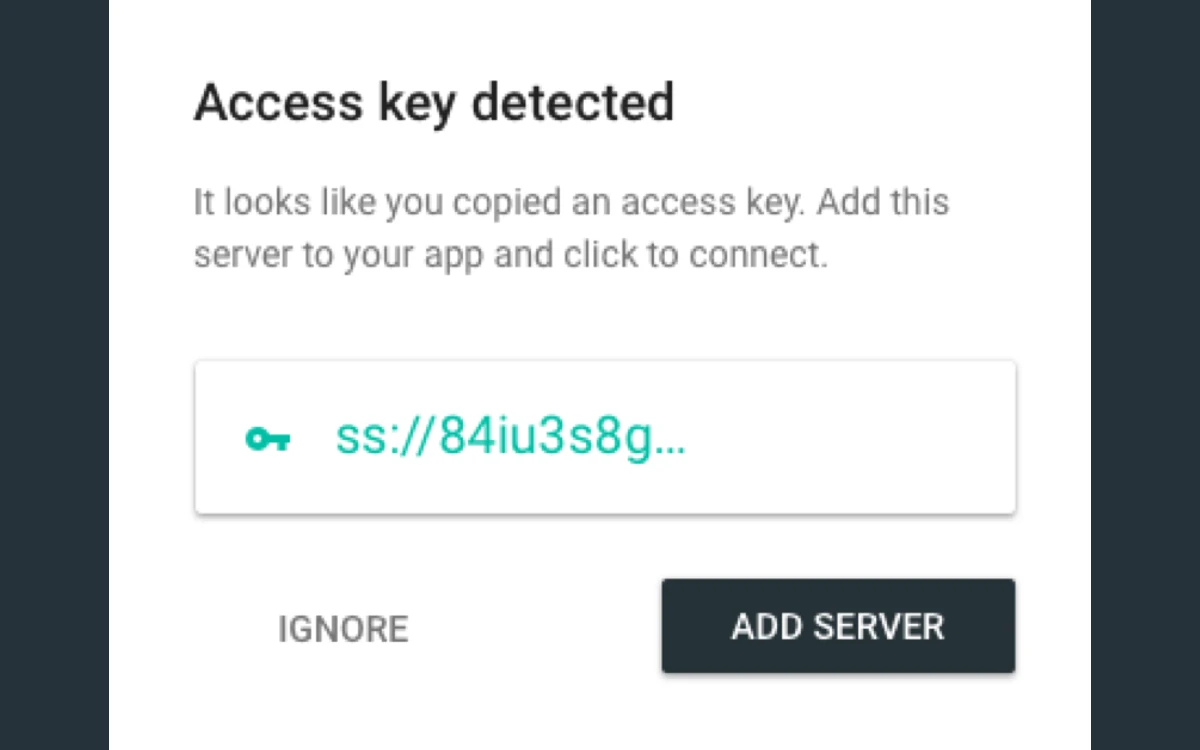
Using it is simple: copy a key and the client detects it, or paste it in, then tap to connect. Outline operates as a system-wide VPN, and it tunnels UDP as well as TCP traffic.
- Current version: 1.22.3 on iOS (23 October 2026) and macOS (22 October 2026); Android updated 26 October 2026.
- The 1.22 Android release is 'Same app as 1.22.0, now built with a modernized toolchain (Capacitor instead of Cordova)... No feature changes'.
- Windows ships for x64 and ARM64. Linux ships as .deb packages for amd64 and arm64 since version 1.15, with in-app auto-update disabled - you update through your package manager.
- Store ratings on 31 October 2026: 4.2 from 1,511 ratings on iOS, 4.3 from 29,611 ratings on Google Play with more than 5 million downloads.
Encryption and censorship resistance
Outline encrypts traffic between the device and the server with the AEAD 256-bit ChaCha20-Poly1305 cipher (chacha20-ietf-poly1305). The server makes AEAD ciphers mandatory and adds probing resistance, protection against replayed data and variable packet sizes - the features that make Shadowsocks harder to fingerprint than a standard VPN protocol.
When plain Shadowsocks gets blocked, Outline has more tools than most self-hosted options:
- Shadowsocks-over-WebSockets, supported on Outline Client 1.15.0 and later. The docs recommend putting it behind TLS with Caddy, nginx, Apache, Cloudflare Tunnel or ngrok, so traffic looks like ordinary HTTPS.
- Prefixes, supported since client 1.9.0: a short disguise of up to 16 bytes at the start of each connection so it resembles an allowed protocol.
- Composable strategies in advanced configs - in the docs' words, 'It's now possible to compose strategies and do multi-hops.'
- The Outline SDK, which powers the Outline Client, Intra and 'dozens of apps'. Its Smart Dialer searches for a strategy that unblocks DNS and TLS for a list of test domains.
Outline is widely used by journalists and civil-society groups in restrictive countries, and the site highlights deployments by the Sudan Ombudsman, Code for Africa and nthLink. How well any setup survives depends on the country and changes over time, so there are no guarantees - but the WebSocket-over-TLS option is the one to reach for first when a basic server stops working.
Privacy and security
Because you run the server, the trust model is different from a commercial VPN. Outline says 'the Outline server does not store any logs', and the Manager tracks only bytes transferred per key - it 'doesn't allow them to see the actual information'.
The Data Collection Policy, last updated 2 March 2026, says Outline does not collect the websites you visit, the content of communications, DNS queries or the IP addresses of end users. Server metrics are not shared with the Outline Foundation by default. If an administrator opts in, they are sent once an hour and reduced to country level after 60 days.
What you cannot switch off
The Privacy Policy, last updated 13 February 2026, says crash reports sent to Sentry are 'not optional, as these reports are essential for us to identify and fix bugs' - Outline states they contain no personal data. While connected, the client uses Cloudflare and Quad9 for DNS. Your server's IP may be visible to the container registry it pulls updates from, currently Quay.io.
The bigger privacy question is the person running the server. Outline's own warning is direct: 'Someone with your access key could potentially inspect all your internet traffic if they have access to it.' Use keys only from people you trust, and if you are the administrator, remember that your users are trusting you.
Audits
Outline lists four independent reviews: a Radically Open Security penetration test in March 2018, a Cure53 pentest and audit in December 2018, another Radically Open Security test in December 2022, and a Cure53 pentest of the Outline SDK in January 2024. The 2024 review covered the SDK only, not the server or the apps, and there has been no published audit since the Outline Foundation took over. The reports are linked from Outline's security page.
Limitations and drawbacks
Outline does one job - private access through a server you control - and it is honest about what it does not do.
- Not an anonymity tool. Outline's FAQ says so in as many words: 'No, Outline is not an anonymity tool.'
- One location per server. 'Once set up, a server location cannot be changed.' You can create as many servers as you like, but each one is a separate bill.
- Streaming is hit and miss. Asked whether sites will know you are using Outline, the help centre says 'Possibly' - services 'will most likely be able to tell that your connection is coming from a cloud server.'
- No documented kill switch, and no split tunnelling on Linux.
- No server-wide data cap and no warning to users who hit their limit.
- Slow server releases. The last server release is v1.12.3 from 24 February 2025, a hotfix after memory issues. The clients are current, but the server has gone about 20 months without a tagged release.
Beware of unofficial Outline sellers
Outline warns that getoutline.me and the @OutlineVpnOfficial Telegram channel are not affiliated with it. The only official access-key partner it names is Paskoocheh, for Farsi speakers. Services such as nthLink and BeePass are third parties built on Outline. If getoutline.org is blocked where you are, Outline publishes a mirror at s3.amazonaws.com/outline-vpn/index.html.
Verdict: who Outline is for
Outline is the easiest way we know to give a group of people a private, hard-to-block connection through a server you own. The Manager turns what would be an afternoon of Shadowsocks configuration into a few clicks, per-key limits keep the cloud bill predictable, and the WebSocket and prefix options give it real staying power against censorship. At US$6 a month for a server that can cover a family, a newsroom or a small team, it is far cheaper than a commercial VPN per head.
It is the wrong choice if you want dozens of countries to switch between, reliable streaming unblocking, a kill switch or anonymity from the server operator. Commercial services like Astrill target censored users with more polish and locations, while mesh tools like Tailscale or a plain WireGuard server suit private networking better than censorship circumvention. The ownership change to a non-profit looks healthy so far - active repos, rewritten policies, fresh client releases - but the stalled server release cadence and the lack of an audit under the new owner are worth watching.
Frequently asked questions
Is Outline VPN free?
Yes, the software is free and open source. You pay only for the server it runs on - US$6 per 30 days for 1 TB on DigitalOcean according to Outline Manager, or from US$3 a month on Google Cloud's Free Tier.
Is there a free trial or a refund policy?
No, because there is nothing to buy from Outline. To stop paying, destroy the server at your cloud provider; billing and any refunds follow that provider's rules, not Outline's.
Is Outline still owned by Google?
No. Outline was launched in 2018 by Jigsaw, an incubator within Google, and in 2026 ownership moved to the Outline Foundation, an independent non-profit. The code now lives under the OutlineFoundation organisation on GitHub.
Does Outline keep logs or collect my data?
Outline says the server keeps no logs and that it does not collect sites visited, traffic content, DNS queries or user IP addresses. Server metrics are shared only if the administrator opts in, but crash reports to Sentry are not optional.
Can I limit how much data each user gets?
Yes, per key. You can set a default trailing 30-day limit for every key and override it on individual keys, enforced hourly. There is no server-wide cap and users are not notified when they hit their limit.
Which devices does Outline support?
Android 10 or later, iOS 16.6 or later, macOS 12.0, Windows 10 (x64 and ARM64), Ubuntu 20.04 and ChromeOS through the Play Store. Outline Manager runs on Windows, macOS and Linux.
Can Outline unblock Netflix or change my country?
Only to the country your server is in, and not reliably for streaming. A server's location cannot be changed, and Outline says sites will most likely be able to tell that traffic comes from a cloud server.
Does Outline work in countries that block VPNs?
It is designed for that, but nothing is guaranteed. If a basic Shadowsocks server is blocked, Outline recommends Shadowsocks-over-WebSockets behind TLS (client 1.15 or later) and supports prefixes to disguise connections.
Key takeaways
- Outline is free, open-source software for running your own Shadowsocks VPN server; you pay only for hosting.
- Outline Manager quotes US$6 per 30 days for 1 TB on DigitalOcean - older pages saying $5 are out of date.
- Since 2026 it is owned by the non-profit Outline Foundation, not Google's Jigsaw.
- Per-key 30-day data limits and Shadowsocks-over-WebSockets are its standout features.
- It is not an anonymity tool: one location per server, no kill switch, and crash reports cannot be turned off.
- Clients update monthly, but the server has had no release since v1.12.3 in February 2025.
More in Virtual Private Network
Browse Virtual Private Network