Anthropic Files S-1 for Nasdaq IPO as ANT: $16.3B First-Half Revenue, First Operating Profit
Anthropic's public S-1 shows revenue jumping from $4.6B in 2025 to $16.3B in the first half of 2026, a first operating profit in Q2, an $80.7B mostly non-cash net loss and a founder share with 50.1% of the vote.
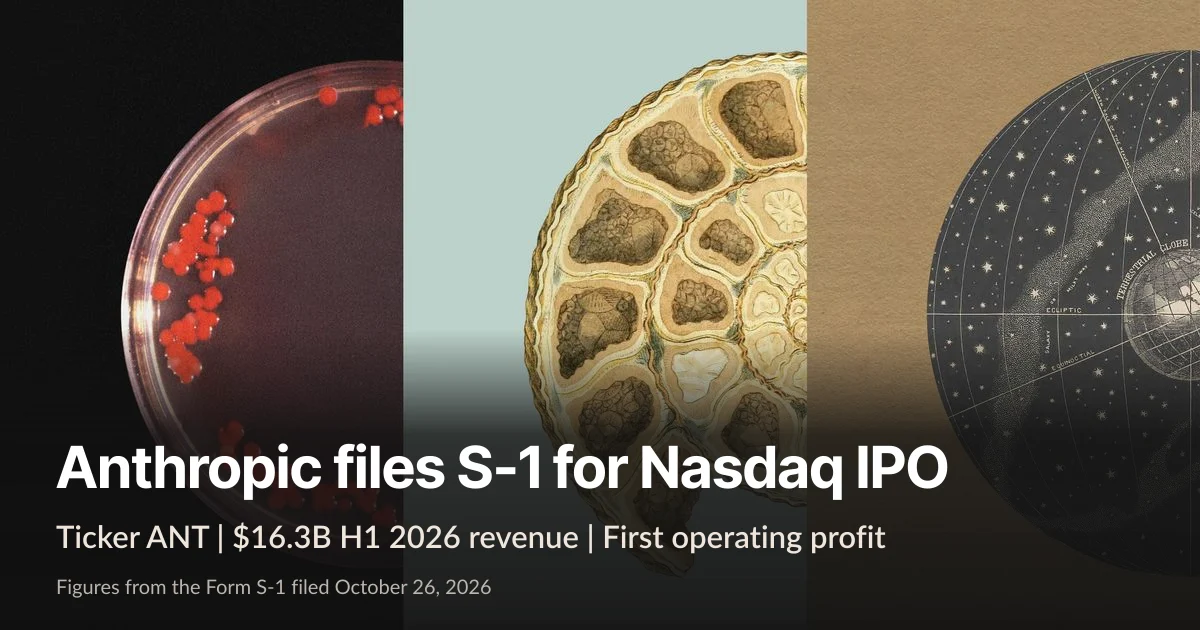
Anthropic, PBC publicly filed a Form S-1 registration statement with the U.S. Securities and Exchange Commission on October 26, 2026, for a proposed initial public offering of its Class A common stock. The company plans to list on the Nasdaq Global Select Market under the ticker ANT.
The filing is the first look at Anthropic's audited books, and it is the largest financial disclosure any AI lab has made so far. Revenue went from $4.6 billion in all of 2025 to $16.3 billion in the first half of 2026, and the second quarter of 2026 was the company's first operating profit. The headline net loss is $80.7 billion for the half, but almost all of it is a non-cash accounting charge.
This is a registration, not a listing. The share count and price range are still blank, and no shares can be sold until the SEC declares the registration effective.
What Anthropic filed
Anthropic says the number of shares to be offered and the price range "have not yet been determined." The S-1 also leaves the expected proceeds, a Run-Rate Revenue figure and the total compute commitment blank, so none of those numbers exist yet as official figures.
Goldman Sachs and Morgan Stanley lead the deal, and the preliminary prospectus is available from both. The cover lists a long syndicate behind them, including J.P. Morgan, Citigroup, Barclays, Wells Fargo Securities, BofA Securities, Deutsche Bank Securities, RBC Capital Markets, UBS Investment Bank, Jefferies, Mizuho and MUFG.
According to Yahoo Finance, Anthropic first filed confidentially with the SEC in June 2026, and the IPO is expected later this fall.
Revenue: from $41 million to $16.3 billion in a half
The S-1 shows annual revenue of $41 million in 2023, $386 million in 2024 and $4,585 million in 2025. In the six months to June 30, 2026, revenue reached $16,286 million, up from $1,163 million in the same period of 2025.
- Q1 2025: $376M revenue, $935M operating loss
- Q2 2025: $787M revenue, $1,200M operating loss
- Q3 2025: $1,382M revenue, $3,089M operating loss
- Q4 2025: $2,040M revenue, $2,836M operating loss
- Q1 2026: $4,731M revenue, $1,667M operating loss
- Q2 2026: $11,555M revenue, $974M operating income
The Q3 2025 operating loss includes a $1.5 billion charge the filing labels the "Bartz settlement." Over the first half of 2026 as a whole, Anthropic posted an operating loss of only $693 million, because the Q2 profit nearly offset the Q1 loss.
Compute costs and the path to profit
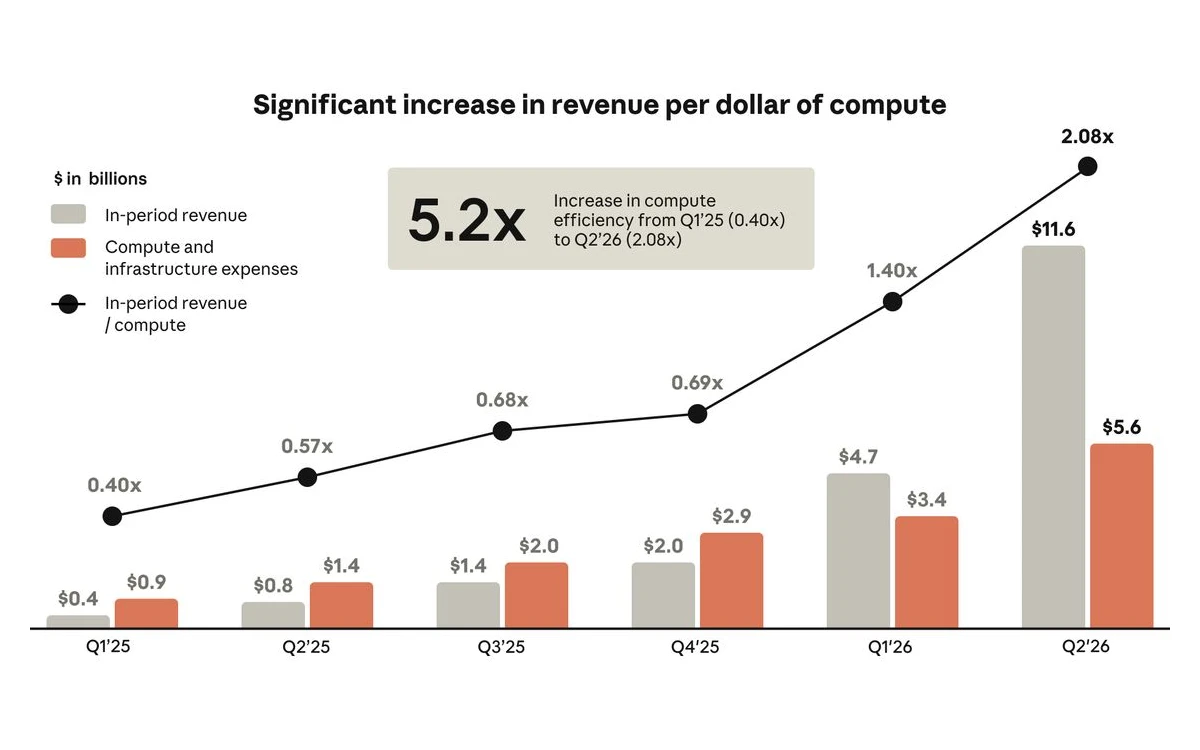
Compute is the biggest cost line. Compute and infrastructure expense was $7,326 million in 2025 and $8,945 million in the first half of 2026, with Q2 2026 alone at $5,558 million. Revenue grew faster: an S-1 chart titled "Significant increase in revenue per dollar of compute" shows revenue per dollar of compute rising from 0.40x in Q1 2025 to 2.08x in Q2 2026, a 5.2x improvement.
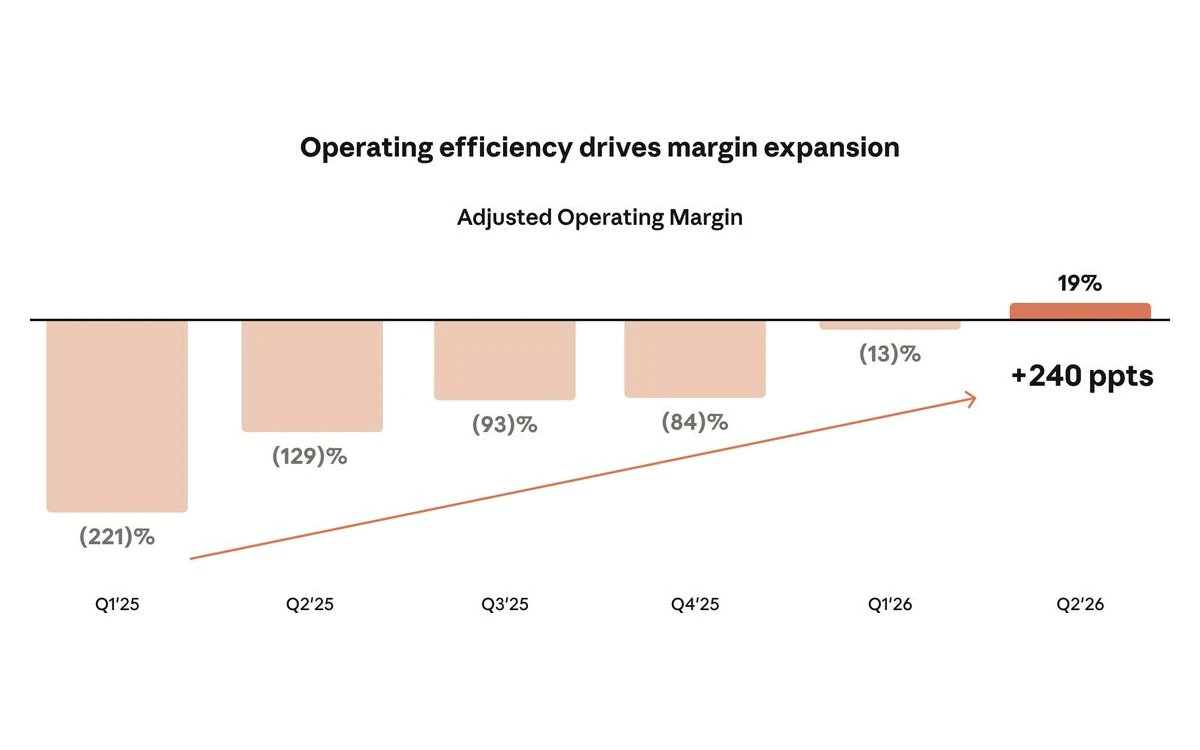
A second chart tracks Adjusted Operating Margin, a non-GAAP measure that excludes items such as stock-based compensation. It goes from (221)% in Q1 2025 to (13)% in Q1 2026 and 19% in Q2 2026, a swing the filing labels "+240 ppts."
Other costs are growing fast too. Stock-based compensation was $1.2 billion in 2025 and $2.2 billion in the first half of 2026. Sales, marketing and partnerships spending rose from $568 million for all of 2025 to $3,168 million in the first half of 2026.
Why the net loss is $80.7 billion
Anthropic reports a net loss of $41,965 million for 2025 and $80,748 million for the first half of 2026, including $66,309 million in Q2 2026 alone. That headline number does not reflect the cost of running the business.
Most of it is the change in fair value of convertible notes, derivative liabilities and SAFEs: $34.3 billion in 2025 and $72.4 billion in the first half of 2026. The filing says this was "primarily driven by an increase in the fair value of our outstanding convertible promissory notes resulting from an increase in our enterprise valuation." In other words, the more the company is worth, the more it owes holders of those instruments on paper, and the charge runs through the income statement without any cash leaving.
Balance sheet at June 30, 2026
Cash, cash equivalents and short-term investments: $131,651M. Total assets: $147,358M. Accumulated deficit: $(132,902)M.
Customers and headcount
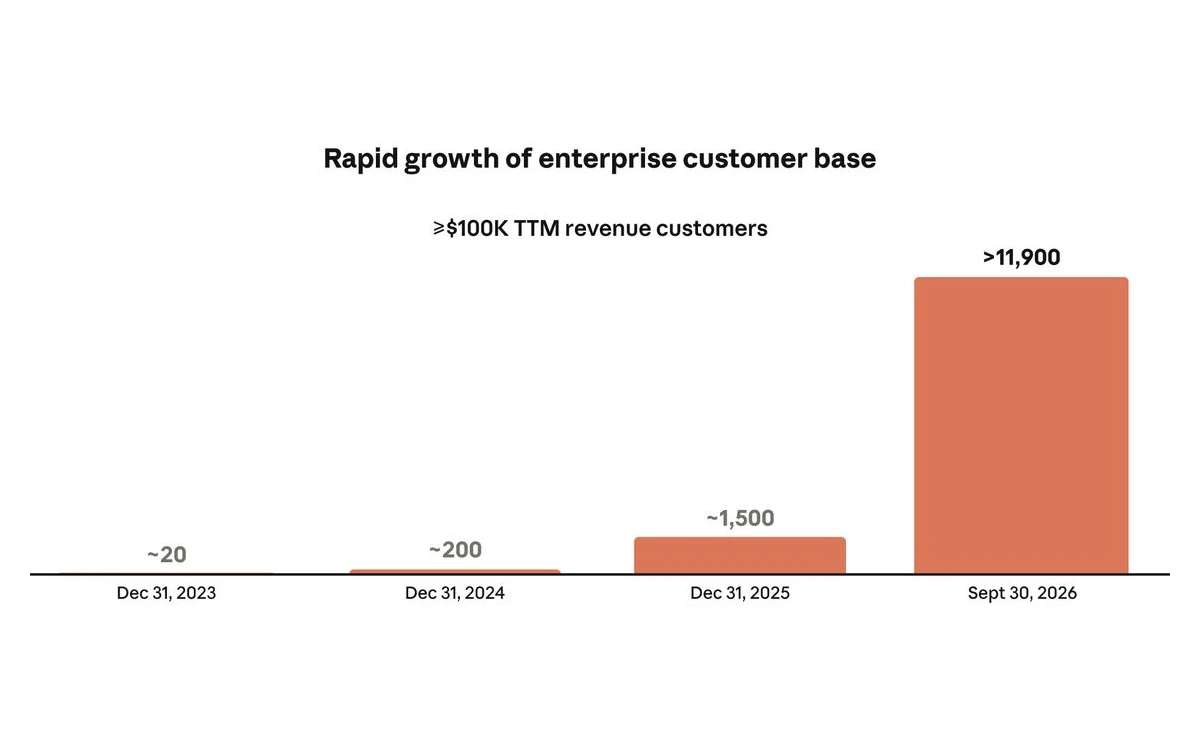
As of September 30, 2026, Anthropic had more than 11,900 customers generating at least $100,000 in trailing-twelve-month revenue, up from more than 950 a year earlier. More than 1,900 customers spend at least $1 million and about 250 spend at least $10 million. The company puts its Net Revenue Retention at about 900%.
Revenue is concentrated, though. Yahoo Finance reports that about one-fifth of revenue came from two customers, and the S-1 warns that losing or seeing reduced spending from its largest customers could hurt results. Anthropic has about 5,300 employees and says trailing revenue per employee is over $6.6 million.
A $120.5 billion compute deal with SpaceXAI
The filing details what it calls the SpaceXAI Arrangements. Anthropic agreed to spend "an aggregate of up to $120.5 billion over terms extending into 2029" on NVIDIA GPU-powered compute from SpaceXAI, a wholly owned subsidiary of Space Exploration Technologies Corp. That works out to about $3.1 billion a month once all capacity is delivered, which is expected in December 2026. The non-cancelable periods end in January 2027 and March 2027.
Amazon, Google and Microsoft still provide substantial portions of Anthropic's compute, and a model the filing calls "Anthropic Direct" has the company buying its own accelerators and running them in leased data centers. The S-1's total commitment figure is blank, but Yahoo Finance reports about $430 billion in locked-in cloud compute deals, rising to as much as $637 billion when cancellable and smaller deals are included.
Who controls Anthropic after the IPO
Anthropic is a public benefit corporation whose stated purpose is "the responsible development and maintenance of advanced AI for the long-term benefit of humanity." The S-1 sets out an unusual control structure built around that purpose.
- Class A: one vote per share. These are the shares being listed.
- Class N: no votes.
- Class T: held only by the Long-Term Benefit Trust, a body of financially disinterested trustees created in 2023. The Trust generally has the power to elect and remove a majority of the board.
- Class F: a single share held by a Founder LLC of the seven co-founders, including CEO Dario Amodei and President and Chair Daniela Amodei. It carries 50.1% of total voting power on general matters, including the election of non-Class T directors, and has no economic rights.
- Class E: issued to non-founder employees, votes only on limited matters, no economic rights.
Because the Trust can elect a board majority, Anthropic will be a "controlled company" under Nasdaq rules. The Class F share lasts until fewer than three Continuing Founders remain for 90 consecutive days, followed by a transition period, or until it is redeemed. Buyers of Class A stock will own economic interest with very little say over the board.
The lockup is also unusual. Some shares become sellable from the first trading day, with staged releases on the 27th, 48th, 62nd and 76th days after the prospectus date, alongside a 180-day lockup and an extended 365-day lockup. Yahoo Finance counts more than 20 unlock windows over about a year.
Risk factors worth reading
The risk section goes further than most tech prospectuses. Anthropic writes that sufficiently advanced AI systems could "pose catastrophic or existential risks to humanity" if misused or allowed to operate with high autonomy, and that its insurance "may not be sufficient to compensate us for the losses that could occur."
Two government disputes are disclosed. In June 2026, the U.S. Department of Commerce imposed worldwide export restrictions on the Fable 5 and Mythos 5 models. Anthropic disabled them for all customers and restored them after updating its safeguards.
Separately, after Anthropic insisted its models not be used for mass domestic surveillance or fully autonomous weapons, the President directed federal agencies to stop using its technology, and the Secretary of War directed that the company be designated a "supply-chain risk to national security." The Department of War sent two designation letters on March 4, 2026. Anthropic is challenging them in Anthropic PBC v. Department of War and obtained a preliminary injunction in the Northern District of California.
Valuation and market reaction
The S-1 gives no valuation. Press reporting fills the gap: Yahoo Finance says Anthropic was valued at $965 billion as of May 2026, against OpenAI's $852 billion in March, and Wall Street talk puts a listing valuation at $1.5 trillion to $2 trillion. OpenAI is expected to go public in early 2027.
Chip stocks rose on the filing day, and the Nasdaq Composite was up 0.8% at midday, according to Yahoo Finance.
Frequently asked questions
Is Anthropic a public company now?
No. Anthropic has filed a registration statement, but the IPO has not priced and shares are not trading. The stock can only be sold once the SEC declares the registration effective.
What will the ticker be?
ANT, on the Nasdaq Global Select Market.
How much is Anthropic raising, and at what price?
Unknown so far. The S-1 leaves the number of shares, the price range and the proceeds blank. Those are usually added in an amended filing before the roadshow.
Is Anthropic profitable?
On an operating basis, for one quarter. Q2 2026 produced $974 million in operating income, the first operating profit in the filing. The first half of 2026 was still an operating loss of $693 million, and the large net loss comes mostly from non-cash fair-value charges.
Will Class A shareholders control the company?
No. The Long-Term Benefit Trust generally elects a majority of the board, and a single founders' share carries 50.1% of the vote on general matters.
Sources
- Anthropic: Anthropic files registration statement for proposed IPO: https://www.anthropic.com/news/s1-sec
- SEC EDGAR: Anthropic, PBC Form S-1: https://www.sec.gov/Archives/edgar/data/0002130357/000162828026067168/anthropicpbc-sx1.htm
- Yahoo Finance: Anthropic IPO live updates: https://finance.yahoo.com/technology/live/anthropic-ipo-live-updates-frontier-ai-lab-discloses-revenue-and-risks-in-highly-anticipated-s-1-filing-141702607.html
- Yahoo Finance: Anthropic publicly files IPO prospectus: https://finance.yahoo.com/technology/article/anthropic-publicly-files-ipo-prospectus-noting-strong-revenue-growth-and-massive-spending-131807138.html
Key takeaways
- Anthropic filed a public S-1 on October 26, 2026 to list Class A shares on Nasdaq as ANT. Price, share count and proceeds are still blank.
- Revenue rose from $4.6B in 2025 to $16.3B in the first half of 2026, and Q2 2026 posted the first operating profit at $974M.
- The $80.7B first-half net loss is mostly a $72.4B non-cash fair-value charge on convertible notes and SAFEs.
- A Long-Term Benefit Trust elects most of the board and a founders' share holds 50.1% of the vote, making ANT a controlled company.
- The filing discloses a compute deal with SpaceXAI worth up to $120.5B and disputes with the Commerce Department and the Department of War.
More in Tech News
Browse Tech News