Marvell to Buy Lumentum in $115 Billion All-Stock Deal Betting on Optical AI Networks
Marvell agreed to acquire Lumentum for 4.5 shares each, an implied $115 billion enterprise value. Both stocks fell sharply as investors questioned the price.

Marvell Technology said on November 2, 2026 that it will acquire Lumentum Holdings in an all-stock transaction with an implied enterprise value of $115 billion, one of the largest technology deals on record.
The pitch is simple: AI data centers are running out of room on copper, and the next generation of links between accelerators will be optical. Marvell makes the chips that drive those links; Lumentum makes the lasers and optical parts that carry the light. Investors were not convinced on day one. Both stocks fell hard, and Lumentum closed far below the value the deal implies.
The deal terms

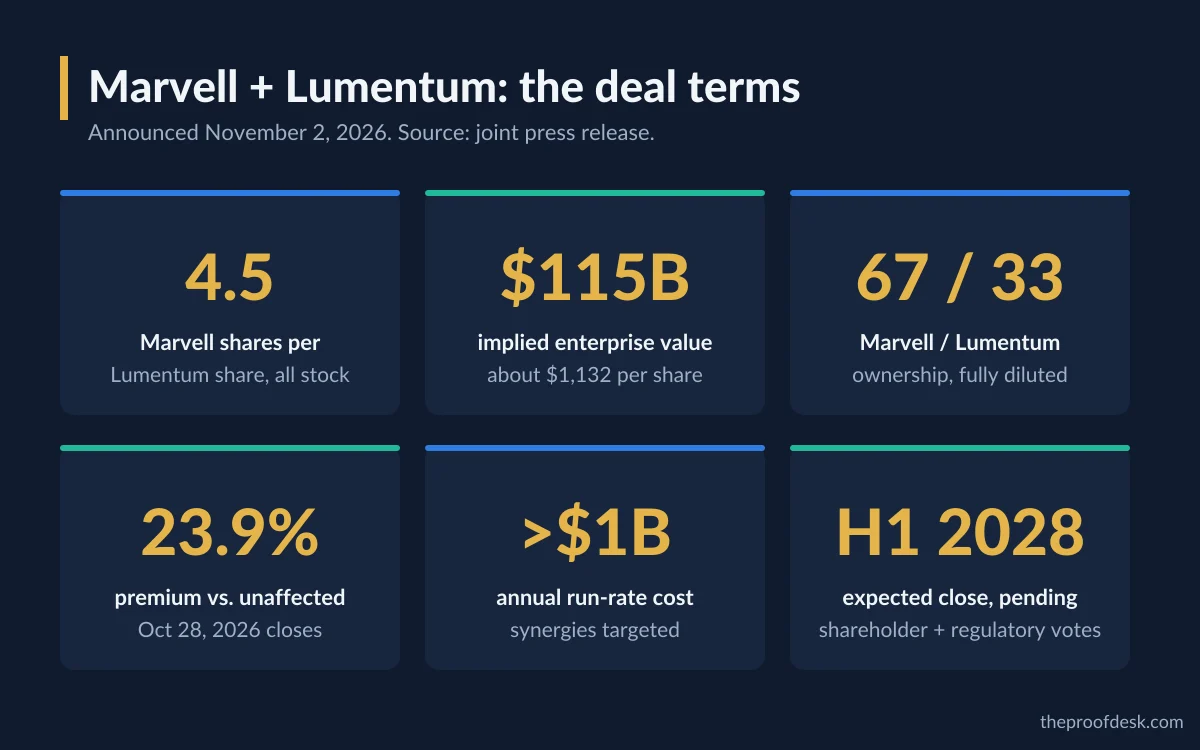
Lumentum stockholders will receive a fixed 4.500 Marvell shares for each Lumentum share they own. There is no cash component. According to the joint release, that works out to about $1,132 per Lumentum share, a premium of about 23.9% based on both companies' unaffected closing prices on October 28, 2026.
- Buyer: Marvell Technology (NASDAQ: MRVL), Santa Clara, California
- Target: Lumentum Holdings (NASDAQ: LITE), San Jose, California
- Consideration: 4.500 Marvell shares per Lumentum share, all stock
- Implied enterprise value: $115 billion, about $1,132 per Lumentum share
- Ownership after closing: about 67% Marvell holders, 33% Lumentum holders (fully diluted)
- Expected close: first half of calendar 2028, subject to both shareholder votes and regulatory approvals
The boards of both companies approved the deal unanimously. Matt Murphy stays on as Chairman and CEO of the combined company, and three Lumentum directors, including CEO Michael Hurlston, will join Marvell's board, which currently has seven members. An internal Lumentum email filed with the SEC says the Lumentum brand "will become part of Marvell".
Which number is the deal worth?
The $115 billion headline is the implied enterprise value from the official release. Hurlston's email to Lumentum staff describes the deal as "valued at approximately $100 billion". Because the price is paid in Marvell stock, the real value moves every day with Marvell's share price.
Why a chip company wants a laser company
Training and serving large AI models means moving enormous amounts of data between thousands of accelerators. Copper links lose signal quickly as speeds rise, so the industry has been shifting more of those links to optical fiber. "AI infrastructure is undergoing a fundamental architectural shift toward optical connectivity," Murphy said in the release, describing the moment as a once-in-a-generation opportunity.
The two companies sit on opposite sides of the same link:
- Marvell brings electrical and optical interconnect chips (DSPs, retimers, linear drivers), network switching, custom XPU and AI accelerator silicon, and advanced packaging and design.
- Lumentum brings high-performance lasers, optical transceivers, optical circuit switching (OCS) and compound semiconductor manufacturing, including indium phosphide fabs.

Put together, the companies say they can sell every part of a data center connection and design the electronics and optics together. Their release calls this "end-to-end extreme co-design". Hurlston's email describes "optics and electronics beginning to collide" and names near-packaged and co-packaged optics (NPO and CPO), where the optical engine sits right next to the processor, as future products. He also calls the combined company the fifth largest network semiconductor company in the world.
Hurlston framed the need as covering interconnect "from scale-across and scale-out today to scale-up and scale-in" later, meaning first the links between racks and data centers, then the links between chips inside a single system. The companies put the combined addressable market at $550 billion.

What the companies promise
Marvell and Lumentum say they have "line of sight" to more than $1 billion in annual run-rate cost synergies. They expect the deal to add to Marvell's non-GAAP earnings per share in the first year after closing and to lift long-term revenue growth and non-GAAP gross and operating margins.
Both companies arrive with momentum. Lumentum's fiscal fourth quarter of 2026, reported in August, brought revenue of about $1.01 billion, up 109% year over year, and it guided fiscal Q1 2027 revenue to $1.225 billion to $1.275 billion. Those results are due after the market closes on November 5. At its October 6 Investor Day, Marvell raised its fiscal 2028 revenue outlook to $20 billion and set a fiscal 2031 target of $70 billion to $90 billion.
Alongside the deal, Marvell said preliminary revenue for its fiscal third quarter of 2027 is in line with prior guidance, with the midpoint unchanged and the range narrowed to plus or minus 2% from plus or minus 5%.
Why the market doubts it
Investors sold both stocks. On November 2, Marvell closed at $170.80, down 13%, on volume of about 60.5 million shares against an average of 21.8 million, according to The Motley Fool. Lumentum closed at $684.40, down 18.59%.
The selling started before the announcement. Bloomberg reported on October 28 that Marvell was in advanced talks, and Marvell fell 13.24% to $218.34 the next day while the Nasdaq Composite slipped 1.38%. Benzinga reported that Marvell was on course for its worst three-day drop since September 2001.
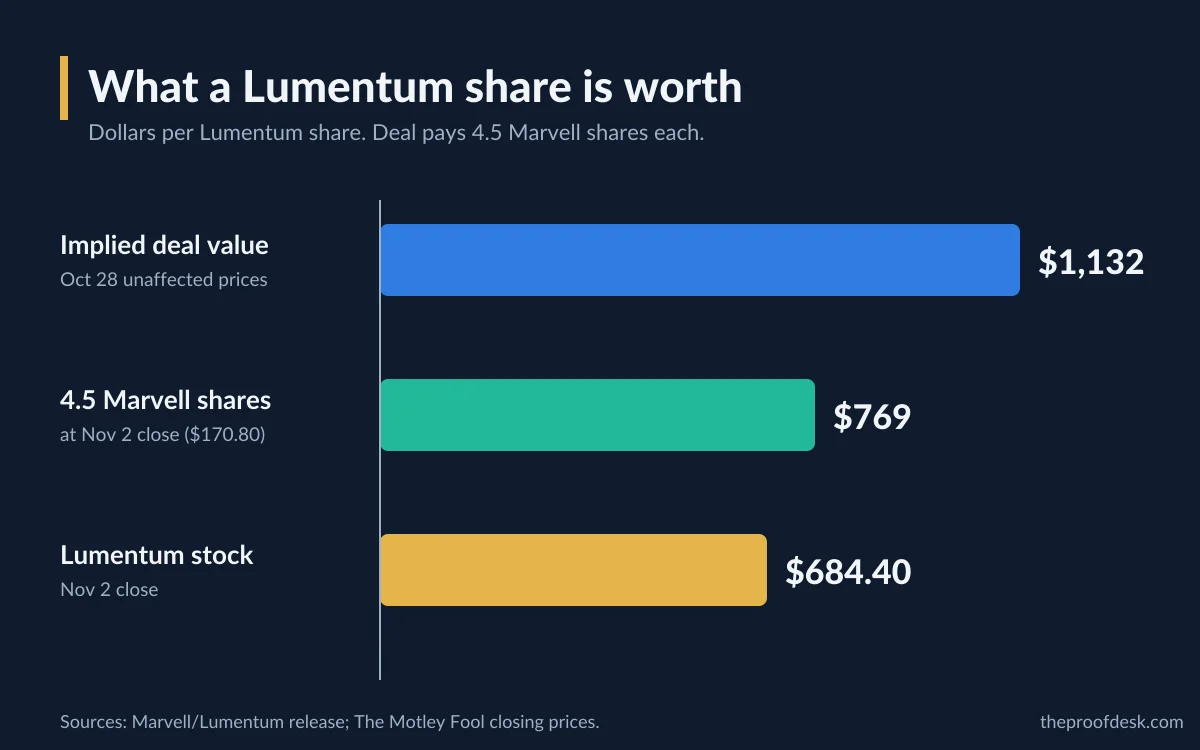
Because Lumentum holders are paid in Marvell stock, Marvell's slide cuts straight into the price. At Marvell's November 2 close, 4.5 shares were worth about $769, well short of the $1,132 headline, which assumed a Marvell price of roughly $251. Lumentum's $684.40 close sat about 11% below even that reduced value, a gap that reflects how much risk traders see in a deal that needs shareholder votes and regulatory sign-off and will not close until 2028.
The companies have not named which regulators must approve the deal. Press reports have flagged US and Chinese antitrust review as risks, but that is analyst commentary rather than a company statement.
What happens next
- November 5, 2026: Lumentum reports fiscal Q1 2027 results, the first numbers since the deal was announced.
- Coming months: both companies file proxy materials and ask stockholders to approve the deal.
- Through 2027: regulatory reviews. Hurlston's email puts the timeline at about 12 to 18 months.
- First half of 2028: expected closing, if every approval comes through.
Advisors on the deal: Qatalyst Partners is Marvell's lead financial advisor, with J.P. Morgan and Goldman Sachs also advising and Wilson Sonsini as legal counsel. Citigroup and Evercore are Lumentum's financial advisors, with Davis Polk & Wardwell as legal counsel.
Key takeaways
- Marvell will acquire Lumentum for 4.5 Marvell shares per Lumentum share, all stock, at an implied $115 billion enterprise value.
- The bet is that AI data center links move from copper to optics, and that owning both the chips and the lasers wins that shift.
- Marvell holders will own about 67% of the combined company; Matt Murphy stays CEO.
- Both stocks fell sharply on November 2, cutting the deal's real value to about $769 per Lumentum share at Marvell's close.
- The deal needs shareholder and regulatory approval and is expected to close in the first half of 2028.
More in Tech News
Browse Tech News