Google's Gemini 4 Carbon goes to cyber defenders first, two weeks after Argon
Google DeepMind's Gemini 4 Carbon tops its own benchmark table and leads on cyber tests, but only vetted defenders in the Fairwind Program can use it for now.
Google DeepMind announced Gemini 4 Carbon on October 28, 2026, calling it "our strongest model with state-of-the-art cybersecurity and long horizon capabilities." It arrives two weeks after Gemini 4 Argon reached the Gemini app, and on Google's own comparison table it beats Argon, GPT-6 Astra and Claude Opus 5.5 on most rows.
Most people can't use it yet. Like Argon at launch, Carbon is going first to a small group of vetted cyber defenders through Google's Fairwind Program while Google takes part in the U.S. government's voluntary pre-release testing. Google has given no date for developers, businesses or consumers.
What Google announced
The announcement came in a blog post by Koray Kavukcuoglu, SVP of Google DeepMind and Google's Chief AI Architect. Google presents Carbon as a step past Argon: "Building on Gemini 4 Argon, which was launched two weeks ago, Carbon illustrates the pace at which we're pushing the frontier forward." That "two weeks" counts from Argon's arrival in the Gemini app on October 13. Argon itself was announced on September 30.
Google pitches two things. The first is security work: finding, exploiting and patching vulnerabilities. The second is long-running agent tasks. Google writes that internally "our teams have seen Carbon run for days to persist through dead ends to tackle complex, multi-step engineering tasks like root-causing and patching subtle bugs across large codebases and low-level systems."
Google lists no public model ID, context window or output limit for Carbon. It isn't in the Gemini API, Vertex AI or the Gemini app.
Where Carbon leads, and where it doesn't
Google says Carbon is #1 on version 5.0 of the Artificial Analysis Intelligence Index with a score of 59. In Google's table, that is one point above Claude Opus 5.5 (58), two above GPT-6 Astra (57) and nine above Argon (50). On WebDev Arena, Google says Carbon "jumps +89 elo points to land at #4 (1768)."
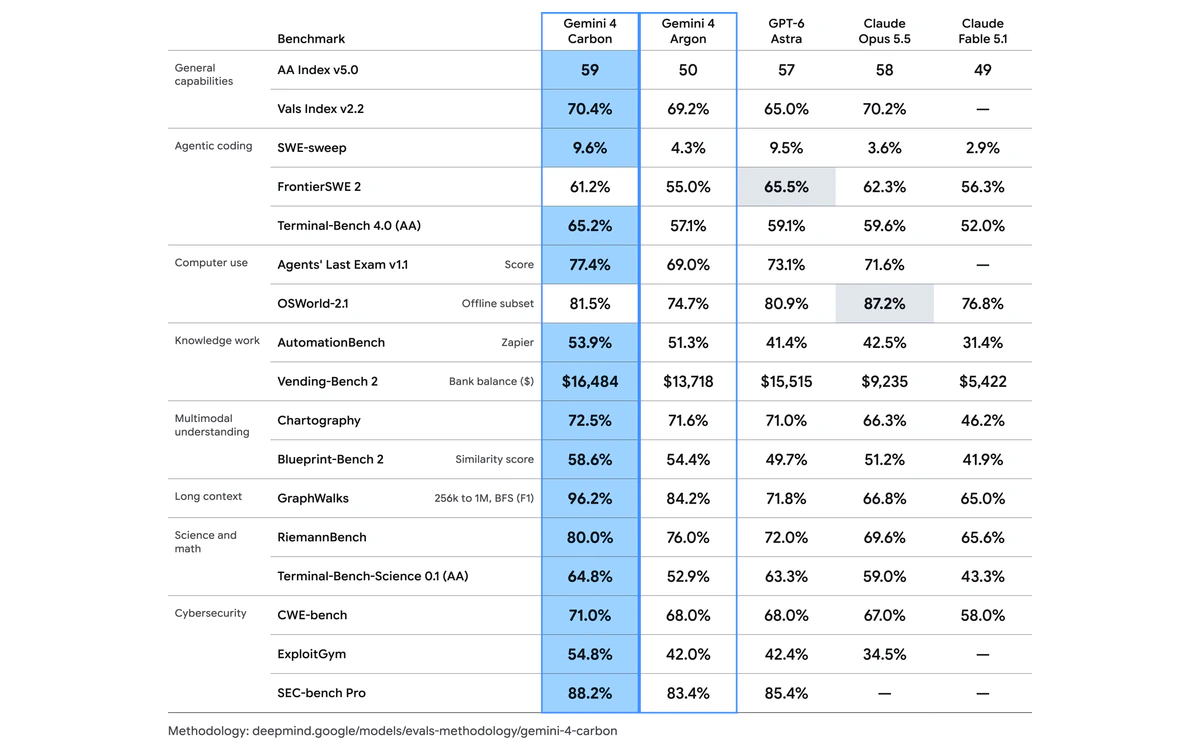
The biggest gaps are on long-context and agent tests. GraphWalks (256k to 1M tokens) scores 96.2% against 84.2% for Argon and 71.8% for GPT-6 Astra. AutomationBench from Zapier is 53.9% against 42.5% for Claude Opus 5.5. Terminal-Bench 4.0 is 65.2% against 59.6% for Opus 5.5. On Vending-Bench 2, Carbon ends with a $16,484 bank balance, against $15,515 for GPT-6 Astra.
Carbon doesn't win every row, though. GPT-6 Astra leads FrontierSWE 2 with 65.5%, ahead of Claude Opus 5.5 at 62.3% and Carbon at 61.2%. Claude Opus 5.5 leads OSWorld-2.1 (offline subset) with 87.2%, against 81.5% for Carbon. On Vals Index v2.2 the lead is small: 70.4% for Carbon and 70.2% for Opus 5.5.
Self-reported numbers
Every score in this article comes from Google's announcement and charts. Google published its methodology, but no independent group has reproduced the results yet.
The cybersecurity results
Google picked three security benchmarks, one for each stage of the job. It notes they were "evaluated without guardrails":
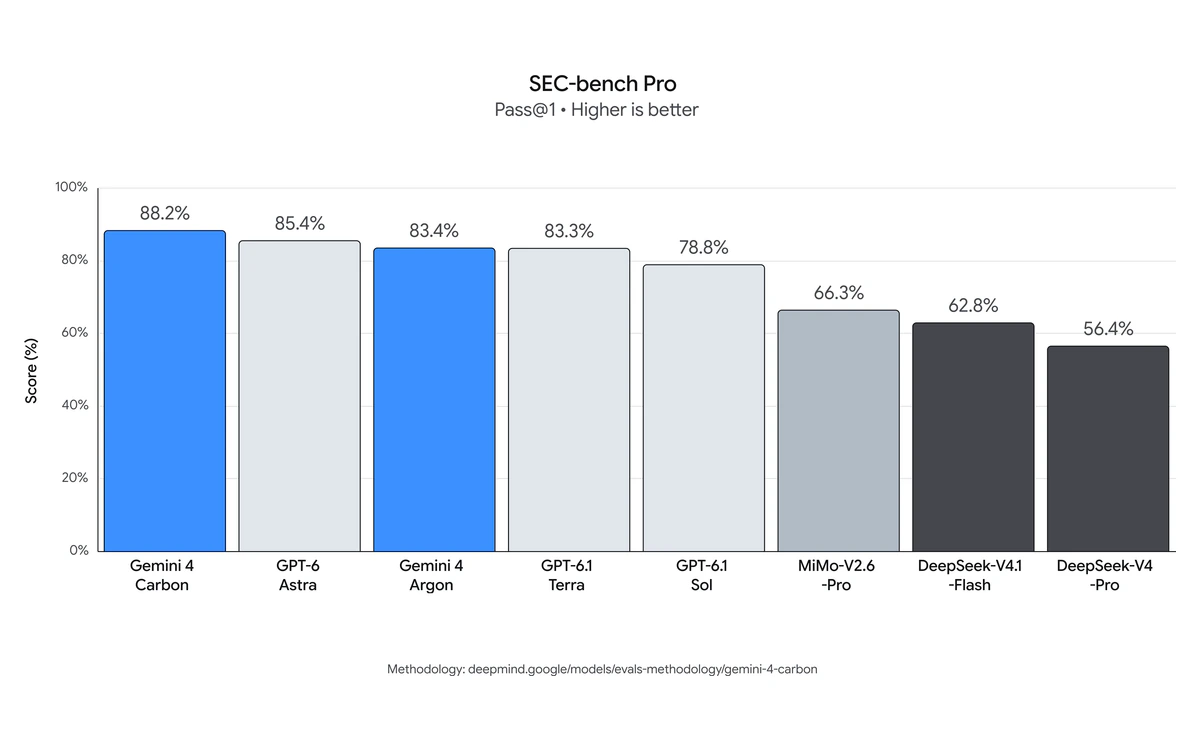
- Finding vulnerabilities: SEC-bench Pro, 88.2% (Pass@1), ahead of GPT-6 Astra at 85.4% and Argon at 83.4%.
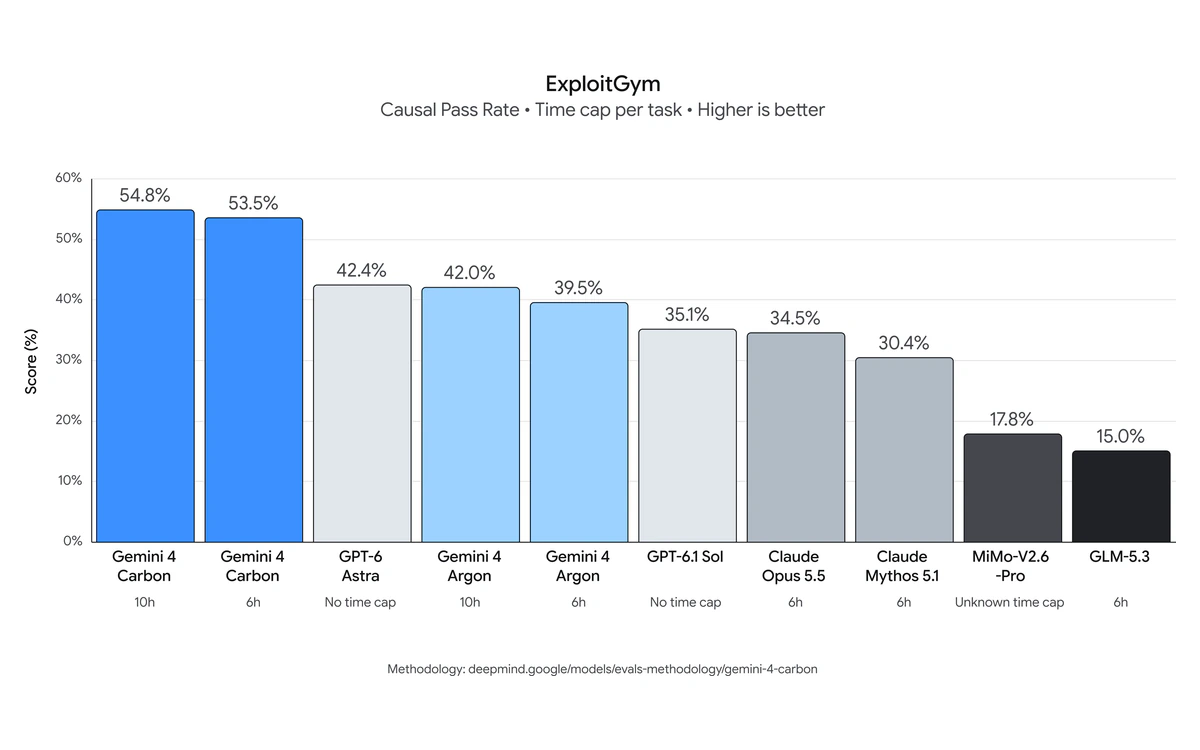
- Exploitation: ExploitGym, 54.8% with a 10-hour cap per task. GPT-6 Astra scores 42.4% with no cap, Argon 42.0% and Claude Opus 5.5 34.5% with a 6-hour cap.
- Patching: Collinear's CWE-bench, 71.0%, against 68.0% for both Argon and GPT-6 Astra and 67.0% for Claude Opus 5.5.
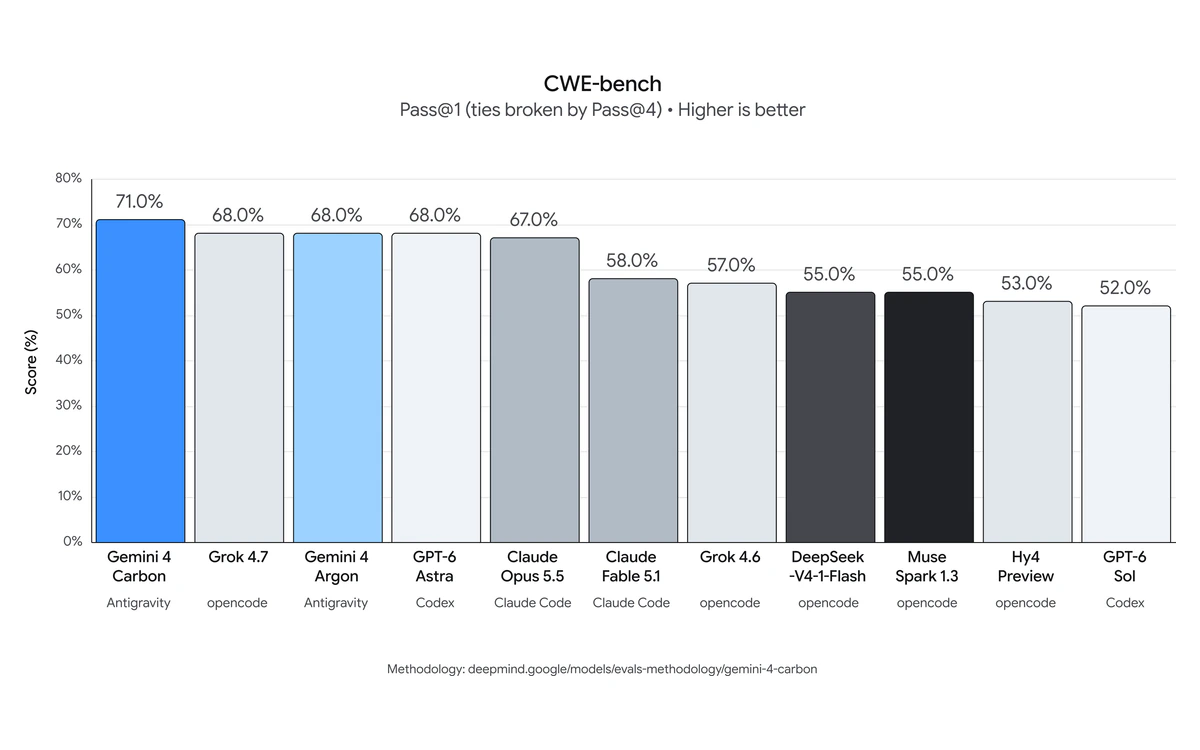
Google adds some internal claims. It reports "more than 2x uplift in success rate for generating secure code over Argon." Its Chrome team says Carbon "performed more than 10X better than another lab's large frontier model when generating high quality patches." Google doesn't name that lab. Wiz says Carbon leads on web penetration testing benchmarks, and it is using the model in its "Scan for Good" initiative.
Safety and prompt injection
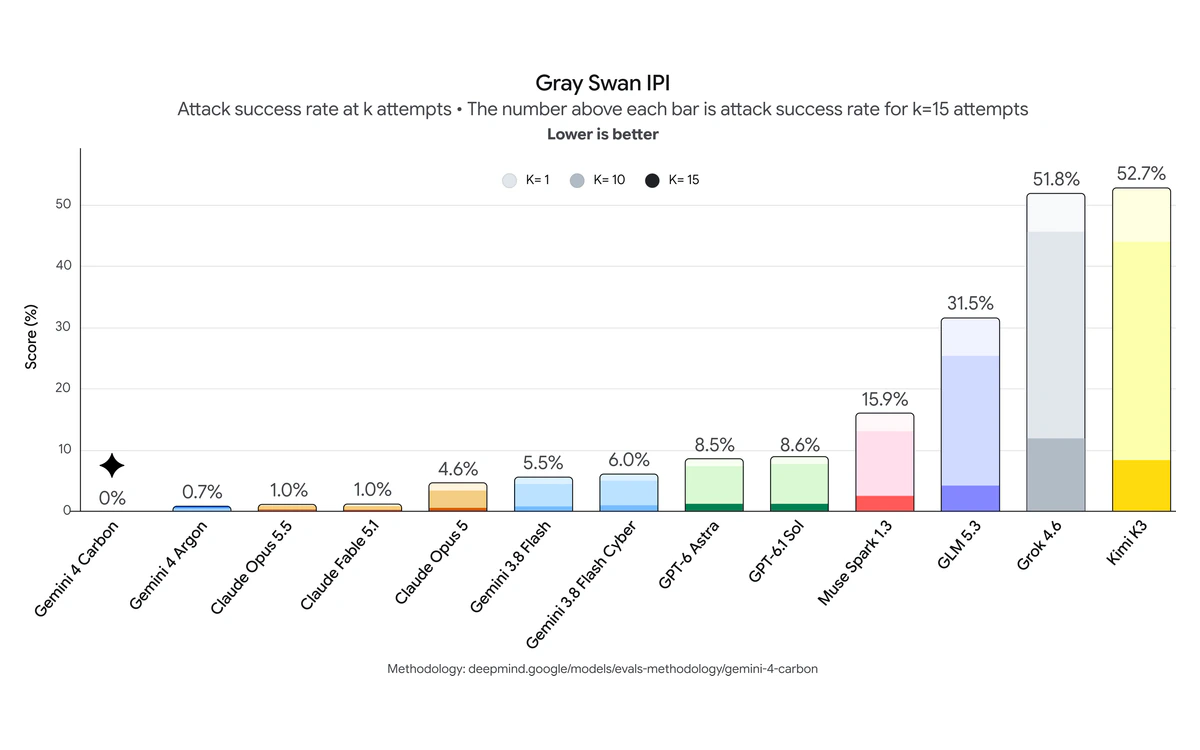
Google says Carbon uses the same layered safety stack as Argon: model training, real-time misuse defenses, prompt-injection resilience and chain-of-thought monitoring. It reports these results:
- Gray Swan Indirect Prompt Injection: 0.0% attack success rate at 15 attempts, against 0.7% for Argon. Google says Carbon resisted "every evaluated attack attempt."
- Terminal-Bench 4.0: successful cheating fell to 0.0%, and cheating attempts were 0.4%.
- Internal live coding: high-severity misalignment alerts fell by almost 80%.
- About half as many unsupported claims as Argon, 26% less overreach and 29% less under-service.
Who can use it now
Google describes the rollout this way: "Starting this week, we will make Carbon available to a subset of cyber defenders and will gradually phase access to additional trusted partners through our Fairwind Program. We're continuing to gather feedback and iterate on guardrails before making Carbon available to developers, businesses, and consumers via our product surfaces as soon as possible."
Fairwind is the access program Google set up for Argon. According to its program page, it gives priority to governments and national cyber authorities, critical-infrastructure operators in healthcare, telecom, energy and finance, and core technology platforms. Academic labs doing defensive benchmarking can apply too. Applications go through a Google Cloud account team. Partners may do only dual-use work such as authorized threat simulation, reverse engineering and malware analysis. Creating malware is banned, phishing-resistant MFA is required, access can't be shared or resold, and organizations are background-checked. The Fairwind page still lists only Argon. Carbon's inclusion comes from the Carbon announcement.
What it will cost
Carbon starts at Argon's introductory price: $2 per million input tokens and $10 per million output tokens. Cached input is 95% off the input price. Google's footnote says that after the introductory period, "the price of $4 per 1M input tokens and $20 per 1M output tokens will apply." Google hasn't said when the introductory period ends. Because the model isn't publicly available, nobody outside the program pays either rate yet.
Why it matters
This is Google's second frontier model in a row to go to defenders before the public, and the pattern looks deliberate. A model that can find and exploit vulnerabilities this well can help either side, so the labs are giving defenders a head start on patching first. For developers, Carbon is a preview for now: something to plan for, not something to build on yet.
We covered Argon's launch in our earlier article at /google-gemini-4-argon-1m-output-tokens-fairwind. Google's announcement is at https://blog.google/innovation-and-ai/models-and-research/gemini-models/introducing-gemini-4-carbon/, and the Fairwind program page is at https://deepmind.google/fairwind-program/.
Key takeaways
- Google DeepMind announced Gemini 4 Carbon on October 28, 2026, two weeks after Gemini 4 Argon reached the Gemini app.
- Google says Carbon is #1 on the Artificial Analysis Intelligence Index v5.0 with 59, ahead of Claude Opus 5.5 (58) and GPT-6 Astra (57).
- It leads Google's chosen security benchmarks: SEC-bench Pro 88.2%, ExploitGym 54.8% and CWE-bench 71.0%, all measured without guardrails.
- It doesn't lead everywhere: GPT-6 Astra wins FrontierSWE 2 and Claude Opus 5.5 wins OSWorld-2.1.
- Access is limited to vetted cyber defenders in the Fairwind Program, with no public availability date.
- Pricing will be $2/$10 per million input/output tokens during an introductory period, then $4/$20.
More in Tech News
Browse Tech News