Apple's MacBook Pro with PROLED XDR Display Is the First Touchscreen Mac, and Touch Costs $400
Apple's new 14- and 16-inch MacBook Pro adds a tandem OLED touchscreen and a Dynamic Island on the same M5 Pro and M5 Max chips, for $400 more. Here is what changes, what it costs and who should buy it.
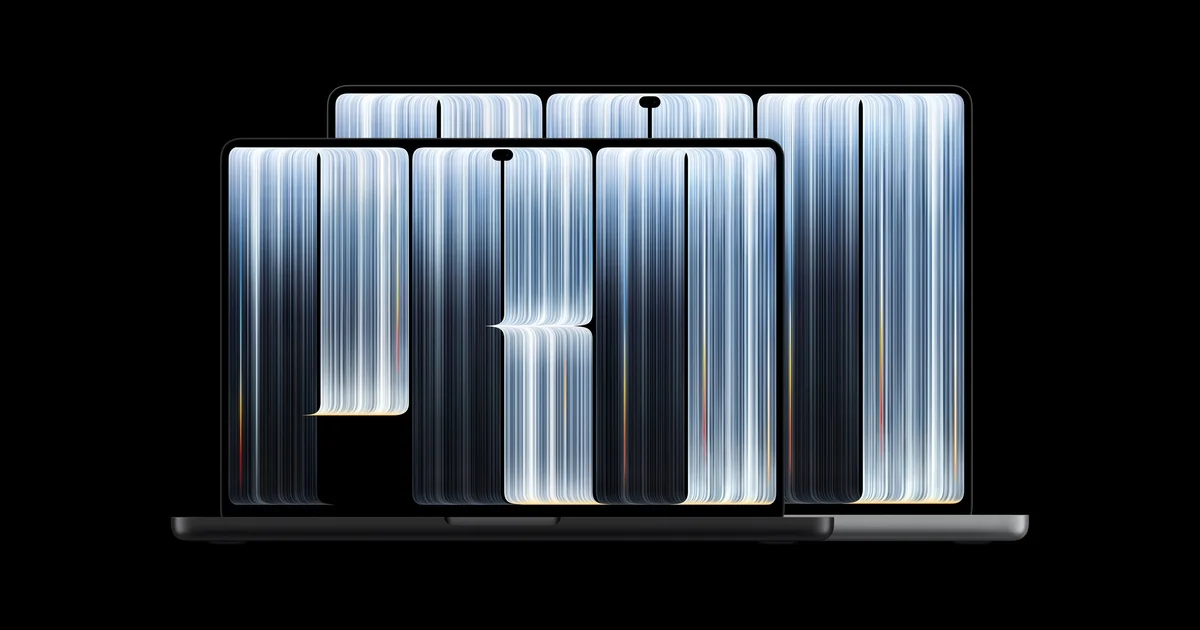
After years of insisting the Mac did not need a touchscreen, Apple has shipped one. On October 28, 2026, Apple announced the MacBook Pro with PROLED XDR Display in 14-inch and 16-inch sizes. It is the first Mac with a touch display and the first Mac with an OLED panel, and it trades the notch for a Dynamic Island.
What it does not change is the silicon. The new models use the same M5 Pro and M5 Max chips as the MacBook Pro Apple released in March, and every configuration costs exactly $400 more than its mini-LED equivalent. Pre-orders are open now, and the first units arrive Friday, November 6.
What Apple announced
Apple's Newsroom calls it "the new MacBook Pro with PROLED XDR Display", and the headline features are the ones Mac users have argued about for a decade: a touch-enabled screen, an OLED panel and a thinner, lighter body. The lid's Apple logo now lights up as well, according to MacRumors.
Johny Srouji, Apple's chief hardware officer, put it plainly: "The new MacBook Pro with PROLED XDR Display is a monumental step forward for the Mac."
The PROLED XDR models sit above the existing line rather than replacing it. The March 2026 mini-LED MacBook Pro configurations stay on sale at their current prices, and a day earlier, on October 27, Apple separately introduced a non-touch 14-inch MacBook Pro with the M6 chip starting at $1,999.
How touch works on a Mac
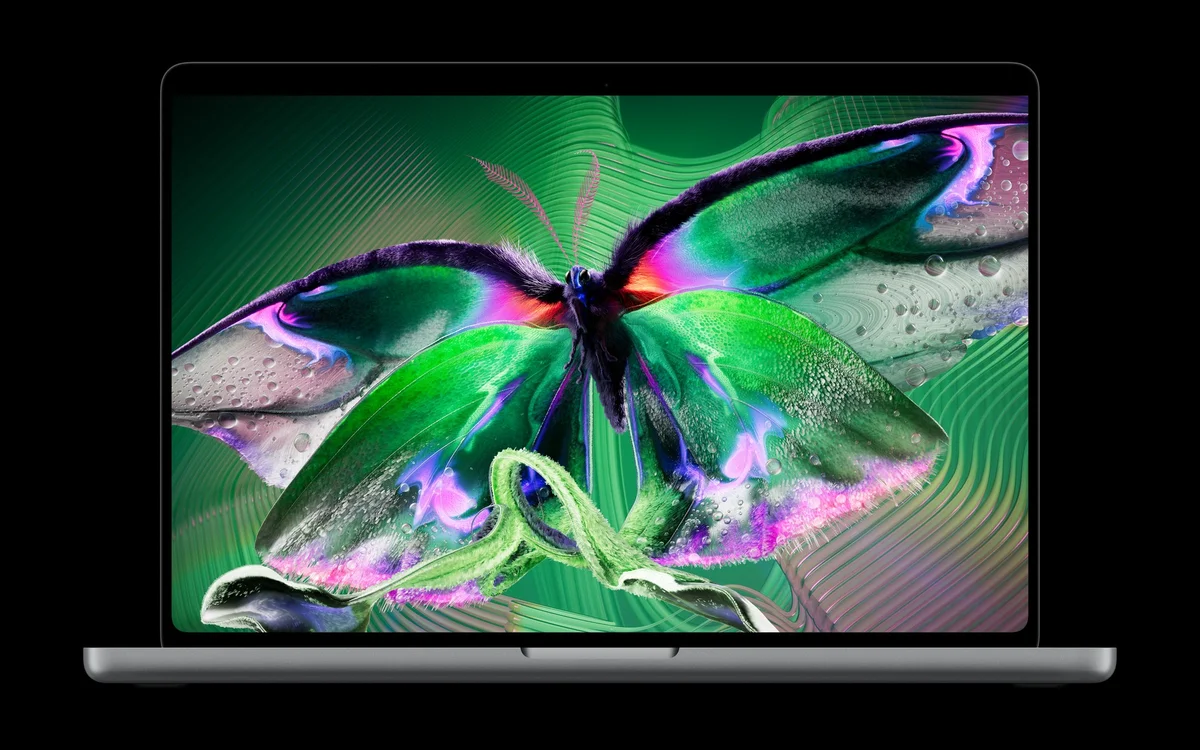
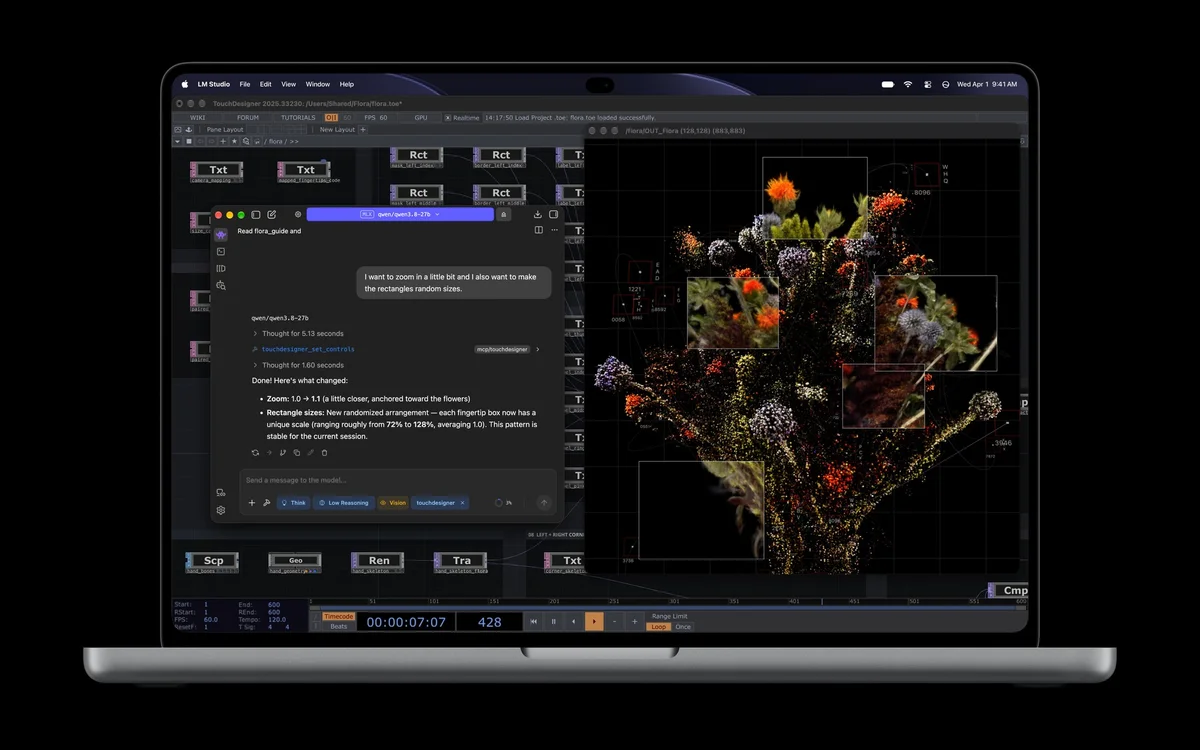
The touch sensor is built into the display panel itself, and Apple says it adds no latency. macOS translates touches into clicks, so many existing apps respond to touch on day one without an update.
In Apple's demos, and as reported by 9to5Mac, touch covers the everyday gestures you would expect from an iPad:
- Swipe to scroll a webpage and pinch to zoom into photos.
- Drag and drop slides between presentations.
- Double-tap a window to fill the screen, or flick it to tile it.
- Draw using the whole display as a canvas.
- Play software instruments onscreen in Logic Pro.
- Test how iOS and iPadOS apps behave under touch directly on the Mac.
Apple redesigned the hinge so the screen wobbles less when you tap it, and video stabilization smooths the camera feed if you touch the display during a call. MacRumors reports that adding touch did not reduce battery life.
Third-party support is lined up, though some of it is listed as "available later this year": Notion, Canva, Zoom, Microsoft Word, Excel, PowerPoint and Outlook, Adobe Lightroom, DaVinci Resolve, Pixelmator Pro, Blender, Cinema 4D, ZBrush, Shapr3D and djay Pro, alongside Apple's own Final Cut Pro and Logic Pro.

The PROLED XDR display
PROLED XDR replaces mini-LED with a tandem OLED panel: two layers of self-illuminating pixels, which means no blooming or halos around bright objects on dark backgrounds. Apple's figures:
- 14.2-inch diagonal on the 14-inch model, 16.3-inch on the 16-inch model.
- Up to 2000 nits peak brightness for both HDR and SDR, up from 1600 nits peak HDR on mini-LED.
- 10,000,000:1 contrast ratio.
- ProMotion adaptive refresh from 10Hz to 120Hz.
- P3 and Adobe RGB in a single default preset, with over 80% Rec. 2020 coverage.
- Antireflective coating as standard, nano-texture glass as an option.
- DICOM medical imaging modes, for nondiagnostic use only.
Apple's announcement does not state the panel resolution.
The notch is gone, the Dynamic Island arrives
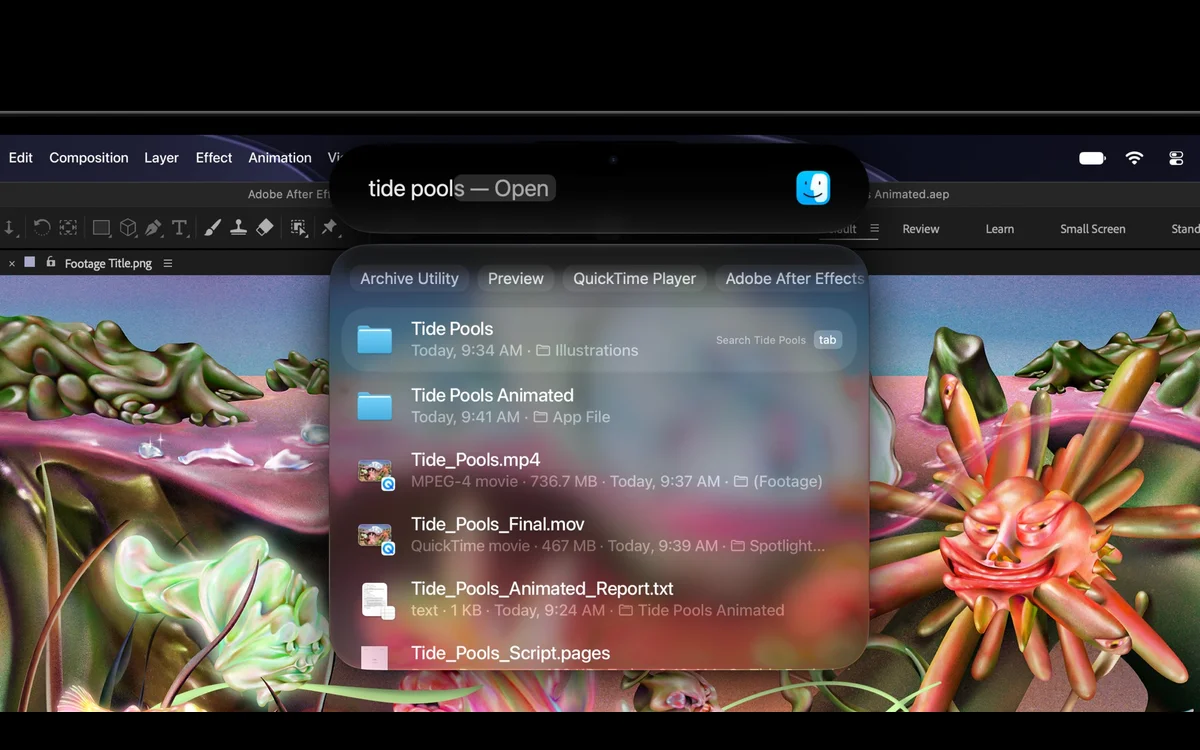
The camera notch at the top of the screen is replaced by a Dynamic Island, borrowed from the iPhone. On the Mac it holds Live Activities, Siri AI and Spotlight.
The Siri AI fine print
Spotlight moves into the Dynamic Island only if Siri AI is available and turned on. Apple's footnotes describe Siri AI as a beta in macOS 27.2, and availability varies by region.
Thinner, lighter, same battery promise
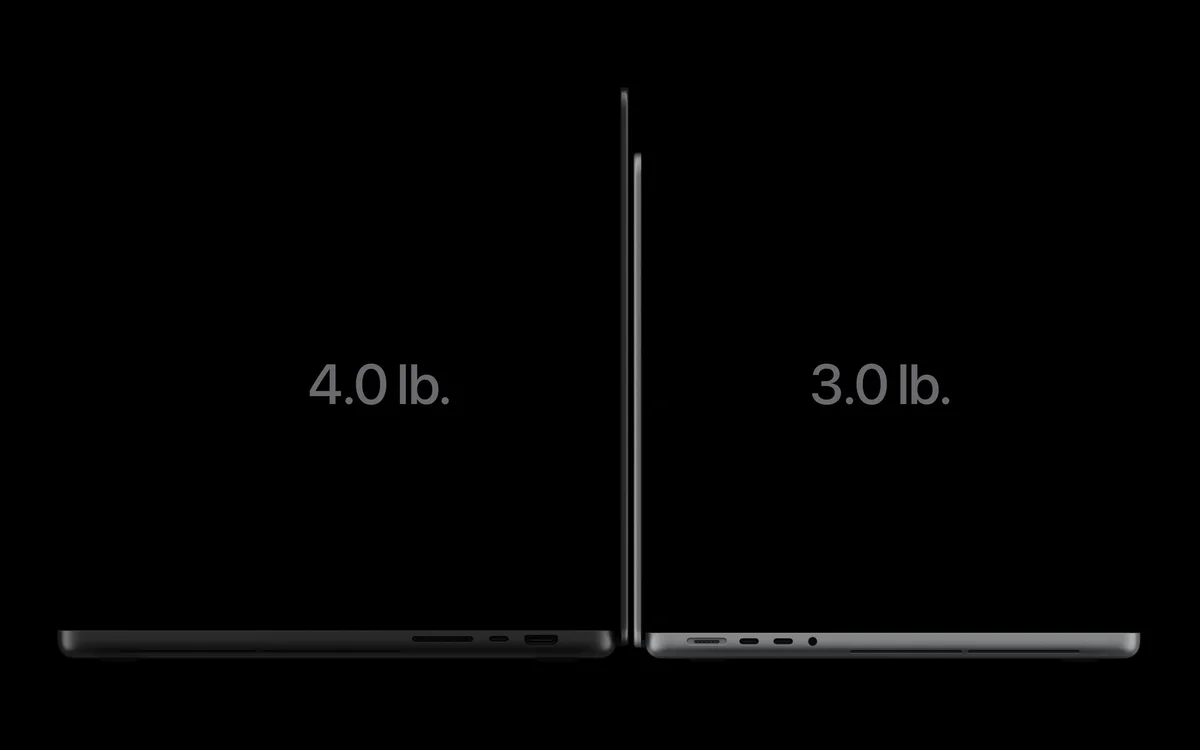
Both sizes lose weight and a little thickness. The thermal system was also redesigned to push warm air away from the display, per MacRumors.
- 14-inch: 3.0 lb, down from 3.5 lb; 0.59 x 12.24 x 8.52 inches, down from 0.61 x 12.31 x 8.71.
- 16-inch: 4.0 lb, down from 4.7 lb; 0.63 x 14 x 9.62 inches, down from 0.66 x 14.01 x 9.77.
Apple claims up to 24 hours of battery life, based on its own testing in September 2026, and a fast charge to 50% in about 30 minutes. The six-speaker system gets 50% deeper bass and dedicated tuning for closed-lid audio, and the 12MP Center Stage camera and Touch ID carry over. It comes in Space Black and Silver.
Same chips, double the storage ceiling
Pre-launch rumours pointed to M6, but the PROLED XDR models run the M5 Pro and M5 Max, the same chips as the March MacBook Pro. Unified memory still tops out at 128GB, while maximum storage doubles from 8TB to 16TB. Each GPU core includes a Neural Accelerator, and Apple says the M5 Max can run large language models with hundreds of billions of parameters on device.
Ports are unchanged in spirit: three Thunderbolt 5 ports, HDMI, an SDXC slot, MagSafe and a headphone jack. The M5 Pro drives up to three external displays and the M5 Max up to four, on top of the built-in screen. Wi-Fi 7 and Bluetooth 6 come from Apple's N1 chip, and the machines ship with macOS 27 Golden Gate.
What you pay: a flat $400 for OLED and touch
US starting prices, with the price of the same configuration on the mini-LED MacBook Pro just before the announcement:
- 14-inch M5 Pro: $2,899, versus $2,499 ($2,749 education).
- 16-inch M5 Pro: $3,399, versus $2,999 ($3,199 education).
- 14-inch M5 Max: $4,499, versus $4,099 ($4,199 education).
- 16-inch M5 Max: $4,799, versus $4,399 ($4,499 education).
MacRumors notes that the $400 premium works out to roughly 16% on the entry-level 14-inch M5 Pro. At the top end, an M5 Max with an 18-core CPU, 40-core GPU, 128GB of memory, 16TB of storage and nano-texture glass costs $14,249 as a 14-inch and $14,549 as a 16-inch. The previous 16-inch topped out at $10,149, with 8TB of storage.
Apple also offers the machine through its Apple Upgrade lease from $55.99 a month over 36 months, based on the $2,899 model.
OLED or mini-LED: who should buy which
Because the chips are identical, the mini-LED MacBook Pro performs about the same, as 9to5Mac points out. The $400 buys the display, touch, the Dynamic Island, the glowing logo and a lighter chassis, not more speed.
- Buy PROLED XDR if you work on HDR video or photos, want touch for drawing, music or testing iPad and iPhone apps, or carry the laptop all day and value the lost weight.
- Stay with mini-LED if your work is compiling, rendering or model training, where the same chip at $400 less is the better deal.
- Look at the M6 14-inch from $1,999 if you do not need M5 Pro or M5 Max class performance at all.
Availability
Pre-orders opened October 28, 2026 on apple.com and in the Apple Store app in 30 countries and regions, including the US. The MacBook Pro with PROLED XDR Display arrives in customers' hands and in Apple Stores and Apple Authorized Resellers on Friday, November 6, 2026. 9to5Mac reports it is also sold through Amazon.
Frequently asked questions
How much does the touchscreen MacBook Pro cost?
It starts at $2,899 for the 14-inch M5 Pro and $3,399 for the 16-inch M5 Pro in the US. M5 Max models start at $4,499 and $4,799, and a fully loaded 16-inch reaches $14,549.
Is the PROLED XDR MacBook Pro faster than the mini-LED model?
No. Both use the same M5 Pro and M5 Max chips, so performance is about the same. The PROLED XDR model does offer up to 16TB of storage instead of 8TB.
Do my existing Mac apps work with touch?
Many do right away, because macOS translates touches into clicks. Apps such as Final Cut Pro, Logic Pro, Microsoft Office, Lightroom and Zoom add dedicated touch support, some of it later this year.
Does touch hurt battery life?
Not according to MacRumors, which reports no reduction from touch. Apple rates the new models at up to 24 hours, based on its own September 2026 testing.
Can I still buy a MacBook Pro without a touchscreen?
Yes. The March 2026 mini-LED MacBook Pro stays on sale at its existing prices, from $2,499, and the new M6 14-inch MacBook Pro starts at $1,999.
When can I get one?
Pre-orders are open now in 30 countries and regions, and orders and in-store availability begin Friday, November 6, 2026.
Key takeaways
- The MacBook Pro with PROLED XDR Display is the first Mac with a touchscreen and the first with an OLED panel.
- It uses the same M5 Pro and M5 Max chips as the March MacBook Pro, so the upgrade is the display, not speed.
- Every configuration costs $400 more than its mini-LED equivalent, starting at $2,899 for the 14-inch.
- The notch is replaced by a Dynamic Island, and both sizes are thinner and lighter.
- Pre-orders are open in 30 countries and regions, with availability on November 6, 2026.
More in Tech News
Browse Tech News