Asana Review 2026: Pricing, AI Credits and Free Plan Limits
An independent look at Asana in 2026: the four plans and their real prices, the two-seat free tier, AI Studio credit pools, AI Teammates as a paid add-on, and where it stops.
Asana has sold the same promise since 2012: put every piece of a team's work in one place so nobody has to ask where a project stands. In 2026 the promise is unchanged and the packaging is not. The company now describes itself as an operating system for human-agent teams, the pricing page leads with credit allowances, and the free tier that once carried a whole small team stops at two people.
This review covers what Asana actually does, what the four plans cost at list price in August 2026, what the AI layer includes and what it hides behind a sales call, and the places the tool reliably frustrates people. Prices quoted are the published annual rates; Asana gives Enterprise numbers on request only.
How Asana is organised
Everything in Asana nests. An organization or workspace holds billing, members and security settings. Teams sit inside it and decide who can see which projects. Projects hold tasks, and tasks hold subtasks. Getting that hierarchy wrong on day one costs months of permission cleanup later, because a project belongs to one team at a time.
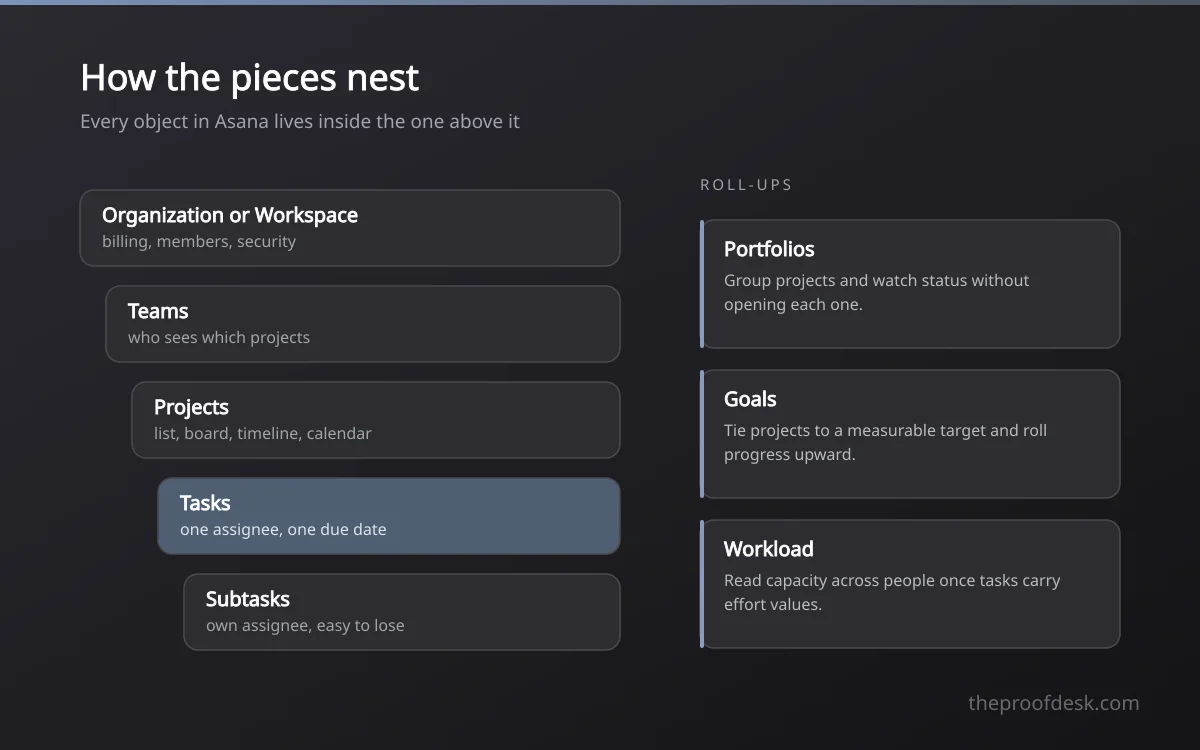
A project is one set of tasks you can look at several ways. The same work renders as a list, a board, a calendar or, from Starter upward, a timeline with dependencies. Switching view copies nothing; it is one dataset drawn four ways, and that is the part that makes the tool click for most teams.
- Custom fields turn a task list into a small database: status, priority, effort, cost, or anything else you name.
- Forms feed a project from outside, so requests arrive with the fields already filled in.
- Rules fire on a trigger such as a status change and handle the assignment, the due date or the notification.
- Portfolios group projects for reporting, and goals connect those projects to a number somebody is accountable for.
- Workload reads effort values across people, which is as close as Asana gets to resource planning.
The rule that catches new teams
A task takes exactly one assignee. Asana treats ownership as a single name on purpose, and there is no supported way to split a task between two people. Teams that work in pairs end up duplicating tasks or hiding the real work in subtasks, and both habits make reporting noisier.
Asana lists more than 200 integrations, including Slack, Microsoft Teams, Google Drive, Salesforce and Jira, and exposes a public API for anything not on that list. Subtasks are the other trap worth knowing early: they do not join the parent's project automatically, so work assigned in a subtask can vanish from the board everyone else is watching.
The four plans and what they cost
Asana publishes three prices and withholds the fourth. Personal is free, Starter is $10.99 per user per month on annual billing, and Advanced is $24.99 on the same terms. Monthly billing costs $13.49 and $30.49, so paying yearly saves a little under a fifth. Enterprise and Enterprise+ are quoted by sales.
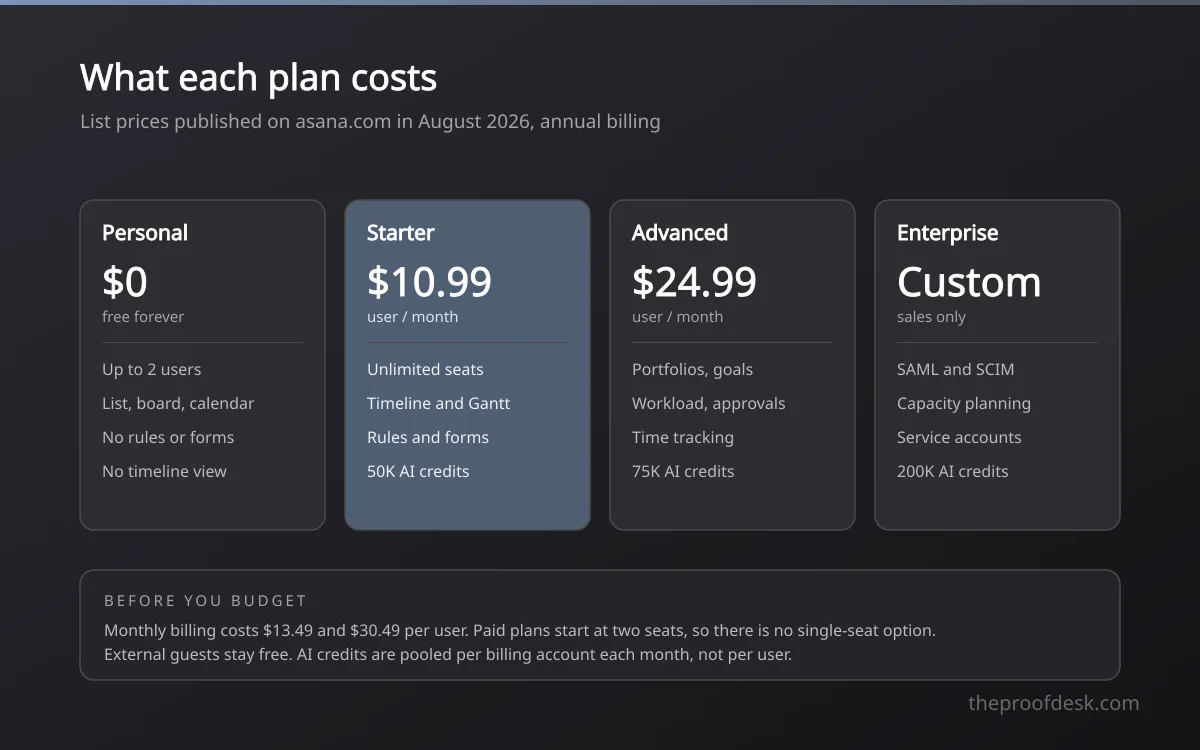
- Personal: up to two users, unlimited tasks and projects, list, board and calendar views, and basic AI in chat and the editor.
- Starter: unlimited seats, timeline and Gantt, reporting dashboards, forms, rules, custom templates, and 50,000 AI Studio credits a month.
- Advanced: adds unlimited portfolios, goals, workload, approvals, proofing, time tracking and formulas, with 75,000 credits a month.
- Enterprise: adds SAML, SCIM provisioning, service accounts, view-only licences, universal workload and capacity planning, with 200,000 credits.
- Enterprise+: the same product with the heavier security and compliance controls regulated buyers ask for.
Two details move the real bill. Paid plans start at two seats, so a freelancer working alone pays for a colleague who does not exist. Above that, seats are sold in blocks: singles up to five users, then fives up to thirty, then tens up to a hundred. A team of thirty-one buys thirty-five. External collaborators, by contrast, are free and unlimited on every paid plan, which is genuinely useful for client and agency work.
Add-ons priced separately
Timesheets and Budgets costs $5.99 per user per month and brings time entry, billable rates and cost tracking. AI Teammates is an add-on on every paid tier with no public price. Compliance management is Enterprise only. Budget for these on top of the seat price rather than inside it.
Where the free plan stops
The Personal plan changed in late 2025. New accounts cap at two collaborating users, where the old free tier carried a much larger group, and workspaces created before the change kept their legacy allowance. Anyone comparing Asana against an article written in 2024 is reading about a plan they can no longer sign up for.
- No custom fields, so no status, priority or effort columns.
- No rules, so every handoff is manual.
- No forms, so intake happens in a chat message.
- No timeline view and no dependencies.
- No Asana AI beyond the basic chat and editor helpers.
What remains is generous in volume and thin in structure: unlimited tasks, projects and messages, list, board and calendar views, and attachments up to 100 MB. That is a real tool for one person tracking their own work or two people sharing a list. The third teammate forces the upgrade, not the feature list.
AI Studio, Teammates and Dash
AI Studio is the part of the AI push every paid customer gets. You describe a workflow in plain language, choose where it triggers, and Asana runs a model over the task: summarising a brief, classifying an incoming request, drafting a first reply, routing work to the right owner. It sits alongside rules rather than replacing them.
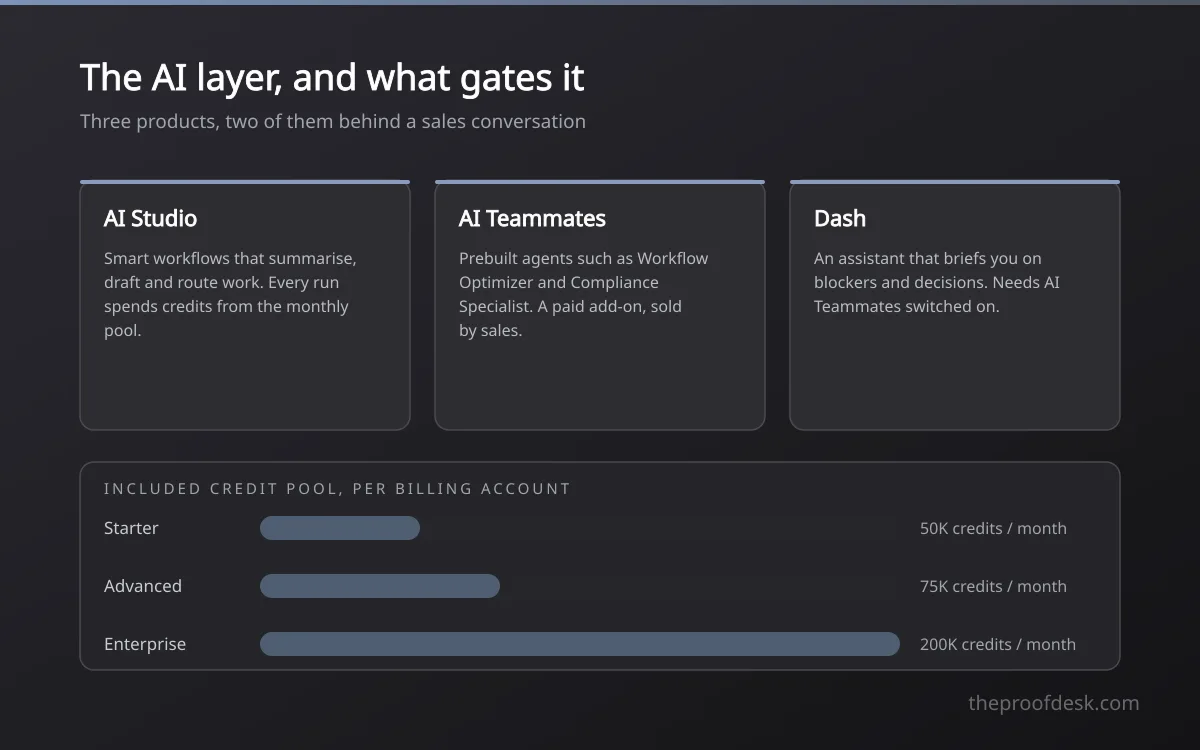
Runs cost credits from a pool that belongs to the billing account rather than to each user. The size of a run drives the cost: text processed in and out, multiplied by a rate that depends on the model chosen, plus more if the workflow reaches out to the web. Heavy models on long attachments drain a monthly allowance quickly, and when the pool empties the smart workflows stop until it resets. Larger Plus and Pro tiers exist for teams that hit the ceiling.
- Pick the lighter model for classification and short summaries.
- Cap output length in the instructions instead of letting the model ramble.
- Add conditions so a rule only runs when its input is actually ready.
- Keep large attachments out of prompts that do not need to read them.
AI Teammates are the sales-led half. Asana ships a gallery of prebuilt agents by function: Campaign Brief Writer, Brand Auditor and Copywriter for marketing, Status Reporter, Workflow Optimizer and Decision Tracker for operations, IT Support Specialist and Compliance Specialist for IT, and Spec Reviewer, Bug Investigator and Sprint Coach for product teams. Custom teammates need no code. All of it is an add-on to Starter, Advanced, Enterprise and Enterprise+, quoted rather than listed.
Dash, announced in June 2026, is the personal layer over the rest: a briefing of what is blocked, what needs a decision and what changed since yesterday, with a suggested next action and the teammate that could take it. It requires AI Teammates to be enabled. Separately, connectors let Claude, ChatGPT and Gemini create projects and assign work in Asana from inside a chat.
Read the strategy before you buy the seat
Asana bought StackAI in May 2026 to run agent workflows across systems it does not own, such as CRM, ERP and ITSM tools. The direction is clear and the roadmap is moving fast, which cuts both ways: the AI features you evaluate this quarter may be repackaged or repriced by the next.
Who it fits, and where it frustrates
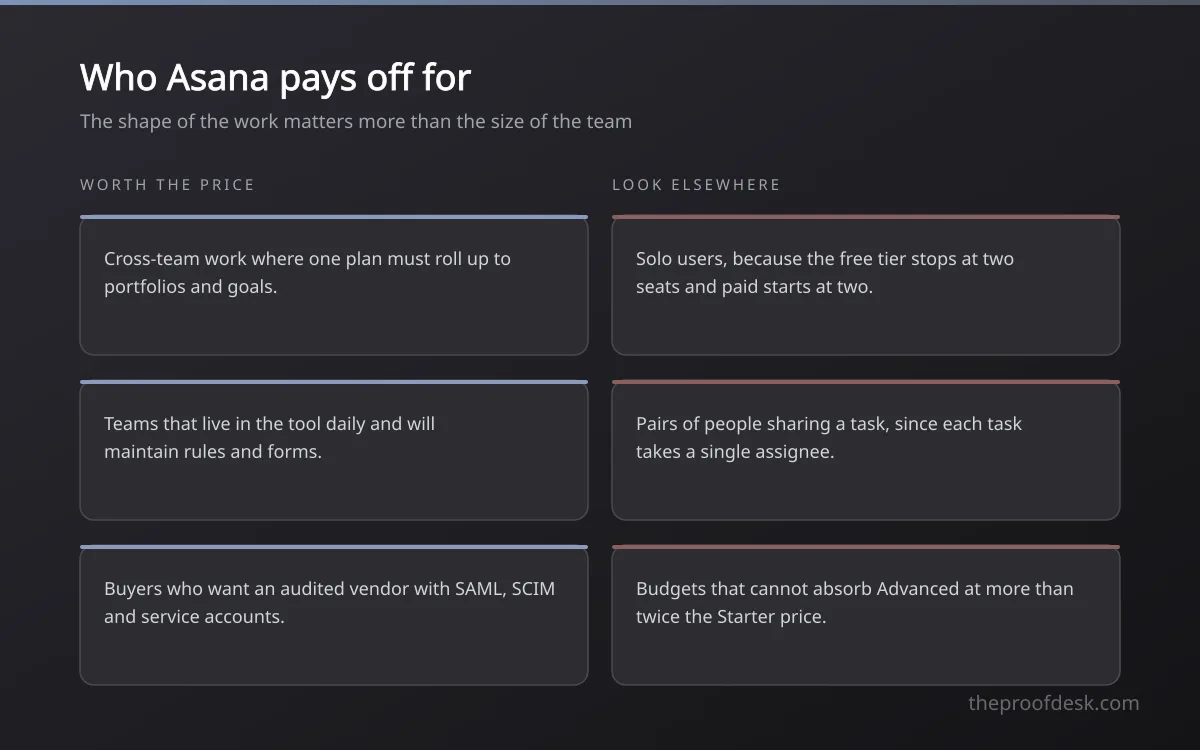
Asana earns its price when work crosses teams and somebody senior needs the summary without chasing anyone for it. Portfolios, goals and workload only pay off when projects are structured the same way, which means one person has to own the setup and keep templates honest. Where nobody owns that, the tool degrades into an expensive shared task list.
- The learning curve is real: workspaces, teams, projects, tasks and subtasks look alike and behave differently.
- The features teams upgrade for, portfolios and goals and workload, all sit on Advanced at more than twice the Starter seat price.
- Support quality draws recurring complaints, with slow and generic replies reported on the lower tiers.
- The most interesting AI is quoted rather than listed, so total cost cannot be compared without a sales call.
- Single assignee ownership suits accountability and annoys teams that genuinely share tasks.
For a team of ten already living in Asana, Starter plus a disciplined project template is the sensible default, and Advanced pays for itself the moment somebody asks for a portfolio view. For two people who mostly need a shared list, the free plan still does the job. For one person, the two-seat minimum makes it an expensive to-do list, and a lighter tool will cost less and teach faster.
Key takeaways
- Starter costs $10.99 and Advanced $24.99 per user per month on annual billing, while Enterprise is quoted privately.
- The free Personal plan now stops at two users, so it no longer covers a small team.
- AI Studio credits are pooled per billing account and spent per run, so heavy models on long documents drain them fast.
- AI Teammates and Dash are add-ons with no published price, which makes the real total cost hard to compare.
- Portfolios, goals and workload, the features most teams upgrade for, all sit on Advanced rather than Starter.
More in Services & Software
Browse Services & Software