Bitdefender VPN Review 2026: $34.99 First Year, IPVanish Servers and an Unnamed Audit
Bitdefender Premium VPN costs $34.99 for year one, then $69.99. We check the 10-device plan, free 200 MB tier, IPVanish backbone and its no-logs audit claim.
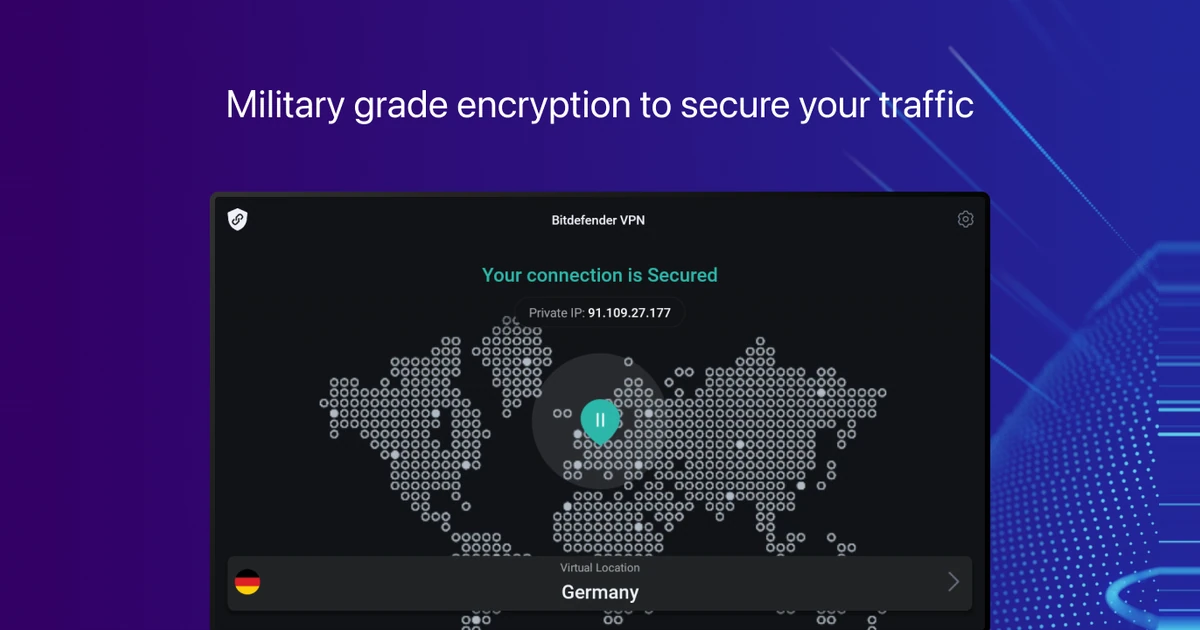
Bitdefender is best known for antivirus, but its Premium VPN is sold as a standalone product too, and it is one of the cheapest first-year VPN deals from a big-name security brand: $34.99 for the first year, renewing at $69.99.
The price is not the interesting part, though. Most reviews still describe Bitdefender VPN as built on Pango (Hotspot Shield) technology. Bitdefender's own privacy policy, version 10.4 adopted on August 18, 2026, now names IPVanish as the company that processes VPN data on its behalf. This review explains what that means, what the plan includes, what the free tier really gives you, and where the app falls short.
All prices below are in US dollars, read from Bitdefender's own store on October 5, 2026. They change with campaigns and by region.
Quick verdict
Bitdefender Premium VPN is a polished, easy VPN for people who want one subscription across up to 10 phones and computers without touching settings. The first-year price is low, WireGuard is available, the kill switch is on every desktop app and Android, and there is a genuinely usable free tier at 200 MB per day.
The weak spots are transparency and depth. The 2025 no-logs audit names no auditor and has no published report, the infrastructure is now run by a US company, split tunneling only exists on Windows and Android, and there is no Linux app, router support or browser extension.
Best for
Bitdefender antivirus users, households that want 10 devices on one cheap plan, and casual users who mainly need public Wi-Fi protection. Look elsewhere if you need Linux, router setup or an audit report you can actually read.
Pricing and plans
Bitdefender sells Premium VPN on its own in two billing options. Both cover up to 10 devices at once.
- Monthly: $6.99 per month, no first-term discount.
- Yearly: $34.99 for the first year, then $69.99 per year at renewal. Bitdefender advertises this as 50% off.
- Effective cost: about $2.92 per month in year one and about $5.83 per month after renewal.
The renewal jump is spelled out on the product page: the offer price "is valid for the first year of subscription. After that, your subscription will be billed at the applicable renewal price which may be higher than the initial purchase price." Two years on the yearly plan costs $104.98. Even at the renewal price, yearly billing stays cheaper than paying $6.99 a month, which adds up to $83.88 a year.

Getting the VPN through a Bitdefender bundle
Premium VPN is also included in Bitdefender's bigger security suites. Premium Security starts at $79.99 for the first year ($129.99 list) for 5 devices, and Ultimate Security starts at $119.99 for the first year ($189.99 list). If you were going to buy Bitdefender antivirus anyway, a bundle can work out cheaper than buying the VPN and antivirus separately. If you only want a VPN, the standalone plan is the better deal.
Refunds and auto-renewal
Bitdefender offers a 30-day money-back guarantee. Refunds are requested by email to [email protected] within 30 days of the initial purchase or of an automatic renewal date. Subscriptions renew automatically at the then-current rate; you can switch that off in Bitdefender Central or by emailing [email protected], and Bitdefender says it emails you before billing. App Store purchases follow Apple's rules and must be turned off at least 24 hours before the period ends.
Free tier and 7-day trial
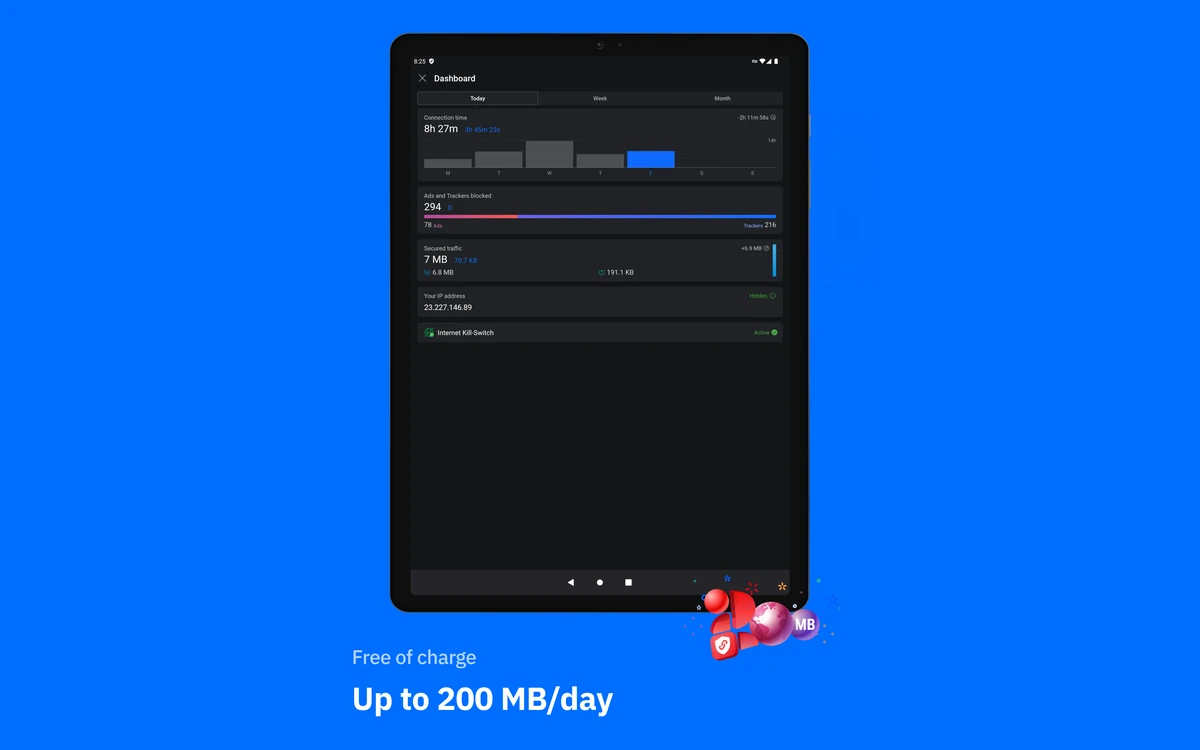
Bitdefender still offers a free version. According to its support documentation it gives 200 MB of traffic per device per day, resets at midnight UTC, and connects you automatically to the optimal server with no option to choose a location. A 500 MB daily quota exists only in Bitdefender Small Office Security subscriptions.
200 MB is enough for checking email and banking on a hotel or cafe network, not for streaming or large downloads. Treat it as an emergency Wi-Fi shield.
There is also a 7-day free trial of the full Premium VPN that Bitdefender says requires no credit card, on the website and in both mobile app stores. That is a better way to test speeds and streaming than the capped free tier.
Who actually runs Bitdefender VPN
Bitdefender does not operate its VPN network itself, and that has always been the case. Many older reviews, and an older answer still on Bitdefender's marketing FAQ that mentions the Hydra protocol, describe the service as built on Pango and Hotspot Shield technology.
Bitdefender's current privacy policy (version 10.4, adopted August 18, 2026) says something different: "For this service, we use IPVanish as data processor who processes data on behalf of Bitdefender in accordance with Bitdefender's instructions and for the sole purpose of providing VPN services to users." The policy does not mention Pango or Aura. Bitdefender's terms of service also quote an acceptable use policy that opens with "All IPVanish customers are responsible for reviewing and complying with this Acceptable Use Policy."
We found no announcement or date for the change, so we cannot say when it happened. What matters for buyers is the current state: the VPN servers and traffic handling are provided by IPVanish.
Why the jurisdiction claim needs context
The product page says Bitdefender "has a privacy-friendly jurisdiction sitting outside of the 5/9/14 eyes". Bitdefender is headquartered in Bucharest, Romania, so that is true of Bitdefender. IPVanish, however, has been owned since 2019 by Ziff Davis (formerly J2 Global), a US company. Your traffic passes through infrastructure run by a US-based processor, which weakens the jurisdiction argument.
Logging policy and the 2025 audit
Bitdefender's privacy policy says it collects "only randomly generated or hashed user and device IDs, IP addresses and randomly generated tokens to establish VPN connection" and that it does not "store any details regarding your location or online activity nor do we share them with other entities." A support article adds that "Once a session ends, no identifiable data is retained."
Two gaps remain. The policy gives no retention period for the IP addresses and IDs it does collect, and Bitdefender publishes no transparency report. The policy also allows device location processing for features such as unsafe Wi-Fi alerts and auto-connect.
On audits, Bitdefender says that "In 2025, the infrastructure used by Bitdefender VPN underwent an independent audit to verify our no-log policy" and that the audit confirmed compliance. It does not name the auditor and has not published the report, so readers cannot check the scope or findings.
For context only: IPVanish has had its own no-logs audits, by Leviathan Security Group in 2022 and Schellman in 2025. Bitdefender does not say that either of those is the audit it refers to, so we do not treat them as Bitdefender's audit.
Apps and features
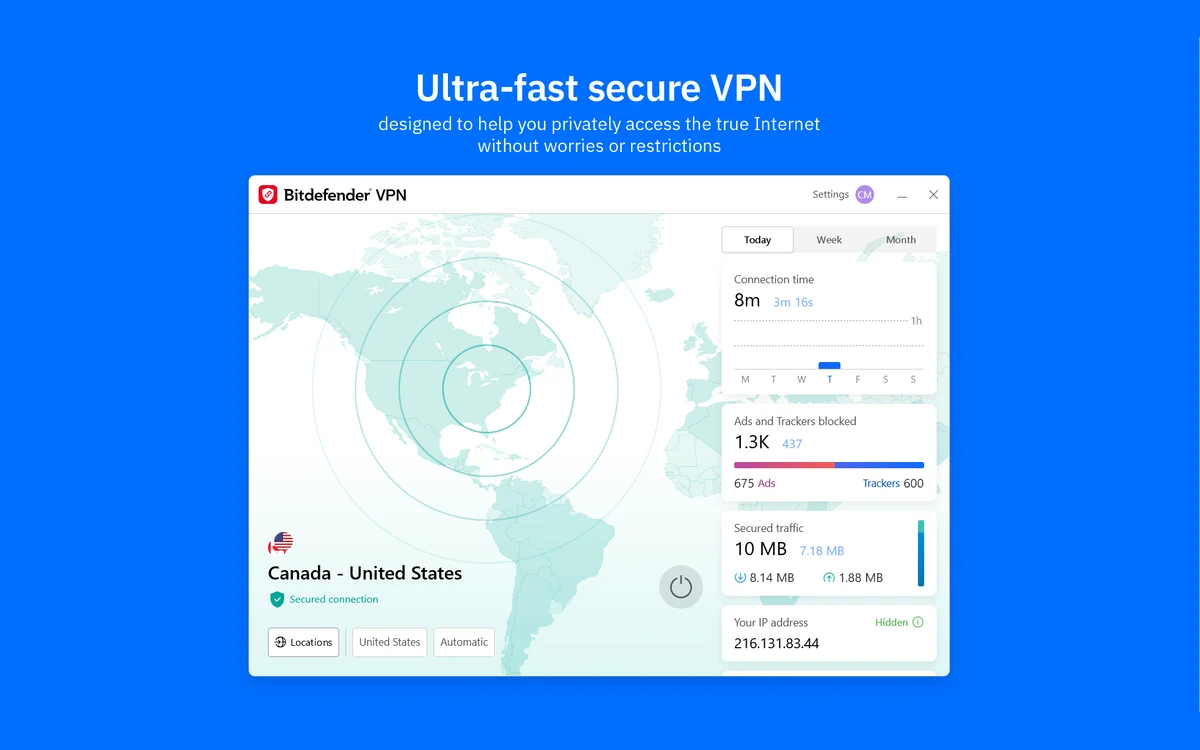
Bitdefender VPN has dedicated apps for Windows, macOS, Android and iOS, and it works on Chromebooks. The desktop apps share one simple layout: a map, a big Connect button, a location picker, connection time, an ad and tracker counter and a kill switch toggle.
What you get
- WireGuard, which Bitdefender calls "the newest and fastest VPN protocol on the market", with a protocol setting in the Windows app's Advanced menu.
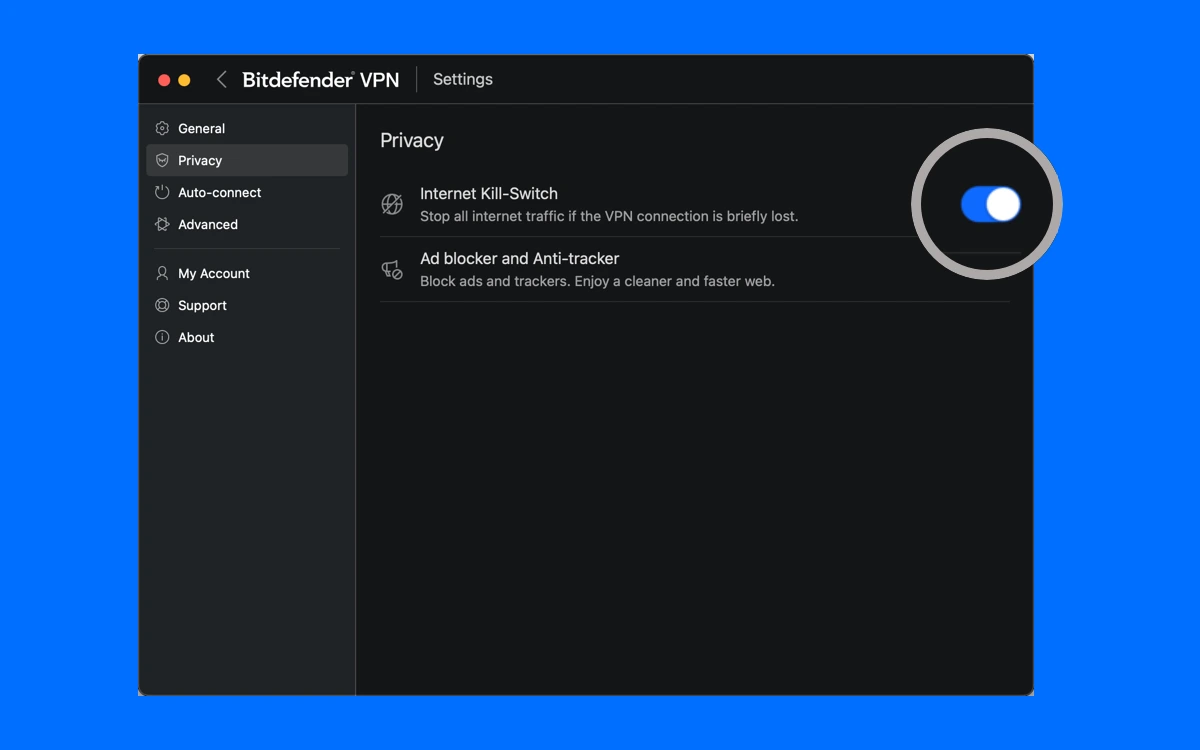
- Internet kill switch on Windows, macOS and Android: "Stops all Internet traffic if the VPN connection is briefly lost."
- Ad blocker and anti-tracker built into the app.
- Auto-connect on Windows for unsecured Wi-Fi and when you start a peer-to-peer file sharing app.
- Double-hop on Android, which routes traffic through two VPN servers. The App Store listing also lists it for iOS.
- App Traffic Optimizer on Windows, to prioritize traffic for chosen apps while connected.
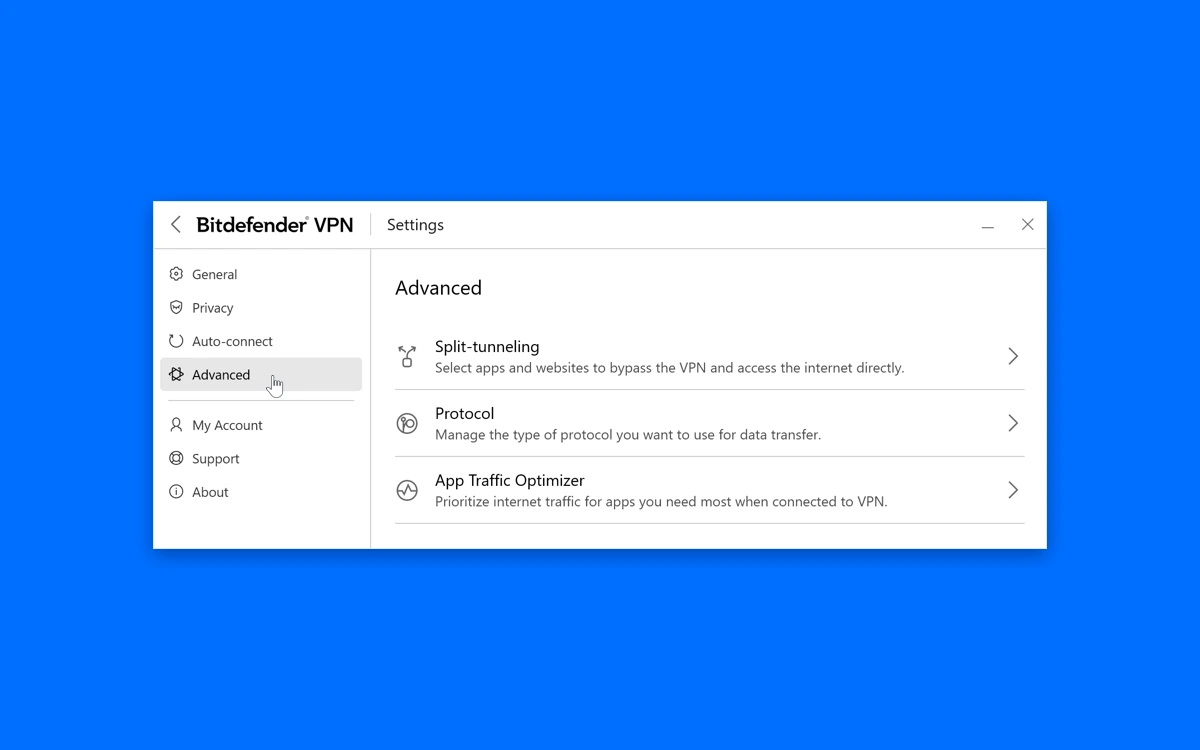
Split tunneling is limited
Bitdefender's support documentation says split tunneling "only applies to Windows and Android devices", and on Windows it only works with .EXE and .COM files. The App Store listing mentions split tunneling for iOS, but the support docs do not confirm it, and Mac users do not get it at all.
Servers, streaming and torrenting
Bitdefender's marketing page claims more than 3,000 servers in 100+ countries, while its support FAQ says the server list covers 110 countries. City-level choice is available in Australia, Canada, France, Japan, Spain, the UK and 21 US cities.
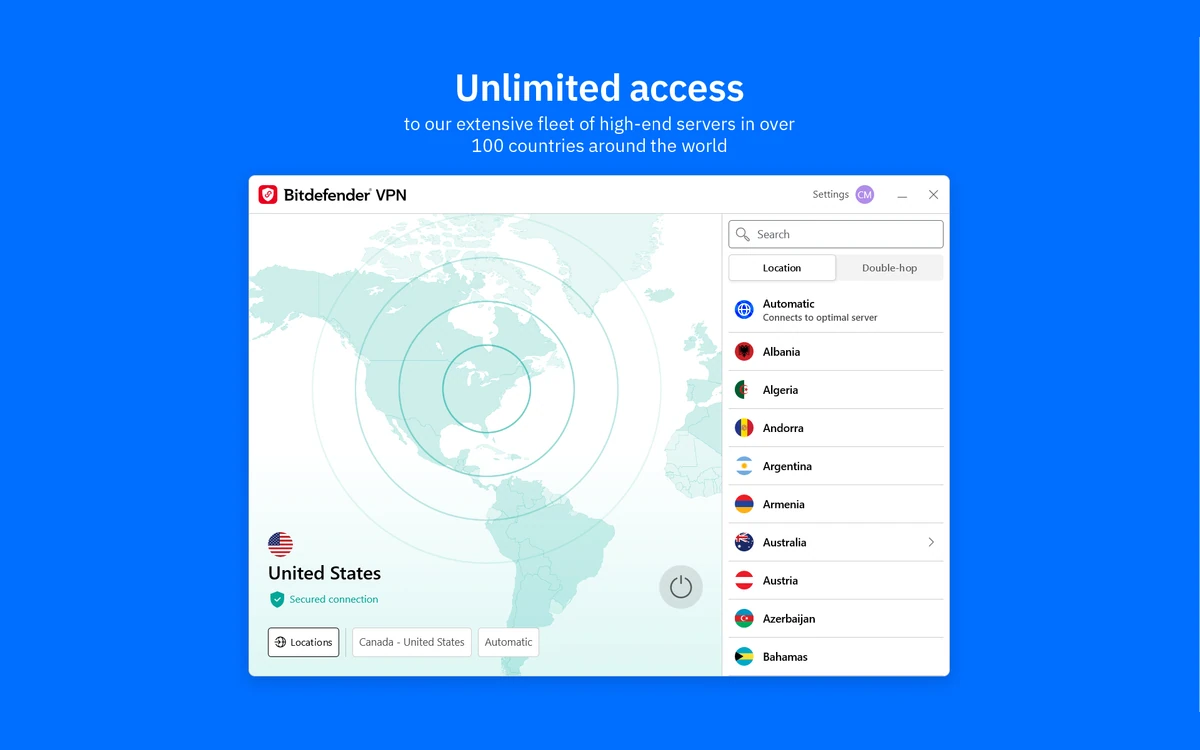
For streaming, the product page only says the VPN "unblocks your favorite streaming sites" without naming any service. Use the 7-day trial to test the specific platforms you care about before paying.
Bitdefender publishes no explicit torrenting policy. The Windows app can auto-connect when a peer-to-peer app starts, which suggests P2P traffic is tolerated, but that is not the same as a written policy.
What is missing
- No router support: Bitdefender says the VPN can only be used through its apps.
- No Linux app and no browser extension.
- No Amazon Fire TV Stick app, per Bitdefender support, even though a marketing FAQ suggests otherwise.
- No named auditor or public audit report.
- No transparency report and no stated retention period for connection IPs and IDs.
- Split tunneling only on Windows and Android.
Who should buy Bitdefender VPN
Buy it if you already use Bitdefender antivirus, want one low-cost plan for up to 10 devices, and value a simple app with a kill switch and ad blocking over advanced controls. Check the bundles first if you also need antivirus, since Premium Security and Ultimate Security include the VPN.
Skip it if you need Linux or router coverage, Mac split tunneling, or verifiable privacy claims backed by a published audit. Also budget for the renewal: the $34.99 first year becomes $69.99 from year two.
Bitdefender also runs a separate free beta called Bitdefender VPN for AI Agents for macOS. That is a different product from Premium VPN and is covered in our news section.
Frequently asked questions
How much does Bitdefender VPN cost?
Bitdefender Premium VPN costs $6.99 per month or $34.99 for the first year on the yearly plan, in US prices checked on October 5, 2026. Prices vary by campaign and region.
What does Bitdefender VPN cost after the first year?
The yearly plan renews at $69.99 per year. Bitdefender's terms say subscriptions renew automatically at the then-current rate unless you cancel before the next billing date.
Is Bitdefender VPN free?
Yes, there is a free tier with 200 MB per device per day. It resets at midnight UTC and connects you to an automatic server only, with no location choice.
Does Bitdefender VPN have a free trial or refund?
Yes to both. Bitdefender offers a 7-day free trial without a credit card and a 30-day money-back guarantee through [email protected].
How many devices can I use with Bitdefender VPN?
Up to 10 devices at once on any Premium VPN subscription, across Windows, macOS, Android and iOS. Routers, Linux and Fire TV Stick are not supported.
Does Bitdefender VPN keep logs?
Bitdefender says it does not store browsing activity or location, but it does collect hashed or random user and device IDs, IP addresses and connection tokens, with no stated retention period. It cites a 2025 independent no-logs audit but names no auditor and publishes no report.
Who runs Bitdefender VPN's servers?
IPVanish, according to Bitdefender's privacy policy version 10.4 adopted August 18, 2026, which names IPVanish as the VPN data processor. IPVanish is owned by the US company Ziff Davis.
Does Bitdefender VPN support split tunneling?
Only on Windows and Android, according to Bitdefender support. On Windows it is limited to .EXE and .COM applications.
Key takeaways
- Bitdefender Premium VPN costs $34.99 for the first year, then $69.99 a year, or $6.99 a month, for up to 10 devices.
- Bitdefender's privacy policy now names IPVanish, a Ziff Davis company based in the US, as the processor running the VPN service.
- The free tier gives 200 MB per device per day on an automatic server; the full trial lasts 7 days with no card required.
- WireGuard, a kill switch and ad blocking are included, but split tunneling is Windows and Android only.
- The 2025 no-logs audit has no named auditor and no published report, and there is no Linux, router or browser extension support.
More in Virtual Private Network
Browse Virtual Private Network