Bluehost Review 2026: Plans, Renewal Costs and Real Speed
An independent Bluehost review for 2026: shared, cloud and VPS pricing, the renewal jump, ten data centers, WordPress tooling, support and refund limits.
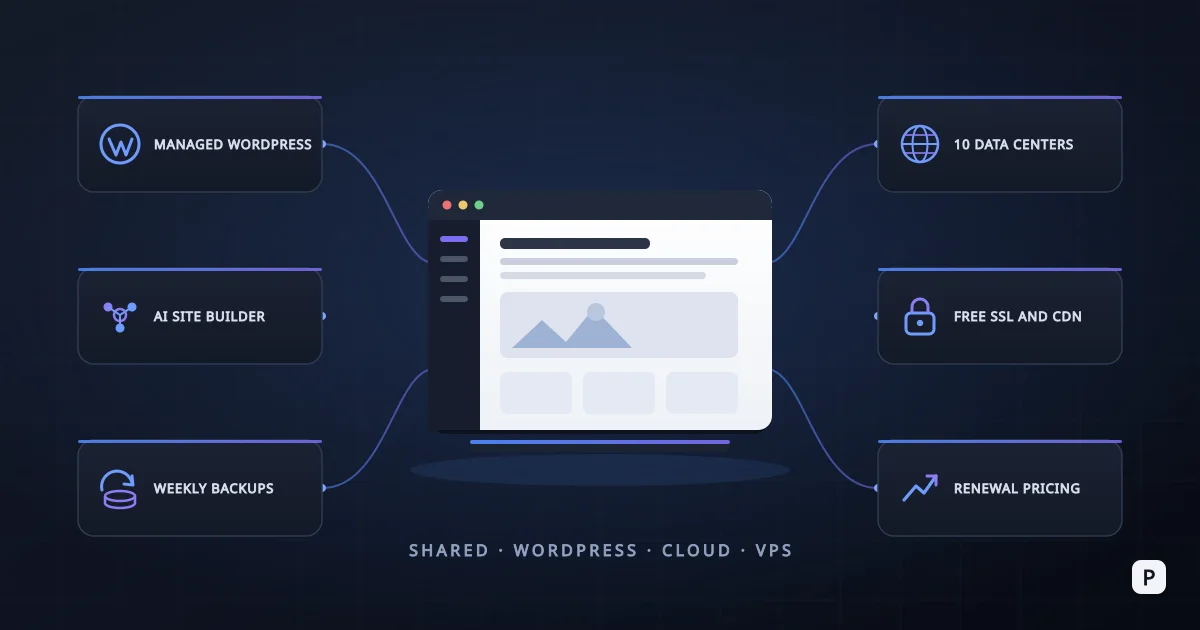
Bluehost sells the shortest possible path to a working WordPress site. Pick a plan and the software, a domain, an SSL certificate and an AI-assisted builder are waiting the first time you log in. It has been listed on the WordPress.org hosting page longer than any other provider, and for a first site that endorsement carries real weight.
The catch is the one every shared host shares: the price you sign up at is not the price you renew at. This review works through the 2026 plan ladder, the renewal figures Bluehost publishes on its own pricing pages, what the recent data center expansion changed, and where independent measurements are less flattering than the marketing copy.
What Bluehost Is in 2026
Bluehost is part of Newfold Digital, the group that also owns HostGator and Network Solutions. On the WordPress.org hosting page it appears alongside Pressable and Hostinger, described there as the longest running recommended host. The shared plans are sold as managed WordPress hosting rather than raw disk space. WordPress arrives preinstalled, core updates are applied for you, Yoast SEO ships in the box, and every standard plan includes a one-click staging site, a free migration tool, weekly backups and daily malware scanning. The first year of a domain is included, the SSL certificate comes from Let's Encrypt, and a CDN sits in front of the site by default.
- WonderStart, an onboarding flow that asks what the site is for and configures it accordingly.
- AI Website Creator, which drafts pages, copy and placeholder images from a short description.
- WonderTheme and WonderBlocks, a theme library and reusable block patterns for the WordPress editor.
- WonderCart, campaign and upsell tooling aimed at WooCommerce stores.
- WonderHelp, an in-dashboard assistant that answers setup questions as you go.
Managed means opinionated
The shared tiers are built around WordPress and around Bluehost's own account dashboard. There is no cPanel on them and no generic hosting panel to fall back on. If you want a neutral Linux box for a Laravel, Node or Python app, the VPS line is the part of the catalog to look at, not the shared plans.
Plans and the Renewal Jump
Bluehost quotes three self-service shared and WordPress tiers plus an enterprise option by quote. Every headline price assumes a 36-month prepayment, and shorter terms cost more per month. To its credit, Bluehost prints the renewal rate next to the intro rate on each plan card, which is more transparent than much of the market, but the gap is wide enough that the intro number is close to meaningless for long-term budgeting.
- Starter: $3.99 a month on the intro term and $9.99 on renewal, with 10 GB of NVMe storage, 10 sites and capacity quoted at roughly 40,000 visits a month.
- Business: $6.99 intro and $13.99 renewal, with 50 GB, 50 sites, roughly 200,000 visits a month, and the cheapest tier that includes phone support.
- eCommerce Essentials: $14.99 intro and $21.99 renewal, with 100 GB, 100 sites and roughly 400,000 visits a month.
- Bluehost Cloud: $65 a month for Cloud 10 through $230 for Cloud 50, adding realtime backups, edge caching, priority support and automatic failover between data centers.
- Self-managed VPS: $4.69 a month for 1 vCPU and 2 GB of DDR5 memory, rising to $25.99 for 8 vCPU and 16 GB, with AMD EPYC hardware, root SSH access and infrastructure-only support.
Do the three-year math before you sign
Across a 36-month term, Starter costs $143.64 for the first period and $359.64 for the second. Business goes from $251.64 to $503.64, and eCommerce Essentials from $539.64 to $791.64. The discount is genuine, but it applies once, and the renewal figure is what you actually live with. VPS renewals move too: NVMe 8 goes from $12.99 to $28.99 a month, more than double.
Infrastructure and What the Numbers Say
For years Bluehost ran everything out of Utah, which was the single biggest complaint from anyone with an audience outside North America. In October 2025 it added seven regions, and it now advertises ten data center locations selectable at checkout, including Frankfurt, London, Paris, Madrid, Mumbai, Sydney and Sao Paulo, with the original Provo and Orem facilities still in service. Bluehost claims the expansion cuts latency by up to 120 milliseconds for users near the new regions and delivers pages two to three times faster than the market average.

Marketing pages quote a 0.35 second average load time and a 99.99 percent uptime SLA on the WordPress plans, while Bluehost Cloud carries a 100 percent network availability commitment backed by service credits of 5 percent of the monthly fee for every 30 minutes of downtime. Independent monitoring published through 2026 is more modest: long-running third-party tests put shared-plan uptime between roughly 99.94 and 99.98 percent, and time to first byte somewhere between 300 and 500 milliseconds depending on test location and hardware generation. Read the vendor figures as a best case on a well-placed server. The realistic picture is competent rather than class-leading, which is enough for a brochure site, a portfolio or a blog, and thin if you are chasing Core Web Vitals scores against hosts running on premium cloud infrastructure.
Support, Refunds and Who It Fits
Support is 24/7 chat on every plan, with phone support from Business upward and priority queues on Cloud. The self-managed VPS line is explicitly infrastructure only: Bluehost keeps the hardware and the network healthy while the operating system, the stack and the patching are yours, and cPanel is not included. Budget for that before treating VPS pricing as a cheap upgrade from shared hosting. The refund terms deserve the same attention, because the 30-day guarantee is narrower than the headline suggests.
- The money-back guarantee runs 30 days and applies to new shared, VPS and dedicated signups.
- If you took the free domain, its standard registration fee is deducted from the refund and you keep the domain.
- Domain registration and renewal, premium domains, setup fees, SSL products, SiteLock and SEO services are not refundable.
- Bluehost Cloud, monthly-term plans and AI products sit outside the guarantee entirely.
- Add-ons quoted per year, such as CodeGuard backups and SiteLock, can cost more annually than the hosting plan they protect.
Who it fits
Bluehost suits a first WordPress site, a small business brochure site or a modest store where the owner wants updates, backups and certificates handled and has no interest in touching a server. It fits less well if you need a specific stack, if you benchmark aggressively, or if the budget only works at the introductory price. Anyone in the last group should compare the second-term cost against Hostinger or a managed WordPress specialist before committing to three years.
Key takeaways
- Bluehost sells managed WordPress hosting with a strong beginner path: preinstalled WordPress, an AI builder and staging on every standard plan.
- The intro price covers one prepaid term, and renewals run roughly 1.5 to 2.5 times higher across the plan ladder.
- The October 2025 expansion to ten selectable data centers fixed the platform's biggest weakness for non-US audiences.
- Vendor performance claims are a best case; independent tests show competent uptime and mid-range time to first byte.
- The 30-day guarantee is real but narrow, excluding domains, add-ons, monthly terms and Bluehost Cloud.
More in Services & Software
Browse Services & Software