Pipedream Review 2026: Connect Pricing, MCP and the Workflows Shutdown
Pipedream is now Connect only. We review its Free, Startup and Business plans, credits, MCP for AI agents, and what Workflows users must do before March 31, 2027.
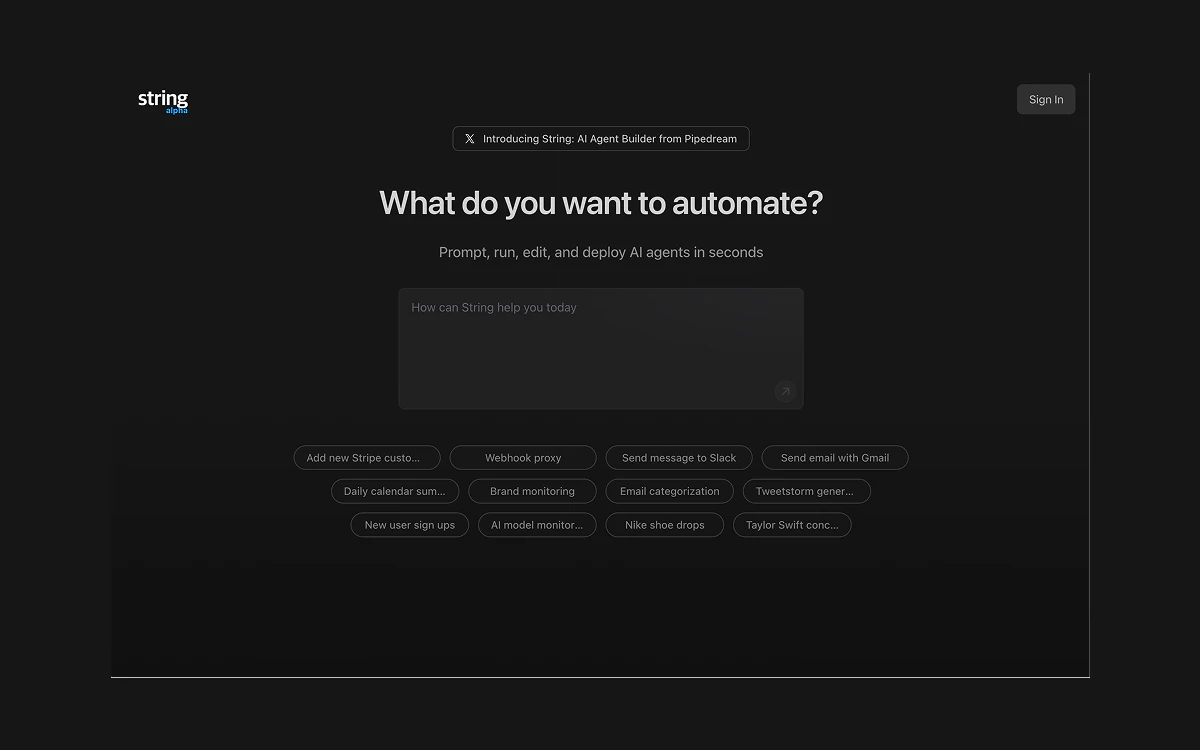
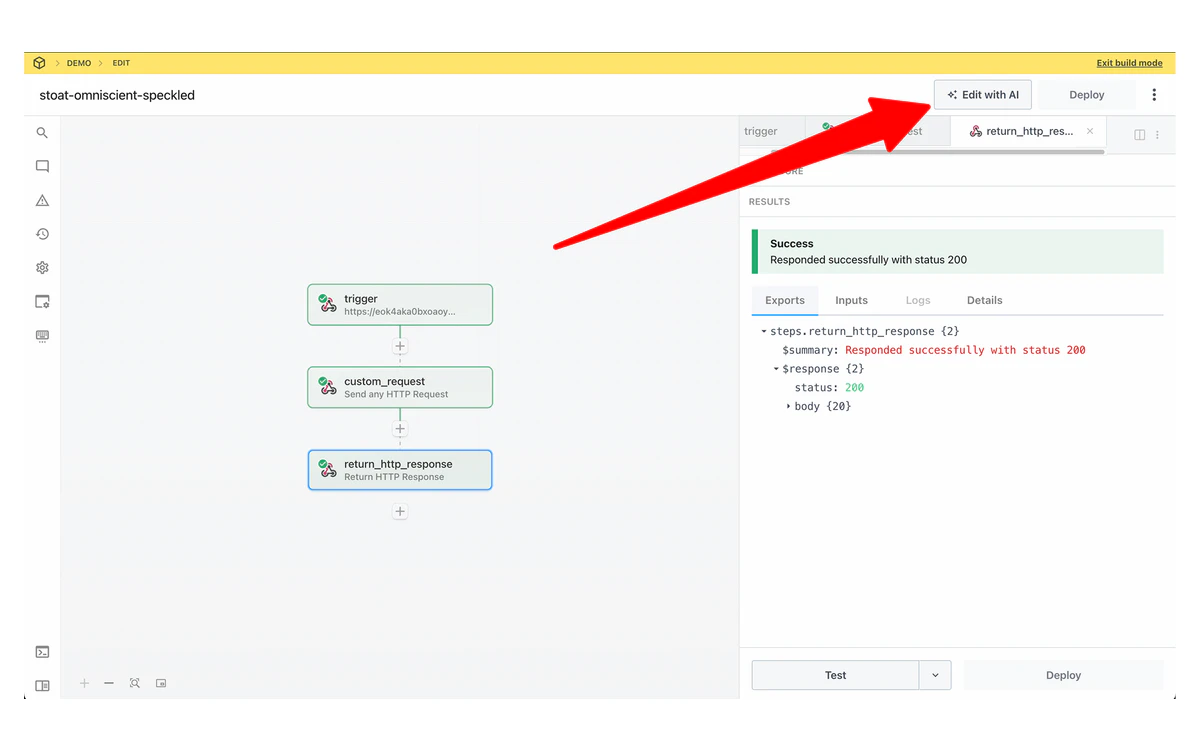
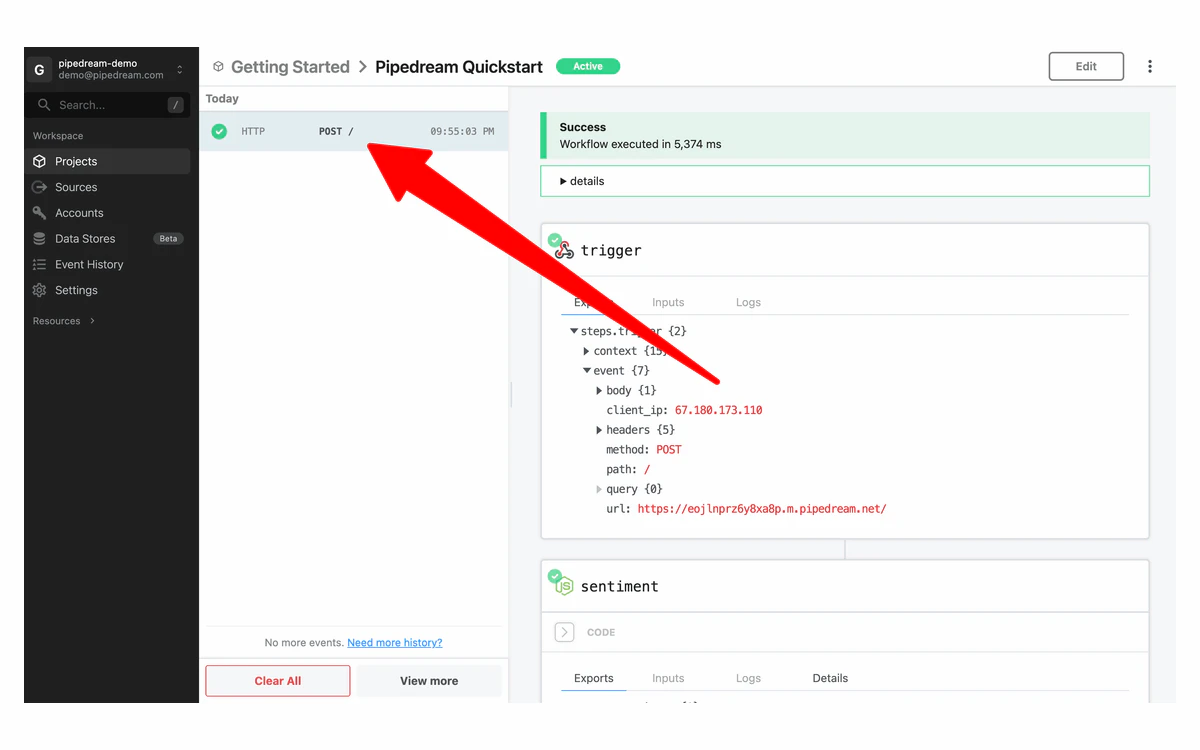
Most Pipedream reviews still describe a Zapier for developers: a hosted workflow builder with Node.js and Python code steps and cheap Basic and Advanced plans. That product is being retired. At the start of October 2026 Pipedream put Workflows and its AI builder String into maintenance mode, stopped taking new signups and subscriptions, and set a shutdown date of March 31, 2027.
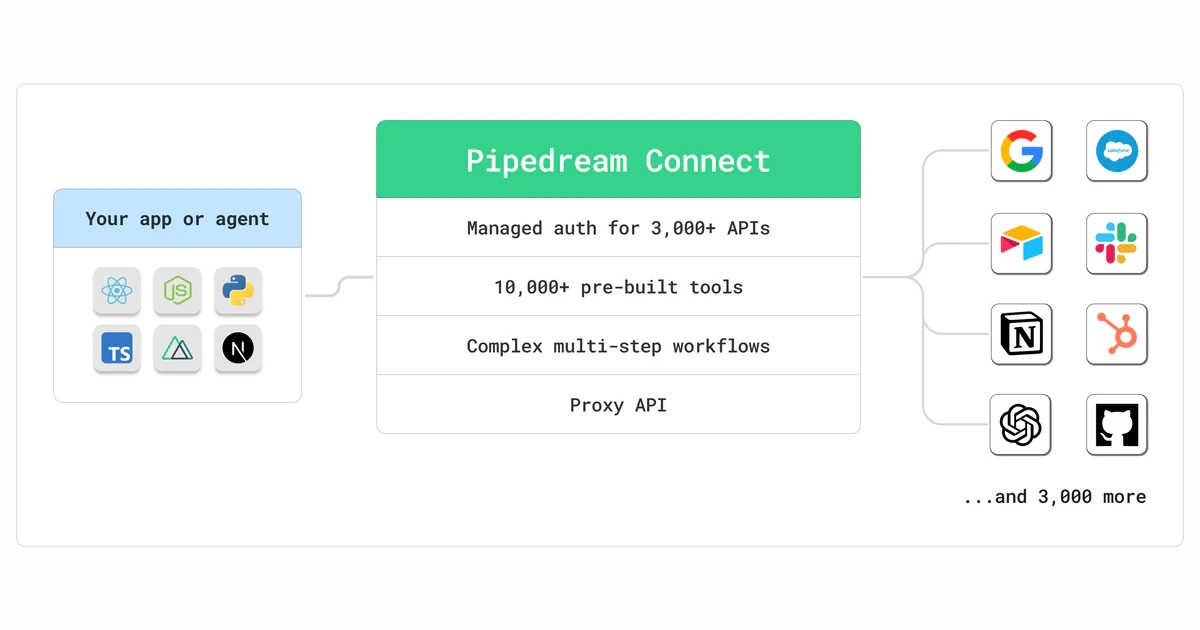
What remains is Pipedream Connect: managed authentication plus 10,000+ prebuilt tools across 3,000+ APIs, sold to developers who want their apps and AI agents to act inside each user's own accounts. Pipedream is now owned by Workday, and its pricing has been rebuilt around Connect alone. This review covers what Pipedream is today, what it costs, who it suits, and what existing Workflows users need to do before the deadlines.
What Pipedream is in late 2026
Pipedream's homepage now calls it "The integration layer for AI agents" and promises "Managed auth and 10,000+ tools across 3,000+ APIs, for the agents you're building." The headline numbers are 10,000+ prebuilt tools and triggers, 3,000+ integrated APIs and more than 1 million connected accounts.
The change follows the acquisition. Workday announced a definitive agreement to buy Pipedream on November 19, 2025, when Pipedream had more than 5,000 customers, and reported the deal closed in its fiscal fourth-quarter results published on February 24, 2026. Financial terms were not disclosed. The docs now carry a Pipedream and Workday logo lockup.
Pipedream explains the narrower focus directly: "We've decided we're focusing on being the integration layer companies rely on to connect AI to the outside world, and Workflows falls outside that focus." In practice the product line is now three things: the Connect API and SDKs, MCP servers for AI assistants, and Conduit, an early-access gateway for companies that want employees to connect their apps to AI tools safely.
Who this review is for
If you are a developer building a SaaS app or AI agent that needs per-user OAuth to many third-party APIs, Pipedream Connect is a serious option. If you wanted a hosted no-code or low-code workflow automator, Pipedream no longer sells one, and our n8n, Make and Zapier reviews are the better starting point.
The Workflows and String shutdown: dates and what to do
Pipedream's notice is short: "We want to let you know that Pipedream Workflows and String will shut down on March 31, 2027." The notice itself carries no date. Third-party coverage places the announcement at the very end of September or on October 1, 2026, which matches the "full six months" Pipedream says it is giving users to migrate.
The key dates
- Now: Workflows is in maintenance mode. Existing workflows keep running, but there are no new signups, no new subscriptions and no new features.
- March 31, 2027: Workflows and String shut down. Pipedream cancels remaining subscriptions automatically and issues a prorated refund with no action needed.
- April 30, 2027: all Workflows data is permanently deleted, including the credentials and OAuth tokens for connected accounts.
- Connect is not affected: "If you're using our Connect API, MCP Servers, or API Proxy, nothing changes for you." Connect settings and credentials are not deleted.
Exporting your workflows
Pipedream added an export tool. In each project, go to Settings and choose Export Workflows. It writes a ZIP archive with one JSON file per workflow, describing its triggers, steps, code, configured props and control flow, to the project's File Store as project_export-<project_id>.zip.
- Export runs one project at a time, so a workspace with many projects needs several exports.
- Your plan must include File Stores, because that is where the archive is written.
- Each project holds only one export at a time. Delete the old ZIP before exporting again.
- The archive is a record to rebuild from, not an importer for another platform. Check the docs section on what is not included, and note your connected accounts separately, since their tokens are deleted with your data.
How Pipedream Connect works
Connect solves one specific and tedious problem: letting each of your users authorize their own Google, Salesforce, Slack or HubSpot account, then calling those APIs on their behalf without you registering OAuth apps, storing tokens or building refresh logic.
- Connect: drop in Connect Link or build your own UI. Your users authorize their accounts, and Pipedream stores and refreshes the credentials.
- Call: use prebuilt tools, the raw API through the Connect proxy, or MCP. Fresh tokens are injected on every request, per user.
- Ship: requests run in Pipedream's managed runtime, so there are no OAuth apps to register and nothing to host or scale.
SDKs cover TypeScript, Python and Java, alongside a REST API and MCP. Python and Java SDKs arrived in September 2025, together with a rewrite of the TypeScript SDK for Connect. Installing the TypeScript SDK is one line:
npm i @pipedream/sdkPipedream says credentials are "encrypted at rest, scoped per project, and never exposed to your app", and any connected account can be revoked with one API call. That matters for agent builders: the model calls a tool, and the token never passes through your code or your prompt.
MCP for AI agents
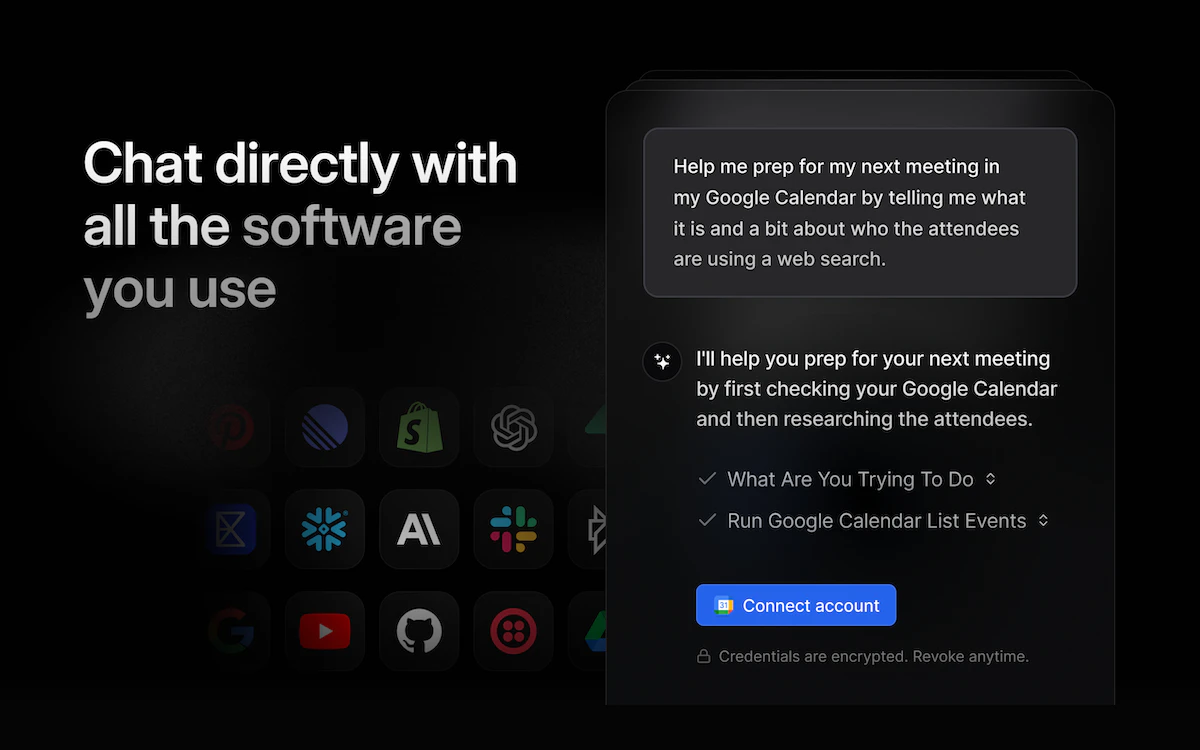
Pipedream offers a dedicated MCP server for all of its 3,000+ integrated apps, exposing over 10,000 prebuilt tools. Developers point their agent at the remote MCP endpoint and pass an external user ID header, so each tool call runs against that user's connected accounts. Since October 2025 the MCP server also supports OAuth with a static URL and works with ChatGPT, and every tool carries tool annotations that help models judge what an action does. MCP servers are included on all three plans.
Pipedream pricing in 2026
The pricing page now reads "Free to build. Pay when your integrations go to production." There are three plans. The old Workflows plans, which a pricing tracker recorded at $29 a month for Basic and $49 a month for Advanced as recently as June 2026, are gone. Ignore reviews that still quote them as current.
Free: $0
No credit card required. You get every feature in development, 3,000+ connectors, 10,000+ prebuilt tools and triggers, unlimited team members and community support. External users and usage credits are development only, with a daily credit limit that cannot be exceeded and a limited number of connected accounts. Pipedream does not publish the numbers.
Startup: $99 a month billed annually, or $150 billed monthly
- Run in production for real external users.
- 100 users included, then $2 per user per month.
- 10,000 usage credits included each month, then $0.012 per credit, with lower rates at higher volume.
- Email support.
Business: custom price
An annual contract with volume pricing, SSO, SCIM, HIPAA, dedicated static egress IPs, SLAs and dedicated Slack support. SOC 2 Type 2 and GDPR compliance are listed on all three plans.
How users and credits are counted
A user is "each distinct user of your app who connects at least one account through Connect", identified by the external user ID you pass. One person with five connected apps counts once. Going past 100 does not break anything; each extra user simply adds $2 a month on Startup.
Credits measure Connect API usage. Running an action, calling a tool through MCP, sending a request through the proxy and emitting an event from a deployed trigger each use 1 credit per 30 seconds of compute. Listing apps and accounts, configuring components and other management calls are free.
A worked example
An agent product on Startup with 300 connected users pays for 200 users beyond the included 100, which is $400 a month on top of the plan. If those users trigger 15,000 short tool calls in a month, the 5,000 credits over the included 10,000 cost $60. On annual billing that month comes to $99 + $400 + $60 = $559. The per-user fee, not the credits, is the number to model first.
Plan changes are self-serve from the workspace billing settings, and Pipedream shows whether a change applies now or at the end of the billing period. The Terms say subscriptions renew automatically, cancellation takes effect after the current billing cycle, and payments are non-refundable unless stated otherwise.
Conduit: AI tool access for employees
Conduit is Pipedream's new product for internal use rather than for app builders. It is "a gateway that lets employees safely connect their apps to AI agents", with SSO, access policies, per-user permissions and a full audit trail managed in one place.
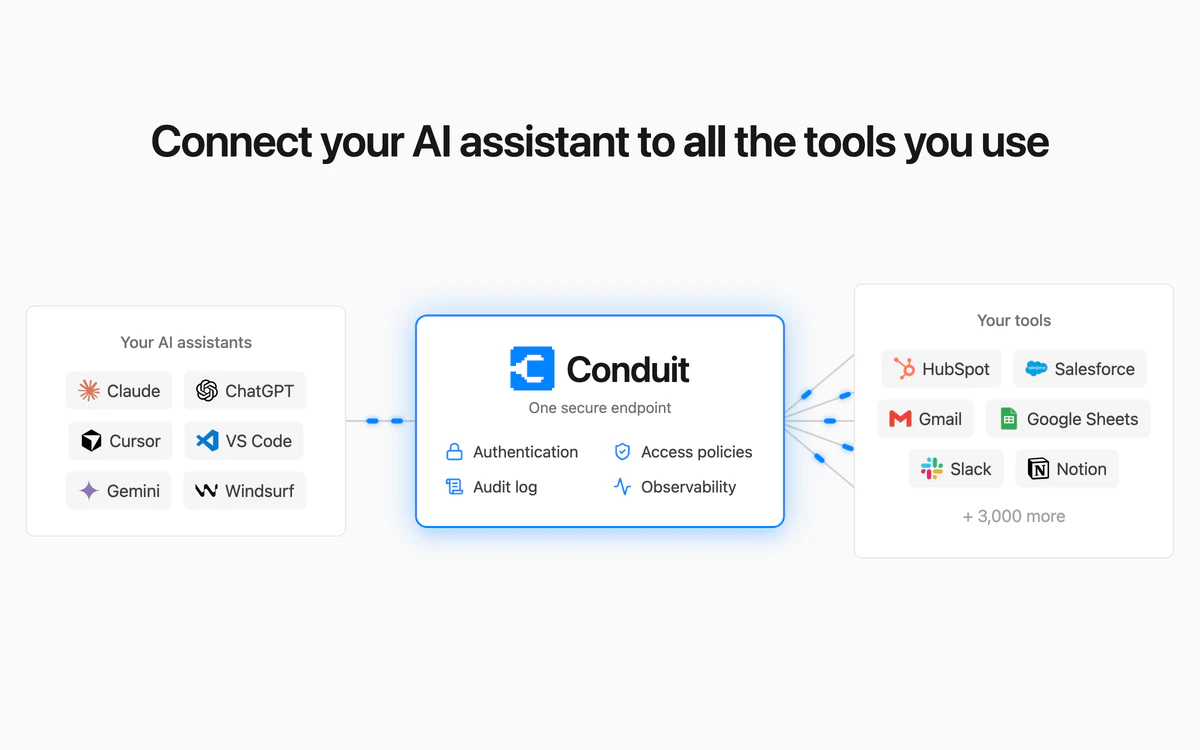
- Works with Claude, ChatGPT, Cursor, VS Code, Gemini, Windsurf and anything else that speaks MCP, because Conduit is a standard MCP server.
- Includes the 3,000+ Pipedream connectors, plus your own MCP servers, OpenAPI or GraphQL APIs.
- SSO through Okta or any OIDC provider, and OpenTelemetry export to tools such as Datadog and Grafana.
- Self-host a single Docker image in your own infrastructure, or use the managed cloud.
Early access is open, but there is no public price, so treat it as a product to evaluate rather than budget for.
Security and compliance
Pipedream can provide a SOC 2 Type 2 report on request and undergoes annual third-party audits. It can sign Business Associate Addendums, though HIPAA sits on the Business plan, and it describes itself as both a controller and a processor under the GDPR. Static egress IPs, useful when a customer's API only accepts allowlisted addresses, are also Business only.
The bigger question for buyers is ownership. Workday is a large, stable parent, which lowers the risk of Pipedream disappearing. The Workflows shutdown shows the other side: a product with paying customers was closed within a year of the deal because it no longer fit the plan. Connect is explicitly where Pipedream says its focus is going, but it is reasonable to keep your own integration layer thin enough to swap out.
Verdict: who should use Pipedream now
Pipedream Connect is a strong fit for developers shipping an AI agent or SaaS product that needs to act in each customer's own accounts across many APIs. Managed OAuth, token refresh, a proxy for raw API calls and an MCP server for every app remove weeks of plumbing, and the free development tier lets you build the whole thing before paying.
- Good fit: AI agent builders, SaaS teams adding many integrations, products where each end user connects their own accounts.
- Watch the cost: the $2 per user fee past 100 users grows faster than credits for most consumer-scale products.
- Poor fit: teams that wanted a hosted workflow builder for internal automations. Pipedream no longer sells one, so look at n8n, Make or Zapier instead.
- Existing Workflows users: export each project now, list your connected accounts, and rebuild elsewhere well before March 31, 2027.
Frequently asked questions
How much does Pipedream cost in 2026?
Free for development, $99 a month billed annually or $150 billed monthly for Startup, and a custom price for Business. Startup includes 100 users and 10,000 credits a month, then charges $2 per extra user and $0.012 per extra credit.
Can I still sign up for Pipedream Workflows?
No. Workflows is in maintenance mode and takes no new signups or subscriptions. Existing workflows keep running until March 31, 2027.
What happens to my workflows and connected accounts after the shutdown?
They stop running on March 31, 2027, and all Workflows data, including credentials and OAuth tokens, is deleted by April 30, 2027. Export each project to a ZIP from its settings first. Connect settings and credentials are not deleted.
Will I get a refund for my Workflows subscription?
Yes, a prorated one. Pipedream cancels remaining subscriptions on March 31, 2027 and refunds automatically. Annual subscribers who leave earlier can ask support for an early cancellation and prorated refund. Outside this shutdown, the Terms say payments are non-refundable.
Can I use the Free plan in production?
No. The Free plan gives full API, SDK and MCP access for building and testing, but serving real external users in production requires Startup.
Does Pipedream work with Claude, ChatGPT and Cursor?
Yes, through MCP. Pipedream runs an MCP server for each of its 3,000+ apps, and Conduit, currently in early access, connects Claude, ChatGPT, Cursor, VS Code, Gemini and Windsurf to company apps behind SSO and access policies.
Is Pipedream SOC 2 and HIPAA compliant?
SOC 2 Type 2 and GDPR are covered on every plan, and the report is available on request. HIPAA, SSO, SCIM and static egress IPs require the Business plan, and Pipedream can sign a BAA.
Who owns Pipedream?
Workday. It announced the acquisition on November 19, 2025 and reported the deal closed in results published on February 24, 2026. The price was not disclosed.
Key takeaways
- Pipedream is now a Connect-only integration platform for AI agents and apps, owned by Workday.
- Workflows and String shut down on March 31, 2027, and their data, including OAuth tokens, is deleted by April 30, 2027.
- Startup costs $99 a month billed annually or $150 monthly, with 100 users and 10,000 credits included.
- The $2 per user fee past 100 users is usually the biggest cost driver.
- If you need a hosted workflow automator, Pipedream no longer sells one; look at n8n, Make or Zapier.
More in Services & Software
Browse Services & Software