Slite Review 2026: The Self-Maintaining Knowledge Base, Agent Credits and Pricing
Slite relaunched in June 2026 with the Slite Agent and new Basic $10 / Pro $20 plans. What the Agent does, how credits work, the limits, and who should buy it.
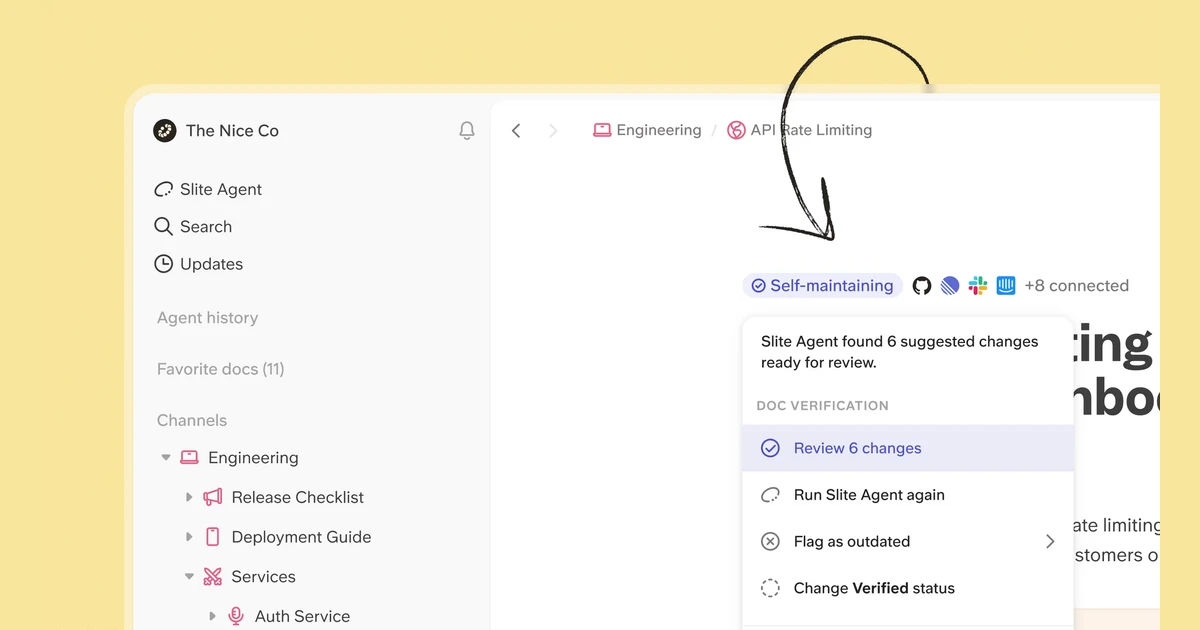
Slite is not the product most Slite reviews describe. On May 28, 2026 its enterprise search app, Super, moved inside Slite, and on June 10, 2026 the company relaunched the whole thing as "the self-maintaining knowledge base". The centrepiece is the Slite Agent: it watches tools like Slack, GitHub, Jira and Linear, spots when a doc has drifted out of date, and drafts a fix that a person approves before anything changes.
Pricing changed with it. The old Standard ($8) and Knowledge Suite ($20) plans are gone, replaced by Basic at $10 and Pro at $20 per user per month, billed yearly, and Pro now meters AI through credits. Many third-party pages still quote the old $8, $6.67 or $12.50 figures. This review covers what the Agent actually does, what each plan costs, where the credit and question limits bite, and which teams should pick Slite over Notion or Confluence.
What Slite is in late 2026
Slite started as a clean, fast team wiki. Slite says it was founded in 2017; it came out of the eFounders startup studio in Paris, is run by CEO Christophe Pasquier, and raised an $11M Series A led by Spark Capital in 2020. In 2025 it went multi-product and built Super, an AI search tool that answered questions across a company's apps.
In 2026 the two products became one. A May 28 changelog entry put Super inside the Slite sidebar ("you no longer need to switch between two apps"), and the June relaunch renamed it the Slite Agent. super.work and its pricing page now redirect to slite.com, and the Slite API has deprecated its /v1/super routes in favour of /v1/agent endpoints. If you see a review telling you to buy Super separately, it is out of date.
Underneath, Slite is still a document editor with collections, comments, doc verification and a knowledge management panel. 2026 added multi-column layouts, a reworked doc history that shows who made each change, desktop tabs and side-by-side windows, and relative and range date filters in search. The pitch has changed, though: Slite now sells itself on keeping that knowledge current, not just storing it.
How the Slite Agent works
According to Slite's launch post, the Agent does five jobs:
- Drift detection: it watches connected sources and flags docs that no longer match reality, for example a process that changed in a Slack thread or a policy updated in another tool.
- Proposed edits: it drafts changes to the outdated doc instead of just raising a flag.
- Maintenance digest: each doc owner gets a list of what needs updating.
- Drafting from tools: a Slack thread can become an onboarding doc, a closed Jira ticket a process update, a Linear change a revised SOP.
- Answers: it reads across connected sources and returns one answer with its sources.
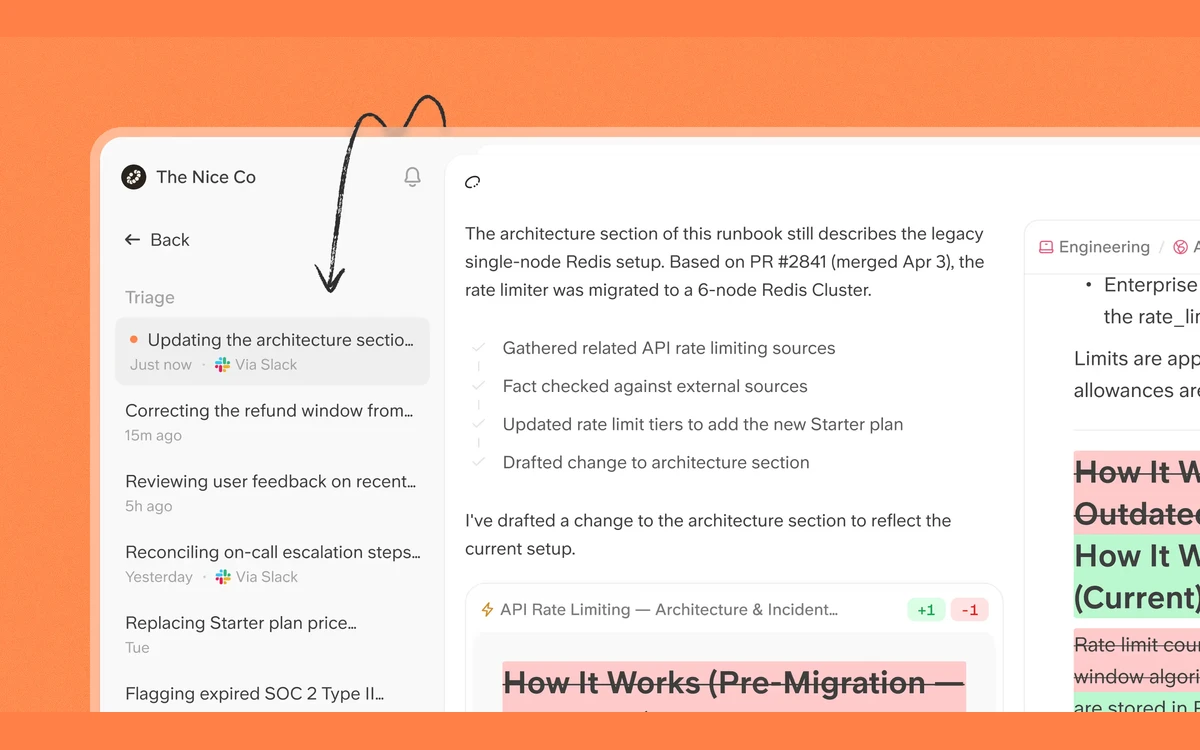
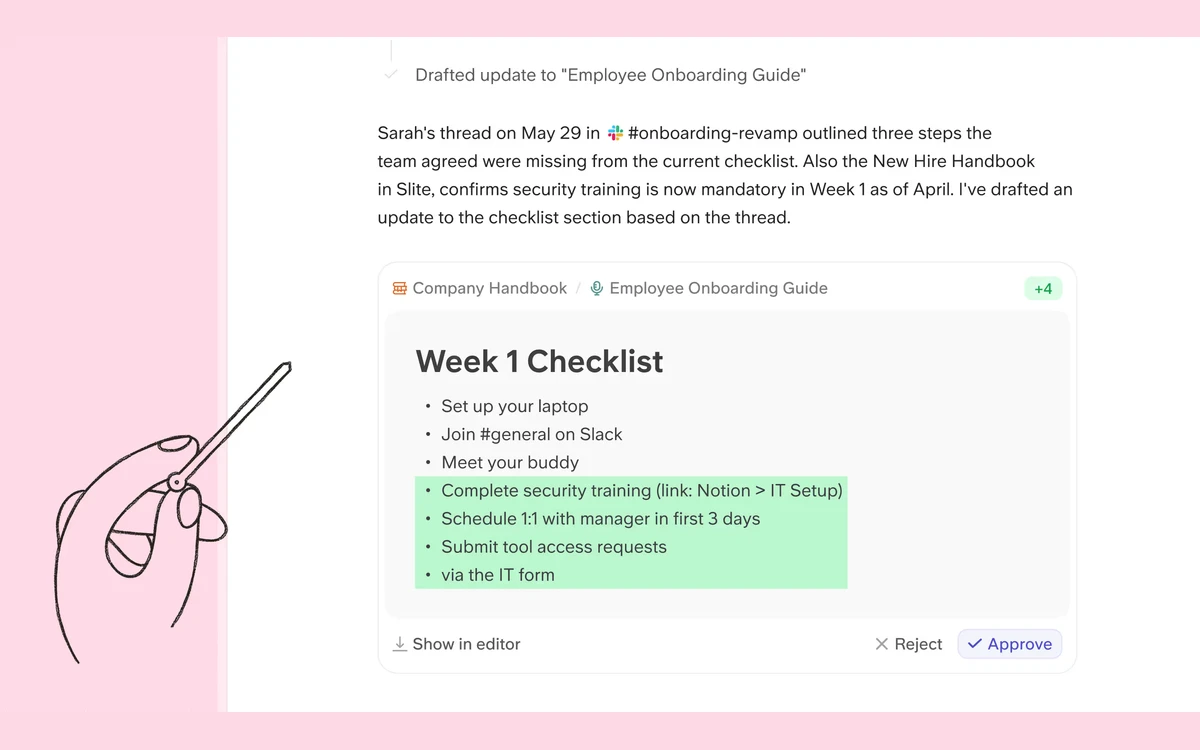
The safety net is a review queue. Every proposed change appears with the old and new versions side by side, and in Slite's words, "nothing goes live until a person approves it." That matters: an AI that silently rewrites your runbooks would be worse than stale docs. Here the Agent does the noticing and the first draft, and a doc owner still decides.
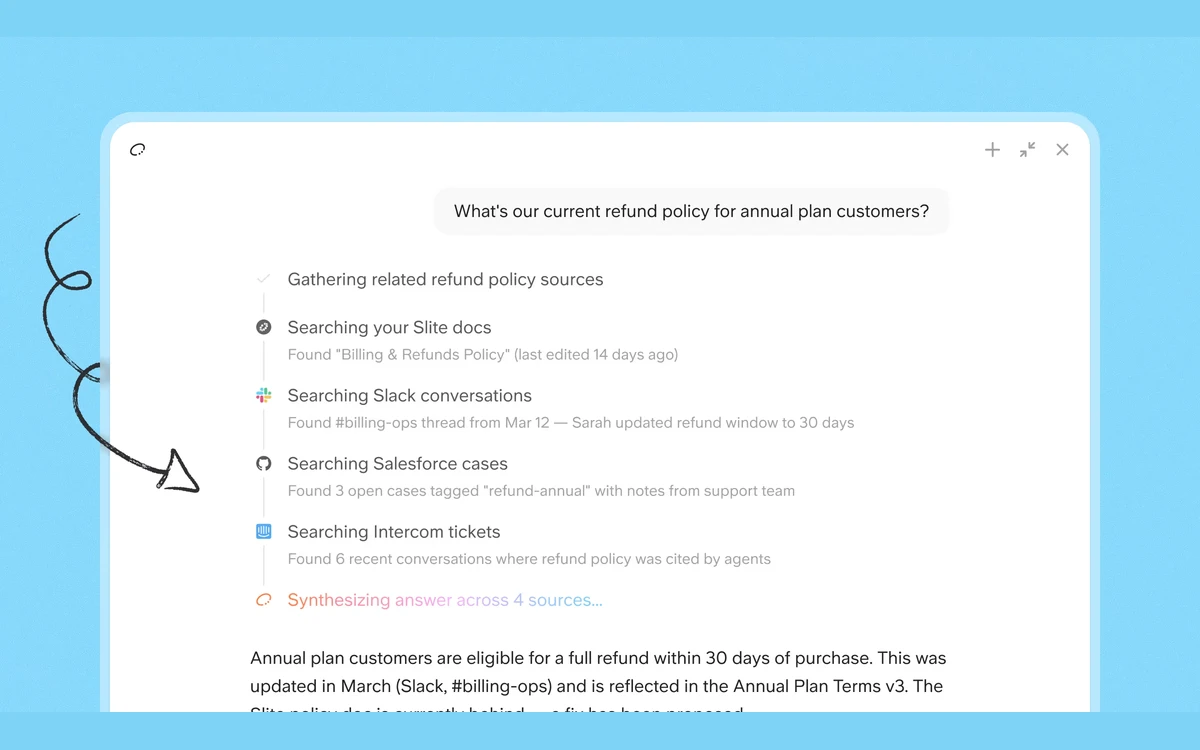
You can reach the Agent in the web app, on desktop with Alt+Space, in Slack through a bot now simply called "Slite" that can ask, write and edit Slite content, through the public API, over MCP, and in scheduled automations. Since August, Ask and the Agent share one interface, so there is a single place to type a question.
Connected tools and their sync limits
Slite says Pro covers "20+ connected tools", and a source marketplace added in July 2026 makes them easier to find and connect. The documented list includes Confluence, Google Drive, Notion, Slack, HubSpot, Jira, Asana, Attio, BigQuery, GitHub, GitLab, Git, Intercom, Linear, Salesforce, SharePoint, websites, Granola, Miro, Monday.com and custom MCP servers. Zendesk and Zoom are in beta; Airtable, Amplitude, Box, ClickUp and Snowflake are alpha.
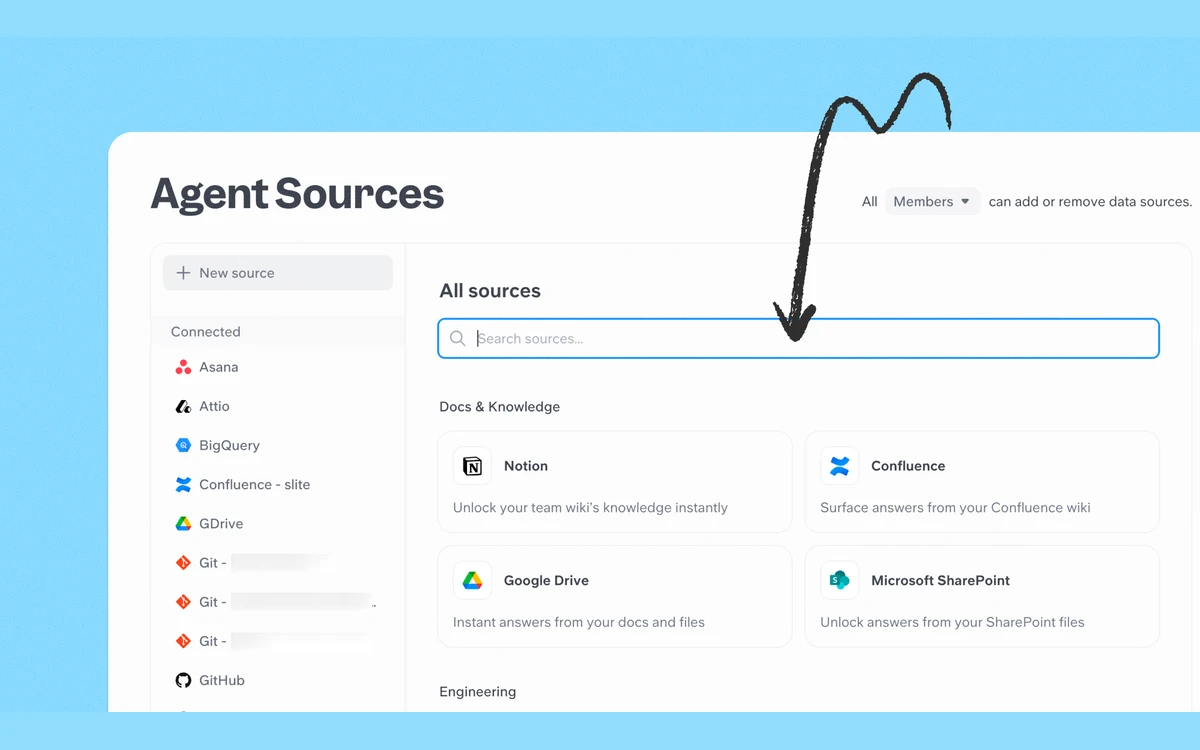
The fine print matters more than the logo count, because the Agent can only catch drift in what it actually syncs:
- Confluence: pages only, no attachments or comments.
- Google Drive: Docs, Slides, .docx, .pptx and .pdf; no Sheets, images or videos.
- Notion: pages under the roots you select, no database objects.
- Slack: threads from public and private channels.
- HubSpot: the 1,000 most recent deals.
- Jira: issue descriptions from the past year, no comments.
- Zendesk (beta): tickets from the past year.
Where the gaps are
If your real source of truth lives in spreadsheets, Notion databases or Jira comment threads, the Agent will not see it. Check the sources article against where your team actually records decisions before you count on drift detection.
Slite pricing in 2026
Slite has three plans. Prices below are per user per month, billed yearly, as listed on slite.com/pricing in November 2026. Monthly billing exists, but the pricing page does not publish its price.
Basic - $10 per user/month
- Unlimited docs, doc verification workflow and the Knowledge Management Panel.
- Ask (AI search and answers) within your Slite docs, about 30 questions per seat per month.
- AI writing assistant: 30 AI edits per user per month.
- MCP and API access.
- File uploads up to 200MB, 5GB storage per user, enforced Google SSO.
- No Slite Agent.
Pro - $20 per user/month
- Everything in Basic, plus the Slite Agent and search across connected tools.
- Doc fact-checking with suggested fixes and agent workflows.
- 50 credits per seat per month, pooled across the team.
- Unlimited AI writing edits, unlimited file upload size, 10GB storage per user.
- SSO with OpenID Connect (Okta, Azure and others) and a custom domain for public docs.
Enterprise - custom pricing
- Reader-only seats, SCIM, audit logs, advanced security and controls.
- SLA, a dedicated account manager and priority support.
- Custom agent sources plus migration and onboarding help. The Agent is optional on Enterprise.
Ignore the old prices
Until mid-2026 Slite sold Standard at $8 and Knowledge Suite at $20 (with a 10-user minimum). The rename to Basic and Pro and the rise from $8 to $10 happened in June 2026, alongside the relaunch. Any page quoting $8, $6.67 or $12.50 is describing the old plans.
Eligible non-profit and academic organisations get discounts on Basic. There is no free plan.
How AI credits work
Credits are the part of Slite pricing worth reading twice. Each paid Pro seat adds 50 credits a month to a shared team pool. The allowance is based on the seats you pay for, not the seats in use, and unused credits do not roll over. Agent requests use credits wherever they are made, including Slack, the API and MCP. Inline AI writing, translation and grammar tools do not.
Slite publishes typical costs per task:
- Find specific information: 0.7 credits
- Search across many tools: 1.4 credits
- Edit a document: 0.4 credits
- Research and edit: 1.5 to 3.2 credits
- Thorough investigation: 2.7 to 5.3 credits
- Digests: 3.8 credits
As a rough guide, a 10-seat Pro team gets 500 credits a month. That is about 700 simple lookups at 0.7 credits, or about 130 digests at 3.8 credits, or some mix of the two. A team that leans on long investigations will burn through it much faster.
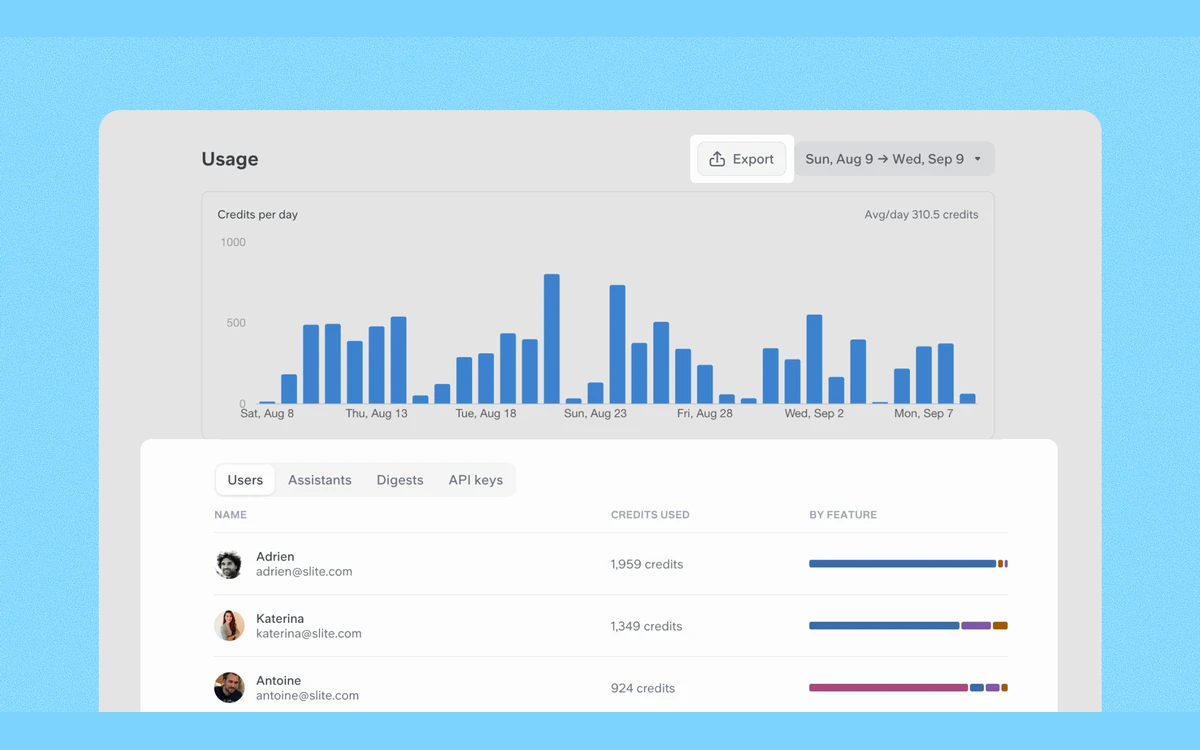
When the pool hits zero, AI features are blocked and nobody can start a new Agent task, but docs, editing, comments and search keep working. You can buy top-ups from $10 for 100 credits, in packs of 100, 500 or 1,000, and top-up credits expire after a year. Automatic top-ups, per-user limits and spending caps are not available yet, so one heavy user can drain the pool for everyone.
On September 17, 2026 Slite said it had rebuilt the Agent engine "from the ground up" and that it now answers the same questions faster "for roughly a third of the credits". That is Slite's claim; the post gives no benchmark numbers. If it holds, the published per-task costs above are the ones to plan with.
Basic is metered differently
Ask on Basic does not use credits. It searches only your Slite docs and stops at about 30 questions per seat per month, then stays unavailable until the 1st of the next month. Slite's pricing page and Ask article say per seat, while its credits article says the quota is pooled across the workspace, so check your own usage page.
The editor and everyday use
Strip away the Agent and Slite is still a pleasant place to write. Docs are fast, the editor stays out of the way, and doc verification lets owners mark a page as reviewed so readers know what to trust. The Knowledge Management Panel, on every plan, shows which docs are stale or unowned.
Developers get a real integration story. The Slite MCP server at https://api.slite.com/mcp uses OAuth, so there are no API keys or config files to manage, and it works with Claude, ChatGPT, Cursor, Gemini Enterprise, Codex and Google Antigravity. It was listed in the Claude directory in September 2026 and can now upload images, PDFs, audio and video. The REST API lives at https://api.slite.com/v1/ with a rate limit of 120 calls per minute. Both are on Basic, though Agent calls made through them spend Pro credits.
What Slite does not try to be is a database tool. There are no Notion-style relational databases or project boards here; it is documents, collections and search. For many teams that focus is the point.
Security, privacy and admin controls
- SOC 2 Type II, audited annually by an independent third party, plus annual penetration tests and code audits.
- All production data hosted in the EU (St. Ghislain, Belgium) on Google Cloud; GDPR compliant.
- HIPAA support with a BAA for enterprise-tier customers.
- 7-day backup retention. Slite says it does not offer end-to-end encryption.
- Google SSO enforcement on Basic; OpenID Connect SSO on Pro and Enterprise. Slite's docs do not mention SAML.
- SCIM and audit logs are Enterprise only.
On AI data, Slite's Ask help article says it retrieves only the most relevant passages and sends them to its model providers, Anthropic and Google. It also says your content is not used to train its models and that nothing is retained or learned from what Ask reads. Its sub-processor list names Google Cloud and Vertex AI in the EU.
Check before you sign
Teams that need SAML specifically, or audit logs on a mid-tier plan, will find neither on Pro. Ask sales directly rather than assuming.
Trial, billing and cancellation
Every new workspace starts a 14-day free trial covering everything in Basic and Pro, with no credit card required. Pro trials include 500 shared credits for the 14 days, regardless of seat count. After that you need a paid plan to keep using Slite.
- Owners cancel self-serve subscriptions in Settings > Billing. Multi-year contracts cannot be cancelled self-serve.
- Switching from yearly to monthly billing means emailing support. Bank transfer is available on annual and enterprise plans.
- Seats added on a yearly plan are prorated; on a monthly plan they appear on the next invoice. Removed seats show up at renewal.
- If a payment fails, Slite retries up to 4 times over the month before locking the workspace, and cancels the subscription for good if the invoice is still unpaid 90 days later.
We could not verify a published refund window, so do not assume one. Use the trial to decide.
Who should use Slite, and who should not
Pick Slite if
- Your docs rot because decisions happen in Slack, GitHub, Jira or Linear and nobody goes back to update the wiki.
- You want an AI that proposes fixes but cannot publish them without a human.
- You want a focused, fast wiki rather than an all-in-one workspace.
- You want EU hosting and SOC 2 Type II out of the box.
Look elsewhere if
- You need databases, project tracking and docs in one tool; Notion covers far more ground.
- You are deep in Atlassian and need Jira and Confluence permissions to line up; Confluence is the safer fit.
- You need a free tier, SAML, or hard caps on AI spend.
- You only want a wiki and no AI; Basic at $10 is no longer the cheap option it was at $8.
Pros
- Drift detection with a side-by-side review queue is genuinely useful, not just a chat box on top of docs.
- Cross-tool answers with sources, across 20+ connectors.
- MCP and API on every plan, with OAuth-based MCP setup.
- Clear published credit costs and a per-feature usage page.
Cons
- No free plan, and the entry price rose to $10.
- The Agent is Pro only, and credits are pooled with no caps or per-user limits yet.
- Connector sync has real gaps: no Sheets, no Notion databases, no Jira comments.
- No SAML documented, no end-to-end encryption, audit logs only on Enterprise.
Verdict
Slite has turned into a different product, and mostly a better one. Plenty of wikis can answer questions; fewer try to notice when the answer has changed and draft the update for a human to approve. If stale documentation is your actual problem and your team lives in Slack and dev tools, Pro at $20 per user is worth trialling, and the 14-day trial with 500 credits is enough to see whether the Agent catches real drift in your sources.
Go in with eyes open on credits. The pool is shared, nothing stops one person from draining it, and the per-task costs add up for heavy research. Teams that only need a clean wiki can still use Basic, but at $10 with a 30-question Ask limit it competes on polish, not price.
Frequently asked questions
How much does Slite cost in 2026?
Basic is $10 and Pro is $20 per user per month, billed yearly; Enterprise is custom. Monthly billing is available, but the pricing page does not list its price.
Does Slite have a free plan?
No. There is a 14-day free trial of Basic and Pro with no credit card, and Pro trials include 500 shared credits. After the trial you need a paid plan.
Is the Slite Agent included on the Basic plan?
No. The Agent is on Pro and optional on Enterprise. Basic gets Ask, which searches only Slite docs and is limited to about 30 questions per seat per month.
What happens when we run out of credits?
AI features stop and nobody can start a new Agent task until the monthly pool resets or you buy a top-up, from $10 for 100 credits. Docs, editing, comments and search keep working.
Do unused credits roll over?
Included monthly credits do not. Purchased top-up credits last for one year.
What happened to Super?
Super merged into Slite in May 2026 and became the Slite Agent at the June 10, 2026 relaunch. super.work now redirects to slite.com, and existing Super customers keep their current subscription setup.
Is my data used to train AI models?
Slite says no. Ask sends only the relevant passages to its model providers, Anthropic and Google, and Slite states that nothing is retained or learned from them. Production data is hosted in the EU.
Does Slite support SSO and SCIM?
Basic can enforce Google SSO, Pro and Enterprise add OpenID Connect SSO for Okta, Azure and others, and SCIM is Enterprise only. Slite's docs do not mention SAML.
How do I cancel Slite?
A workspace owner cancels a self-serve subscription in Settings > Billing. Multi-year contracts cannot be cancelled self-serve, and switching from yearly to monthly billing goes through support.
Key takeaways
- Slite relaunched on June 10, 2026 as a self-maintaining knowledge base, with Super folded in as the Slite Agent.
- The Agent flags outdated docs, drafts fixes and answers across 20+ tools, but nothing changes until a person approves it.
- Plans are Basic $10 and Pro $20 per user per month billed yearly; the old $8 Standard price is gone and there is no free plan.
- Pro includes 50 pooled credits per paid seat per month with no rollover and no spending caps yet; top-ups start at $10 per 100.
- Connector sync has gaps (no Sheets, Notion databases or Jira comments), and SAML is not documented.
- Best for teams whose docs go stale because decisions happen in Slack and dev tools.
More in Services & Software
Browse Services & Software