CyberGhost VPN Pricing 2026: Plans, Renewal Costs and Refunds
CyberGhost sells one VPN on three terms, and the $2.19 headline is a division of a single upfront charge. What each plan costs, what renewal really does to the rate, and how the 14 and 45 day refunds work.
CyberGhost advertises CyberGhost VPN from $2.19 a month. That number is a division, not a payment. It belongs to the longest commitment on the price list, it is charged as one lump sum covering more than two years, and it applies to the first term only. Nobody is billed $2.19 in any given month.
This guide separates the four things that decide what CyberGhost actually costs you: which term you pick, what lands on your card on day one, what the subscription renews at, and which add-ons are genuinely optional. Prices below were checked on 27 August 2026 against United States listings. CyberGhost reprices frequently and runs regional and seasonal offers, so treat the figures as the shape of the pricing rather than a permanent quote.
Three terms, one identical VPN
CyberGhost keeps its price list simpler than most of its rivals. There are no feature tiers: no Basic, Plus and Complete, no bundle that quietly decides whether you get the password manager. Every subscription buys the same product, and the only variable is how long you commit. That is worth stating plainly, because it means a cheaper CyberGhost plan is never a weaker CyberGhost plan.
- 1 Month: advertised at $12.99/mo, charged as $12.99.
- 6 Months: advertised at $6.99/mo, charged as $41.94 up front.
- 2 Years + 2 Months: advertised at $2.19/mo, charged as $56.94 up front, covering 26 months.
- Every term includes the same 9,700+ servers, the same 100 countries and 115+ locations, the same 7 simultaneous connections and the same unlimited bandwidth.
The advertised rate is arithmetic
$56.94 divided by 26 months is $2.19. That is the entire basis of the headline price. You are not signing up to a $2.19 monthly bill that you could stop after a month; you are paying $56.94 once and dividing it yourself afterwards.
What actually lands on your card
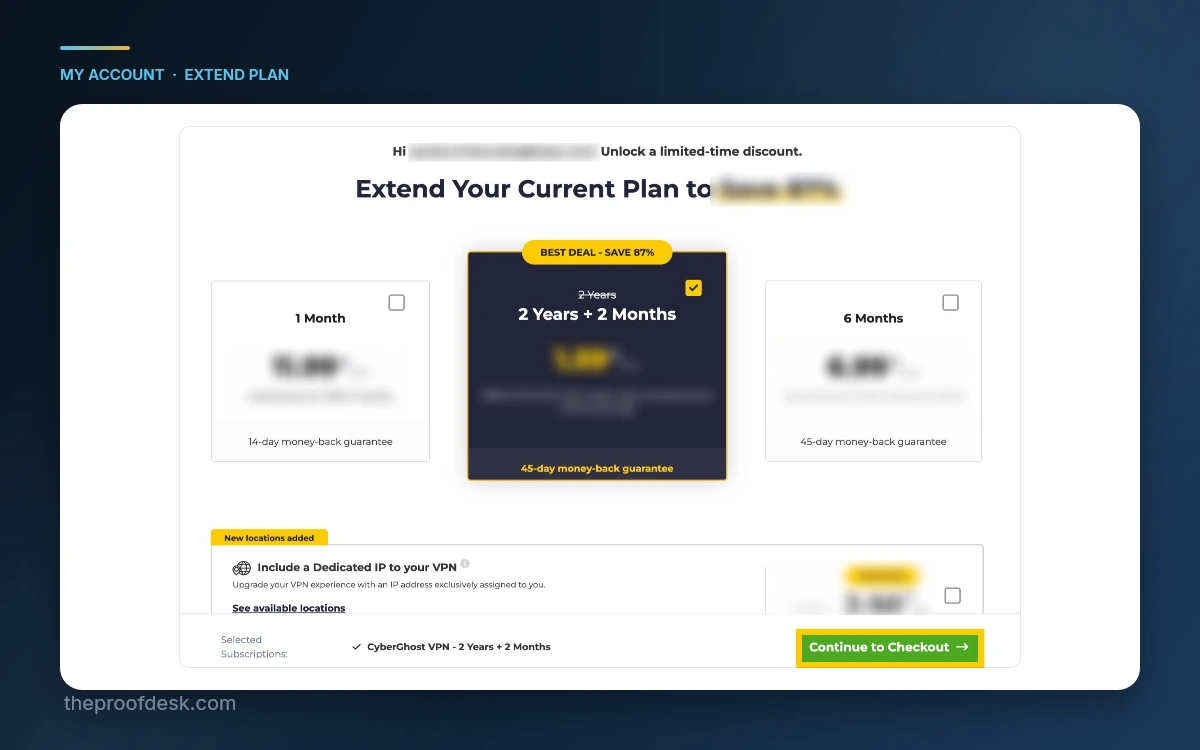
The long plan is a single charge, not a payment schedule. Buy the 2 Years + 2 Months offer and $56.94 leaves your account that day for the whole 26 months. The 6-month plan behaves the same way at $41.94. Only the monthly plan bills the way its advertised price implies, and it is the one that costs the most per month by a wide margin.
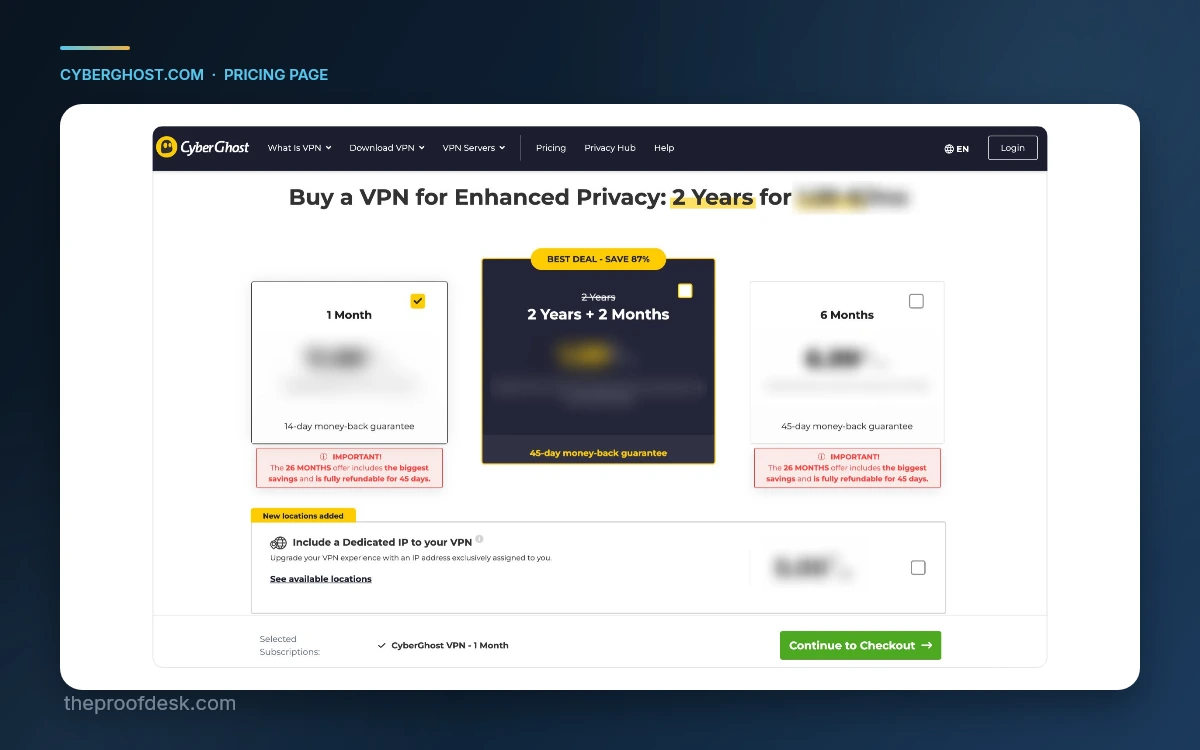
The two bonus months on the long plan are real, and they are part of why the per-month figure looks as low as it does. The term is 24 paid months plus 2 free ones, and CyberGhost divides the price across all 26. Those extra months are also a first-term sweetener: they do not repeat when the subscription renews, which is where the pricing gets more interesting.
Taxes sit on top
CyberGhost's own footnote states that all amounts are in US dollars and that taxes may apply based on your jurisdiction. The figure on the pricing card is not always the figure on the receipt.
The renewal keeps the price and shortens the term
Most VPN pricing guides tell you to brace for a renewal price hike. CyberGhost's works differently, and the difference is easy to miss. The Automatic Renewal Terms displayed at checkout state that each plan renews at the same dollar amount you paid the first time. What changes is how much time that amount buys.
- The 1 Month plan renews every month at $12.99 per month.
- The 6 Months plan renews every 6 months at $41.94, an unchanged $6.99 per month.
- The 2 Years + 2 Months plan renews every year at $56.94 per year.
This is the number that matters
The long plan's first term is $56.94 for 26 months, which is $2.19 a month. Its renewal is $56.94 for 12 months, which is about $4.75 a month. The charge on your statement looks identical; the rate you are paying has slightly more than doubled, because the 26 months became 12.
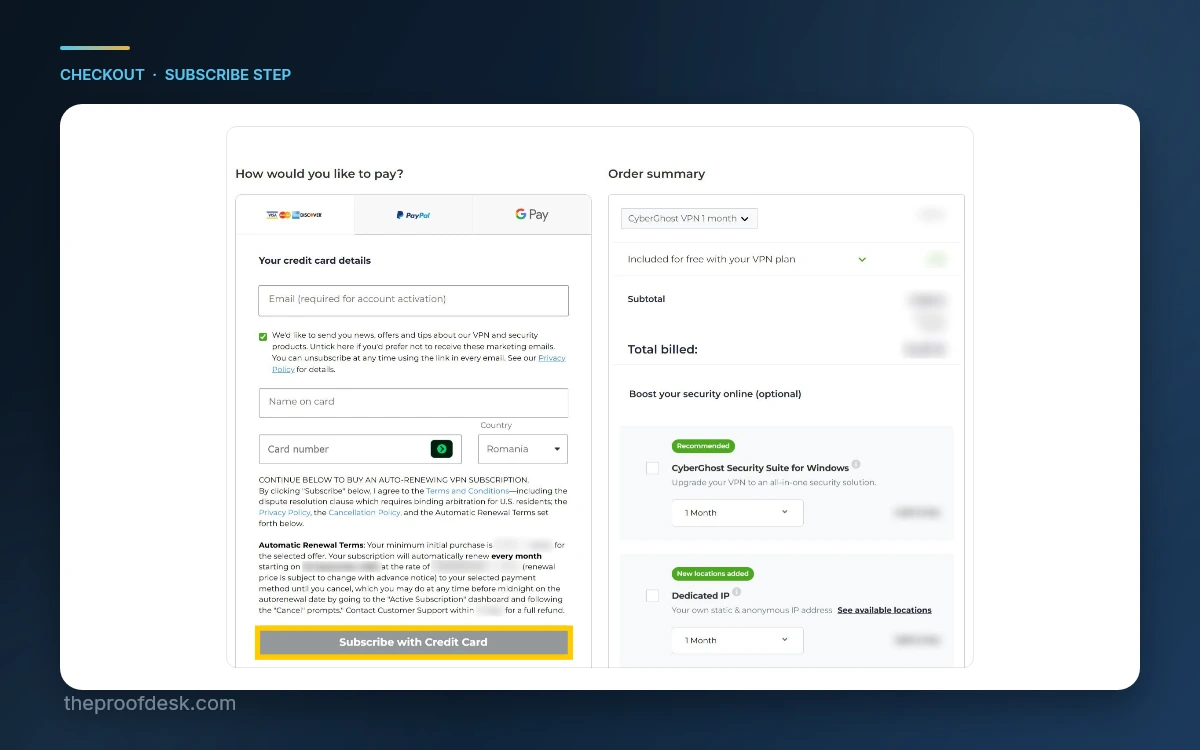
Read that clause before you pay rather than trusting any figure quoted elsewhere, including this one. Each of CyberGhost's renewal disclosures carries the qualifier that the renewal price is subject to change with advance notice, and the company's help centre explicitly defers to checkout, stating that the exact renewal price and terms are displayed there before you complete your purchase. The checkout box is the binding number on the day you buy.
The practical consequence is that CyberGhost's long plan is at its best value in its first term and merely competitive afterwards. If you intend to keep the service for years, the renewal rate of roughly $4.75 a month is the number to compare against rivals, not the $2.19 on the advertisement.
Add-ons, and the features you already have
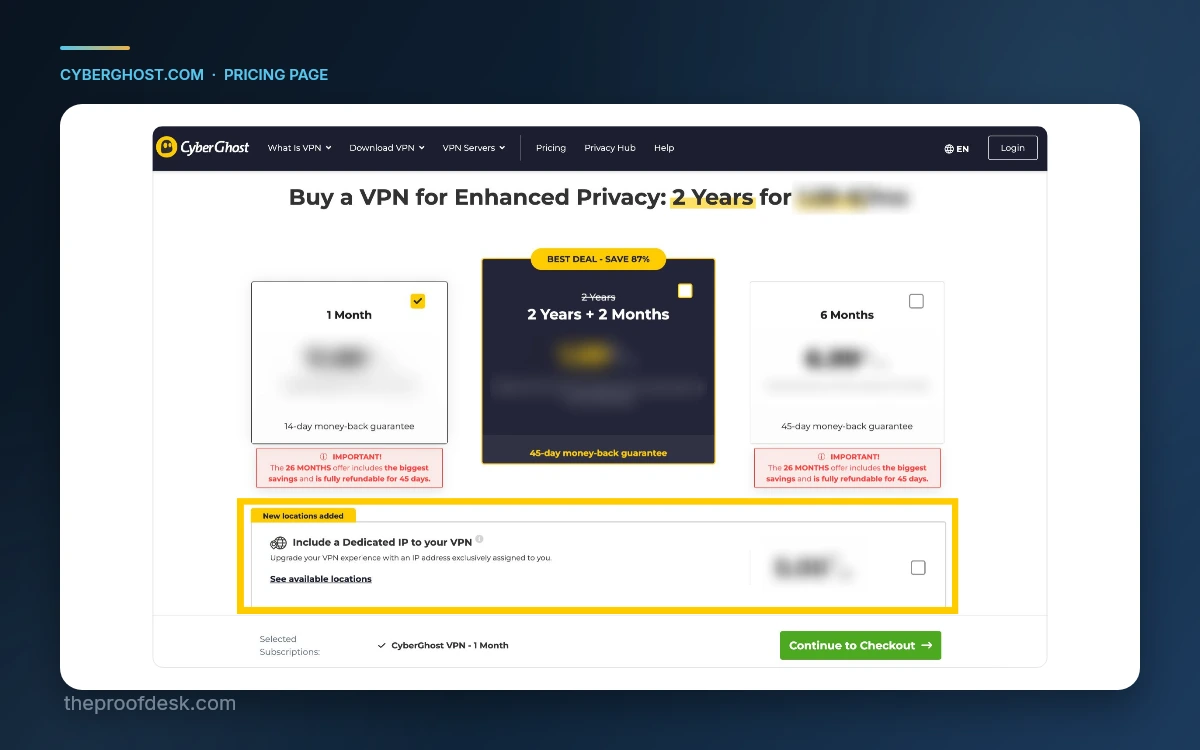
CyberGhost sells a small number of genuine extras at checkout, and their pricing is tied to the VPN term you choose: pick the long plan and the add-on is billed for the whole period at once, exactly like the subscription itself.
- Dedicated IP: $5.00/mo alongside the monthly plan, $4.00/mo on the 6-month tier. On the 26-month plan the renewal clause puts it at $60 per year. It allows up to 7 simultaneous device connections, and CyberGhost allows only one Dedicated IP subscription per account.
- CyberGhost Security Suite: $4.50/mo alongside the monthly plan, renewing at $24 per year on the long plan. It adds antivirus and a security updater, and it is Windows only.
- CyberGhost Password Manager: access to PassCamp, sold at checkout as a one-time payment for a year of access, listed at $3.49 alongside the monthly plan.
Two features you should not pay extra for
Identity Guard, which monitors your email address for breach exposure, and Mac Cleaner, which clears junk files on macOS, are included with every CyberGhost plan at no additional cost. They appear in the same dashboard as the paid extras, so it is worth knowing which side of the line they sit on before you add anything.
Trials, and the 14 or 45 days that follow
CyberGhost is unusual in offering a genuine no-card trial on desktop, and the terms differ sharply by platform. The desktop trials are short but ask for nothing; the mobile trials are longer but run through the app stores, which means a payment method is required up front.
- Windows: 24 hours, no payment method required.
- macOS: 24 hours, no payment method required.
- iOS: 7 days, payment method required.
- Android: 3 days, payment method required.
After that, the money-back guarantee is the real safety net, and its length depends on the term you bought. CyberGhost's refund policy gives 14 days on the 1-month subscription and 45 days on any subscription of 6 months or longer. Both are full refunds within the window.
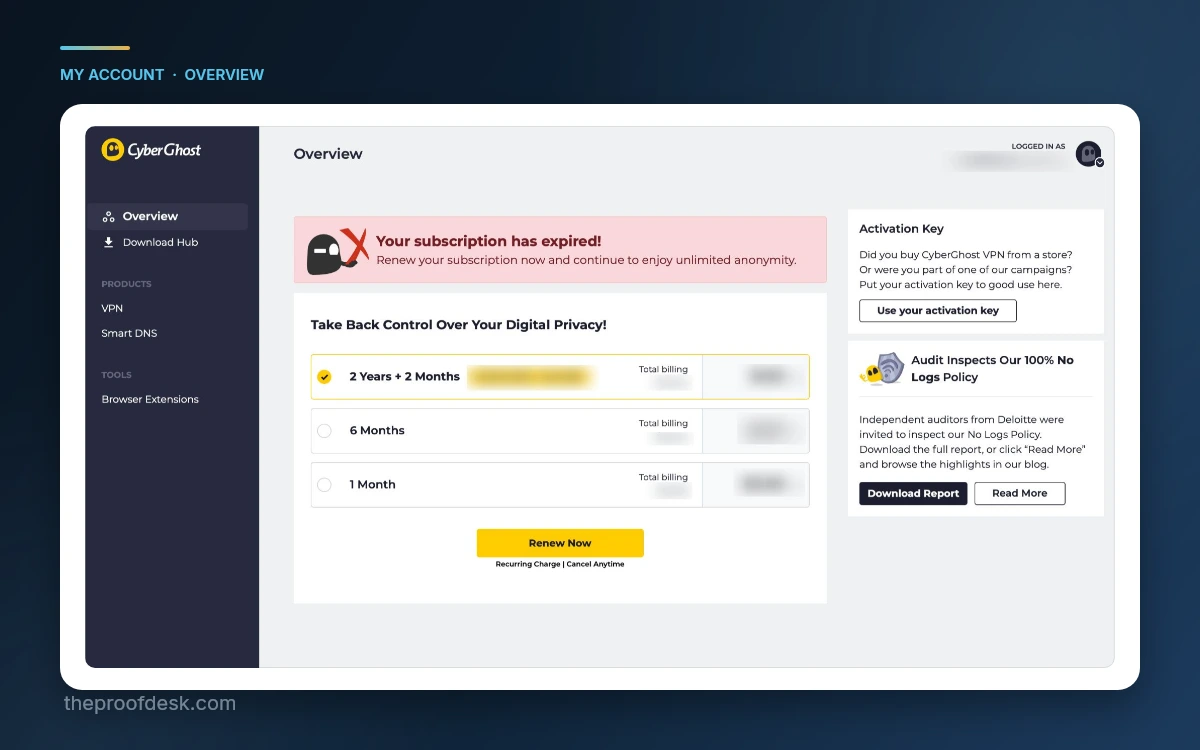
Cancelling is not the same as refunding
CyberGhost states directly that disabling automatic renewal will not initiate a refund request. Turning off auto-renew stops the next charge; getting your money back for a charge already taken requires contacting support inside the 14 or 45 day window. Doing one and assuming it did the other is the most common way people lose the guarantee.
The company's terms also make the post-window position explicit: cancel a yearly subscription after three months and you receive no refund, but you keep access until the term expires, at which point it simply does not renew.
Where you buy decides who refunds you
CyberGhost's own summary is blunt: the store where you purchased your subscription is responsible for everything related to billing, including cancellations, refunds, or payment issues. The VPN itself is identical across every channel, including the 7-device limit, but the refund route is not.
- Direct from cyberghostvpn.com: CyberGhost's own 14 or 45 day money-back guarantee applies, and its support team handles billing.
- Apple App Store: CyberGhost states its money-back guarantee does not apply, and that refunds must be requested through the App Store, issued solely at the discretion of Apple Support.
- Google Play and other app stores: billing is managed by the store, and cancelling there prevents future charges without automatically refunding payments already made.
- Physical gift cards and third-party sellers: you must contact that seller for their own refund policy.
Buying direct is therefore the option that keeps the guarantee in CyberGhost's hands. Support access is the one thing that does not vary: CyberGhost confirms that all users can reach its customer support regardless of where they subscribed, even when it cannot process the refund itself.
Frequently asked questions
How much does CyberGhost VPN cost per month?
It depends entirely on the term. The monthly plan is $12.99, the 6-month plan works out at $6.99 a month billed as $41.94, and the 2 Years + 2 Months plan works out at $2.19 a month billed as $56.94 for 26 months. Only the first of those is an actual monthly bill.
Does the price go up when it renews?
The charge does not, but the value does. Each plan renews at the same dollar amount, so the long plan renews at $56.94 again. That renewal covers 12 months instead of 26, which takes the effective rate from $2.19 to roughly $4.75 a month. CyberGhost also notes the renewal price is subject to change with advance notice, so check the Automatic Renewal Terms at checkout.
Which plan should most people buy?
The 2 Years + 2 Months plan, because every plan ships the identical VPN and this one costs less per month than the alternatives even after renewal. The 45-day guarantee attaches to it too. The monthly plan is worth its premium only if you need a VPN for a specific short trip or a single project.
How many devices can I use at once?
Seven simultaneous connections, on any mix of platforms, and the limit is the same no matter where you bought the subscription. Note that CyberGhost's terms of service still contain older language referring to unlimited simultaneous devices; the current product limit published in its help centre and on its checkout page is 7.
Is there a free trial, and do I need a card?
Yes, and the card requirement depends on the platform. Windows and macOS both offer a 24-hour trial with no payment method needed. iOS offers 7 days and Android offers 3 days, but both run through the app stores and require a payment method.
Can I get a refund if I subscribed through the App Store?
Not from CyberGhost. It states its money-back guarantee does not apply to Apple App Store or iTunes purchases, and that you must request the refund through the App Store, where it is issued solely at Apple's discretion. The same principle applies to gift cards and third-party sellers, where you deal with that seller. Buying direct is the only route that keeps the 14 or 45 day guarantee with CyberGhost.
What do the paid add-ons actually cost?
A Dedicated IP is $5.00 a month alongside the monthly plan and renews at $60 a year on the long plan. The Windows-only Security Suite is $4.50 a month alongside the monthly plan and renews at $24 a year on the long plan. The PassCamp password manager is sold as a one-time payment for a year of access. Identity Guard and Mac Cleaner cost nothing extra and are included with every plan.
Key takeaways
- Every CyberGhost term buys the identical VPN, so a cheaper plan is a longer commitment rather than a reduced product.
- The advertised $2.19 a month is $56.94 charged once for 26 months, not a monthly bill you can stop after a month.
- Renewals keep the same dollar amount but shorten the term, taking the long plan from $2.19 to about $4.75 a month.
- The money-back guarantee is 14 days on the monthly plan and 45 days from six months up, and cancelling auto-renew does not itself trigger a refund.
- Desktop trials need no payment method, but buying through an app store hands the refund decision to Apple or Google instead of CyberGhost.
More in Virtual Private Network
Browse Virtual Private Network