DreamHost Review 2026: New Plan Names, Renewals and the 30-Day Refund
DreamHost renamed its shared plans, and the famous 97-day guarantee is gone. What Launch, Growth and Scale cost at renewal, what the custom panel does instead of cPanel, and who the host actually fits.
Two things about DreamHost changed recently enough that most reviews still get them wrong. The shared hosting plans people search for by name, Shared Starter and Shared Unlimited, are no longer sold; the lineup is now Launch, Growth and Scale. And the 97-day money-back guarantee DreamHost was known for is not what the company's own help center currently promises. It says 30 days.
Neither change is a scandal. But if you pick a host based on a review written against the old plan sheet, you will budget for the wrong renewal price and plan around a refund window that is roughly a third of the one you expected. This review is written against DreamHost's own pricing pages, terms of service and help center as they read in August 2026, with the renewal number quoted next to every intro number, because the gap between them is the whole story with shared hosting.
DreamHost is also unusual in a way that matters more than the price: it is independent, it does not run cPanel, and it has been doing both since long before either was a marketing position.
What DreamHost is, and what makes it unusual
DreamHost's own overview article says the company was originally founded in 1997 as the New Dream Network by four Harvey Mudd College undergraduates, and that it hosts over a million websites worldwide. That founding story matters less than what followed it: DreamHost never sold to Endurance International or its successor Newfold Digital, the roll-up that absorbed Bluehost, HostGator and a long list of other familiar brands. DreamHost is still independently owned.
The practical consequence is a host that made its own decisions about tooling. The most visible one is that DreamHost does not offer cPanel. Its help center is blunt about this: "cPanel is not available at DreamHost. Instead, DreamHost uses a custom-built panel to manage your websites, databases, email, and billing." You get panel.dreamhost.com, a purpose-built interface for websites and hosting, domains, email, servers, billing and support.
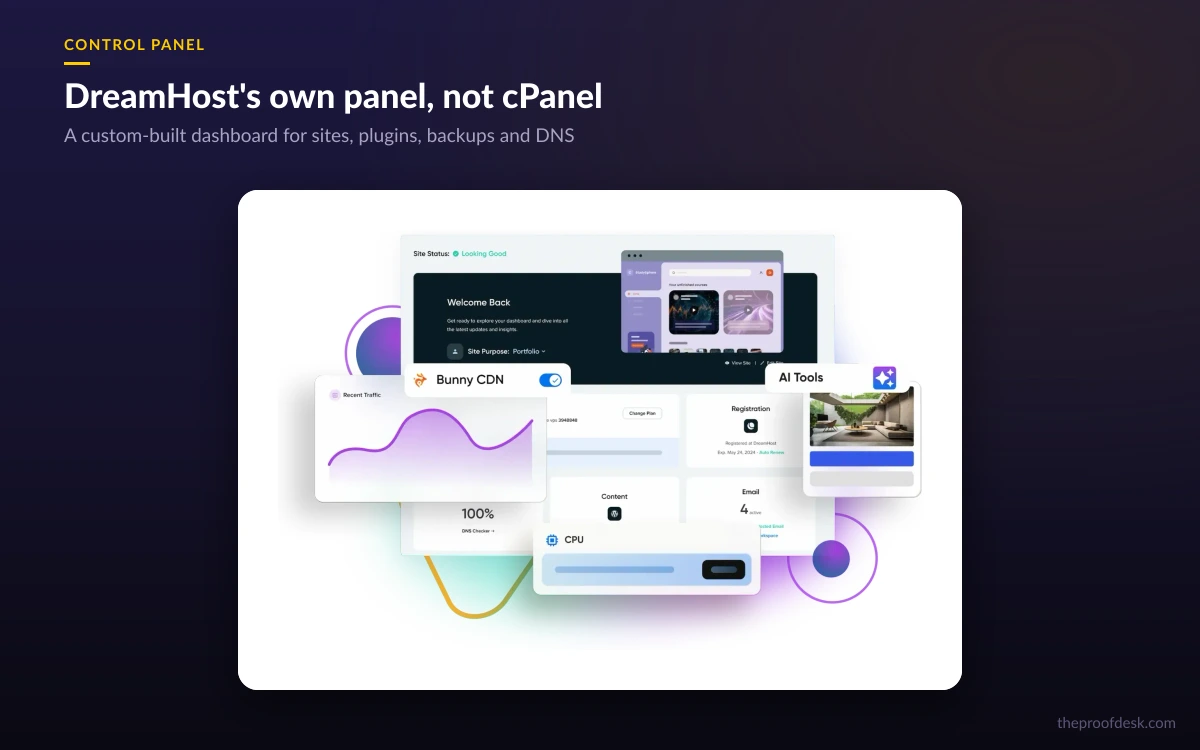
Whether that is a feature depends entirely on your history. If you have never used cPanel, DreamHost's panel is cleaner and easier to navigate, and it runs on separate servers from the one serving your site. If you have a decade of cPanel muscle memory, or a developer who bills by the hour and expects it, every task takes a little longer until you relearn where things live. It also means the enormous library of "log into cPanel and click here" tutorials on the wider web does not apply to you.
The short version
Independent, opinionated, and cheapest in the first year by a wide margin. The renewal price is where you should make the decision, and the refund window is shorter than DreamHost's reputation suggests.
Shared hosting: Launch, Growth and Scale
The current shared lineup has three tiers. Existing customers on the retired Shared Starter and Shared Unlimited plans keep them, but you cannot buy those names today.
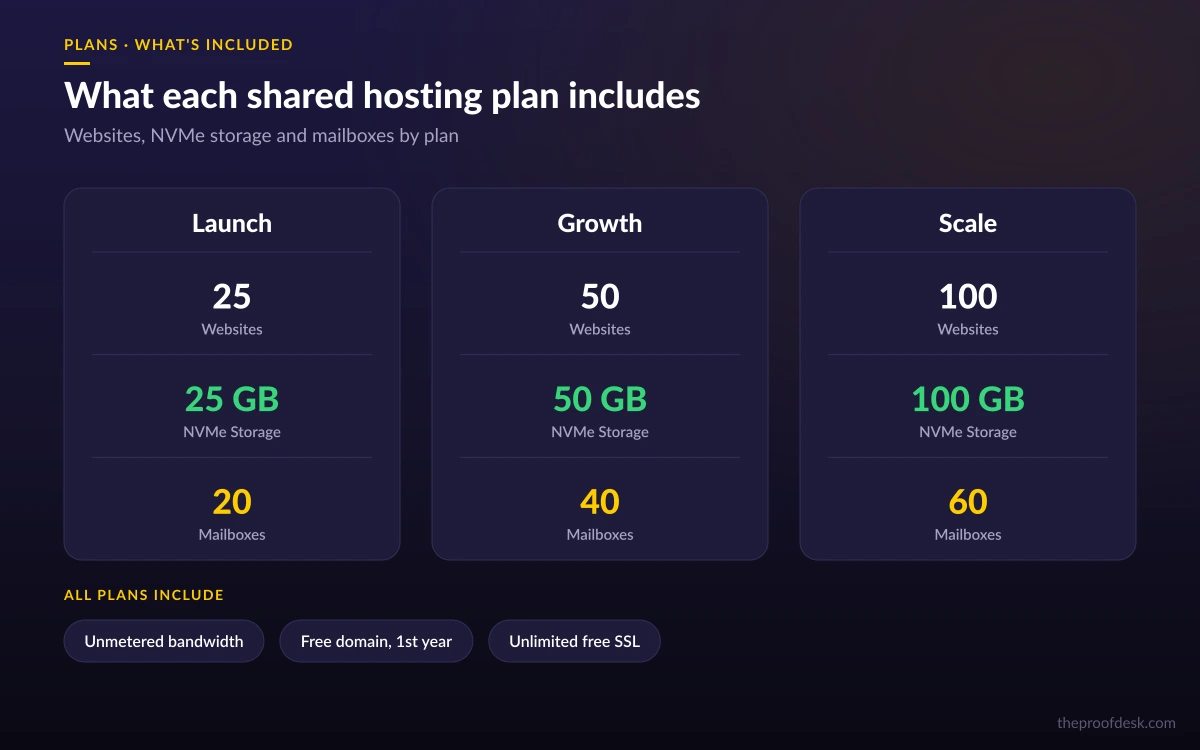
- Launch: 25 websites, 25 GB NVMe SSD, 20 mailboxes
- Growth: 50 websites, 50 GB NVMe SSD, 40 mailboxes
- Scale: 100 websites, 100 GB NVMe SSD, 60 mailboxes
Every tier advertises unmetered bandwidth, unlimited free SSL certificates, a free domain for the first year and daily automated backups. DreamHost's pricing pages also list monthly visit guidance of roughly 40,000 for Launch, 200,000 for Growth and 400,000 for Scale, though that figure is presented inconsistently across its own landing pages, so treat it as guidance rather than a hard meter.
The mailbox numbers carry an asterisk that is easy to miss in the checkout flow. Each plan lists its mailboxes as "3 Months Free" — after that promotional period, email moves to a Paid Email plan. DreamHost's pricing page lists email hosting as starting at $1.67/mo. Each address allows up to 25 GB of storage. If email for a handful of addresses is part of why the plan looked cheap, add that line back into your budget.
Monthly billing exists, with a catch
You can pay month to month rather than commit to a term. DreamHost's own marketing notes that monthly plans do not include the free domain registration. We could not find the exact monthly-only sticker price quoted on a first-party DreamHost page, so check it in the cart.
The renewal math, which is the actual decision
Shared hosting is sold on the first-term price and paid on the renewal price. Here is what DreamHost publishes for both, on a one-year term.
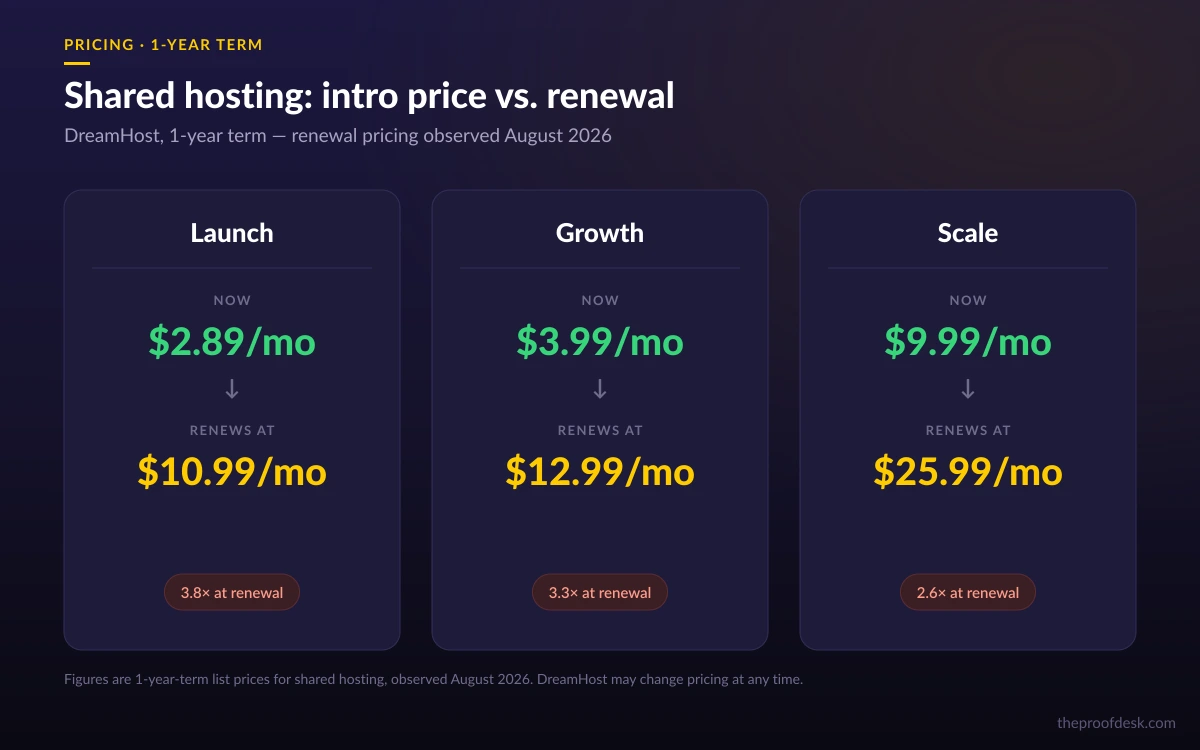
- Launch: $2.89/mo intro, auto-renews at $10.99/mo
- Growth: $3.99/mo intro, auto-renews at $12.99/mo
- Scale: $9.99/mo intro, auto-renews at $25.99/mo
Now the part that is genuinely counter-intuitive, and that no other budget host handles quite this way. DreamHost also sells a four-year term, and the four-year term does not just cut the intro price — it locks in a permanently lower renewal rate.
- Launch: $1.99/mo intro on a four-year term, renewing at $7.99/mo instead of $10.99
- Growth: $3.49/mo intro on a four-year term, renewing at $8.99/mo instead of $12.99
- Scale: $7.99/mo intro on a four-year term, renewing at $19.99/mo instead of $25.99
Read that twice, because it inverts the usual advice. At most hosts, a longer prepay buys a deeper first-term discount and nothing else, so the standard guidance is to take the shortest term you can tolerate. At DreamHost the longer term changes the price you pay forever after. Growth on a four-year term renews at $8.99/mo; Growth on a one-year term renews at $12.99/mo for the same product. That is a 31% permanent difference for choosing a checkbox at signup.
The trade is the obvious one: four years is a long commitment to a company, a stack and a control panel, paid up front, and the money-back window covers 30 days of it. Prepaying four years to save $4/mo is a good deal only if you are confident you will still want this host in year three.
DreamPress, the managed WordPress tier
DreamPress is DreamHost's managed WordPress product, and it is priced as a real step up rather than a shared plan with a badge. Six tiers, all currently showing a 40% first-year discount:
- DreamPress 1 — $14.99/mo first year, renews $19.99/mo — 1 website, 15 GB
- DreamPress 2 — $17.99/mo first year, renews $24.99/mo — 2 websites, 25 GB
- DreamPress 3 — $20.99/mo first year, renews $28.99/mo — 3 websites, 30 GB
- DreamPress 5 — $29.99/mo first year, renews $40.99/mo — 5 websites, 50 GB
- DreamPress 10 — $47.99/mo first year, renews $65.99/mo — 10 websites, 100 GB
- DreamPress 20 — $77.99/mo first year, renews $107.99/mo — 20 websites, 200 GB
DreamPress 1 includes 40k monthly visits, 14 days of backup retention, one professional site migration, one-click staging, a free Essential CDN, unlimited mailboxes, unmetered bandwidth and a free domain for the first year. The staging and the included migration are the two features most likely to justify the jump from shared, since both are things you would otherwise do by hand or pay for.
On caching, DreamHost's help center says DreamPress "includes built-in server caching, which speeds up your site significantly," managed through the Nginx Helper plugin, which covers pages for logged-out users. Redis object caching is gated: "Redis is a service that only runs on DreamPress Pro accounts (due to the extra memory that it requires)." DreamHost's knowledge base still uses the older "Pro" naming while the sales page numbers the tiers 1 through 20, and we could not confirm which numbered tiers now count as Pro. If Redis object caching is a requirement — for a WooCommerce store or a membership site, where logged-in traffic bypasses page cache entirely — ask support to confirm the tier in writing before you buy.
Where DreamPress earns its price
Sites with lots of logged-in traffic. Page caching does nothing for logged-in users, so object caching and the extra memory are what actually keep a store or a membership site responsive.
VPS and dedicated servers
DreamHost sells two separate VPS lines, which is a genuine source of confusion because both are called VPS on the site.
Managed VPS keeps the DreamHost panel and DreamHost's management. Prices are promotional for the first three years, then renew:
- VPS Business — $10/mo, renews $24.99/mo — 2 GB RAM, 2 cores, 60 GB NVMe
- VPS Professional — $20/mo, renews $46.99/mo — 4 GB RAM, 2 cores, 120 GB NVMe
- VPS Enterprise — $40/mo, renews $92.99/mo — 8 GB RAM, 4 cores, 240 GB NVMe
- VPS Premier — $60/mo, renews $114.99/mo — 12 GB RAM, 6 cores, 360 GB NVMe
All managed VPS tiers advertise unlimited websites. One caution: DreamHost's general hosting landing page simultaneously advertises VPS Business at $13.75/mo renewing at $31.99/mo on a one-year term, for what appears to be an identical 2-core, 2 GB, 60 GB machine. Two campaigns, two terms, one product. Confirm which offer your cart has actually applied before paying.
Unmanaged VPS, branded as the Stack tiers, gives you root on AMD EPYC and NVMe hardware with unmetered bandwidth and no overage bills. Intro pricing here covers only the first three months, so the renewal arrives fast: Stack 4 at $8.99/mo renewing to $15.99 (4 GB, 75 GB, 2 vCPU), Stack 8 at $13.99 renewing to $21.99 (8 GB, 150 GB), Stack 16 at $22.99 renewing to $34.99 (16 GB, 250 GB), and Stack 32 at $45.99 renewing to $59.99 (32 GB, 450 GB).
Dedicated servers start at a Standard 16 configuration listed at $199/mo, discounted to $165/mo, with a 6-core/12-thread CPU, 16 GB RAM and a 480 GB SSD. The range runs up to an Enhanced 64 at $349/mo with 12 cores, 24 threads and 64 GB RAM, and larger 960 GB and 1920 GB storage builds from $335/mo to $749/mo. DreamHost does not publish a renewal price for dedicated servers anywhere we could find, which for a product at this price point is worth a written answer from sales before you commit.
The panel, migrations and the AI builder
Day to day, the panel is where you will live, and it covers the expected ground: traffic and bandwidth graphs, one-click WordPress installs, malware scanning, DNS, email and billing in one place.
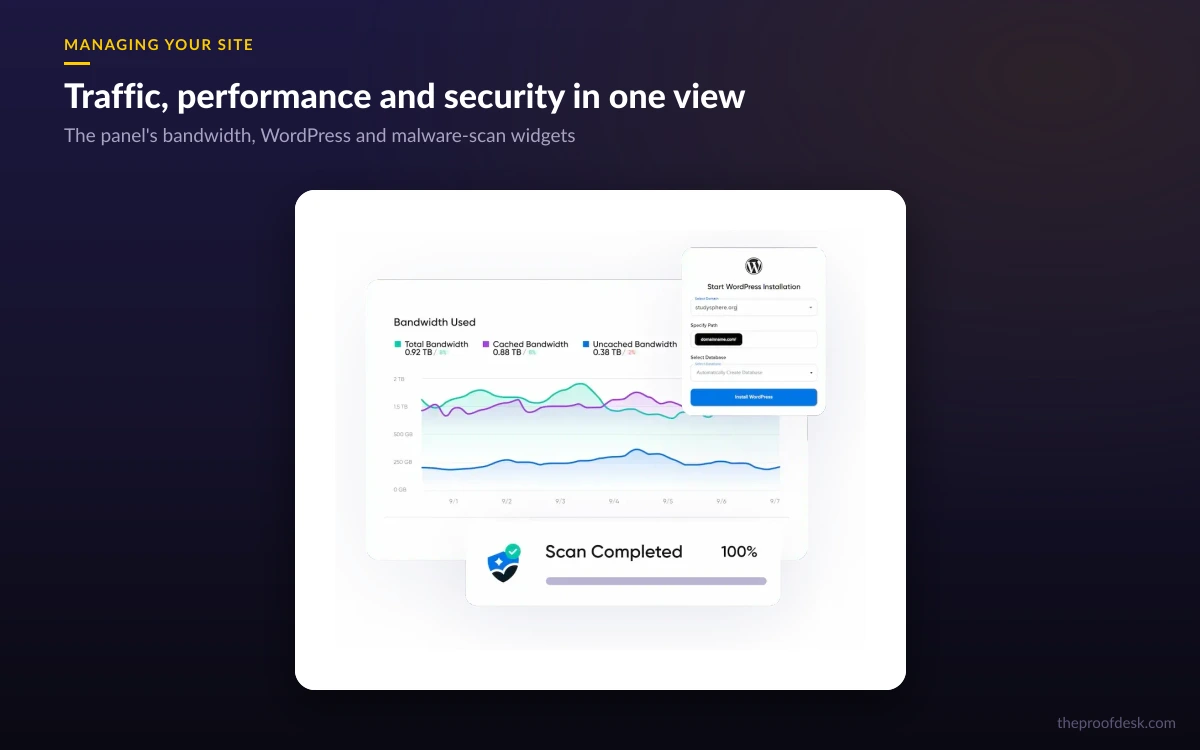
Migration is handled three ways. There is a free DreamHost Automated Migration plugin for WordPress, built on BlogVault's technology, which handles most straightforward moves without a support ticket. There is a paid Professional Site Migration for complicated sites, and DreamPress plans include one of those at no cost. And you can always move a site manually. For a standard WordPress install, the plugin route is genuinely free, which is not true at every host that advertises "free migration" and then defines it narrowly.
On the AI side, DreamHost launched Liftoff in September 2024, described in its press release as "an AI website builder for WordPress designed to create fully customized WordPress websites in seconds" and made "available now to all DreamHost customers at no additional cost." The help center says it generates a customized WordPress site in 60 seconds. Set expectations accordingly: this is a fast way to get a structured starting draft, not a replacement for design work. DreamHost also markets a separate builder called Remixer, and we could not determine from its own pages whether that is the same product rebranded or a parallel offering.
Data centers and the uptime guarantee
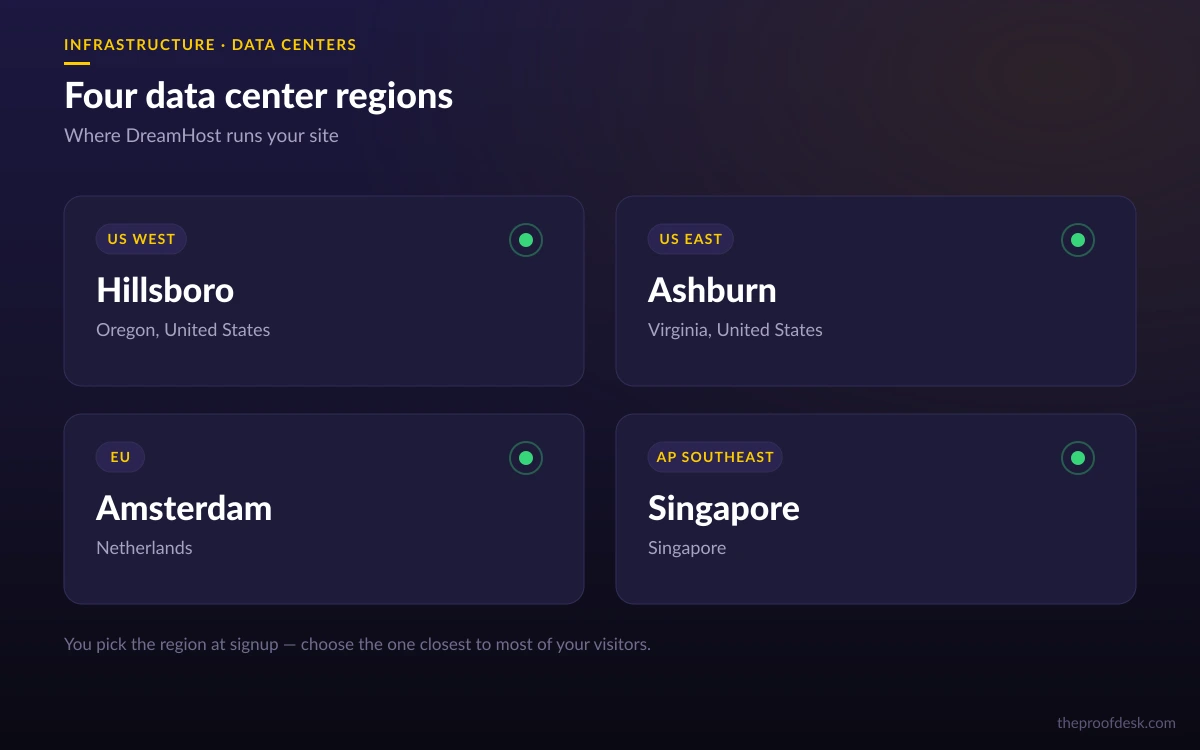
DreamHost operates four regions, and you choose one at signup. Physical distance to your visitors is still the cheapest performance win available, and it costs nothing to get right on day one.
The uptime guarantee is unusually worded. DreamHost's terms of service, last updated 27 August 2026, state plainly: "DreamHost guarantees 100% uptime." A 100% guarantee is a marketing number rather than an engineering one, so what matters is the remedy behind it, and the remedy is specific.
The terms define downtime as your website, databases, email, FTP, SSH or webmail becoming unusable through a failure in DreamHost's systems, excluding scheduled maintenance and customer error. Compensation is "credit equal to the Customer's current hosting cost for 1 (one) day of service for each 1 (one) hour (or fraction thereof) of service interruption, up to a maximum of 10% of Customer's next pre-paid hosting renewal fee."
That day-per-hour formula is generous compared to the industry norm, but note the two limits that make it much smaller in practice: it caps at 10% of your next renewal, and it is not automatic. You have to open a support ticket to report the problem and claim it. No ticket, no credit, no matter how long the outage ran.
Refunds, billing and getting help
This is where the internet's collective memory of DreamHost is furthest out of date. For years DreamHost's signature offer was a 97-day money-back guarantee, and a great many review sites still say so. DreamHost's own refunds article, last updated 4 August 2026, says 30 days — for shared Web Hosting, for Managed VPS, and for DreamPress on both monthly and yearly billing. The live shared hosting sales page advertises "30-Day Money-Back Guarantee" too. We could not find 97 days quoted on any current first-party DreamHost page. Treat it as history.
There is one clause worth knowing that most hosts do not offer: if you cancel within 30 days of an annual renewal, DreamHost credits the current subscription cost. That is a real safety net against the renewal price landing on a card you forgot about — but it is a credit, and it requires you to notice within 30 days.
What is excluded from refunds and credits: monthly VPS, monthly Dedicated, the Paid Email plan, DreamCompute, DreamShield, SSL certificates and unique IPs. Domain registrations are non-refundable, which is standard across the industry. Prorated credits are available for annual VPS, the SEO Toolkit, Bunny CDN and PHP Extended Support.
Billing runs on auto-renew with no soft landing. DreamHost's billing FAQ states that "Each DreamHost service automatically renews at the end of its service period. The only way to prevent a service from renewing is to close the service before it automatically renews." Services can be closed individually without closing your whole account. If a balance goes 30 days past due, the panel becomes restricted until you resolve it. Paying by check or money order can take three weeks to clear, so do not leave that to the last week of a term.
Support is 24/7 live chat in English and Spanish, plus email tickets that DreamHost aims to answer within two hours. Phone support is the weak spot and you should price it in honestly: there is no number to call. DreamHost's help center says the only way to speak to support directly is to request a callback, available during business hours seven days a week. Dedicated Server and DreamPress Plus accounts get three free callbacks a month and DreamPress Pro gets five; on other plans a callback costs $9.95, or $14.95/month for three. If talking to a human on the phone during an outage is how you cope, that is a real cost and a real delay.
Who DreamHost actually fits
DreamHost fits you if you are willing to commit to a long term. The four-year renewal rates are the strongest argument the company has, and they are genuinely competitive rather than promotional theatre — $7.99/mo for 25 sites and 25 GB of NVMe, locked in, is a good price in 2026. It also fits anyone who wants a host with no corporate parent and no cPanel licence fee baked into the bill, and anyone hosting many small sites, where the 25-to-100 website allowance across the tiers is unusually generous.
It fits you less well if you need cPanel specifically, whether for a client, a developer or a migration path to another host later. It fits less well if phone support matters, since callbacks cost money on most plans. And it fits less well if you want to try a host cautiously: 30 days is an ordinary refund window, and the pricing structure actively rewards the four-year commitment that a cautious buyer would not make.
The most common mistake we would expect a buyer to make here is signing up on the one-year term because that is the conservative-seeming choice, then discovering at renewal that the conservative choice costs 31% more per month forever. Decide up front which you are: short and flexible at $10.99-$12.99/mo, or long and cheap at $7.99-$8.99/mo. The middle option is just the expensive one.
Frequently asked questions
Does DreamHost still have a 97-day money-back guarantee?
No. DreamHost's own refunds help article, updated 4 August 2026, states a 30-day full refund window for shared Web Hosting, Managed VPS and DreamPress, and the shared hosting sales page advertises the same 30 days. The 97-day guarantee was real historically and is still repeated by many third-party review sites, but no current DreamHost page quotes it. Plan around 30 days.
How much does DreamHost cost after the introductory price ends?
On a one-year term: Launch renews at $10.99/mo, Growth at $12.99/mo and Scale at $25.99/mo. On a four-year term the renewal rates are permanently lower — $7.99, $8.99 and $19.99/mo respectively. The term you choose at signup changes your renewal price, not just your first-term discount, which is unusual and worth getting right.
Is email included with DreamHost shared hosting?
Only for the first three months. Each shared plan lists its mailboxes — 20 on Launch, 40 on Growth, 60 on Scale — as three months free, after which a Paid Email plan applies. DreamHost's pricing page lists email hosting starting at $1.67/mo, and each address gets up to 25 GB of storage. Add this to your budget if the plan's mailbox count is part of why it looked cheap.
Does DreamHost use cPanel?
No, and it never has. Its help center states directly that cPanel is not available and that DreamHost uses a custom-built panel for websites, databases, email and billing. The panel is well organised and runs on separate servers from your site, but cPanel-based tutorials will not match it, and a developer expecting cPanel will need time to adjust.
Can I get DreamHost support on the phone?
Not by calling in. DreamHost has no inbound phone line; the only way to speak to support is to request a callback during business hours, available seven days a week. Dedicated Server and DreamPress Plus plans include three free callbacks per month and DreamPress Pro includes five. On other plans a single callback costs $9.95 or you can buy three per month for $14.95. Live chat is free and available 24/7 in English and Spanish, and email tickets target a two-hour response.
Where are DreamHost's servers located?
Four regions: Hillsboro, Oregon (US West); Ashburn, Virginia (US East); Amsterdam, Netherlands (EU); and Singapore (AP Southeast). You select your region and can check the assigned data center in the panel. There is no South American or African region, so if most of your traffic comes from those markets you will be leaning on a CDN rather than server proximity.
Key takeaways
- The shared plans are now Launch, Growth and Scale. Shared Starter and Shared Unlimited are retired and cannot be bought, though existing customers keep them.
- The four-year term locks in a permanently lower renewal rate, not just a deeper intro discount — Growth renews at $8.99/mo instead of $12.99/mo. This inverts the usual advice to prepay as little as possible.
- The 97-day money-back guarantee is history. DreamHost's own help center says 30 days, and cancelling within 30 days of an annual renewal earns a credit rather than a refund.
- Mailboxes are free for three months, then billed as a Paid Email plan from around $1.67/mo. Budget for it.
- There is no cPanel and no inbound phone line. The custom panel is good; callbacks cost $9.95 each on most plans.
- The 100% uptime credit is one day of hosting per hour of downtime, capped at 10% of your next renewal, and only if you open a ticket to claim it.
More in Services & Software
Browse Services & Software