ExpressVPN Pricing 2026: Plans, Renewals and Real Costs
ExpressVPN now sells three tiers. Here is what Basic, Advanced and Pro include, what each billing term costs, what happens at renewal and how to test it risk free.
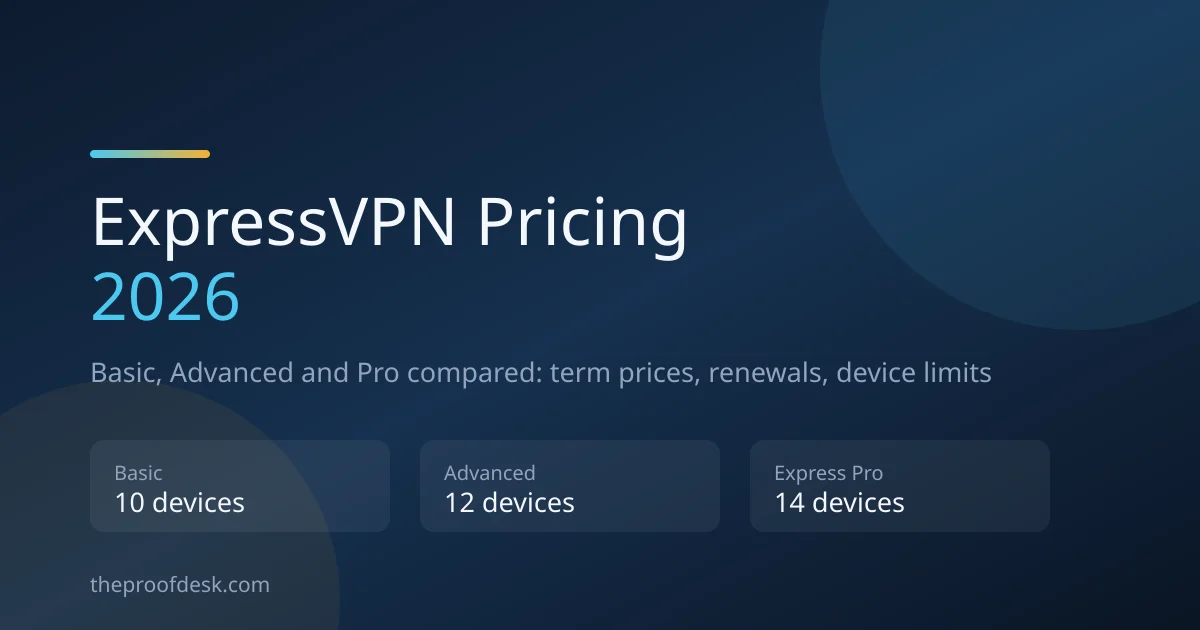
ExpressVPN used to sell one product at one price. It now sells three: Basic, Advanced and Express Pro. The tunnel is the same in all three, but the device limit, the bundled extras and the sticker price are not, so the old question of what ExpressVPN costs no longer has a single answer.
This guide breaks down what each tier includes, what the monthly, yearly and two-year terms really cost, what happens at renewal, and how to test the service without losing money. Figures were checked in August 2026 and ExpressVPN reprices often, so treat them as a guide and confirm at checkout.
What Basic, Advanced and Express Pro include
Every tier gives you the same VPN: the same server network in more than 100 countries, the same Lightway protocol, the same Network Lock kill switch and split tunneling. What changes above Basic is the software bundled around the VPN, plus how many devices you can connect at once.
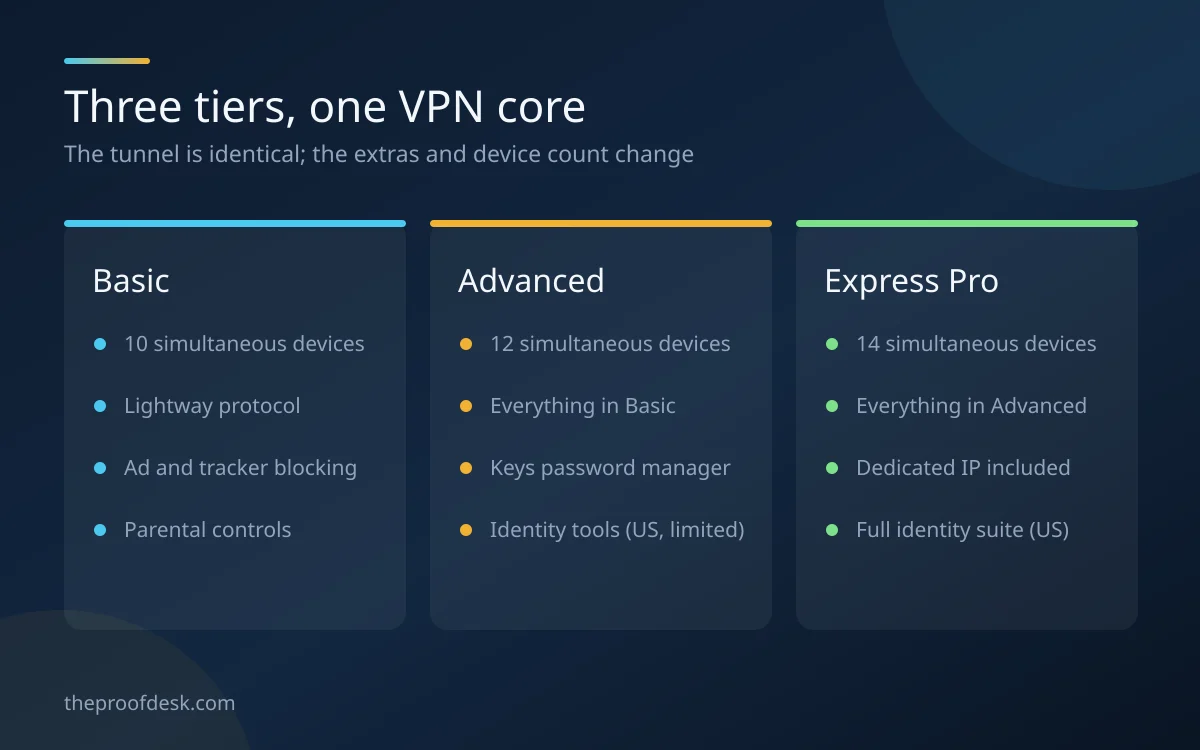
- Basic: the VPN itself, 10 simultaneous devices, ad and malicious site blocking, parental controls and a limited version of the ExpressMailGuard email relay.
- Advanced: 12 devices, the ExpressKeys password manager, the fuller MailGuard tier, stronger tracker blocking, plus a few days of travel eSIM and an Aircove router discount on longer terms.
- Express Pro: 14 devices, a dedicated IP address at no extra cost, the complete MailGuard feature set, ExpressAI credits and the largest Aircove discount.
- Identity Defender, the credit and data removal service, is limited to customers in the United States and only reaches full capability on Pro.
The upgrade is a bundle, not better privacy
Encryption, no-logs policy and server access are identical on Basic. Move up only if you would otherwise pay separately for a password manager, a dedicated IP or identity monitoring.
Device limits and the router workaround
The connection limit is the clearest difference between tiers, and it is also the easiest one to work around. A phone, a laptop, a tablet and a TV stick already use four slots, and a two-person household with a games console gets close to ten faster than people expect.
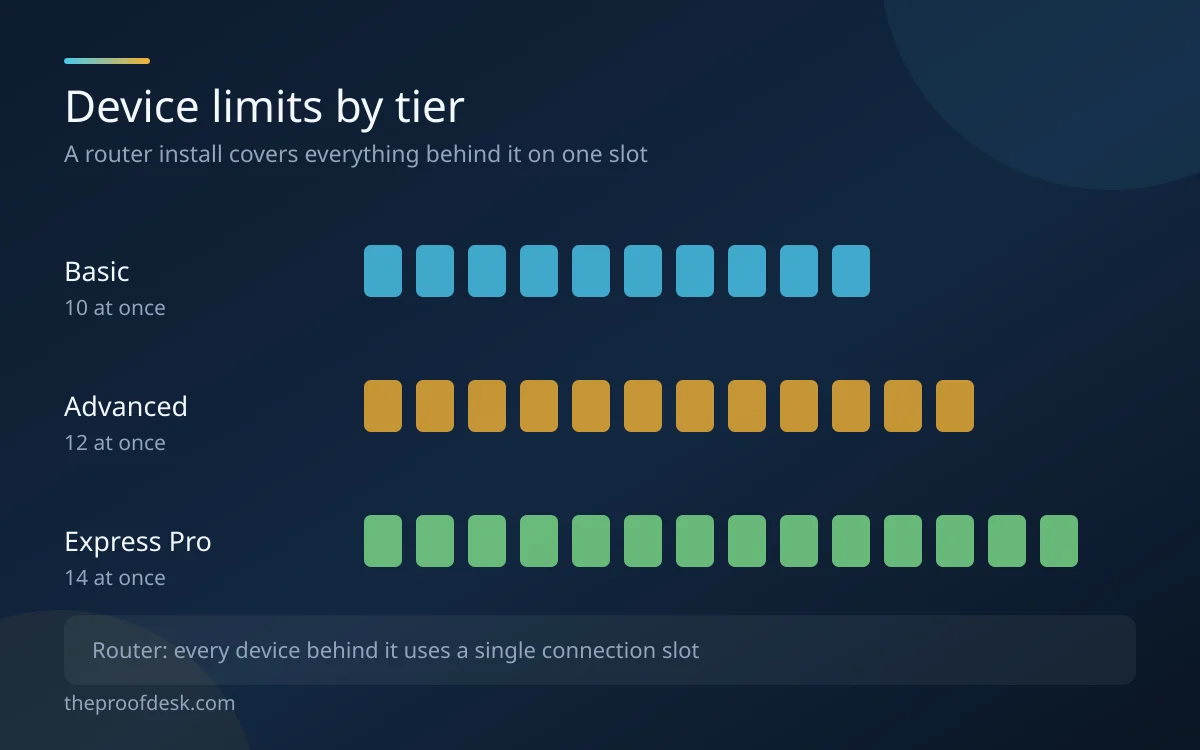
- Install ExpressVPN on a compatible router and every device behind that router shares one connection slot.
- A router install also covers hardware with no VPN app of its own, such as smart TVs and consoles.
- Sharing a connection from a Windows machine achieves the same thing for a small number of devices.
- If you genuinely need more than fourteen direct app installs, a second subscription costs less than the jump between tiers.
That workaround matters when you price the plans. Buying Pro purely for four extra slots is poor value if a router install would have solved the same problem on Basic.
What each billing term actually costs
Price depends far more on the length of the commitment than on the tier. Month-to-month billing is the most expensive way to buy ExpressVPN by a wide margin, running from roughly thirteen dollars a month on Basic to about twenty-three on Pro. The twelve-month term drops the effective rate to around six dollars a month and usually adds bonus months.
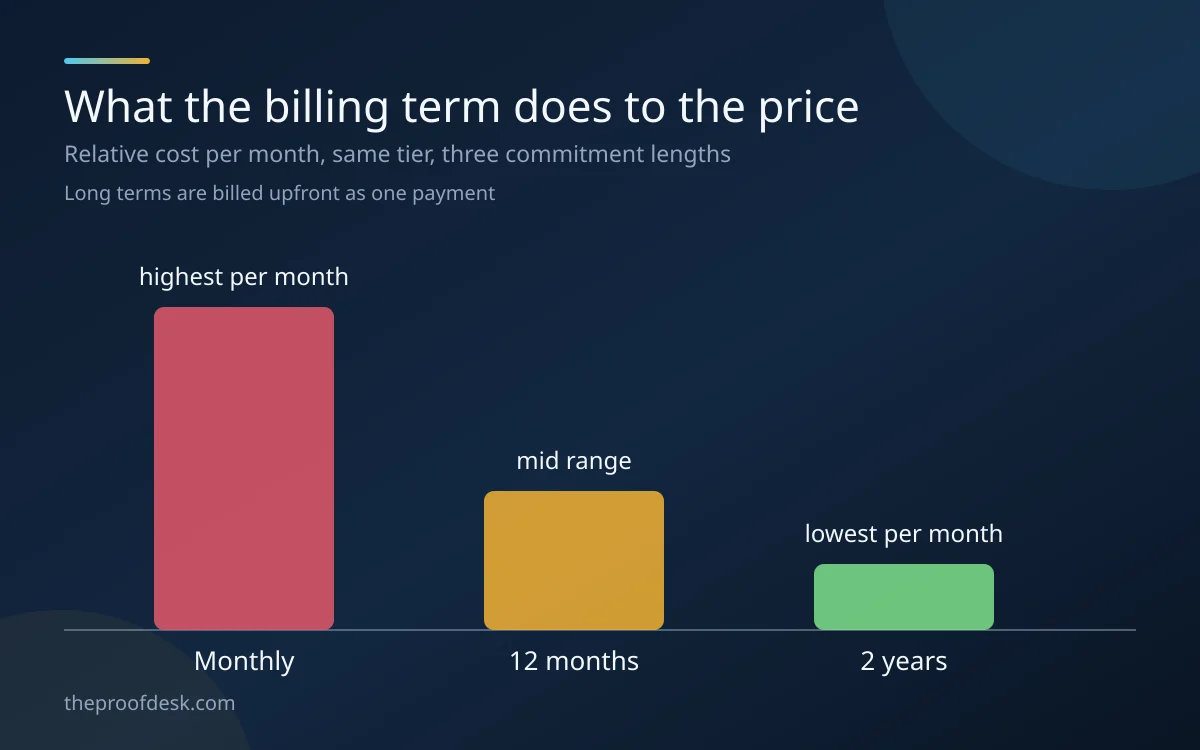
- Two-year introductory offers land somewhere between two and a half and three and a half dollars a month, with extra months added on top of the term.
- Long terms are charged as a single upfront payment, so a cheap monthly figure can still mean around a hundred dollars leaving your account on day one.
- Advertised discounts are calculated against the monthly price, which is why they look dramatic.
- Prices differ by currency and region, and promotional rates move throughout the year.
The honest comparison is total cost over the period you will actually keep the service, not the headline per month figure. If you want a VPN for a two-week trip, the monthly plan is cheaper than a two-year commitment you cancel after a month.
The renewal is where the discount disappears
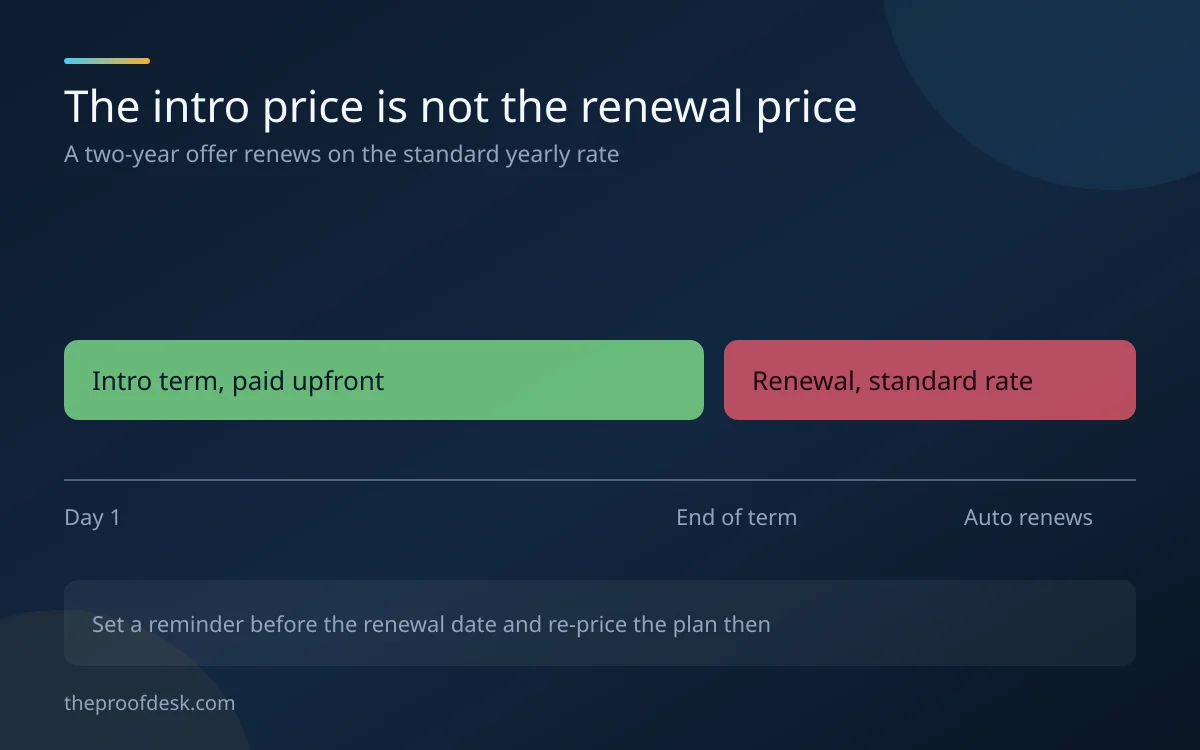
The introductory rate applies to the first term only. Subscriptions renew automatically, and a two-year offer renews on the standard yearly price rather than the promotional one. That is the single most common complaint about VPN billing in general, and it is entirely avoidable.
Three minutes that save real money
Set a reminder for a week before the renewal date. At that point you can cancel auto-renewal, re-price the plan against current offers, or drop to a cheaper tier if the extras went unused.
It is also worth asking what the premium buys against cheaper rivals. ExpressVPN is registered in the British Virgin Islands, runs its servers from RAM so each reboot wipes them, and has had its no-logs claim examined repeatedly by KPMG, most recently in 2025. Kape Technologies has owned the company since 2021, which some privacy-focused buyers weigh against it, and repeated independent audits are the counterweight ExpressVPN offers.
How to test it without risking money
There are two separate ways to try ExpressVPN and they cover different devices. The free trial runs for three days and exists only in the mobile apps. Everything else is covered by the money-back guarantee, which lasts thirty days from the moment of purchase and is meant for first-time subscribers.
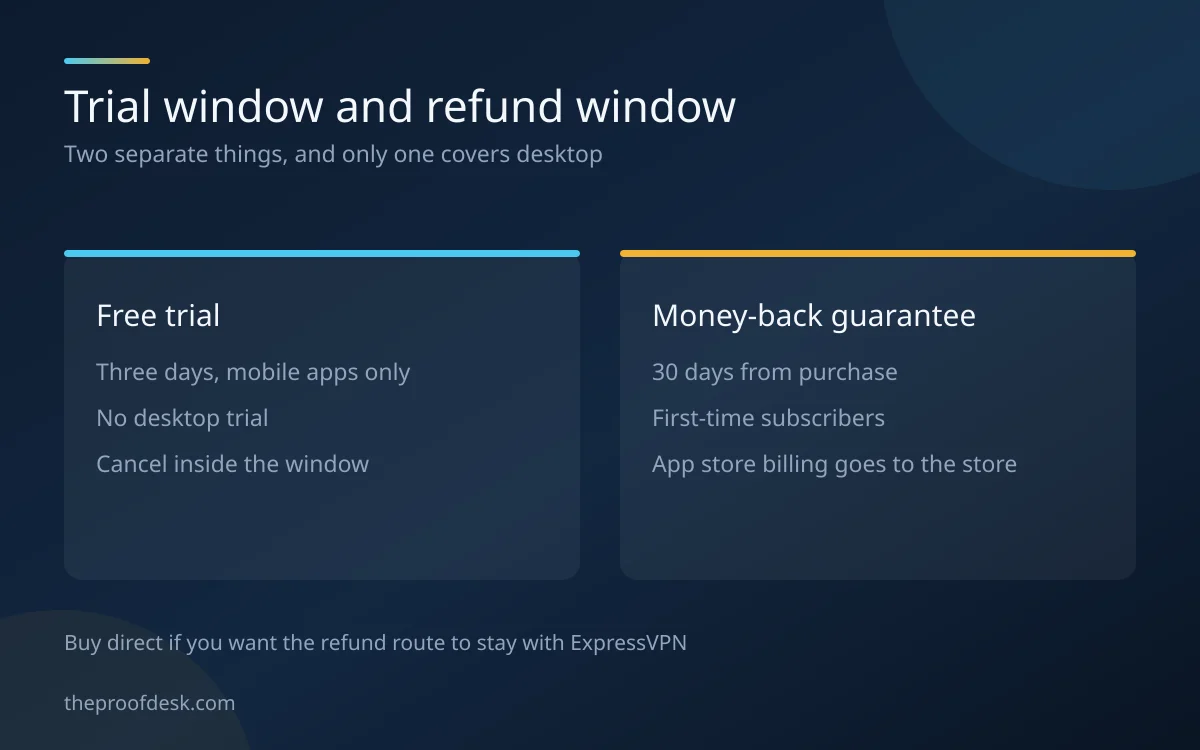
- Buy the longest term you are comfortable with directly from ExpressVPN, since app store purchases are refunded by Apple or Google under their rules instead.
- In the first week, test what you actually care about: speed on your own connection, the streaming services you pay for, and the apps on every device you own.
- If it disappoints, request the refund through the account dashboard or support chat before the thirty days elapse.
- If you keep it, note the renewal date immediately and decide then whether the tier still fits.
Testing during the guarantee period is more useful than any review, including this one, because VPN speed depends on your line, your distance from the server and the time of day.
Frequently asked questions
How much does ExpressVPN cost per month?
Between roughly two and a half and twenty-three dollars a month, depending entirely on the term and tier. Rolling monthly billing sits at the top of that range, the twelve-month term around six dollars, and two-year introductory offers at the bottom. The cheap figures are effective rates on a lump sum paid upfront.
Which plan should most people buy?
Basic, for most people. It carries the full VPN and ten connections, which covers a typical household. Advanced makes sense if you would otherwise pay for a password manager, and Express Pro only pays off if you are in the United States and want the identity monitoring and the included dedicated IP.
Does the price go up when it renews?
Yes. Introductory pricing covers the first term, and the subscription then renews at the standard rate, with two-year offers renewing on a yearly cycle. You can cancel auto-renewal at any time from the account dashboard and re-subscribe on a current offer instead.
How many devices can I connect at the same time?
Ten on Basic, twelve on Advanced and fourteen on Express Pro. Devices connected through a router running ExpressVPN count as a single connection, so a router install is the cheapest way to cover a house full of hardware.
Is there a free trial, and how does the refund work?
There is a three-day free trial in the iOS and Android apps, and no trial on desktop. Everything else relies on the thirty-day money-back guarantee, which applies to first-time subscribers who buy directly and is counted in exact days from purchase.
Can I get a refund if I subscribed through the App Store or Google Play?
Not from ExpressVPN. In-app purchases are billed by Apple or Google, so refunds follow their policies and have to be requested from them. Buying from the ExpressVPN site keeps the refund process with ExpressVPN support.
Does the Kape Technologies ownership affect privacy?
It is a reasonable thing to weigh, and the evidence points the other way so far. Kape acquired ExpressVPN in 2021, and since then the no-logs policy has been examined by KPMG more than once, most recently in 2025, while the RAM-only server design limits what could be handed over. Audits are snapshots, so this remains a question of how much you trust the operator.
Is ExpressVPN worth more than a budget VPN?
Key takeaways
- The three tiers share one VPN; the price difference buys extras and connection slots, not stronger privacy.
- Commitment length moves the price far more than the tier does, and long terms are billed upfront in one payment.
- Introductory rates cover the first term only, so diary the renewal date the day you subscribe.
- A router install turns one connection slot into whole-home coverage and can save you a tier upgrade.
- Buy direct, test inside the thirty-day guarantee, and keep the refund route with ExpressVPN rather than an app store.
More in Virtual Private Network
Browse Virtual Private Network