GoDaddy Review 2026: Cheap to Start, Costly to Renew?
GoDaddy is the world's largest domain registrar and a major host, but its 2026 pricing leans on steep first-term discounts that renew at roughly double. Here is what the vendor's own pages show.

GoDaddy is the name most people meet first when they buy a domain, and it has spent two decades turning that head start into a full stack of hosting, email, an AI website builder and marketing tools. It is big, it is reliable, and for a beginner it is genuinely easy to get a site online without touching a config file.
The catch is the pricing model. Almost every GoDaddy plan is advertised at a heavy first-term discount, and on the same page the standard rate sits struck through beside it. When the intro term ends, the price you actually pay is usually the standard one, roughly double what got you in the door. This review works from GoDaddy's own live pricing, refund and support pages, plus the 2025 FTC security order, to judge whether the cheap entry is worth the renewal trade-off.
GoDaddy at a glance
GoDaddy is the world's largest domain registrar, and it wraps that core business in shared and WordPress hosting, professional email, an AI-driven website builder branded Airo, and a range of marketing and commerce add-ons. The appeal is convenience: one account, one dashboard, and a setup flow designed so that someone with no technical background can register a domain and publish a site in an afternoon.
That breadth is also the reason to read the fine print. GoDaddy upsells aggressively at checkout, and the products that look cheapest up front are the ones whose renewal pricing changes the most. None of that makes it a bad host — it is a legitimate, well-resourced company millions of sites run on — but it does mean the sticker price and the price you pay in year two are rarely the same number.
Bottom line
GoDaddy is a solid, beginner-friendly registrar and host with genuine 24/7 support in many regions. Budget for the renewal rate, not the intro rate, and it is a reasonable choice. Judge it only on the first-term price and you will be surprised at your next invoice.
Hosting plans and the renewal catch
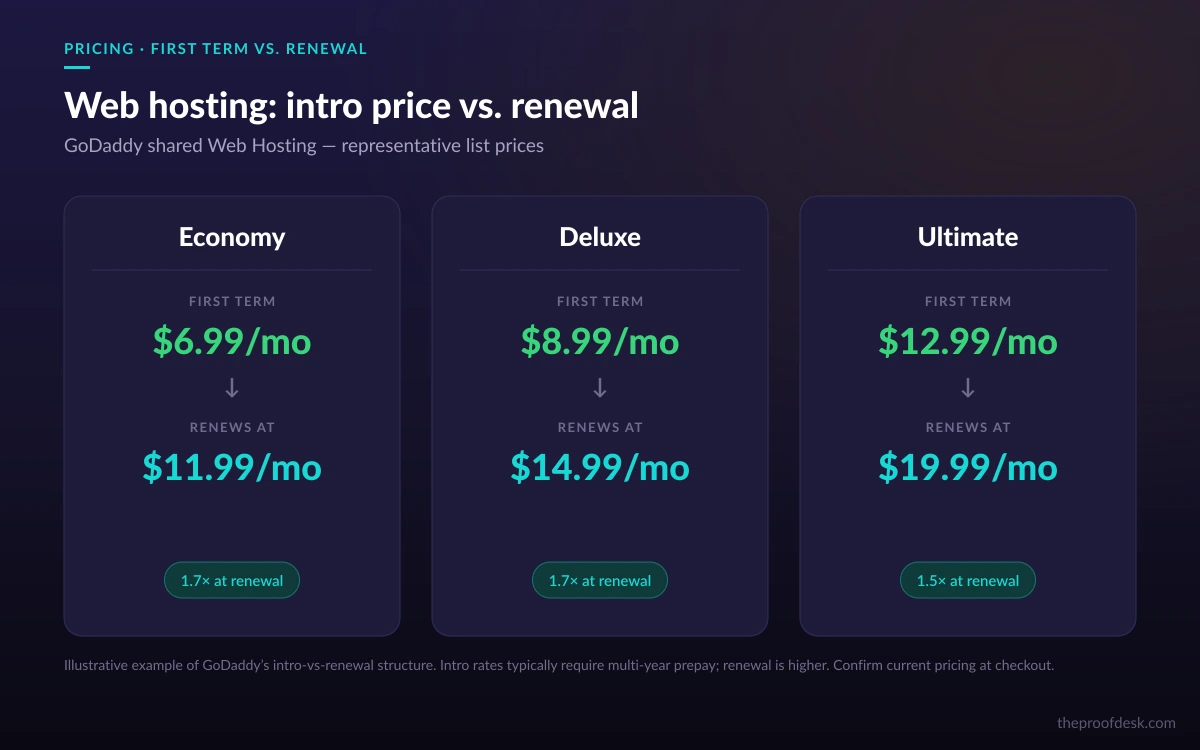
GoDaddy's shared and WordPress hosting is organised into familiar tiers. The consistent thread across all of them is that the advertised price is a first-term promotional rate, shown next to the standard rate crossed out. On most tiers the renewal is roughly double the promotional price, so the real question is what the standard rate looks like once the discount lapses.
Economy (shared hosting)
The entry shared plan, Economy, is advertised at around 79% off its standard price for the first term. It covers one website with 25GB of NVMe storage, the cPanel control panel, a free domain and free email, and a free SSL certificate for the first year. A 30-day money-back guarantee applies.
Hosting for WordPress Basic
The managed WordPress entry plan is shown at roughly 57% off for the first term. It includes one website, 10GB of NVMe storage and GoDaddy's Managed WordPress control panel rather than cPanel, plus a free domain, free email and a free SSL that GoDaddy lists with no renewal fee on the certificate itself. The same 30-day money-back guarantee applies.
Deluxe and Ultimate
Web Hosting Deluxe is advertised at 50% off and steps up to 10 websites, 50GB of NVMe storage, cPanel, a free domain, and free unlimited SSL across those sites. Web Hosting Ultimate sits one tier above it at around 42% off. Notice the pattern in the discount itself: the cheaper the tier, the larger the headline percentage — and the larger the gap between what you pay now and what you renew at.
Read the struck-through number
On every hosting tier, the price beside the strikethrough is the one you renew at. Treat the discounted figure as a one-term coupon, not the ongoing cost, and compare hosts on their standard rates.
A note on prices in this review: exact figures for .com registration and renewal, standalone SSL and domain privacy shift by region and promotion, and GoDaddy localises them by request origin. Rather than quote numbers that may not match your checkout, this review describes the pattern GoDaddy's own pages show — a steep first-year discount and a renewal that roughly doubles on most tiers.
The Airo website builder
GoDaddy has rebranded its website builder around an AI assistant called Airo. If you have read older reviews that mention Basic, Premium and Commerce tiers, those names are out of date; the current live tiers are Free, Starter, Professional and Ultimate. Keep GoDaddy's Airo distinct from an unrelated company with a similar-sounding name — they are not the same thing.
- Free — a no-cost tier to try the builder and stand up a basic presence.
- Starter — the first paid tier, billed annually at a discounted monthly-equivalent rate versus paying month to month.
- Professional — flagged 'Most Popular', aimed at local businesses that need bookings and payments.
- Ultimate — pitched at online stores and agencies that need the full commerce feature set.
Airo leans on AI to generate a starter site, copy and imagery from a few prompts, which lowers the barrier for someone who has never built a page. As with hosting, the paid tiers are cheapest when billed annually up front, so the monthly-equivalent figure you see assumes a year's commitment rather than a rolling monthly charge.

Domains, SSL, and email
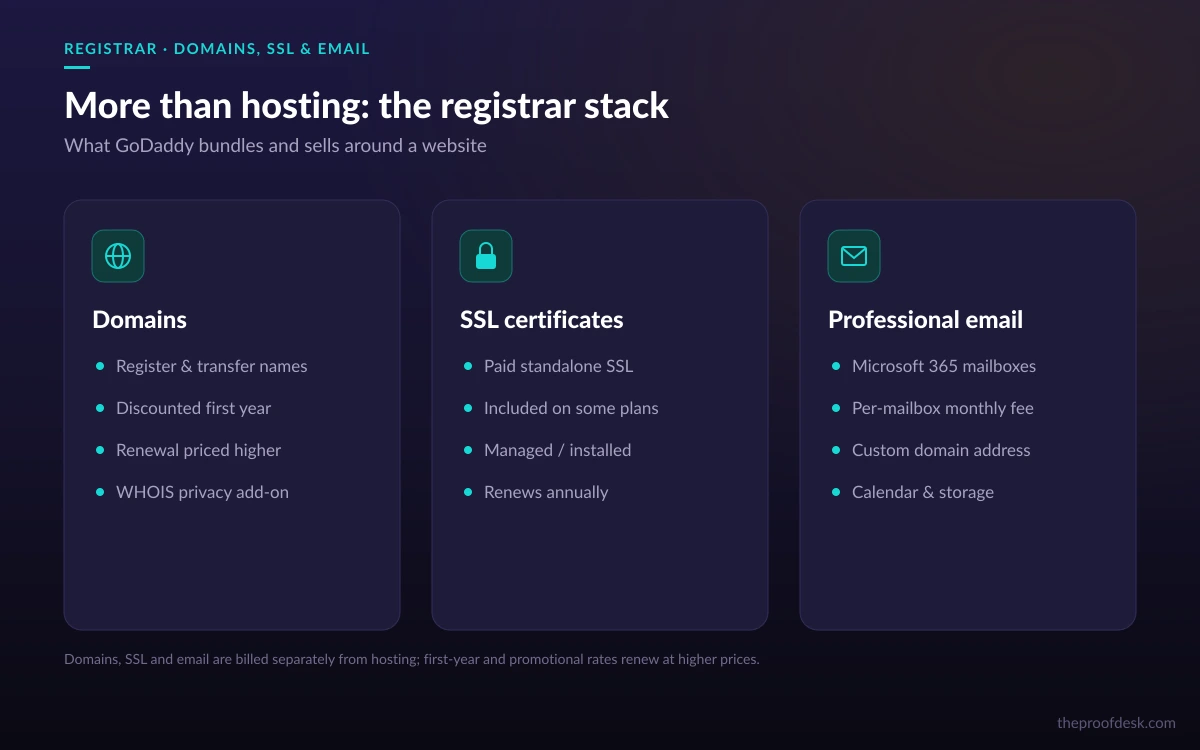
As a registrar, GoDaddy is hard to fault on selection and reach — it is the largest in the world, and it will sell you almost any TLD along with privacy protection and DNS management. The domain refund terms are unusually generous in one place: a one-year domain auto-renewal is refundable within 45 days, which is longer than most competitors offer.
SSL and email are worth understanding as plan perks rather than permanent freebies. The free SSL and free domain that come with hosting are tied to signing up for a plan — typically covering the first year — not standalone gifts that persist independently of the plan. If you cancel the hosting, do not assume the certificate or the domain stays free on the same terms.
Domain privacy and add-ons
GoDaddy's checkout is add-on heavy. Domain privacy, backups, security scans and premium email are offered as upsells, each with its own renewal. Decide what you actually need before you reach the payment screen.
Support and refunds
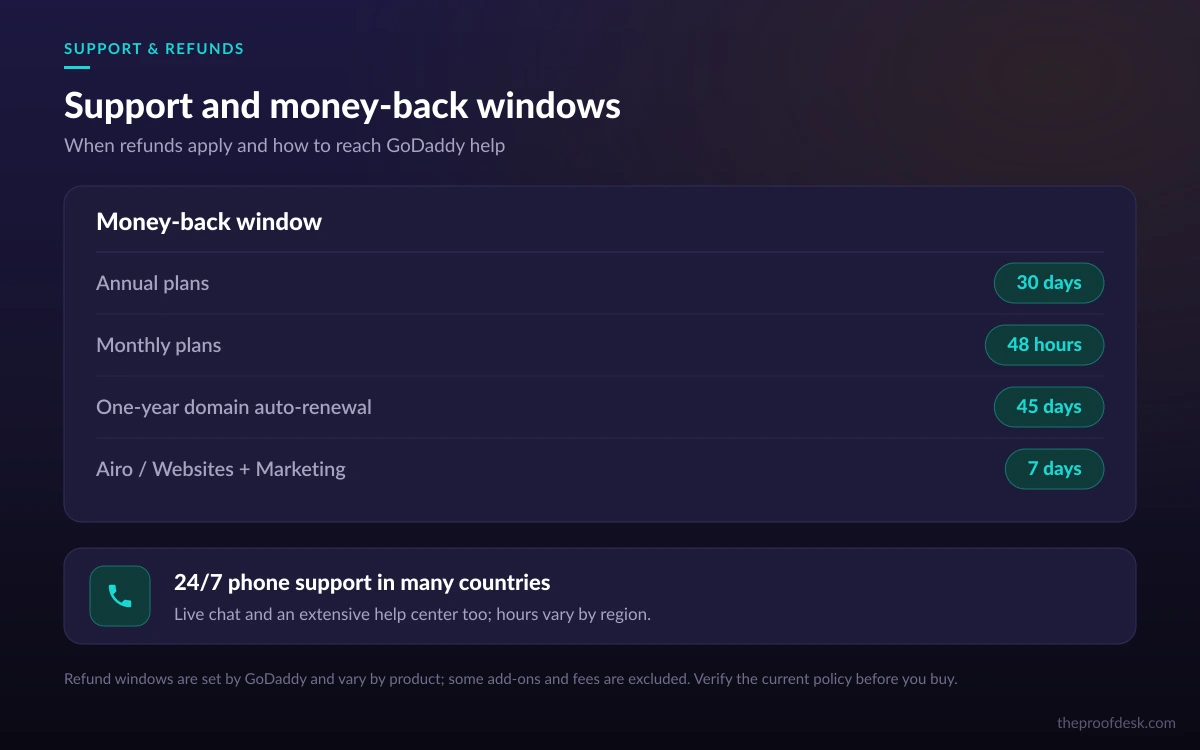
Support is one of GoDaddy's real strengths. It offers 24/7 phone support in numerous countries — Australia, Argentina and Belgium, among others, carry explicit round-the-clock labels on the contact page. Coverage is not universal, though: hours vary by country and language, and some regions get weekday-only support rather than 24/7. Check the contact page for your own country before you rely on midnight help.
The refund policy (last revised 27 May 2026) is layered, and the window depends on the product:
- Annual plans: refundable within 30 days (720 hours).
- Monthly plans: refundable within 48 hours.
- New domain registrations: refundable within 5 days.
- One-year domain auto-renewals: refundable within 45 days.
- Multi-year auto-renewals and manual renewals: refundable within 5 days.
- 'Websites + Marketing' annual plans and GoDaddy Airo All Access / Airo Plus subscriptions: a shorter 7-day window, and Airo Plus becomes non-refundable once any AI-generated content has been accessed or downloaded.
The takeaway is that the newer AI and marketing subscriptions carry the tightest refund windows, while classic hosting and domains are more forgiving. If you are trialling Airo Plus, note that accessing the AI output can end your ability to get money back.
The 2025 FTC security order
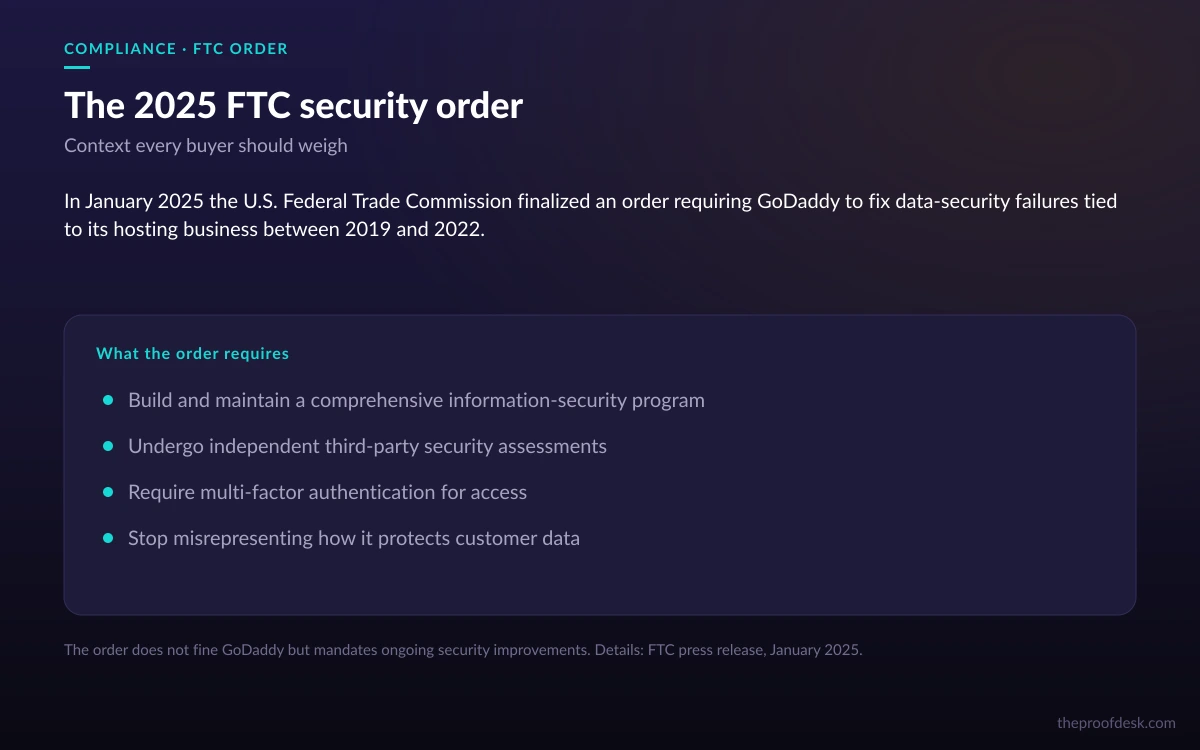
The recent context every prospective customer should know is the Federal Trade Commission's order against GoDaddy, announced in January 2025 and finalized in May 2025. The FTC alleged 'unreasonable security practices' linked to data breaches between 2019 and 2022, and said GoDaddy had misrepresented its security posture.
The order requires GoDaddy to stop misrepresenting its security practices, to implement a comprehensive information security program, and to undergo biennial independent third-party security assessments. Importantly, it carried no monetary penalty and no admission of fault. GoDaddy, for its part, frames the resolution as a continued focus on security investment rather than a fine.
How to weigh it
This is a compliance order, not a shutdown or a fine — but the required third-party audits are a signal that GoDaddy's past security claims drew regulator scrutiny. Factor it into your due diligence rather than treating it as a dealbreaker.
Who GoDaddy is for
GoDaddy fits beginners, small businesses and anyone who values a single vendor with real phone support over squeezing out the last dollar. The onboarding is smooth, the product range means you rarely need a second provider, and the domain refund terms are genuinely good.
It is a weaker fit if you are price-sensitive over the long haul, comfortable managing hosting yourself, or you want to avoid renewal shock. In those cases, compare GoDaddy's standard (not promotional) rates against hosts that price flat, and you may find the multi-year cost lands higher than the headline suggested.
Frequently asked questions
Does GoDaddy hosting renew at a higher price?
Yes. GoDaddy's hosting prices are advertised as first-term promotional rates, with the standard rate shown struck through beside them. On most tiers the renewal is roughly double the intro price, so budget for the standard rate rather than the discount.
Is the free domain and SSL really free with GoDaddy?
They are free as plan perks, typically for the first year, and tied to signing up for hosting — not permanent freebies that continue if you cancel. On managed WordPress, GoDaddy lists the SSL certificate itself as having no renewal fee, but read your plan's terms before assuming anything stays free.
What is GoDaddy's refund policy?
Annual plans are refundable within 30 days and monthly plans within 48 hours. New domains have a 5-day window, one-year domain auto-renewals a generous 45 days, and multi-year or manual renewals 5 days. 'Websites + Marketing' annual plans and Airo All Access / Airo Plus subscriptions carry a shorter 7-day window.
What are the current GoDaddy website builder plans?
The builder is now branded Airo, with four live tiers: Free, Starter, Professional (marked 'Most Popular') and Ultimate. Older Basic/Premium/Commerce names cited by some third-party sites are out of date. Paid tiers are cheapest when billed annually up front.
What was the 2025 FTC action against GoDaddy?
The FTC finalized an order in May 2025 over unreasonable security practices tied to 2019-2022 data breaches and alleged misrepresentation of its security. GoDaddy must stop misrepresenting its security, run a comprehensive security program and undergo biennial third-party assessments. There was no fine and no admission of fault.
Does GoDaddy offer 24/7 support?
In many countries, yes — the contact page shows explicit 24/7 phone support for regions such as Australia, Argentina and Belgium. Coverage is not universal, and some countries list weekday-only hours, so check the contact page for your region before relying on it.
Key takeaways
- GoDaddy's advertised prices are first-term promotions; on most hosting tiers the renewal is roughly double, so compare hosts on their standard rates.
- Free domain and SSL are plan perks tied to sign-up (usually year one), not permanent freebies.
- Refund windows vary: 30 days for annual plans and 45 days for one-year domain auto-renewals, but only 7 days for Websites + Marketing and Airo subscriptions.
- The website builder is now the AI-branded Airo with Free, Starter, Professional and Ultimate tiers — ignore older Basic/Premium/Commerce pricing.
- The 2025 FTC order requires ongoing third-party security audits but carried no fine or admission of fault; weigh it in your due diligence.
More in Services & Software
Browse Services & Software