GreenGeeks Review 2026: What 300% Renewable Actually Means, and What Renewal Costs
A sourced look at GreenGeeks in 2026: EcoSite pricing and renewal rates, plan resource caps, the BEF renewable energy certificate, backups, migrations and the 30-day refund.
GreenGeeks sells ordinary shared hosting with an environmental claim bolted to the front of it: every account is advertised as running on 300% renewable energy. That claim is real, it is certified by a third party, and it means something narrower than most people assume when they read it. Understanding exactly what it covers is most of the reason to choose GreenGeeks over any other cPanel host at the same price.
The hosting underneath is competent and unremarkable: LiteSpeed and MariaDB, cPanel, Cloudflare CDN, four data centers, nightly backups. The pricing follows the same pattern as the rest of the budget shared market, which is to say the advertised price is not the price you will pay for most of the time you are a customer.
This review is built from GreenGeeks' published pricing page, its terms of service (the page carries a "Last updated November 9, 2022" stamp) and its support knowledge base, read on 1 September 2026. We did not run our own uptime or speed benchmarks, and every figure below comes from GreenGeeks' own pages. Where its pages contradict each other, we say so rather than picking the flattering version.
EcoSite pricing: the intro price buys you twelve months
GreenGeeks sells three shared plans, marketed as Lite, Pro and Premium and named EcoSite Lite, EcoSite Pro and EcoSite Premium inside the dashboard. WordPress hosting is the same three plans at the same three prices, not a separate product with its own rate card.
Every advertised price requires prepaying twelve months, and the pricing page states the renewal rate directly under each one:
- Lite: $2.95/mo, renews at $13.95/mo
- Pro: $4.95/mo, renews at $18.95/mo
- Premium: $8.95/mo, renews at $30.95/mo
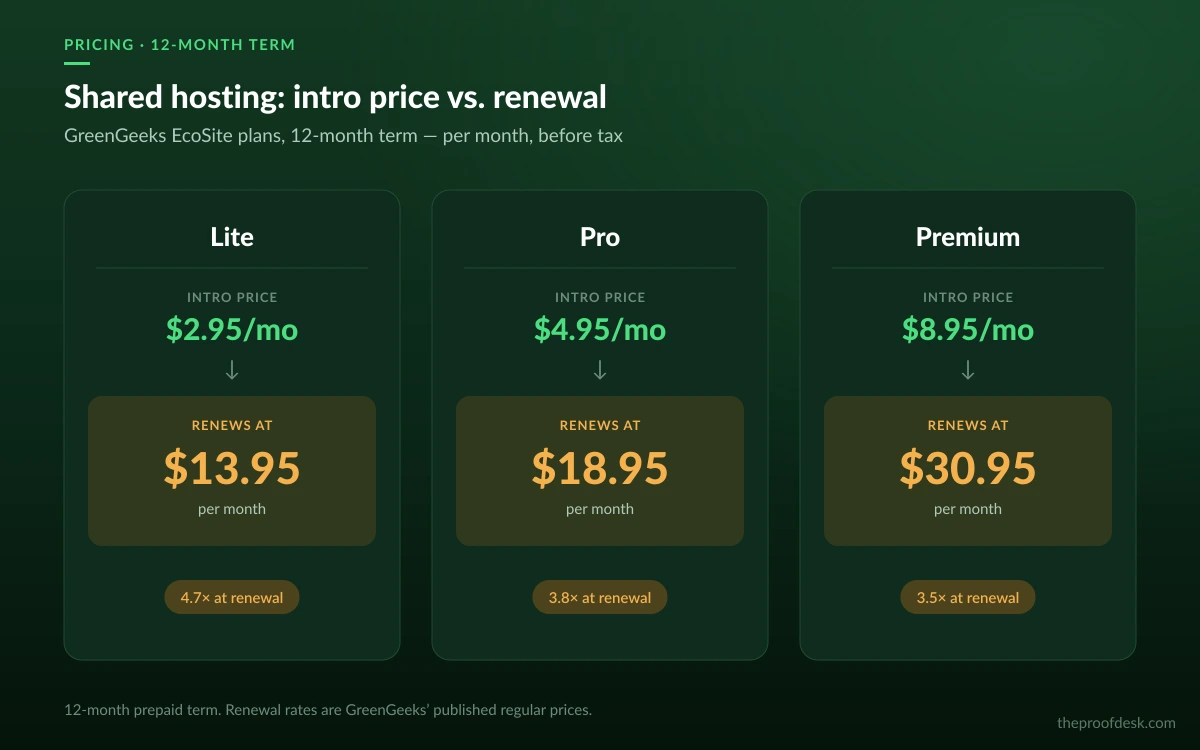
In cash terms, a Lite account costs $35.40 for the first year and $167.40 for the second. Pro goes from $59.40 to $227.40, Premium from $107.40 to $371.40. Nothing about the account changes at renewal; only the price does.
There is a wrinkle worth knowing before you reach for a longer term out of habit. A GreenGeeks support article titled "GreenGeeks Shared Hosting Features and Pricing" publishes a multi-term table in which only the 12-month term carries the deep promotional price. It lists the 24-month term at the full regular rate ($13.95, $18.95, $30.95) and the 36-month term at $13.45, $18.45 and $30.45, a discount of fifty cents. That article is stamped "Last Updated March 2021," though every dollar figure in it still matches the live 2026 pricing page. The live page itself advertises only the 12-month price, so check what the term selector actually charges before committing to three years.
Price the second year, not the first
On a 12-month term the intro discount lapses after one year, and unlike hosts that sell 36-month intro terms, GreenGeeks gets you to full price faster. If a Lite site is worth $167 a year to you, the plan is fine. If your decision depends on it costing $35 a year, you are buying a one-year deal and should diary the renewal date now.
What each plan actually includes
Storage and website counts are the headline differences, but the resource caps in GreenGeeks' own support table are what determine whether a site stays up under load:
- Lite: 25 GB disk, 1 website, 50 email accounts, 2 CPU cores, 1.0 GB memory, 10 MB/sec disk I/O, 200,000 inodes, 100 emails per hour
- Pro: 50 GB disk, unlimited websites, unlimited email, 3 CPU cores, 2.0 GB memory, 15 MB/sec disk I/O, 400,000 inodes, 300 emails per hour
- Premium: 100 GB disk, unlimited websites, unlimited email, 4 CPU cores, 3.0 GB memory, 20 MB/sec disk I/O, 600,000 inodes, 500 emails per hour, plus a premium SSL that is a paid add-on on the lower plans
- All three: unmetered traffic, free Let's Encrypt SSL, unlimited MySQL databases, free Cloudflare CDN integration, cPanel
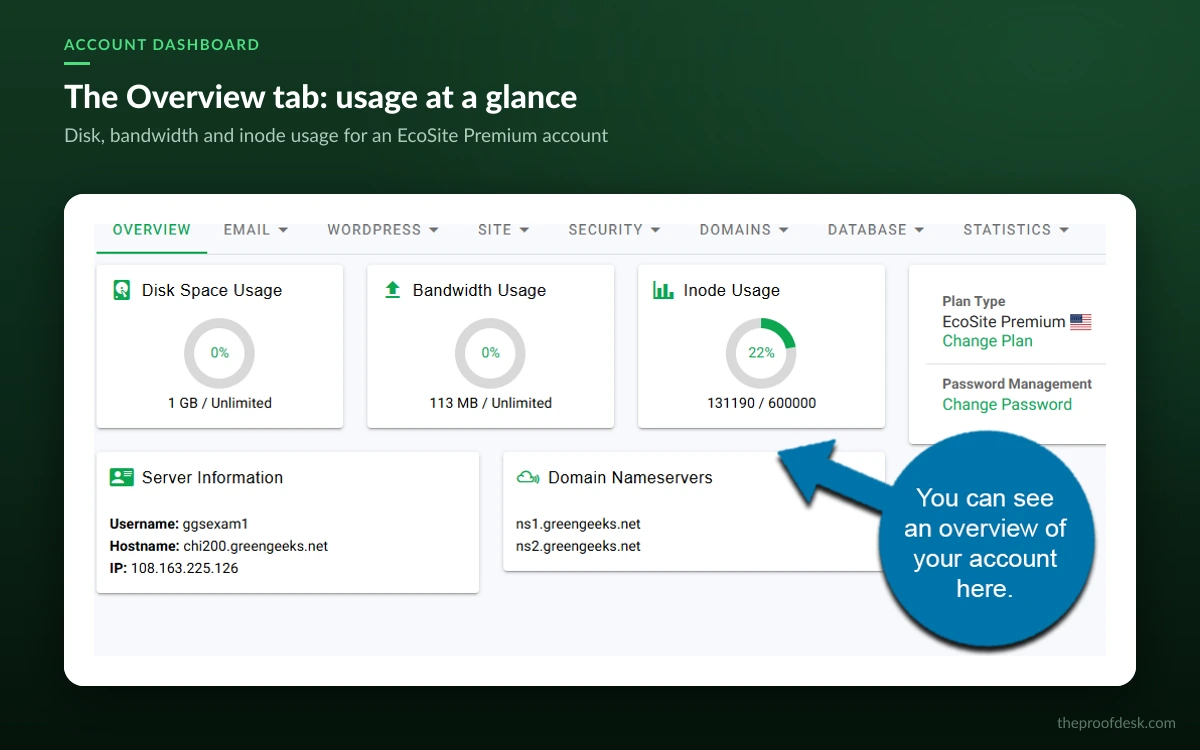
"Unmetered traffic" is the usual shared-hosting phrasing and is not the operative limit. The inode count is: it caps the total number of files on the account, and a WordPress install with a large media library and a caching plugin consumes them quickly. Lite's 200,000 inodes is workable for one ordinary site and tight for a busy one. The email-per-hour caps matter if you send transactional mail from the site rather than through a mail service.
The free domain is for the first year only, and GreenGeeks is unusually direct about the history: its knowledge base states that "effective October 31st, 2016, GreenGeeks no longer provides a Free Domain Name for Life" and that "Domains will be included for the first year at no additional cost where advertised. Subsequent years will renew at the regular rate for the specific domain extension." GreenGeeks does not publish which TLDs qualify. WHOIS privacy is not stated as included either; ID Protect appears on its domain price list as a $9.95/year add-on, so do not assume the free year comes with it.
The plan names are inconsistent on GreenGeeks' own site
The pricing table calls the entry plan "Lite 25" and the signup URL calls it lite25, while the email support article calls it "Lite50" and caps it at 50 mailboxes. The substance agrees across pages: entry tier gets 25 GB of disk and 50 mailboxes. The feature table itself comes from an article stamped March 2021, so treat the resource caps as indicative and confirm them at signup.
The 300% renewable claim, read literally
This is the reason the company exists, so it deserves precision rather than either enthusiasm or cynicism. GreenGeeks publishes the actual certificate behind the claim, which is more than most hosts making environmental marketing claims do.
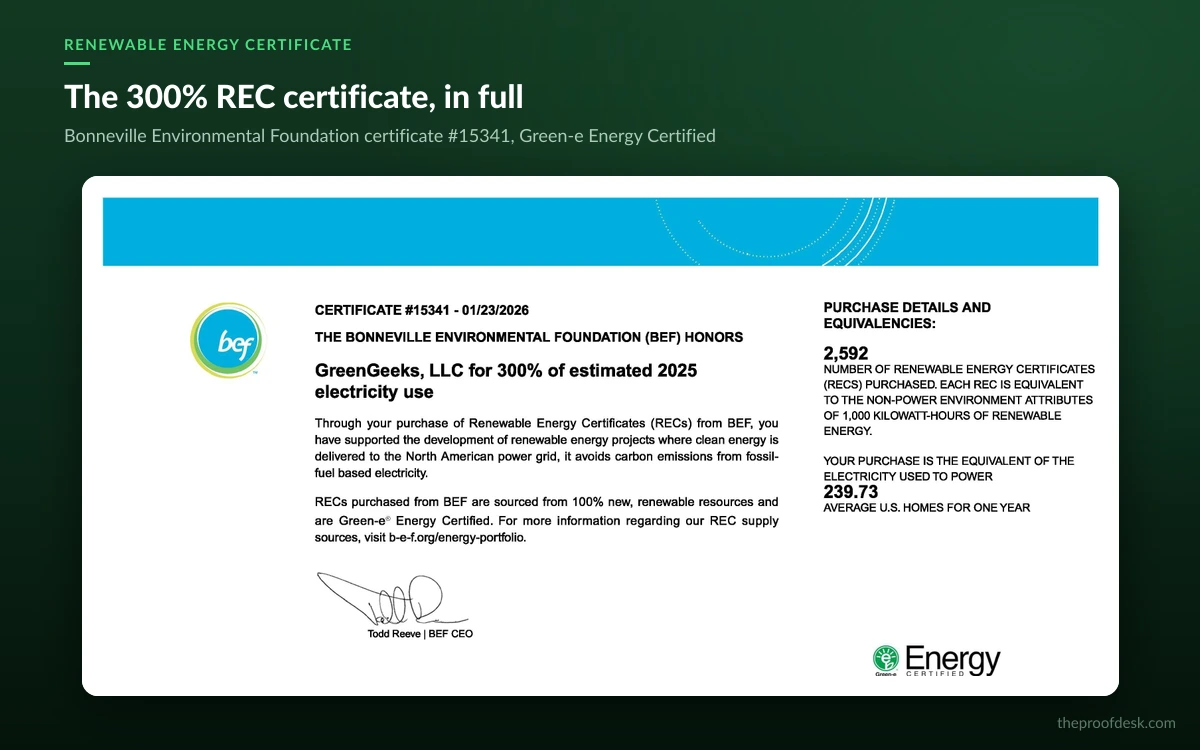
The certificate reads: "THE BONNEVILLE ENVIRONMENTAL FOUNDATION (BEF) HONORS GreenGeeks, LLC for 300% of estimated 2025 electricity use," against 2,592 Renewable Energy Certificates purchased, each equivalent to "the non-power environment attributes of 1,000 kilowatt-hours of renewable energy," sourced from "100% new, renewable resources" and "Green-e Energy Certified." BEF puts the total at the equivalent of powering 239.73 average U.S. homes for a year.
GreenGeeks describes the mechanism plainly on its Going Green page: "We tell BEF how many servers, personnel, etc. that we have and they calculate our yearly energy consumption and carbon footprint. We then have BEF purchase RECs 3 times as much than we have consumed, and we put that energy back into the grid." It has also been an EPA Green Power Partner since 2009, and says it plants a tree per account provisioned through One Tree Planted, with more than 50,000 planted to date.
What the 300% buys and what it does not
It is a certificate purchase, not on-site generation and not a green power contract for the buildings the servers sit in. The electricity running your site comes from whatever the local grid supplies; GreenGeeks pays for renewable generation elsewhere on the North American grid at three times its estimated consumption. That is a real, audited, above-average commitment, and it is matching rather than displacement. Anyone told GreenGeeks servers physically run on renewable power has been told something the certificate does not say.
Judged as what it is, the record is good. Most hosts that claim carbon neutrality match at 1x, many buy offsets rather than Green-e certified RECs, and a fair number publish no certificate at all. A 3x match against an independently estimated footprint, documented annually, is at the strong end of the market. It is still worth noting that a REC match does not reduce the electricity a busy, badly optimised site consumes; nothing here substitutes for a site that is smaller and cached.
Backups and migrations: read the policy, not the banner
GreenGeeks backs shared accounts up nightly and says it "aims to keep approximately 30 sets of recovery backups at all times." Access to those backups is tiered: EcoSite Pro and Premium customers can restore on demand from the dashboard, while Lite customers get "one free manual restore per month, additional restores are $25 each." The policy also states plainly that GreenGeeks "does not guarantee that our disaster recovery backup system can restore your website to a specific date."
Two limits catch people out. Backups you generate yourself through the cPanel Backup Wizard or Softaculous are "automatically purged after 48 hours" — the shared platform is not a place to park archives. And VPS and dedicated servers are not backed up automatically at all, which is easy to miss when moving up from shared.
Migration is where the marketing and the policy diverge most sharply. The WordPress hosting page advertises "Free Unlimited Migration." The migration policy article publishes a table in which shared hosting gets one total free migration, and full cPanel migrations are listed as not available on shared at all. Beyond that first site, manual migrations cost $15 per website. Reseller and VPS accounts get 30 free cPanel migrations; dedicated servers get none. Moving an existing account between data center locations is a one-time $29.95 fee, and each account includes one complimentary malware cleanup.
"Free unlimited migration" means one site
If you are moving a single WordPress site, the marketing claim holds. If you are moving a portfolio of ten sites onto a Pro plan, budget $135 in migration fees or plan to move nine of them yourself. GreenGeeks' terms also reserve the right to "refuse or cancel any migration request at any time," and state that migration fees are non-refundable.
The 30-day refund, and how cancelling works
GreenGeeks offers "an unconditional 30-day money back guarantee that covers cancellations on shared hosting, reseller hosting and VPS hosting made during the first 30 days of service." VPS being included is genuinely better than the market norm. Dedicated servers are excluded.
What is carved out of a refund is longer than what is in it:
- Setup fees and domain name registrations or transfers are never refundable; a transferred domain "incurs an additional year of registration and therefore is considered a domain registration"
- Add-ons are excluded, including dedicated IPs, SSL certificates, CDN and professional services — and add-ons "included in the hosting package" are also non-refundable once activated
- The guarantee "applies only to the start date of the clients' service with GreenGeeks, and does not apply to renewals of service"
- Accounts involved in "non-use, misuse, and/or abuse" of the agreement are excluded
- Refunds are not available at all after day 30
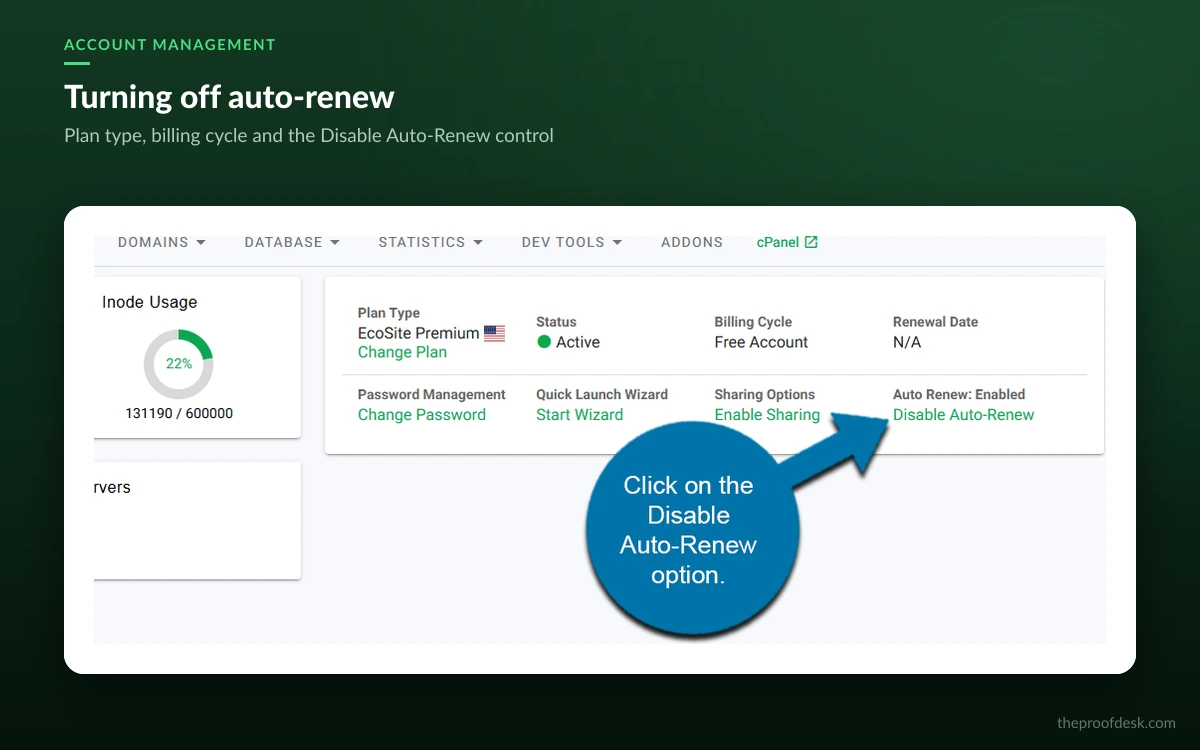
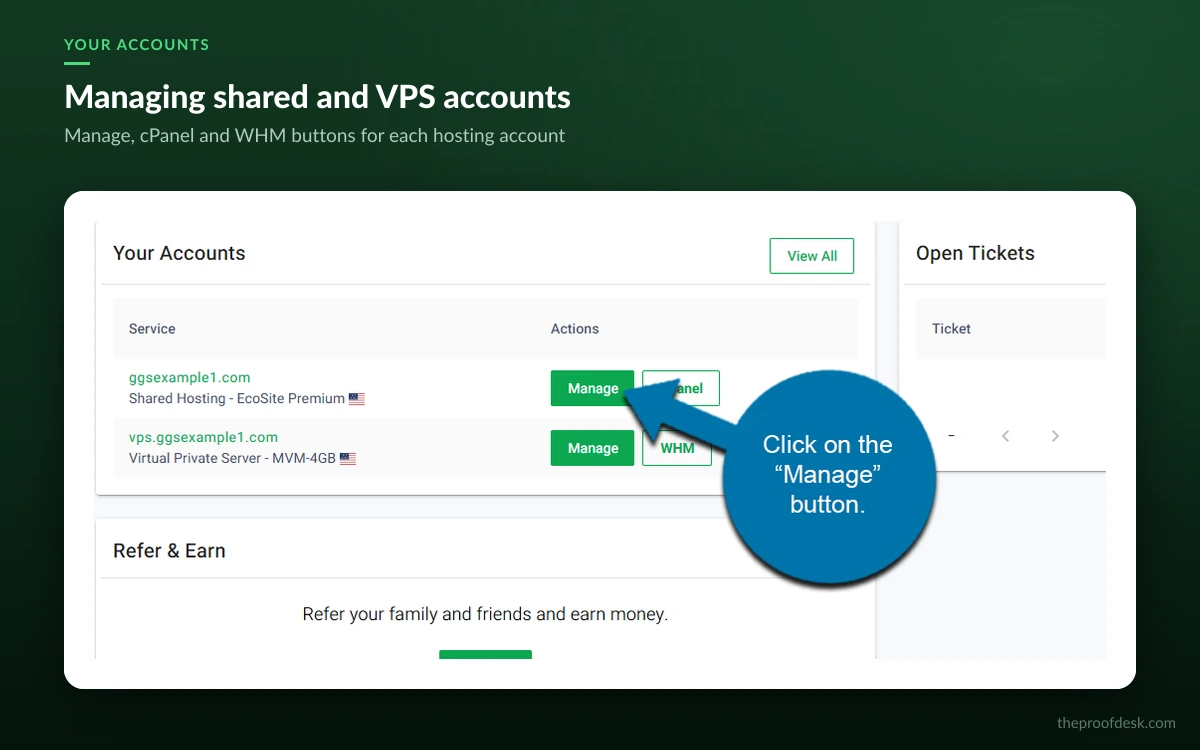
Cancelling starts in the dashboard: open Manage on the service, disable auto-renew, and a link to the cancellation request form appears. Leaving it there lets the account run to the end of the paid term. Choosing "Cancel Now" instead "will terminate your GreenGeeks account immediately without waiting for the service expiration date," and the terms confirm that files are then "permanently removed from the GreenGeeks servers."
One contradiction we could not resolve from GreenGeeks' own pages: the support articles present cancellation as fully self-serve, while the terms of service state "You will need to contact customer service and verify information before cancellation takes place." Neither document references the other. Assume a support conversation may still be part of it, and start the process well before your renewal date rather than on it.
The practical rule is the same one that applies to every host with an immediate-termination option: take a full export and confirm it opens somewhere else before you press Cancel Now. The refund is worth less than an unrecoverable site.
VPS, reseller and dedicated
Managed VPS is priced flat, with no promotional rate and no renewal jump: $69.95/mo for 4 vCPU and 4 GB RAM with 75 GB SSD, $129.95/mo for 6 vCPU and 8 GB with 150 GB, and $179.95/mo for 6 vCPU and 16 GB with 250 GB. Managed plans include a cPanel Solo license.
Self-managed VPS is the cheaper line and does use intro pricing:
- VPS 4 GB: $9.99/mo, renews at $19.99/mo — 2 vCPU, 80 GB SSD
- VPS 8 GB: $19.99/mo, renews at $39.99/mo — 4 vCPU, 160 GB SSD
- VPS 16 GB: $39.99/mo, renews at $79.99/mo — 8 vCPU, 320 GB SSD
- VPS 32 GB: $59.99/mo, renews at $109.99/mo — 16 vCPU, 640 GB SSD
Reseller plans run $19.95/mo renewing at $34.95 for 25 cPanel accounts and 60 GB, $24.95 renewing at $49.95 for 50 accounts and 80 GB, and $34.95 renewing at $69.95 for 80 accounts and 160 GB, all on a 12-month prepaid term.
Three constraints apply to VPS specifically and are easy to miss. Support is ticket-only — GreenGeeks states it "is only able to provide support for VPS services via Support Ticket," so the 24/7 phone and chat lines do not cover it. Self-managed admins will help with hardware, OS and basic configuration but "will not assist with debugging or making changes to custom server software" or manage site code. And VPS and dedicated servers are excluded from the SLA credit policy except for upstream and networking outages.
Dedicated servers appear in GreenGeeks' navigation and footer, but we found no published pricing for them on the pricing page or in the knowledge base. If you need one, expect to ask sales rather than compare a rate card.
Data centers, uptime and support
There are four locations: Chicago, Montreal, Amsterdam and Singapore, each listed as available on all plans. Choose carefully at signup, because moving later is the $29.95 location migration. The platform is LiteSpeed with MariaDB, PHP 8, RAID-10 SSD arrays and free Cloudflare CDN integration; GreenGeeks does not publish specific PHP or MySQL point releases, only "PHP 8" and "the latest version of MySQL."
The uptime story needs both documents to make sense. The terms of service promise "a 99.9% network uptime guarantee for customer satisfaction purposes" and then add that GreenGeeks "will try to maintain maximum uptime," with no credit mechanism attached. A separate support article does define one: downtime is compensated at 1x the hosting rate for scheduled maintenance and 3x for unscheduled or emergency maintenance, rounded to the nearest hour. Its own worked example is a monthly shared customer at $9.95 receiving $0.08 for a 1.5-hour unscheduled outage.
Read that example twice before treating the SLA as protection. Credits are also "eligible by request for seven days after the confirmed resolution of an outage," so they are opt-in and easy to miss. Neither document cross-references the other, and we could not establish which governs in a dispute.
Support is 24/7 across live chat, phone and tickets, on 1-877-326-7483, and is "only available in English" — GreenGeeks' own advice to non-fluent customers is to use Google Translate. Billing issues, failed payments, affiliate questions, compliance notices and all VPS support are ticket-only regardless of the hour. Escalation to management is available, with "most requests resolved within 24-48 hours."
Who GreenGeeks actually fits
GreenGeeks fits someone running one site or a small handful of them who wants a sustainability claim they can point at and defend. The certificate is public, the multiplier is above what competitors do, and the hosting underneath is a normal, decently specified LiteSpeed and cPanel stack with 24/7 human support. For a small business site or a portfolio, Pro at $59 for the first year is a reasonable buy.
It fits less well if your decision is driven by three-year cost. The promotional discount only attaches to the 12-month term, the renewal is 3.5x to 4.7x the intro rate, and the longer terms in GreenGeeks' own table barely discount at all. Hosts that sell 36-month intro pricing will look cheaper over the same window even where their renewal multiple is similar.
It fits badly for agencies moving many sites in — one free migration on shared, then $15 per site — and for anyone who needs conversational support on a VPS, since VPS is ticket-only. If you need restores to a specific date, GreenGeeks explicitly does not promise them, and Lite gets one free restore a month before the $25 charge starts.
The short version
Buy GreenGeeks for the certified 3x renewable match and a competent, well-supported shared platform, with your eyes open about a first-year price that roughly quadruples on Lite. Do not buy it expecting unlimited free migrations, a meaningful uptime credit, or servers that physically run on renewable power.
Frequently asked questions
How much does GreenGeeks cost after the introductory period?
Lite renews at $13.95/mo, Pro at $18.95/mo and Premium at $30.95/mo, against intro rates of $2.95, $4.95 and $8.95. The intro rate requires prepaying twelve months, so the increase arrives at the start of year two: a Lite account goes from $35.40 to $167.40 a year.
Is the 300% renewable energy claim real?
Yes, as a certificate purchase. The Bonneville Environmental Foundation certificate #15341, dated 23 January 2026, covers 2,592 Green-e certified Renewable Energy Certificates, described as "300% of estimated 2025 electricity use." It means GreenGeeks pays for three times as much renewable generation to enter the grid as it consumes. It does not mean its servers are physically powered by renewable electricity.
Does GreenGeeks include a free domain?
For the first year only. GreenGeeks ended its free-domain-for-life offer on 31 October 2016, and states that subsequent years "renew at the regular rate for the specific domain extension." Eligible TLDs are not published, and WHOIS privacy is not listed as included — ID Protect is a $9.95/year add-on.
What does the 30-day money-back guarantee actually cover?
Hosting charges on shared, reseller and VPS plans within the first 30 days of a new account. Setup fees, domain registrations and transfers, dedicated IPs, SSL certificates, CDN and other add-ons are non-refundable, dedicated servers are excluded entirely, and the guarantee "does not apply to renewals of service."
How do I cancel a GreenGeeks account?
Open Manage on the service in the dashboard, disable auto-renew, then use the cancellation request form that appears. Doing only that lets the account run to the end of the paid term; choosing "Cancel Now" terminates it immediately and permanently deletes your files. The terms of service also say you must contact customer service to verify information before cancellation takes place, which the support articles do not mention.
Is GreenGeeks migration really free and unlimited?
Not on shared hosting. GreenGeeks' migration policy gives shared accounts one total free migration; additional sites are $15 each, and full cPanel migrations are not offered on shared at all. Reseller and VPS accounts get 30 free cPanel migrations, and dedicated servers get none.
Does GreenGeeks back up my site, and can I restore it myself?
Shared accounts are backed up nightly with roughly 30 sets retained. Pro and Premium customers can restore on demand from the dashboard; Lite customers get one free manual restore per month and pay $25 for each additional one. GreenGeeks does not guarantee restoration to a specific date, purges self-made cPanel or Softaculous backups after 48 hours, and does not back up VPS or dedicated servers automatically.
Key takeaways
- The intro price is a 12-month deal: Lite $2.95 renews at $13.95, Pro $4.95 at $18.95, Premium $8.95 at $30.95 per month, and GreenGeeks own table shows the 24- and 36-month terms carry almost no discount.
- The 300% claim is a Green-e certified REC purchase from the Bonneville Environmental Foundation at three times estimated consumption — real and above market norms, but energy matching rather than servers running on renewable power.
- "Free unlimited migration" is one free migration on shared hosting; extra sites are $15 each and cPanel migrations are not available on shared at all.
- The 30-day refund covers shared, reseller and VPS but excludes domains, setup fees, add-ons, dedicated servers and all renewals.
- Backups are nightly with about 30 sets, but only Pro and Premium can self-restore; Lite gets one free restore a month, then $25 each, with no guarantee of a specific date.
- Support is 24/7 by chat, phone and ticket in English only — except VPS and billing, which are ticket-only at any hour.
More in Services & Software
Browse Services & Software