hide.me VPN Review: Audited No-Logs Privacy With Deep Manual Control
A hands-on look at hide.me VPN: five tunnelling protocols, a repeatedly audited no-logs policy, multihop and dynamic port forwarding, plus the pricing and free-plan caveats worth knowing before you buy.
Most mainstream VPN apps have spent the last few years hiding their controls. hide.me went the other way. The Malaysia-based provider keeps five tunnelling protocols on tap, exposes multihop, split tunnelling and manual port forwarding as first-class toggles, and backs its no-logs promise with an independent audit it has now repeated more than once rather than a single one-off certificate.
That makes it an unusual pick: less polished than the big-brand VPNs, but far more transparent about what is happening under the hood and far more willing to let you tune it. This review works through what hide.me actually does well, where it is only average, and the two things — an inconsistent pricing page and a genuinely limited free tier — worth checking before you pay.
All figures below come from hide.me's own pricing, features and policy pages. Because the live site blocks automated access, some were confirmed from archived snapshots dated in August 2026; pricing in particular moves with promotions, so treat the current pricing page as the last word before you buy.
What hide.me is, and who it is for
hide.me is a consumer VPN service run out of Malaysia, a jurisdiction outside the major intelligence-sharing alliances. It has been operating since the mid-2010s and positions itself around two ideas: privacy you can verify, and control most rivals have quietly stripped from their apps.
In practice that means hide.me suits a slightly different buyer than the one-tap crowd. If you want to open an app, hit connect and never think about it again, plenty of VPNs do that with a glossier interface. If you want to choose your protocol, chain two servers together, forward a specific port for a game or a seedbox, and read the audit before trusting the no-logs claim, hide.me is built for you.
At a glance
Malaysia-based, no-logs policy independently audited more than once, five tunnelling protocols out of the box, 2,600+ servers across 92+ locations, up to 10 simultaneous connections, and a free plan that exists but is deliberately limited.
Protocols and encryption
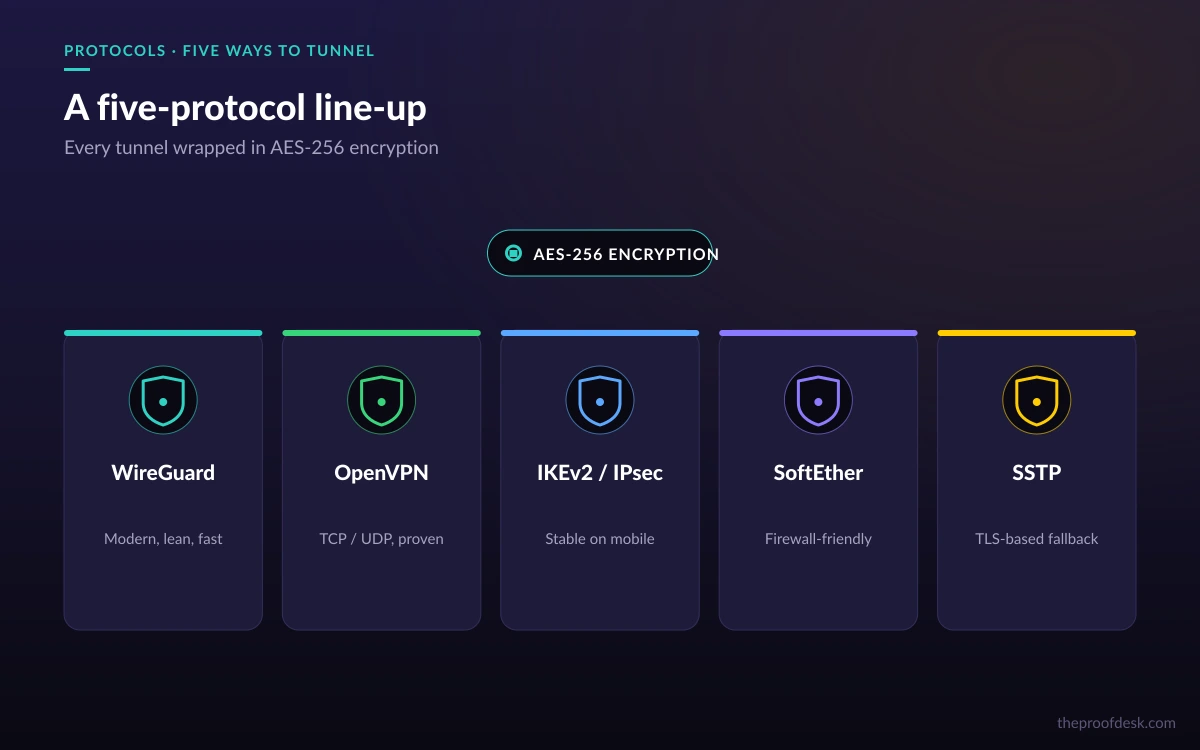
The protocol line-up is hide.me's headline feature and genuinely one of the broadest around. IKEv2/IPsec, OpenVPN, WireGuard, SoftEther and SSTP are all supported out of the box, each with AES-256 encryption. hide.me also describes itself as the first professional VPN provider to support IKEv2.
That breadth is not just a spec-sheet flex. WireGuard gives you the fastest modern option; OpenVPN is the interoperable workhorse; IKEv2 reconnects gracefully when a phone switches between Wi-Fi and mobile data; and SoftEther and SSTP exist mainly to punch through restrictive networks that block the others. Having all five means you can change protocol when one is throttled instead of being stuck with whatever a simpler app decided for you.
- WireGuard — modern, lean and fast; the default for most everyday use.
- OpenVPN (UDP/TCP) — the compatibility fallback when a network fights WireGuard.
- IKEv2/IPsec — stable roaming on mobile, quick to reconnect.
- SoftEther and SSTP — niche options for slipping past aggressive filtering.
Encryption across all of them is AES-256, the same standard the rest of the industry treats as the baseline. There is nothing exotic here on the cipher side, which is exactly what you want — the interesting part is that you get to pick the transport.
The no-logs claim, and the audits behind it
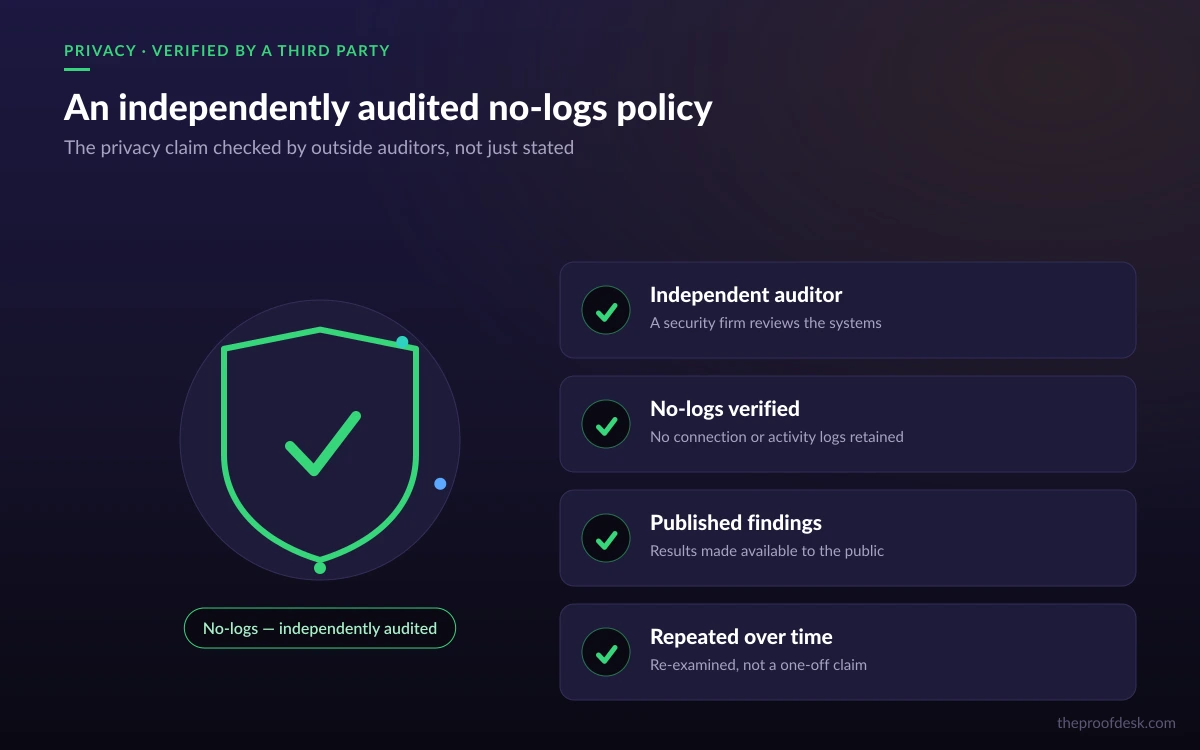
A no-logs policy is only as good as the evidence behind it, and this is where hide.me separates itself from providers that simply assert it. The company says it was among the first VPNs to be audited back in 2015, and that Securitum, a European security firm, has once again confirmed the no-logs policy is strictly enforced — the most recent report dated to mid-2024.
The important word is 'again'. A single audit is a snapshot; a repeated audit is closer to a habit. hide.me's 2015 review was carried out by a separate firm, and the return to independent testing years later — with a downloadable report — is the kind of continuity that a marketing badge cannot fake.
How to read a VPN audit
An audit tells you what the auditor examined and when, not that logging is impossible forever. Treat hide.me's Securitum report as strong, current evidence for its no-logs claim rather than a permanent guarantee, and check the report date whenever you re-evaluate.
One honest note: the absence of any reported breach or logging scandal for hide.me is reassuring, but it is an absence of evidence, not proof of a spotless record. The audit is the positive signal here; the quiet history is merely the lack of a negative one.
Features: where the manual control lives
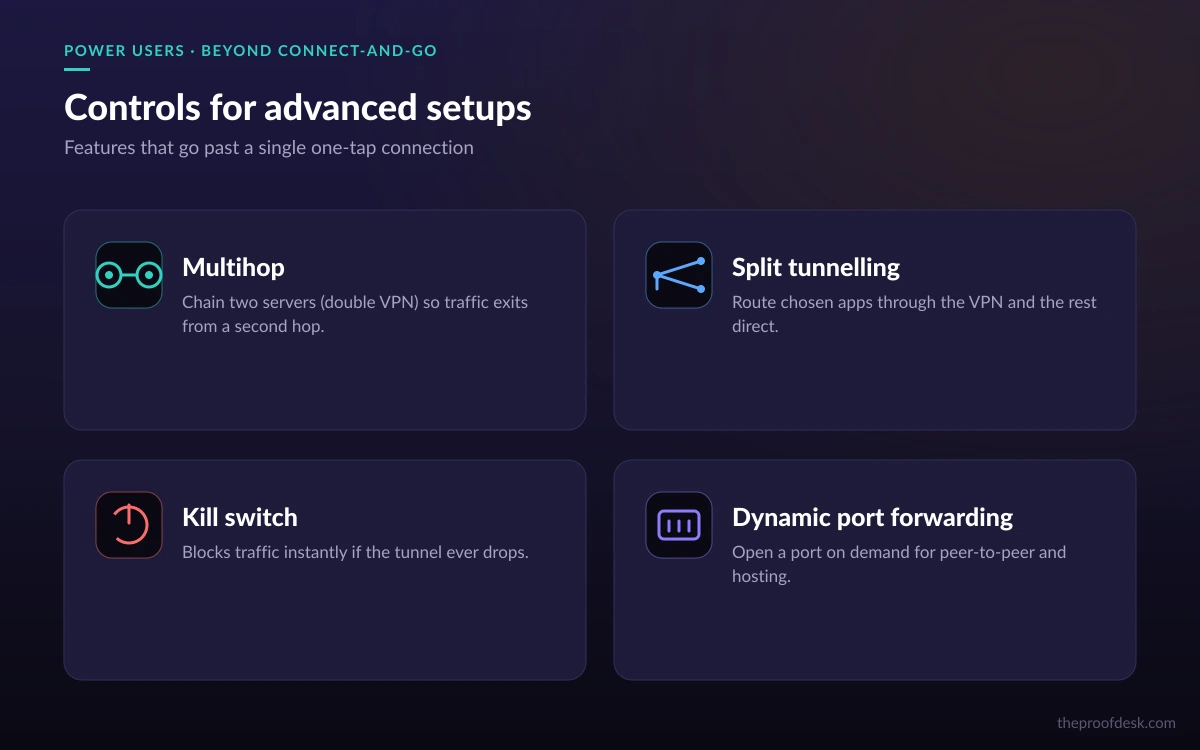
Beyond the protocol menu, hide.me ships the power-user toggles that mainstream apps increasingly bury or omit. This is the part of the service that rewards people who actually want to configure their tunnel.
- IP-leak protection (kill switch) — cuts your traffic if the tunnel drops so nothing leaks to your real IP.
- Split tunnelling — route chosen apps through the VPN and let the rest use your normal connection.
- Multihop (double VPN) — chain two servers so no single server sees both who you are and where you go.
- Dynamic port forwarding — open a port for P2P, self-hosting or gaming, adjustable rather than fixed.
- StealthGuard — a named obfuscation/protection feature in the client.
Multihop and dynamic port forwarding are the standouts. Double-VPN routing is something several big providers have dropped, and adjustable port forwarding is close to essential if you run a torrent client or a game server and want reliable inbound connections. hide.me also advertises optimised streaming servers, though it describes streaming support in general terms — it does not publish a named list of services it guarantees to unblock, so buy it for the privacy tooling first and treat streaming as a bonus to test during the refund window.
One caveat on StealthGuard: hide.me lists it by name but its exact behaviour was not something we could confirm from a first-party description, so we are flagging it as present rather than describing what it filters.
Network size and app coverage
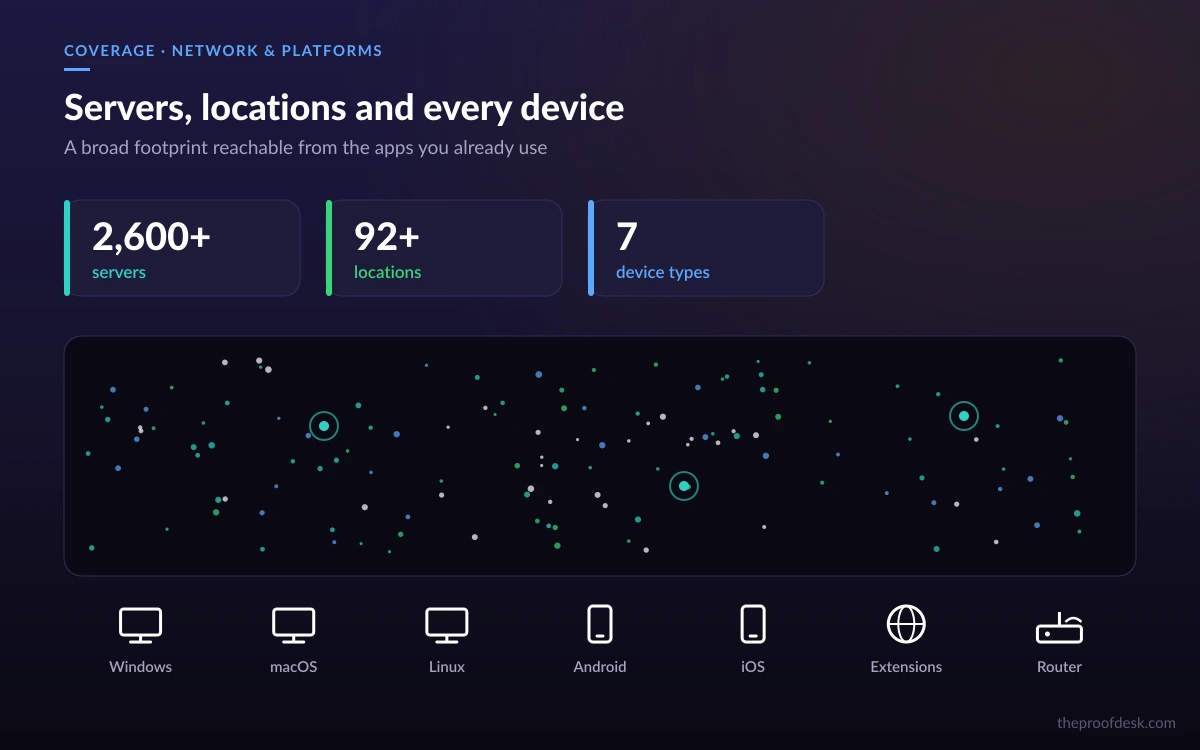
hide.me advertises 2,600+ servers across 92+ locations, with 10 Gbps capacity available on every server and 'unlimited everything' on paid plans — no data caps, no bandwidth throttling on the premium tier. The raw server count is smaller than the headline numbers some rivals quote, but 10 Gbps ports and broad location coverage matter more for real-world speed than a five-figure server tally.
App coverage is comprehensive. There are native clients for Windows, macOS, Linux, Android and iPhone/iPad, browser extensions for Chrome, Firefox and Edge, and router support for whole-home coverage. A TV app category also appears in hide.me's navigation. On the premium plan you can connect up to 10 devices at once, which is generous and enough for most households.
Pricing, the free plan, and refunds
hide.me's paid pricing, taken from its own pricing page, breaks down like this. As with every VPN, the long-term plan is where the real discount lives and the monthly plan is the expensive convenience option.
- 1 month — $11.99/month.
- 12 months — $54.99 up front, working out to about $4.58/month.
- 27-month promo (billed as the long plan with extra months) — $69.99 up front, about $2.59/month.
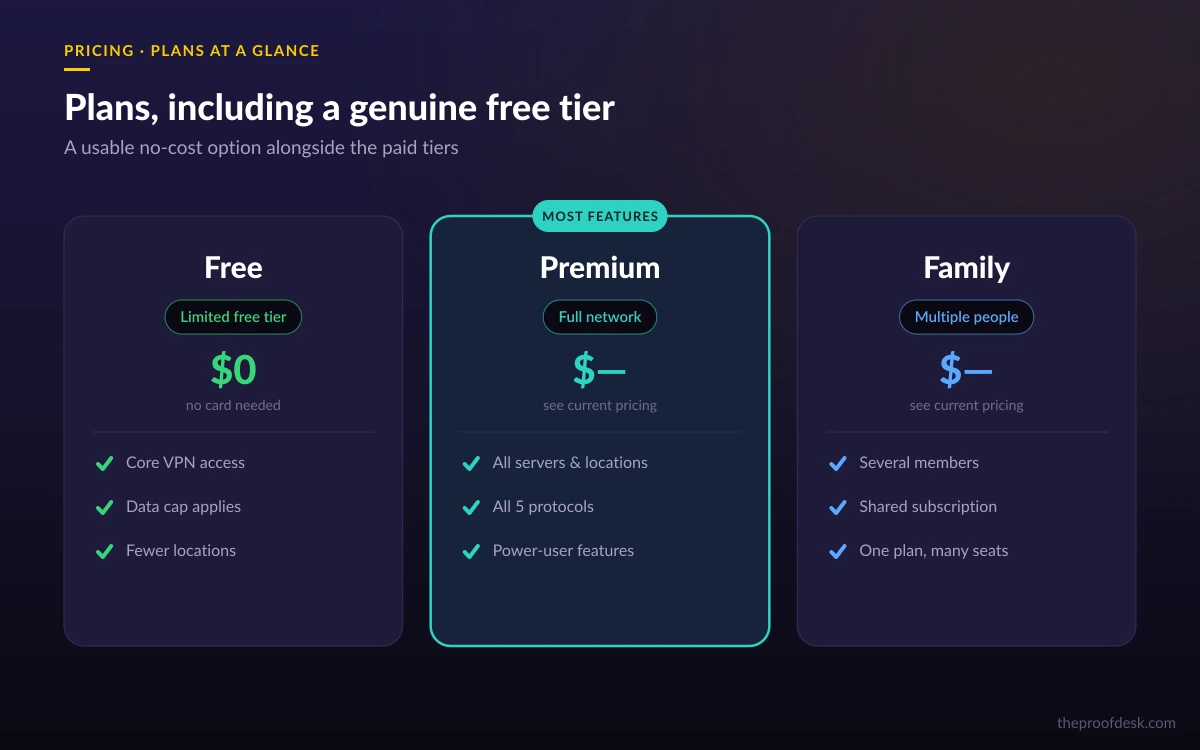
All three tiers include a 30-day money-back guarantee, prices are in USD, and VAT may apply depending on where you are. A word of caution: hide.me's pricing has appeared at different numbers across third-party pages, which suggests promotions shift the figures. The amounts above are the ones on hide.me's own page at the time of writing — check the live pricing page for the current promo before you commit.
There is also a free plan, and it is worth being precise about it. It offers unlimited data with no credit card required, which is rare, but it is capped hard everywhere else: restricted speeds, just 8 locations, and a single device connection. It shares the audited no-logs policy of the paid tiers, which makes it a legitimate way to try the service or cover light, occasional use — but it is not a full free VPN, and the speed limit will show on anything demanding.
Refund policy
hide.me lets you cancel within 30 days, no questions asked. Refunds are processed within up to 10 days of cancellation depending on your payment method. That 30-day window is enough to properly test speeds, streaming and port forwarding before you are locked in.
Verdict: who should buy hide.me
hide.me is a strong choice for privacy-minded users who want proof rather than promises and controls rather than a single connect button. The repeated independent audit, the five-protocol line-up, multihop, and dynamic port forwarding add up to a package aimed squarely at people who like to understand and tune their VPN.
It is a weaker fit if you want the most hand-holding streaming experience with a guaranteed list of unblocked services, or if you dislike checking a pricing page for the current promo. And the free plan, while genuinely no-logs, is limited enough that it is a trial rather than a destination.
- Buy it if: you value an audited no-logs record, want a choice of protocols, and use multihop or port forwarding.
- Look elsewhere if: you want a one-tap app with a published, guaranteed streaming-unblock list and fixed, simple pricing.
- Try the free plan if: you need occasional, light coverage on one device and can live with capped speed.
Frequently asked questions
How much does hide.me cost?
On hide.me's own pricing page the plans are $11.99/month for one month, $54.99 for 12 months (about $4.58/month), and $69.99 for the 27-month promo (about $2.59/month). Prices are in USD, VAT may apply, and every paid plan includes a 30-day money-back guarantee. Because promotions change the numbers, confirm the current price on hide.me's pricing page.
Is hide.me's no-logs policy actually audited?
Yes. hide.me was among the first VPNs to be audited in 2015, and the European firm Securitum has since re-confirmed that its no-logs policy is strictly enforced, with the most recent report dated to mid-2024. A repeated audit is stronger evidence than a single one-off review.
Is the hide.me free plan any good?
It is a legitimate trial rather than a full free VPN. You get unlimited data with no credit card required and the same no-logs policy, but you are limited to restricted speeds, 8 locations and a single device. It suits light, occasional use; heavier tasks will run into the speed cap.
How many devices can I connect at once?
The premium plan supports up to 10 simultaneous connections, which is enough for most households and covers phones, laptops and a router at the same time. The free plan allows a single connection.
Which protocols does hide.me support?
Five out of the box: IKEv2/IPsec, OpenVPN, WireGuard, SoftEther and SSTP, all with AES-256 encryption. WireGuard is the fast default, OpenVPN and IKEv2 cover compatibility and mobile roaming, and SoftEther and SSTP help on restrictive networks.
Can I get a refund if hide.me does not work for me?
Yes. You can cancel within 30 days with no questions asked, and refunds are processed within up to 10 days of cancellation depending on your payment method. That window is long enough to test speeds, streaming and port forwarding properly.
Does hide.me support torrenting and P2P?
Yes. hide.me supports P2P and offers dynamic port forwarding, which lets you open a port for more reliable inbound connections for torrents, self-hosting or gaming. Combined with the kill switch, that makes it a practical pick for privacy-conscious P2P use.
Key takeaways
- hide.me pairs a repeatedly audited no-logs policy with five tunnelling protocols — a rare combination of verifiable privacy and manual control.
- Power-user features like multihop, split tunnelling and dynamic port forwarding are the real reason to choose it over simpler mainstream apps.
- Paid plans run about $2.59–$11.99/month with a 30-day money-back guarantee, but confirm the current promo on hide.me's pricing page before buying.
- The free plan is genuinely no-logs but capped to one device, 8 locations and restricted speeds — a trial, not a full free VPN.
- Streaming support is described generically with no guaranteed service list, so test it inside the refund window if that is your priority.
More in Virtual Private Network
Browse Virtual Private Network