HostGator Review 2026: Plans, Renewals and the Fine Print
An independent HostGator review for 2026: the four shared plans, renewal pricing, US-only data centers, courtesy backups, migration fees and refund exclusions.
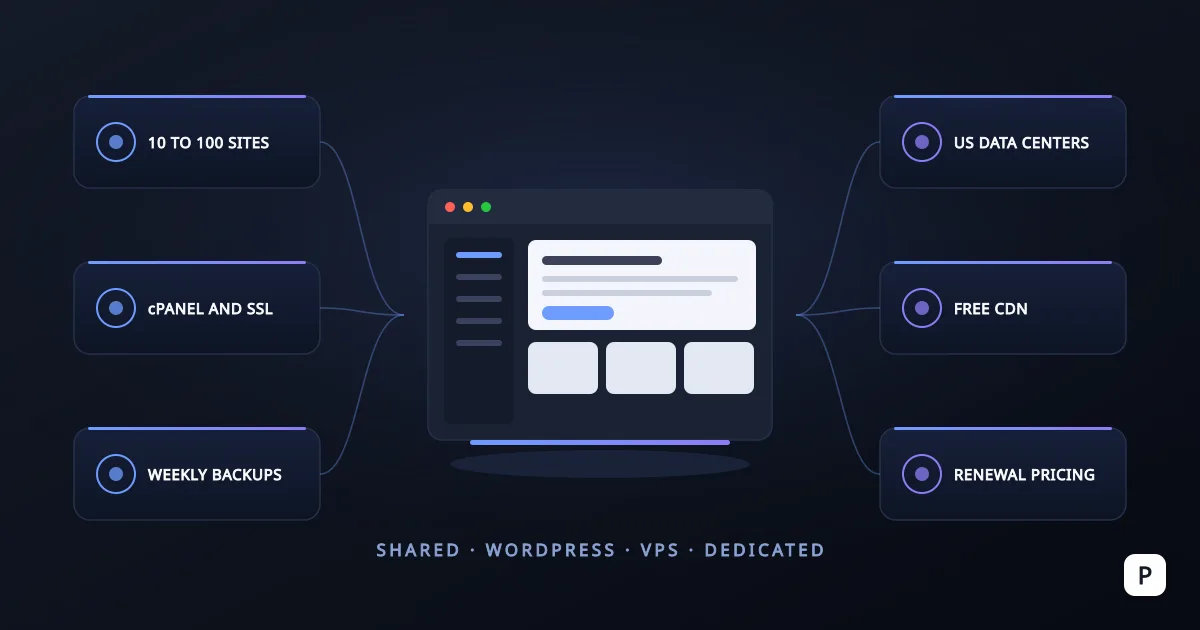
HostGator sells the most familiar version of shared hosting: cPanel, unmetered bandwidth, a free domain for the first year, and a headline price low enough to make the decision feel small. That price is the part most buyers examine, and it is the part that changes the soonest.
This review covers what HostGator actually sells in August 2026, how the four shared plans differ, what the published terms say about renewals, refunds, backups and migrations, and which of those terms tend to surprise people after signup. Every rule quoted here comes from HostGator's own plan pages, terms of service and support articles.
What HostGator Is in 2026
HostGator is a shared hosting brand owned by Newfold Digital, the group that also owns Bluehost and Network Solutions. The product line is conventional: shared hosting, managed WordPress, VPS and dedicated servers, all administered through cPanel rather than a custom panel. For anyone who has used cPanel before, nothing about the interface will need learning.
Two products long associated with the brand are no longer part of the pitch. The Gator website builder has been discontinued, and the classic reseller tiers have been replaced: the reseller page now sells the same Snappy VPS containers as the VPS page, with optional cPanel and WHM. If a review or coupon page still describes Gator or the old Aluminium and Copper reseller plans, it is out of date.
The one thing to check first
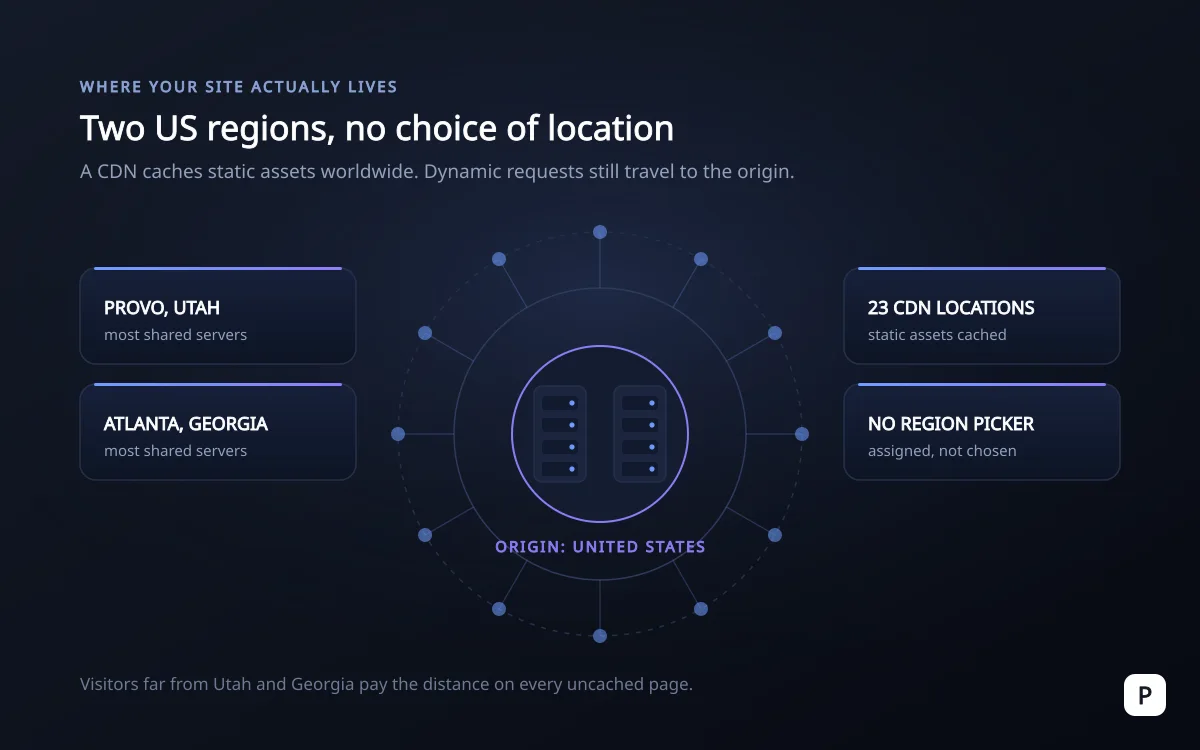
HostGator's servers are in the United States. Most sit in Provo, Utah and Atlanta, Georgia, and HostGator's own support documentation states that you cannot choose which data center houses your server. If your audience is mainly in Europe, Asia or Australia, that single fact matters more than any price on the page.
The Four Shared Plans
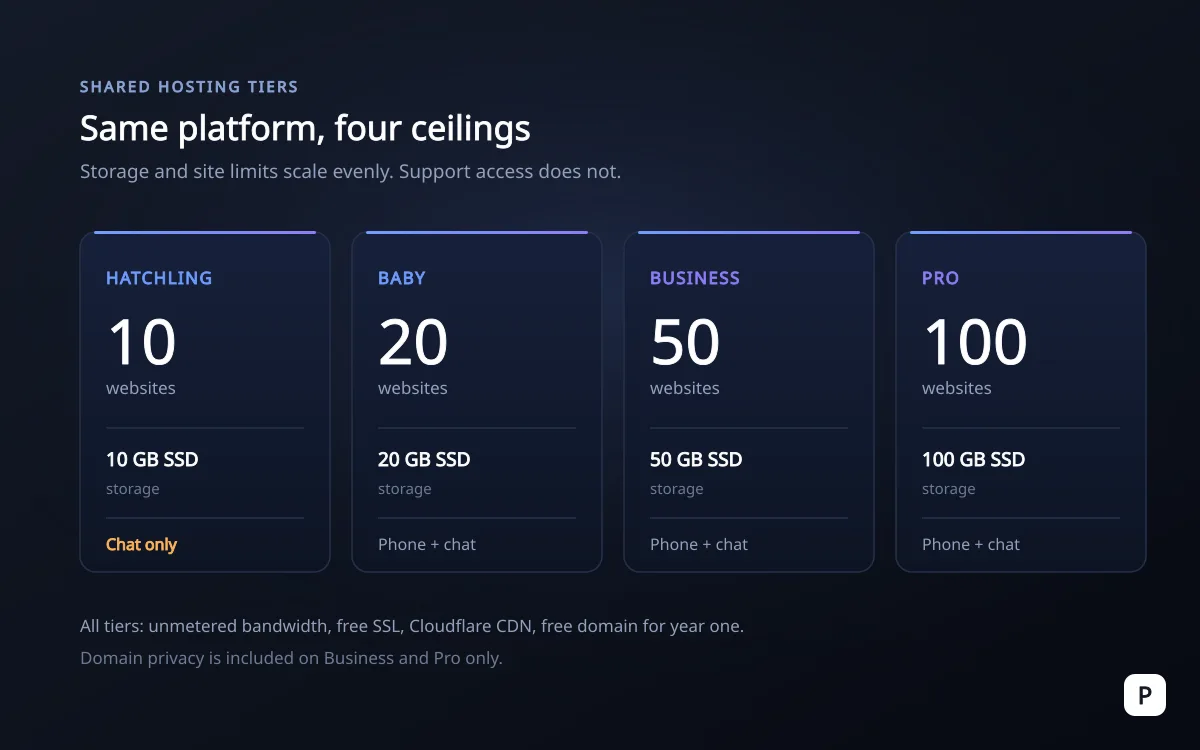
Shared hosting comes in four tiers that differ mainly by site count, storage and support access. The site limits are newer than most published comparisons suggest; the entry plan is no longer a single-site plan.
- Hatchling: 10 websites, 10 GB SSD storage, chat support only.
- Baby: 20 websites, 20 GB SSD storage, 24/7 phone and chat support.
- Business: 50 websites, 50 GB SSD storage, phone and chat, plus domain privacy free for the first year.
- Pro: 100 websites, 100 GB SSD storage, phone and chat, plus domain privacy free for the first year.
Every tier includes unmetered bandwidth, a free Let's Encrypt SSL certificate, a Cloudflare CDN with Argo routing, free malware scanning, managed WordPress core updates, one-click application installs and a free domain for the first year on 12, 24 and 36 month terms. The practical gap between Hatchling and Baby is not storage but the telephone: dropping phone support on the cheapest plan is a real limitation during an outage.
Introductory Price Versus Renewal Price
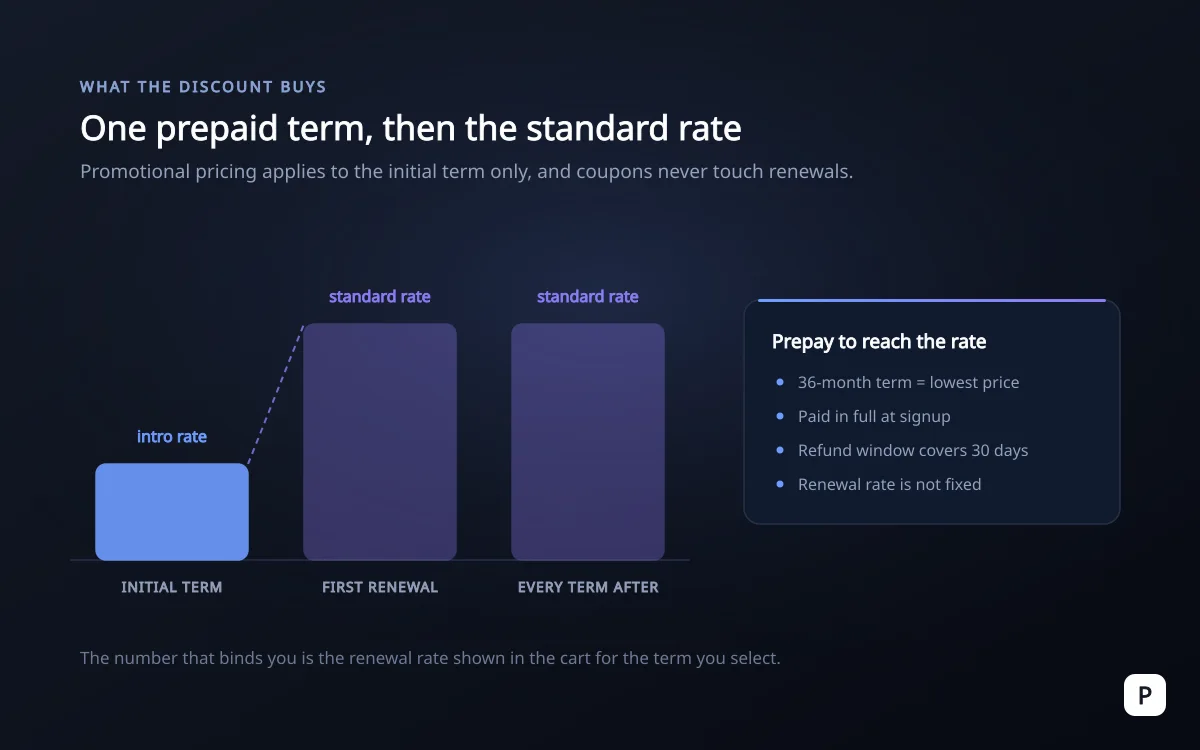
The advertised monthly rate is an introductory rate tied to a prepaid term, and HostGator states the rule plainly on its own pricing page: special offers are available to new customers, are valid for the initial term only, and do not apply to successive or renewal periods. The terms of service add that coupon discounts apply only to the initial purchase and do not affect the renewal price.
The lowest headline number always belongs to the 36 month term, which is paid in full up front. A three year prepayment is a real commitment: the discount is genuine, but so is the amount leaving your account on day one, and the refund window covers only the first 30 days of it.
HostGator does not publish renewal rates in a way that survives being quoted, and the figures in circulation vary by source and by month. Third-party trackers in mid-2026 reported renewals in the range of roughly eleven to twenty-two dollars per month across the shared ladder, against introductory rates a half to a third of that. Treat those as an order of magnitude, not a quote: the number that binds you is the one shown in the cart next to the term you select.
Read the cart, not the landing page
Two things routinely differ between the landing page and the checkout total: the term length, which defaults to the longest option, and pre-added extras. Buyers frequently report Professional Email arriving in the cart as a free trial that converts to a paid subscription. Remove what you did not choose before paying.
Managed WordPress, VPS and Reseller
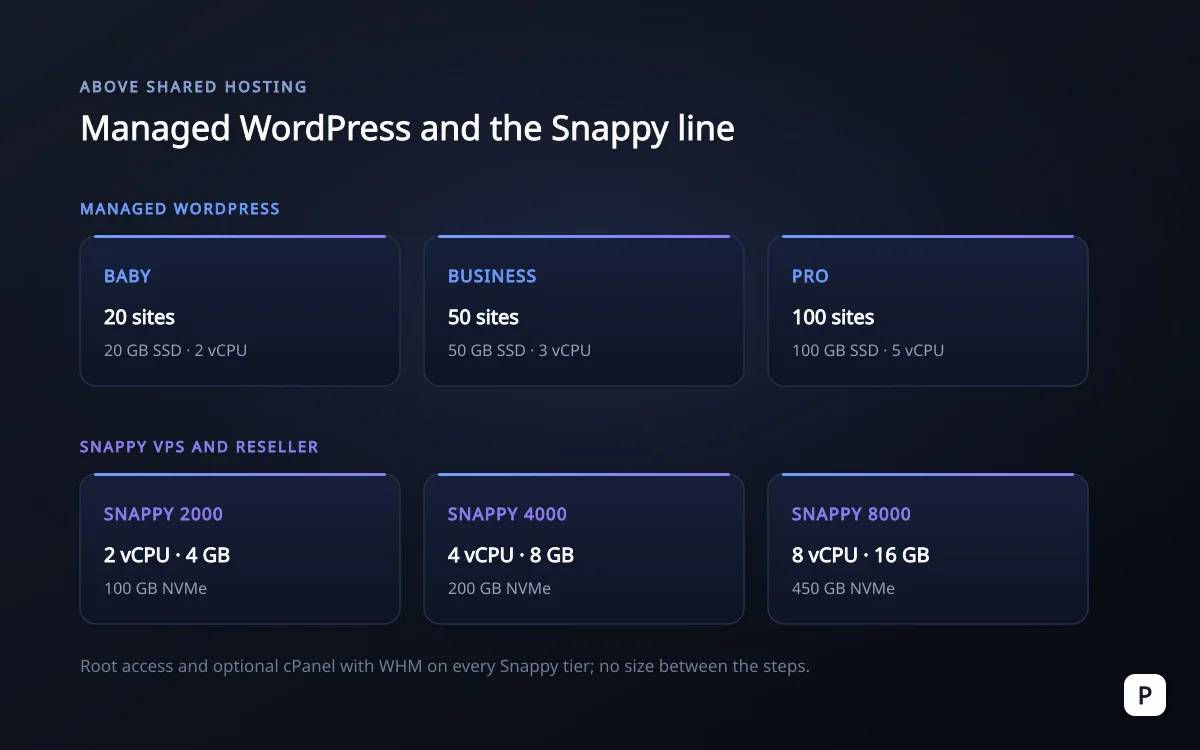
Managed WordPress skips the entry tier and starts at Baby. The three plans map to 20, 50 and 100 sites with 20, 50 and 100 GB of SSD storage, and they add an explicit CPU allocation of 2, 3 and 5 vCPUs. WordPress arrives preinstalled, core updates are managed, and the plans include AI-powered malware detection and removal, courtesy automatic backups, basic email and the Cloudflare CDN. Weekly website backups are called out on the Business and Pro tiers.
Above shared hosting, the Snappy line covers both VPS and reseller use. Snappy 2000 provides 2 vCPU cores, 4 GB of DDR5 memory and 100 GB of NVMe storage; Snappy 4000 doubles that to 4 cores, 8 GB and 200 GB; Snappy 8000 reaches 8 cores, 16 GB and 450 GB. All three include root access, a dedicated IP address, unmetered bandwidth and optional cPanel and WHM.
- Managed WordPress is a convenience layer on the same platform, not a separate high-performance stack.
- A VPS transfers real system administration to you, even with managed support attached.
- Reseller work now means running a Snappy container with WHM rather than buying a purpose-built reseller plan.
- Migration onto VPS and dedicated plans is free only within specific terms, covered below.
Performance, Uptime and the Guarantee
HostGator advertises a 99.9% uptime guarantee. The compensation is one month of credit on the affected package for shared and reseller accounts, and like most hosting guarantees it is claimed rather than paid automatically. A credit for one month is worth noting for what it is: a refund of a few dollars, not a remedy for a day of lost orders.
Independent testing in 2026 does not converge on a single verdict. Some reviewers recorded 100% uptime over their monitoring window with response times near 112 ms and sub-second largest contentful paint on a light test site. Others measured three to four second load times without caching and flagged a worsening trend in average outage duration between 2024 and 2025. The honest reading is that HostGator performs adequately for small and medium sites and is not competitive at the top of the market.
Geography explains much of the spread. With servers only in Utah and Georgia and no choice of location, a visitor in Sydney or Frankfurt pays a network penalty on every uncached request. The bundled Cloudflare CDN routes static assets through 23 locations worldwide and softens that, but a CDN cannot hide the distance to the origin for a dynamic page such as a logged-in cart or a WordPress admin screen.
Backups and Migrations: Read These Terms
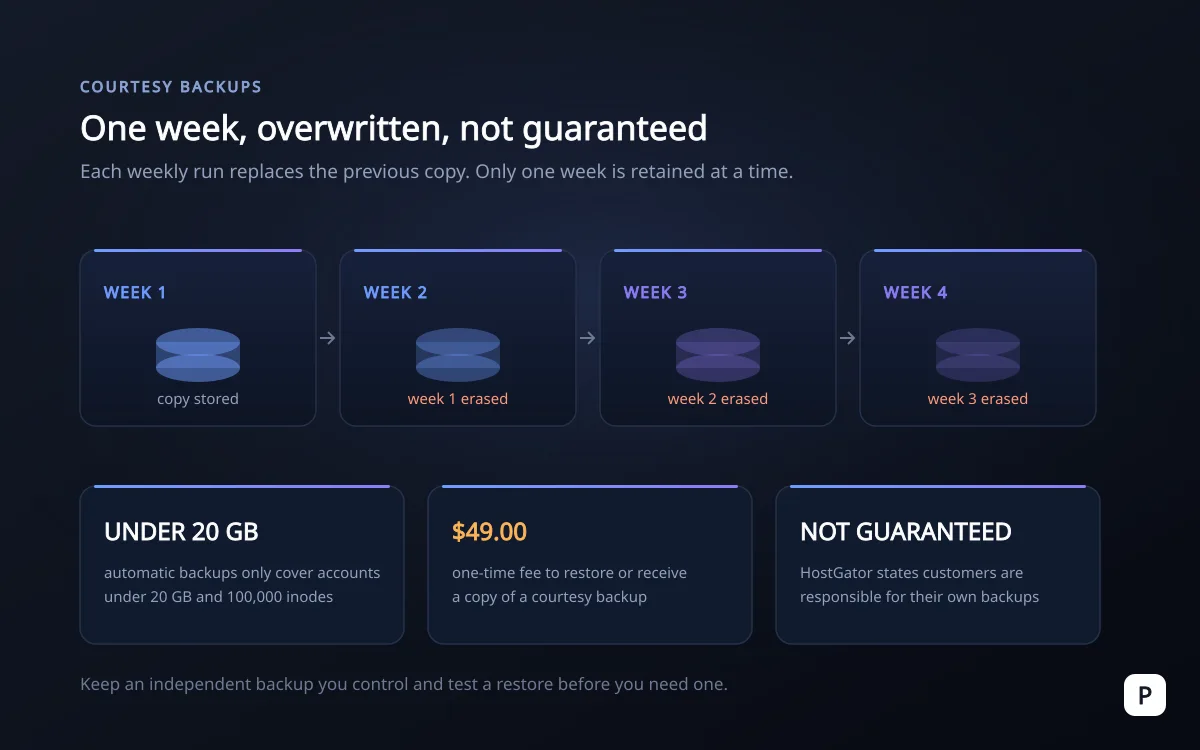
HostGator's backup policy is unusually explicit, and it is the part of the service most often misread. Automatic backups run once a week on a random day, each run overwrites the previous one, and only one week is retained. The policy states directly that backups are provided as a courtesy and are not guaranteed, and that customers are responsible for their own backups.
- Automatic shared backups cover accounts under 20 GB and 100,000 inodes; larger accounts fall outside them.
- Manual cPanel backups are capped at 10 GB or 150,000 inodes.
- Restoring content from a courtesy backup, or receiving a copy of one, carries a one-time fee of $49.00.
- An account suspended for more than a week before the next backup run loses its stored copy entirely.
Migrations have their own conditions. A free content transfer covers one website per request and must be requested within 30 days of signup, and the courtesy migration on VPS and dedicated plans applies to customers who select a 12 month billing term. External migrations without root access are limited to 5 cPanel accounts and 10 GB of data per site. Outside those bounds, migration is a paid service at $149.99.
Run your own backups regardless
A weekly, overwritten, explicitly non-guaranteed copy is not a backup strategy for a site that earns money. Add an independent backup that you control and can restore yourself, and verify a restore once before you need it. This is HostGator's own stated recommendation, not an outside criticism.
Refunds and the Rest of the Fine Print
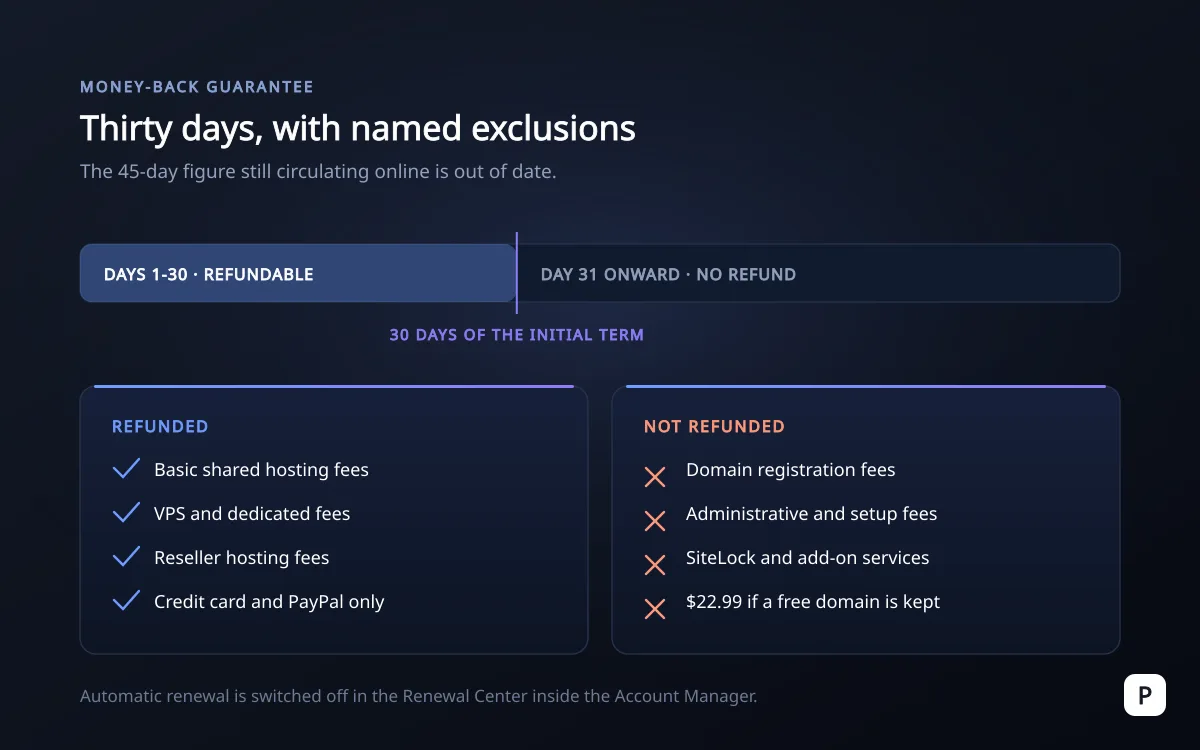
The money-back guarantee is 30 days, not the 45 days that older articles and coupon sites still advertise. HostGator's terms of service specify a full refund of basic shared, VPS, dedicated and reseller hosting fees if you cancel within the first thirty days of the initial term. Several exclusions sit alongside it.
- Domain registration fees, administrative fees, setup and custom software install fees, and fees for additional services are not refundable.
- Domain names and SiteLock are excluded from refunds outright.
- If your plan included a free domain and you cancel within the first year, a standard $22.99 domain fee is deducted from the refund.
- The guarantee applies only to payments made by credit card or PayPal.
- Plans renew automatically; automatic renewal is switched off in the Renewal Center inside the Account Manager.
None of this is unusual for the budget hosting market, and none of it is hidden. It is simply written in the terms rather than on the plan page, which is why the first renewal invoice is where most complaints about HostGator begin.
Who HostGator Suits
HostGator fits a specific buyer well: someone hosting brochure sites, small business sites or WordPress blogs for a mainly North American audience, comfortable with cPanel, who wants several sites on one cheap account and will prepay for a long term to get the rate. On that profile it is a reasonable, unexciting choice with a well-understood control panel and 24/7 phone support above the entry tier.
It fits poorly where latency, data residency or recovery guarantees matter. A store serving European customers, a site under compliance rules about where data lives, or a business that cannot lose a week of content should look at a host that offers a choice of region and a real backup product. The same applies to anyone unwilling to prepay years in advance to reach the advertised price.
Frequently asked questions
How much does HostGator cost after the introductory period?
Substantially more than the advertised rate, and HostGator does not commit to the figure in advance. Its pricing page states that promotional offers apply to the initial term only, and its terms add that coupons do not affect the renewal price. Third-party trackers in mid-2026 reported shared renewals roughly in the eleven to twenty-two dollar per month range depending on tier and term. Check the renewal rate shown in the cart for your chosen term before buying, because that is the only binding number.
Is the money-back guarantee 30 days or 45 days?
Thirty days. The 45 day figure is outdated but still widely republished. HostGator's current terms of service refund basic shared, VPS, dedicated and reseller hosting fees if you cancel within the first thirty days of the initial term, and only for credit card and PayPal payments.
Is the free domain really free if I cancel?
No. If your plan included a free domain and you cancel within the first year, HostGator deducts a standard $22.99 domain fee from your refund. Domain registration fees are excluded from the guarantee in general, so the domain is free only for as long as you keep the hosting.
Does HostGator back up my website?
It takes backups, but it does not promise them. HostGator's policy states that backups run once a week on a random day, that each run overwrites the previous one so only a single week is retained, and that they are a courtesy and are not guaranteed. Automatic shared backups only cover accounts under 20 GB and 100,000 inodes, and restoring from a courtesy backup costs a one-time $49.00. Keep your own independent backup.
Is site migration free?
Only within narrow limits. A free content transfer covers one website per request and must be requested within 30 days of signup, and the courtesy migration on VPS and dedicated plans requires a 12 month billing term. External migrations without root access are capped at 5 cPanel accounts and 10 GB per site. Outside those conditions, migration is a paid service at $149.99.
Can I choose which data center hosts my site?
No. HostGator's support documentation states plainly that you cannot choose which data center houses your server. Most servers are in Provo, Utah and Atlanta, Georgia. The included Cloudflare CDN caches static content across 23 locations worldwide, but the origin stays in the United States, so non-US visitors still pay the distance on dynamic requests.
Key takeaways
- HostGator's advertised price applies to the first prepaid term only, and the renewal rate is not published in a form you can hold it to.
- All four shared tiers include unmetered bandwidth, free SSL and a Cloudflare CDN; the entry plan's real limitation is chat-only support.
- Servers are in Utah and Georgia with no choice of location, which caps how fast a non-US audience can be served.
- Backups are weekly, overwritten, explicitly not guaranteed, and cost $49.00 to restore, so bring your own backup.
- The refund window is 30 days and excludes domains, add-ons and setup fees, with $22.99 deducted for a free domain cancelled inside a year.
More in Services & Software
Browse Services & Software