Hotspot Shield VPN Review 2026: Catapult Hydra Speed, Pricing and the Audit Gap
A practical 2026 review of Hotspot Shield VPN: its Catapult Hydra protocol, real pricing, free-vs-premium limits, device counts and the unaudited no-logs gap every buyer should weigh.
Hotspot Shield is one of the oldest names in consumer VPNs. It launched in 2008 under AnchorFree, made its reputation on a generous free tier, and still leans on a protocol most of its rivals do not have: the proprietary Catapult Hydra, tuned for speed rather than borrowed from the open-source WireGuard and OpenVPN everyone else ships.
But a VPN is a trust product, and Hotspot Shield's history complicates the trust. The service has changed corporate hands twice in the last two years, its no-logs promise has never had an independent third-party audit, and its pricing is easier to find on review sites than on its own storefront. This review lays out what you actually get in 2026 — the protocol, the plans, the device limits and the platforms — and, just as importantly, where the marketing and the evidence part ways.
What Hotspot Shield is in 2026
Hotspot Shield is a commercial VPN with a free (Basic) tier and paid Premium plans. Its calling card is Catapult Hydra, an in-house transport protocol the company also licenses to other security firms as an SDK. Around that it wraps the usual VPN feature set: a large server network, apps for the major desktop and mobile platforms, split tunneling and a kill switch.
The corporate story matters here more than for most products, because who runs a VPN decides who can see your traffic. Hotspot Shield was built by AnchorFree, which rebranded to Pango and was acquired by Aura around 2020-2021. In September 2024 Pango split back out of Aura, and in December 2024 it merged with Total Security — the parent of TotalAV — to form a new company, Point Wild. Point Wild is Hotspot Shield's parent as of 2026.
Why the ownership churn is relevant
A no-logs commitment is only as durable as the company standing behind it. Two ownership changes in two years means the entity making that promise today is not the one that made it a few years ago, and privacy policies can be rewritten after an acquisition. It is a reason to read the current policy rather than trust the brand's reputation.
Pricing and plans
A caveat before the numbers: Hotspot Shield's own pricing page did not load reliably at the time of writing, so the figures below come from third-party pricing breakdowns current as of publication rather than directly from the vendor. Treat them as indicative and confirm at checkout.
- Premium Individual: about $7.99/month billed annually ($95.88/year, roughly 38% off) or $12.99/month billed monthly.
- Premium Family: about $11.99/month billed annually ($143.88/year, roughly 40% off) or $19.99/month billed monthly, covering 5 accounts and up to 25 devices in total.
- Free (Basic): $0, one device, a short list of locations and data/speed limits.
The Individual plan advertises unlimited data and access to 115+ virtual locations. Paid plans carry a 45-day money-back guarantee, which is longer than the 30 days most rivals offer and gives you real time to test the service before committing.
The device-limit conflict
Sources disagree on how many devices Premium covers. Hotspot Shield's own support documentation says Premium users can connect up to 10 devices simultaneously, while third-party pricing breakdowns list 5 devices for the base Premium Individual tier (with up to 25 across a 5-account Family plan). Both are current as of research; if the exact number matters to you, verify it on the plan page before buying.
Free tier versus Premium
The free Basic tier is real but deliberately narrow. Per Hotspot Shield's own support docs it links only one device and exposes a handful of virtual locations — Auto, Los Angeles, New York, Singapore and the United Kingdom, five options in all — with data and speed limits on top. It is enough to secure a coffee-shop connection occasionally, not to be your everyday tunnel.
Some third-party reviews cite specific caps on the free tier such as a daily data allowance and a throttled speed ceiling, but those exact figures are not confirmed on a vendor page, so treat any precise cap you see quoted as an estimate. What is not in dispute is the direction of travel: the free plan exists to move you onto Premium, where the data cap, the location list and the device count all open up.
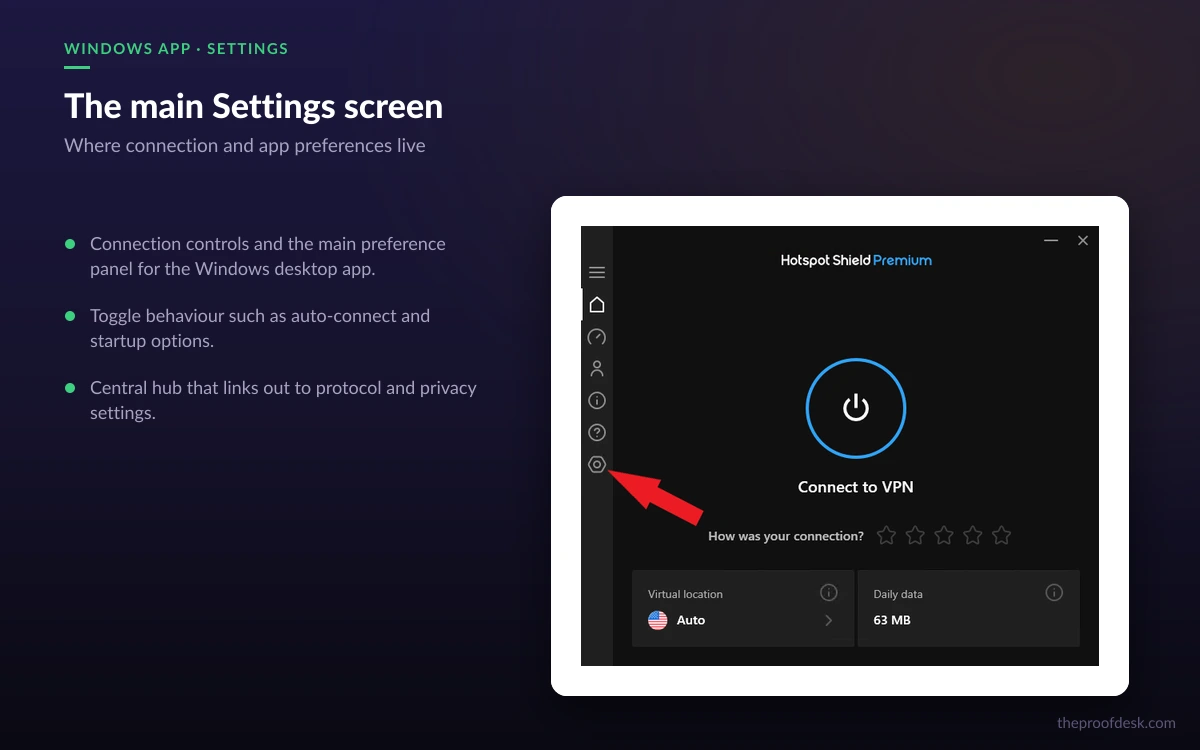
Catapult Hydra and the feature set
Catapult Hydra is the reason Hotspot Shield tends to score well on speed tests. It uses TLS 1.2 handshakes with no downgrade allowed, 2048-bit RSA certificates for server authentication and ECDHE for ephemeral key exchange, and it was engineered to hold throughput over long distances better than a stock protocol. Importantly, the Hydra code itself has been reviewed by third-party security experts from firms that license the SDK — a point worth keeping separate from the no-logs question below.
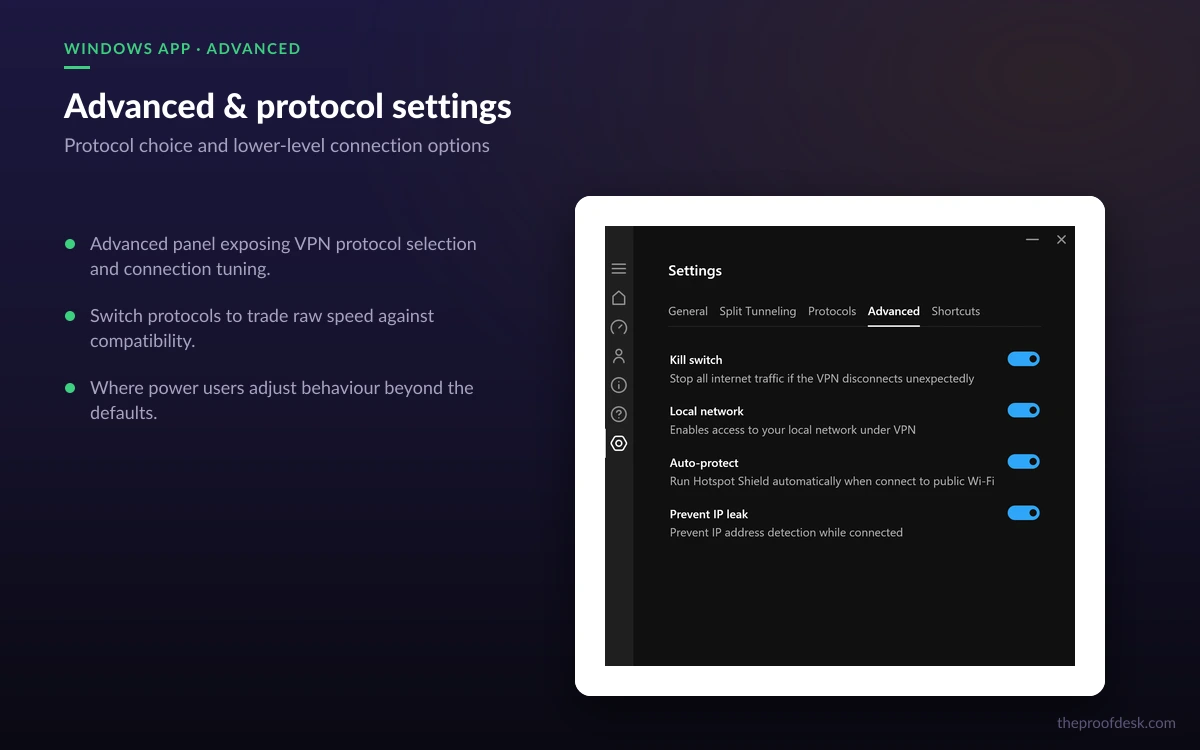
You are not locked into Hydra. Hotspot Shield also supports WireGuard and IKEv2/IPSec, so you can trade a little speed for an open, widely audited protocol when you prefer one. That flexibility is a genuine strength: Hydra for speed, WireGuard when you want transparency.
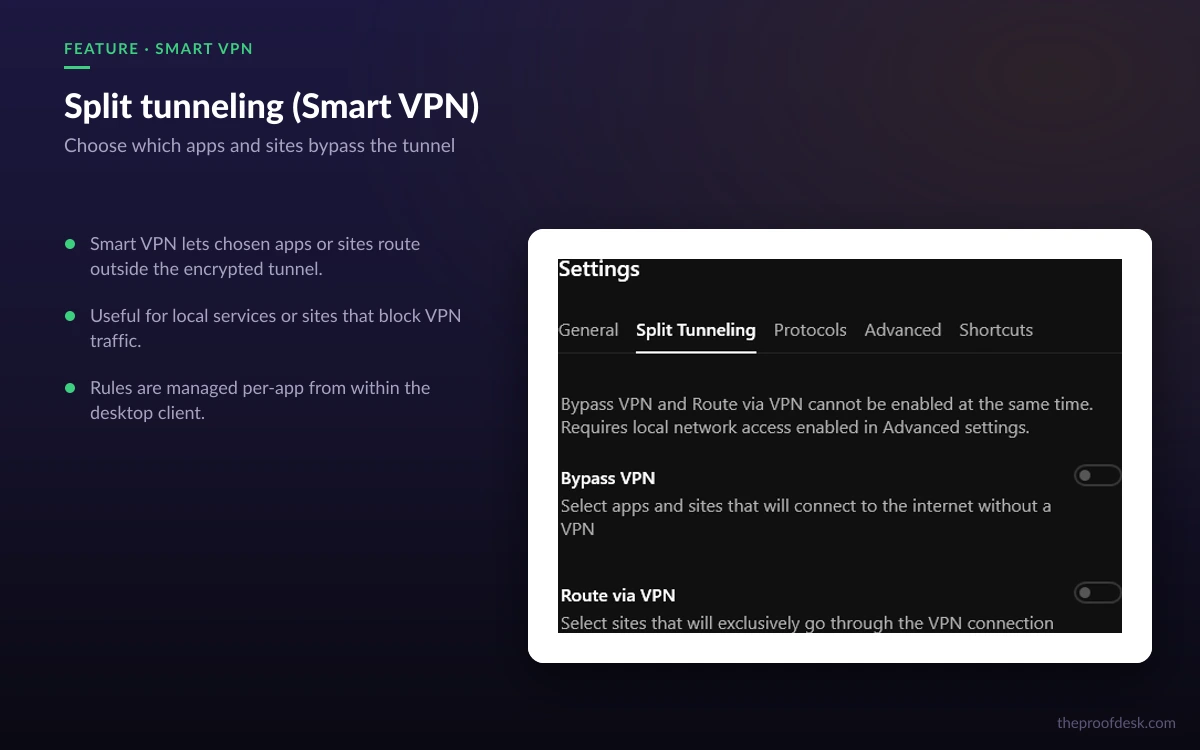
On features, the app includes split tunneling — branded 'Smart VPN' — which lets you pick which apps bypass the tunnel, useful for keeping local banking or a printer off the VPN while everything else stays protected. A kill switch is available to cut traffic if the tunnel drops.
Servers and platform support
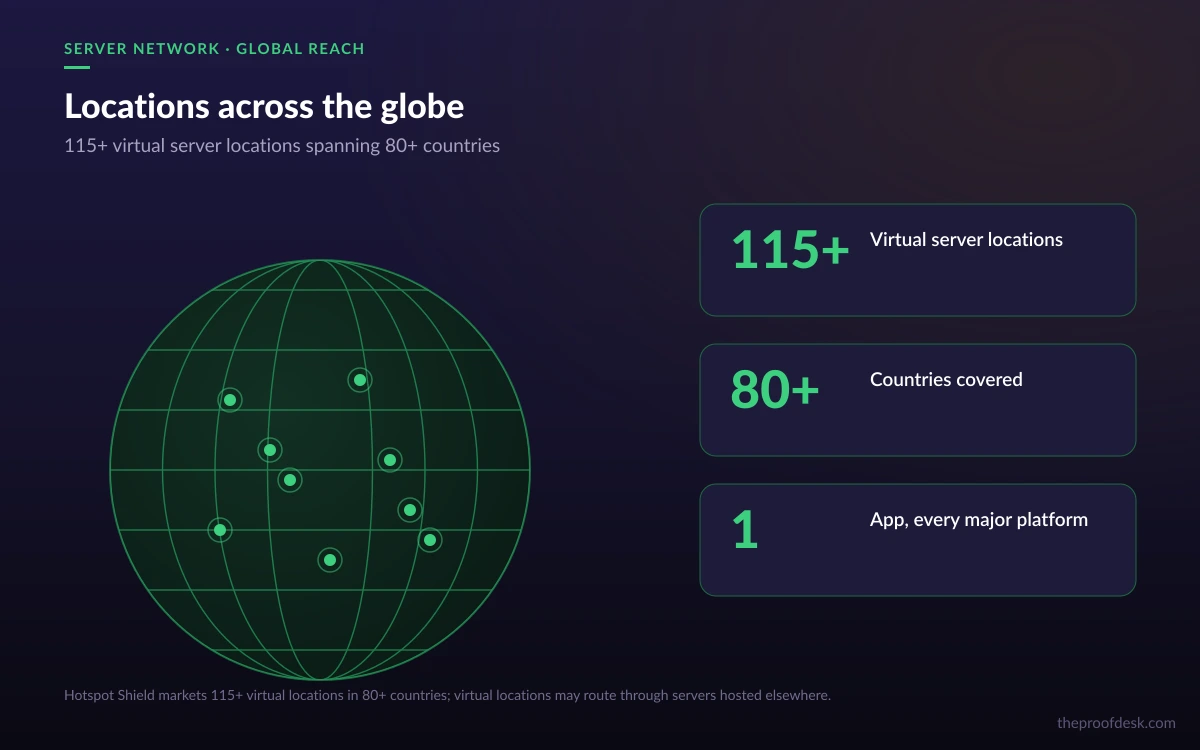
Hotspot Shield runs a large server network described as spanning more than 80 countries for Premium users, with 115+ virtual locations you can select from. The company does not publish an exact physical server count, so treat 'thousands of servers' claims from third parties with the usual caution — the figures that can be confirmed are the country and location counts, not a hardware total.
Platform coverage is broad on phones and computers: iOS 14 and later, Android 5.0 and later, Android TV 5.0 and later, macOS 10.12 and later, and Windows 7 and later. There is no native app for gaming consoles, so console users would need to route through a router or a shared connection rather than install directly.
Privacy: the no-logs claim and the audit gap
This is where a buyer should slow down. Hotspot Shield states that it does not log your browsing activity, but that is a claim, not an independently verified fact. No named third-party audit of Hotspot Shield's no-logs policy — of the kind Cure53 or PwC have carried out for some competitors — could be confirmed. The Hydra protocol's code has had third-party review, but a protocol audit is not a logging audit; the two prove different things and should not be conflated.
There is also evidence that 'no logs' does not mean 'no data.' A detailed third-party review found Hotspot Shield does collect IP addresses, email addresses, device information, usernames, mobile identifiers, session duration and bandwidth usage. Some of that is ordinary for running a service, but it is a broader footprint than the privacy-first VPNs that minimise collection by design. The company has also not published a transparency report since 2019.
The bottom line on trust
If your threat model is casual — public Wi-Fi, geo-shifting a streaming catalogue, general encryption — the audit gap may not bother you, and Hydra's speed is a real draw. If you need a VPN you can point to an independent audit for, a service with a current, named no-logs audit is a better fit than Hotspot Shield today.
Frequently asked questions
How much does Hotspot Shield cost?
Premium Individual is roughly $7.99/month on an annual plan ($95.88/year) or $12.99/month billed monthly; Premium Family is about $11.99/month annually ($143.88/year) or $19.99/month monthly. These figures come from third-party pricing breakdowns current as of publication, since the vendor's pricing page did not load reliably during testing — confirm the live price at checkout.
Is there a free version of Hotspot Shield?
Yes. The free Basic tier covers one device, offers about five virtual locations (Auto, Los Angeles, New York, Singapore and the UK) and applies data and speed limits. It is fine for occasional use but is designed to nudge you toward Premium.
How many devices can Hotspot Shield protect at once?
It depends on the source. Hotspot Shield's own support docs say Premium allows up to 10 simultaneous devices, while third-party pricing breakdowns list 5 for the base Premium Individual tier and up to 25 across a 5-account Family plan. Verify the number on the current plan page before buying if it matters to you.
Has Hotspot Shield's no-logs policy been independently audited?
No independent, named audit of its no-logs policy could be confirmed. Only the Catapult Hydra protocol's code has documented third-party review, which is a separate matter from logging. The company also collects some account and connection metadata and has not published a transparency report since 2019.
Who owns Hotspot Shield now?
As of 2026 it is owned by Point Wild. The lineage runs AnchorFree to Pango, then Aura (2020-2021), then a split from Aura in September 2024, followed by a December 2024 merger with Total Security — TotalAV's parent — that created Point Wild.
What protocols and features does Hotspot Shield support?
It defaults to its proprietary Catapult Hydra protocol (TLS 1.2, 2048-bit RSA, ECDHE) and also supports WireGuard and IKEv2/IPSec. Features include split tunneling, branded 'Smart VPN,' and a kill switch.
Can I get a refund if I don't like it?
Paid plans come with a 45-day money-back guarantee, which is longer than the industry-standard 30 days and gives you a genuine window to test the service before deciding.
Key takeaways
- Hotspot Shield's Catapult Hydra protocol is its real edge — built for speed, with TLS 1.2, 2048-bit RSA and ECDHE, and it also supports WireGuard and IKEv2/IPSec.
- Premium runs about $7.99/month annually for Individual and $11.99/month for Family, with a generous 45-day money-back guarantee; prices are third-party-reported, so confirm at checkout.
- The free tier is one device with a short location list and data/speed caps — a taster, not a daily driver.
- Device limits are reported inconsistently: up to 10 per the vendor's docs, 5 for base Individual per pricing breakdowns. Check before buying.
- The biggest caveat is trust: the no-logs claim is unaudited (only the Hydra code has third-party review), some metadata is collected, and ownership has changed twice since 2024, now sitting with Point Wild.
More in Virtual Private Network
Browse Virtual Private Network