InMotion Hosting Review 2026: Renewal Prices, the 90-Day Refund and Who It Fits
InMotion Hosting's intro prices are cheap and its renewals are not. A look at what Launch, Power and Pro actually cost in year two, plus the 90-day refund and the cancel flow.
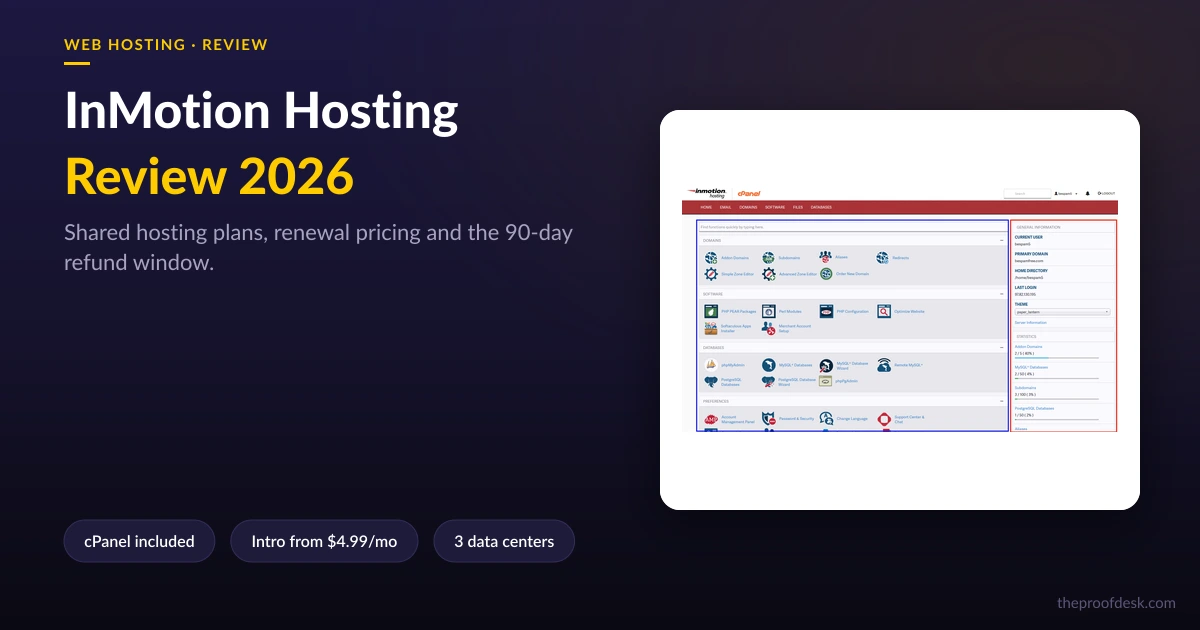
InMotion Hosting has been selling web hosting since 2001, and in 2026 it sells the same thing most of its competitors do: cheap shared hosting on a long contract, with the real price arriving at renewal. What sets it apart is a refund window that is genuinely longer than the industry norm, and a support setup that is better than average once you are past the cheapest plan.
This review is built from InMotion's published pricing, terms of service and support documentation as of 31 August 2026. We did not run our own uptime or speed benchmarks, and where a number comes from somewhere other than InMotion's own pages, it is attributed. Hosting prices change often, so treat every figure here as a checkpoint rather than a quote.
The short version: InMotion is a reasonable choice if you intend to stay for years and you buy the 36-month term with your eyes open about year two. It is a poor choice if you want a cheap first year and plan to move on, because the renewal multiple is steep and the early-cancellation terms are not friendly.
Shared hosting pricing: the intro price is not the price
InMotion sells three shared hosting plans in 2026: Launch, Power and Pro. Older reviews still describe a cheaper fourth tier called Core, which no longer appears on InMotion's pricing page, so ignore any comparison built around it.
The advertised price is a promotional rate on a long prepaid term. Here is what the 36-month term costs going in, and what it costs when it renews, per month:
- Launch: $4.99/mo, renews at $13.99/mo
- Power: $5.99/mo, renews at $17.99/mo
- Pro: $10.99/mo, renews at $24.99/mo
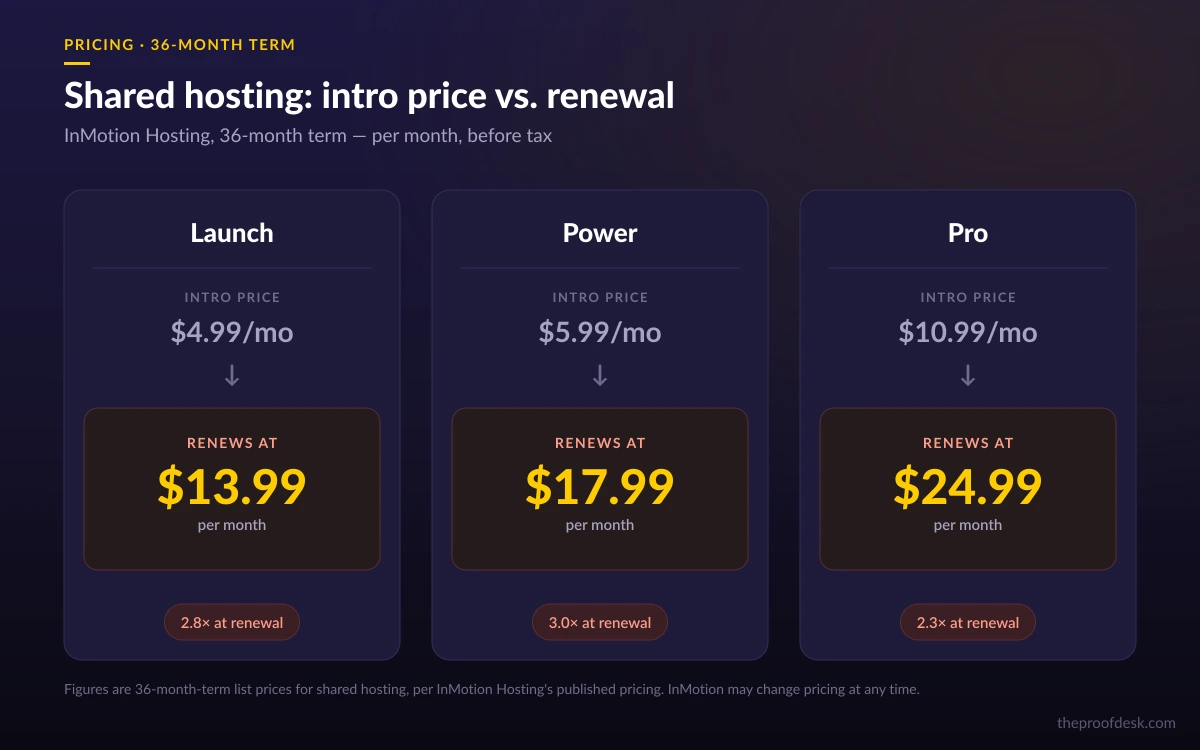
That is a 2.3x to 3x increase, and it is the single most important thing to understand before buying. Power looks like the value pick at $5.99/mo and is the worst renewal deal of the three at exactly 3x. Pro has the highest sticker price and the gentlest increase.
Shorter terms do not help much. The 12-month term is a few cents cheaper up front but renews higher: Launch is $4.79/mo renewing at $14.99, Power is $5.79 renewing at $18.99, Pro is $10.59 renewing at $25.99. Month-to-month skips the discount entirely, at $16.99/mo for Launch, $17.99 for Power and $26.99 for Pro.
Do the three-year arithmetic
A 36-month Launch term costs about $180 up front. The three years after that cost about $503 at the renewal rate. Budget for the second number, because that is what you will actually be paying for most of the time you are a customer.
The free domain is real but conditional. It comes only with a 12, 24 or 36-month plan, covers .COM, .ORG, .NET, .INFO or .BIZ, and is free for the first year only. InMotion states plainly that if you cancel inside the refund window, the standard domain registration fee is deducted from your refund, and that domain fees are never refundable.
What each plan actually includes
The plan tiers differ on more than site count. Two limits matter more than the marketing copy suggests: the per-inbox email cap, and whether you get phone support at all.
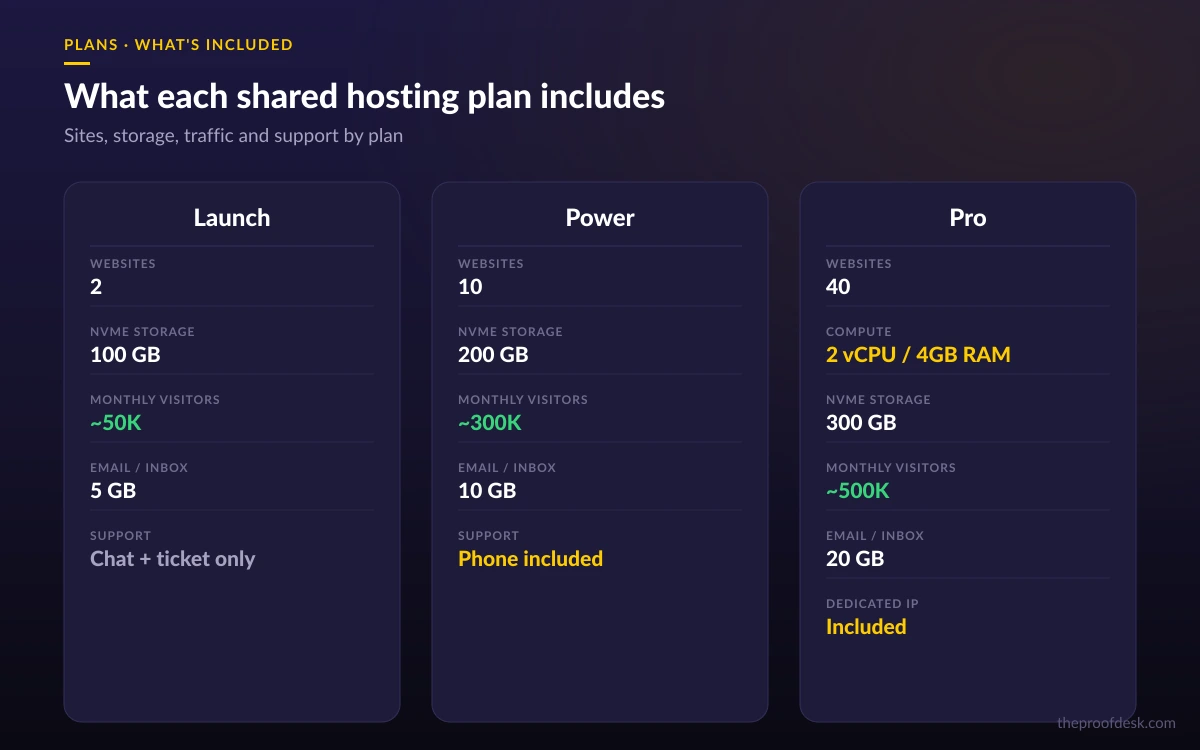
- Launch: 2 websites, 100GB NVMe storage, roughly 50,000 visitors a month, 5GB of email storage per inbox, chat and ticket support only
- Power: 10 websites, 200GB NVMe storage, roughly 300,000 visitors a month, 10GB per inbox, phone support included
- Pro: 40 websites, 2 vCPU cores and 4GB RAM, 300GB NVMe storage, roughly 500,000 visitors a month, 20GB per inbox, a dedicated IP and WHM access for up to four cPanel accounts
All three include free SSL, unmetered bandwidth, free website migration, malware and DDoS protection, and a free domain on annual-or-longer terms. Email addresses and databases are listed as unlimited, but the per-inbox storage cap is the limit that will actually bite: 5GB per mailbox on Launch is tight for a business account that keeps attachments.
The visitor figures are InMotion's own guidance rather than an enforced quota. InMotion does not publish a numeric inode limit or a CPU-seconds threshold for shared hosting; its acceptable use policy only prohibits vague "excessive resource usage" without stating where the line sits. That is normal for shared hosting and it is also the reason resource-limit disputes are hard to argue.
Backups cost extra
Automatic backups are not bundled with shared hosting. Backup Manager is a paid add-on starting at $2.50/month for daily automatic backups. Assume you are responsible for your own backups unless you buy it, or you are on a Premier Care dedicated plan where backup storage is included.
VPS, WordPress and dedicated servers
InMotion's VPS range is where the pricing gets genuinely aggressive on the way in and genuinely expensive on the way out. Four tiers, all with full root access, NVMe storage and dedicated IPs:
- VPS 4 vCPU: 8GB RAM, 160GB NVMe, 5TB bandwidth, 2 dedicated IPs. $9.99/mo on 36 months, renewing at $16.99
- VPS 8 vCPU: 16GB RAM, 260GB NVMe, unlimited bandwidth, 3 dedicated IPs. $13.99/mo on 36 months, renewing at $46.99
- VPS 12 vCPU: 24GB RAM, 360GB NVMe, 5 dedicated IPs. $27.99/mo on 36 months, renewing at $76.99
- VPS 16 vCPU: 32GB RAM, 460GB NVMe, 10 dedicated IPs, Docker compatible. $34.99/mo on 36 months, renewing at $111.99
Look at the 8 vCPU tier: $13.99 becomes $46.99, a 3.4x jump. The entry 4 vCPU plan is the outlier, renewing at only $16.99, and it is the one genuinely good long-term price in the range. These VPS rates are also flagged as new-customer-only promotional pricing with an expiry date, so the intro figures in particular are the most perishable numbers in this review.
Managed and self-managed are different products. Managed VPS bundles cPanel and WHM, OS patching and Launch Assist onboarding, which InMotion values at $199. Self-managed is cheaper and ships with SSH only: no cPanel, no control panel GUI at all. If you were assuming cPanel came with every VPS, it does not.
WordPress hosting mirrors the shared tiers at a small premium: WP Launch from $5.49/mo renewing at $14.49, WP Power from $6.49 renewing at $18.49, WP Pro from $11.49 renewing at $25.49. The differentiator is PHP workers per site, three on Launch up to six on Pro, which is the number that actually governs how many simultaneous uncached requests a WordPress site can handle.
Dedicated servers start with the Aspire tier at around $25/mo on a 12-month term, renewing at $49.99 for a 4-core Xeon with 16GB RAM and 960GB SSD. Managed dedicated tiers start near $79.99/mo renewing at $99.99. Premier Care, the white-glove tier, runs from about $184.97/mo and bundles cPanel, 500GB of backup storage and Monarx security.
Two control panels: AMP and cPanel
InMotion splits account management across two interfaces, and knowing which one does what saves a lot of clicking. cPanel handles the hosting itself: files, databases, email accounts, DNS zones, SSL, one-click installers. It is the standard cPanel most hosts ship, with InMotion branding on top.
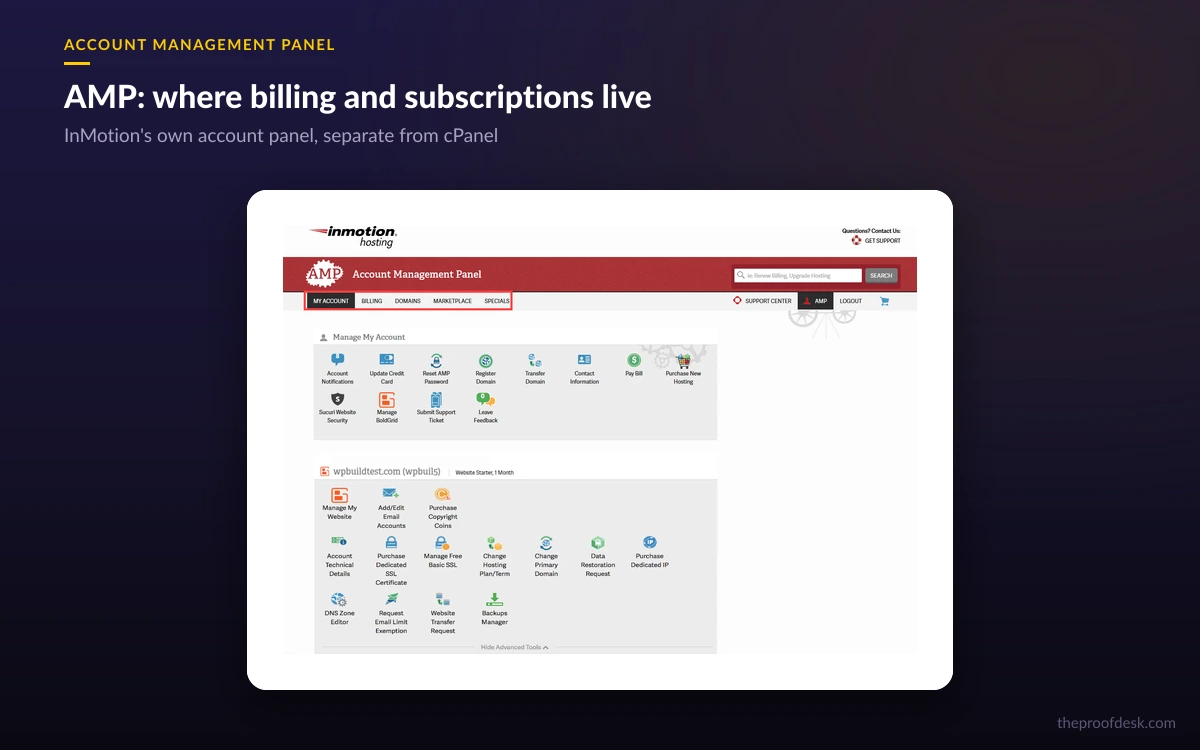
AMP, the Account Management Panel, is InMotion's own layer and it owns everything commercial: subscriptions, renewal dates, payment methods, domain registration and transfers, support tickets, and plan or term changes. Anything to do with money happens in AMP, not cPanel.
This matters because renewal settings and cancellation are in AMP, and if you go looking for them in cPanel you will not find them. Pro shared plans additionally get WHM access through AMP, which lets an agency run up to four separate cPanel accounts under one plan.
The 90-day refund, and where it stops
InMotion's 90-day money-back guarantee is the strongest thing on its sales pages, and it is real. It is also narrower than the headline suggests, because the length depends on what you bought and how long a term you signed.
- 90 days: all shared hosting and WordPress hosting plans, unconditionally. Also VPS, UltraStack WordPress VPS and Reseller, but only on terms of six months or longer
- 30 days: month-to-month VPS, UltraStack VPS, Reseller and all dedicated server plans, before the first renewal
- 7 days: Minecraft hosting
Read that second line carefully. Dedicated servers never get 90 days regardless of term length, and a month-to-month VPS gets 30. The flat, no-conditions 90-day window applies to shared and WordPress hosting only, which happens to be what most buyers are looking at, but it is not the blanket policy the marketing implies.
What you do not get back: domain registration fees are non-refundable and the standard domain price is deducted from any refund if you took the free domain. Setup fees, cancellation fees, the regular cost of anything given away free, and prepayment discounts are all excluded from refunds under the universal terms of service.
The $50 early cancellation fee
InMotion's terms of service state that cancelling a non-enterprise product before the end of its term, outside the money-back guarantee window, carries a minimum $50.00 early cancellation fee. There are also no partial-month refunds: only full months remaining after cancellation takes effect can be refunded, and even then InMotion says it is under no obligation to refund them.
Cancelling: self-serve, but it only schedules an expiry
Cancellation is self-serve, which is more than several competitors offer. In AMP you open My Subscriptions, click the red X next to the product, answer a short survey and submit. The subscription then shows as "Set to Expire".
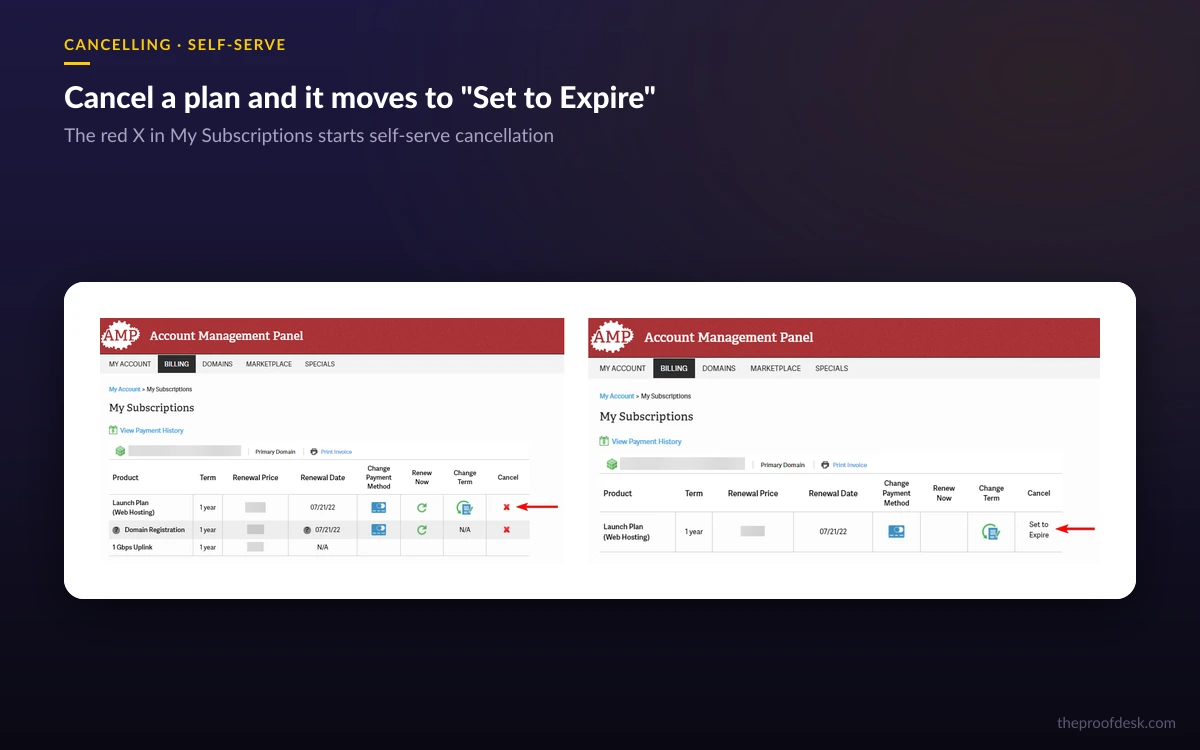
The important nuance: "Set to Expire" does not cancel anything now. It stops the auto-renewal and lets the account lapse at the end of the term you already paid for. That is usually what you want, but it is not a refund request and it is not an immediate closure.
For an immediate cancellation you have to contact Customer Service, and that department keeps shorter hours than technical support: 9AM to 9PM Eastern, Monday to Friday. InMotion recommends phone as the fastest route, then chat, then a ticket. Technical support is 24/7; the billing side is not.
Auto-renewal is on by default and the terms permit InMotion to charge renewals up to two weeks or more before the expiry date, at the then-current rates, which the terms explicitly note may be higher than what you paid. If you want out, set the expiry well before your renewal date rather than in the final week.
Data centers, uptime and support
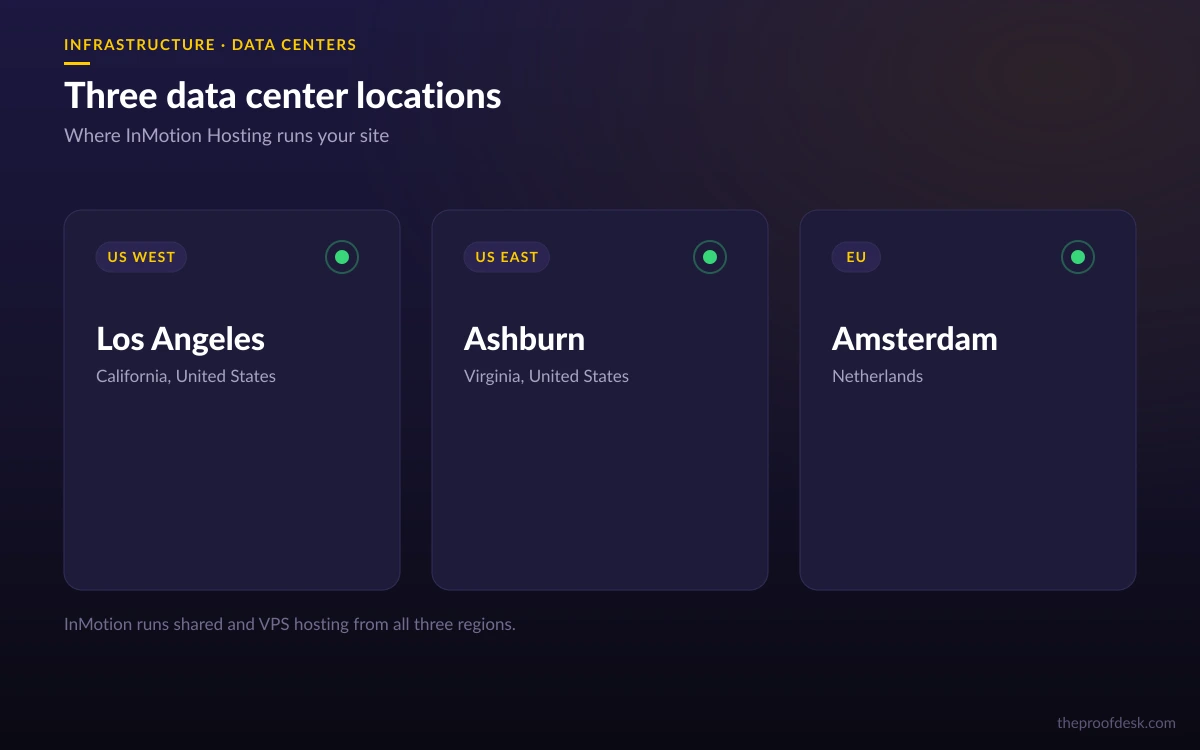
InMotion runs three data center regions: Los Angeles on the US West Coast, Ashburn in Virginia on the East Coast, and Amsterdam in the Netherlands. The Amsterdam facility is the newest and is described as built for GDPR compliance, which matters if you have EU users and would rather not host their data in the US.
Hardware is NVMe SSD storage on Intel Xeon CPUs, with facilities placed at internet exchange points behind redundant Tier 1 providers. InMotion advertises a 99.99% credit-backed uptime guarantee across shared and VPS. We could not find a published credit schedule stating what percentage of a monthly fee is refunded for a given amount of downtime, so the practical value of that guarantee is unclear.
Third-party uptime testing in 2025 and 2026 is mixed rather than damning. Cybernews reported 100% uptime across a two-week test window, while another cited test recorded roughly an hour and twelve minutes of downtime in a single week, which would miss the advertised figure. Both are second-hand and neither is a substitute for monitoring your own site.
Support is 24/7 by phone, chat and ticket, and InMotion leans on it heavily in its marketing. The catch is the gating: Launch, the entry shared plan, is chat and ticket only. Phone support starts at Power. InMotion publishes no numeric response-time commitment on any of its pages. On reputation, Trustpilot shows roughly 4.5 out of 5 across more than 2,600 reviews, with renewal pricing the recurring complaint.
Free migration is included on shared, VPS, WordPress and dedicated plans, covering one cPanel or WordPress backup. InMotion's own migration page is internally inconsistent about its track record, claiming over 500,000 completed migrations in the banner and over 170,000 further down the same page. The commonly repeated third-party claim that you get three free transfers and pay $10 each after that does not appear anywhere on InMotion's current pages, so confirm the scope before you rely on it for a multi-site move.
Who InMotion Hosting actually fits
InMotion suits a long-horizon buyer. If you have a site you expect to keep for five years, want cPanel rather than a proprietary panel, and value a 90-day window to change your mind, the 36-month Launch or Power plan is a defensible purchase. The 4 vCPU VPS at $9.99 renewing at $16.99 is the standout value in the whole catalogue.
It suits agencies reasonably well too. Pro gives you 40 sites, WHM for four cPanel accounts, a dedicated IP and real compute allocation for $10.99 going in and $24.99 at renewal, which is not unreasonable for what it is.
It does not suit a price-sensitive buyer who plans to shop around annually. The renewal multiples are among the steeper ones in shared hosting, the $50 early cancellation fee discourages leaving mid-term, and there are no partial-month refunds. Nor does it suit anyone who needs phone support on the cheapest plan, or who assumed backups were included.
Buy it this way
If you buy, take the 36-month term, decline the free domain if you are at all unsure (it is deducted from your refund), budget for the renewal rate rather than the intro rate, and either buy Backup Manager or set up your own backups on day one. Use the 90 days properly: migrate the real site, put real traffic on it, and decide before the window closes.
Frequently asked questions
How much does InMotion Hosting cost after the introductory period?
On the 36-month shared term, Launch renews at $13.99/mo, Power at $17.99/mo and Pro at $24.99/mo. That is 2.3x to 3x the introductory rate of $4.99, $5.99 and $10.99 respectively. Twelve-month terms renew slightly higher still, at $14.99, $18.99 and $25.99.
Is the 90-day money-back guarantee really 90 days?
For shared and WordPress hosting, yes, unconditionally. For VPS, UltraStack WordPress VPS and Reseller plans it is 90 days only on terms of six months or longer, and 30 days month-to-month. Dedicated servers get 30 days regardless of term. Minecraft hosting gets 7.
What is not refundable if I cancel within the guarantee?
Domain registration fees, always. If you took the free domain with an annual-or-longer plan, the standard domain price is deducted from your refund. Setup fees, cancellation fees, the regular cost of anything provided free, and prepayment discounts are also excluded under the terms of service.
Can I cancel InMotion Hosting myself without phoning support?
Yes. In AMP, open My Subscriptions and click the red X next to the product, then complete a short survey. The subscription is marked "Set to Expire" and lapses at the end of your paid term. Immediate cancellation is the exception: that requires Customer Service, available 9AM to 9PM Eastern, Monday to Friday.
Are automatic backups included with InMotion Hosting?
Not on shared hosting. Backup Manager is a separate add-on starting at $2.50/month for daily automatic backups. Premier Care dedicated plans bundle backup storage, but on standard shared and WordPress plans you should assume backups are your responsibility unless you buy the add-on.
Does every InMotion plan include phone support?
No. The entry-level Launch shared plan is chat and ticket only. Phone support is included from Power upward. Technical support runs 24/7, but the billing and cancellation team keeps shorter hours, 9AM to 9PM Eastern on weekdays.
Does a VPS from InMotion come with cPanel?
Only if it is a Managed VPS. Managed plans bundle cPanel and WHM along with OS patching and Launch Assist onboarding. Self-managed VPS plans are cheaper and give you SSH access only, with no cPanel or any other graphical control panel.
Where are InMotion's servers located?
Three regions: Los Angeles for the US West Coast, Ashburn in Virginia for the East Coast, and Amsterdam in the Netherlands. The Amsterdam facility is described as designed for GDPR compliance, which is the one to pick if your audience and your data protection obligations are European.
Key takeaways
- Shared hosting renews at 2.3x to 3x the intro price: Launch $4.99 to $13.99, Power $5.99 to $17.99, Pro $10.99 to $24.99 per month on the 36-month term.
- The 90-day money-back guarantee is unconditional on shared and WordPress plans only. VPS needs a six-month-plus term to qualify, and dedicated servers get 30 days.
- Cancelling is self-serve in AMP but only schedules the account to expire at term end. Leaving mid-term outside the refund window carries a minimum $50 fee.
- Automatic backups are a paid add-on from $2.50/month, and the entry Launch plan has no phone support.
- The 4 vCPU VPS, at $9.99 going in and $16.99 at renewal, is the least punishing renewal in the catalogue and the best long-term value InMotion offers.
More in Services & Software
Browse Services & Software