InVision Review 2026: Shut Down, Data Deleted - What Former Users Need to Know
InVision shut down on December 31, 2024. What it was, its last prices, what happened to prototypes and Freehand boards, what can be recovered and where to go instead.
InVision was one of the defining design tools of the 2010s: clickable prototypes, a whiteboard called Freehand, developer handoff through Inspect and a design system manager called DSM. At its peak in December 2018 it was valued at $1.9 billion. Today it does not exist. Every InVision account and every document in it was permanently deleted after December 31, 2024.
If you type invisionapp.com into a browser in October 2026, you land on miro.com. There is no shutdown notice and no archive page, just a 301 redirect. This review explains what InVision was, what it cost at the end, what happened to the prototypes and boards people built in it, what can still be recovered (very little) and where its former users should go instead.
Verdict: do not look for InVision, pick a successor
There is nothing to buy, trial or log into. InVision's design collaboration services, including prototypes, Freehand, Inspect and DSM, shut down at the end of 2024 and the company said it would not be able to recover any documents after that date. Share links stopped working with the deletion.
The practical answer for anyone who still has InVision in a workflow, a bookmark or an old project brief is the one InVision gave itself: Miro for whiteboarding and Figma plus Miro for prototyping.
Status in October 2026
invisionapp.com, www.invisionapp.com and the old pricing page all return a 301 redirect to miro.com. The help center (support.invisionapp.com) and projects.invisionapp.com no longer resolve. Accounts and data are gone.
What InVision was
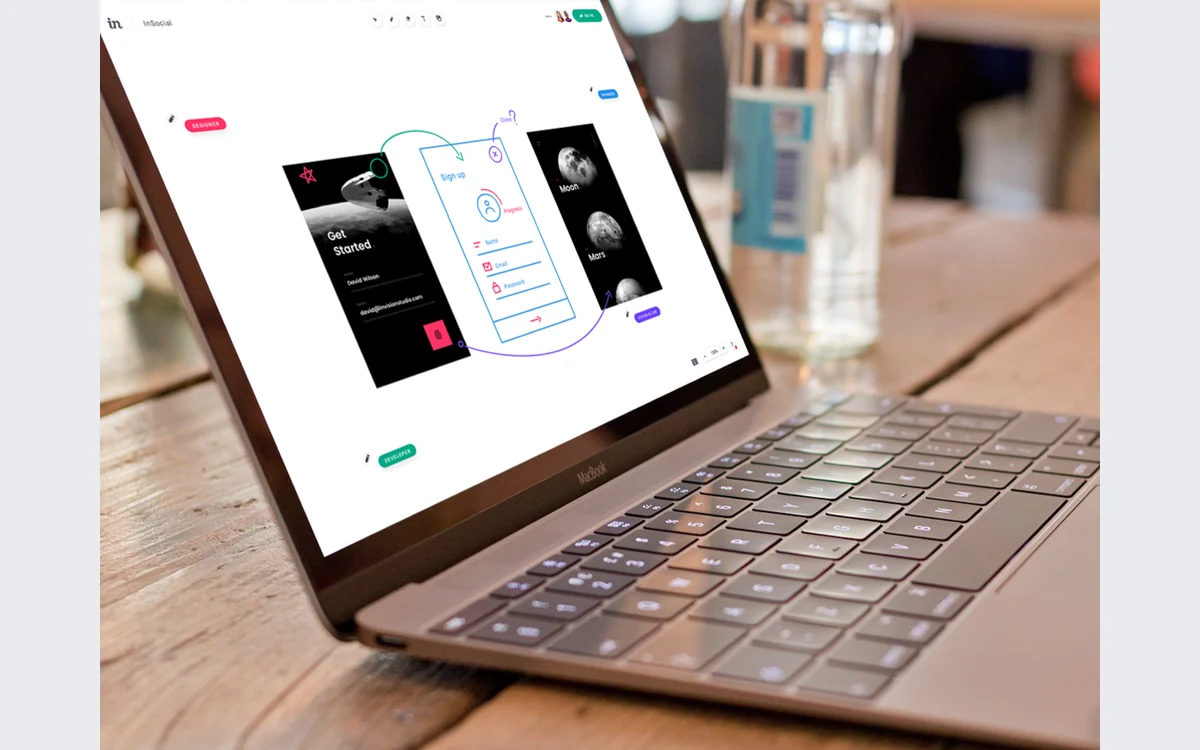
InVision was founded in 2011 by Clark Valberg and grew into a suite of tools that sat between a designer's drawing app and the engineering team. Its last pricing page listed five products:
- Prototypes - upload static screens, link them with hotspots and share a clickable prototype for review and user testing.
- Freehand - an online whiteboard for brainstorming, workshops and wireframing, later marketed as a cheaper rival to Miro and Mural.
- Boards - mood boards and presentation boards for sharing visual work.
- Inspect - what InVision called developer-ready specs, so engineers could read measurements, colors and assets from a design.
- DSM and DSM Enterprise - a design system manager for publishing shared component libraries, typically built from Sketch files.
Funding came early and often. Silicon Republic reported $1.5 million in its first year, $45 million in 2015 and $100 million in 2017. In December 2018 TechCrunch reported a $115 million Series F led by Spark Capital, bringing total funding to $350 million at a $1.9 billion valuation, with $100 million in annual recurring revenue.
What happened: from Freehand sale to full shutdown
Coverage of the shutdown framed it against the rise of Figma, which absorbed much of the prototyping and handoff work InVision had built its business on. The end came in two steps.
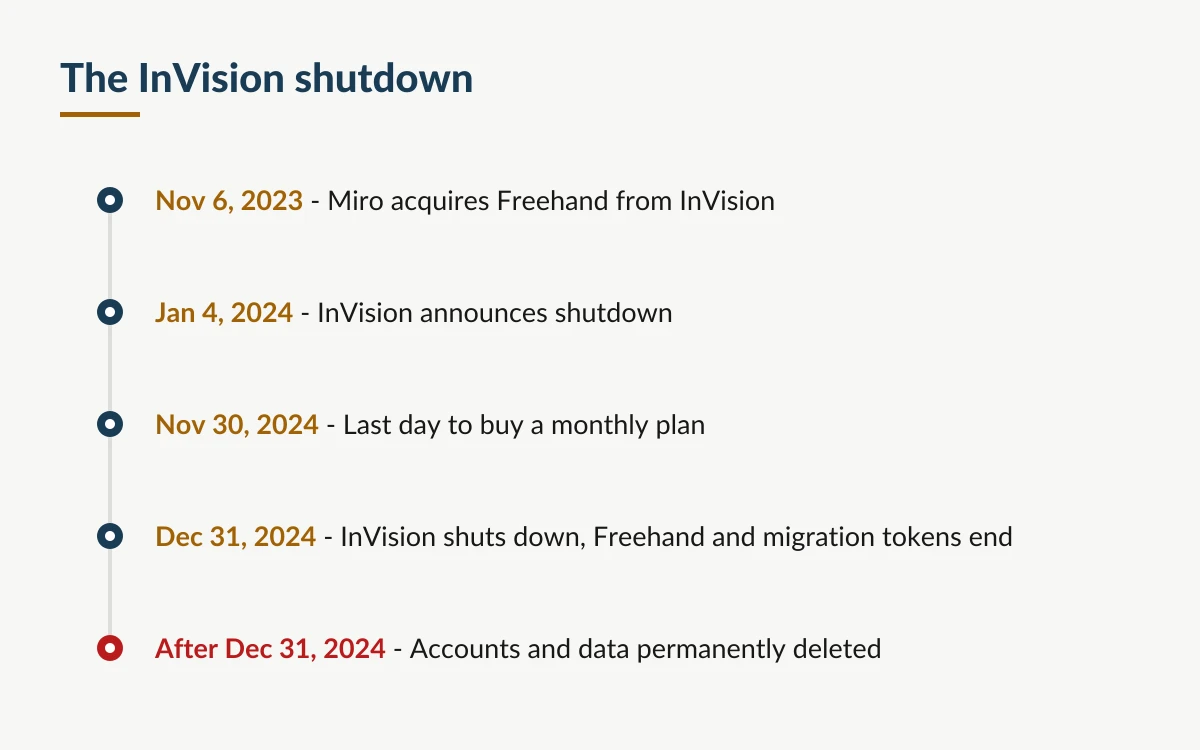
- November 6, 2023 - Miro announces it has acquired Freehand from InVision, including the technology and brand assets, customer relationships and talent associated with Freehand. Jeff Chow, Freehand's former Chief Product Officer and recently promoted InVision CEO, joins Miro as Chief Product and Technology Officer.
- January 4, 2024 - InVision CEO Michael Shenkman announces the decision to discontinue InVision's design collaboration services (including prototypes, DSM, etc) at the end of 2024. Annual subscriptions are discontinued and self-serve customers move to monthly plans.
- November 30, 2024 - the last day a non-Enterprise customer could purchase a monthly plan.
- December 31, 2024 - the last day InVision was available. All active paid subscriptions were cancelled automatically and no further payments were collected. Miro also invalidated Freehand and all its migration tokens at 11:59 PM EST that day.
- After December 31, 2024 - InVision began the shutdown process shortly thereafter, permanently deleting accounts along with all their data.
Miro bought Freehand only. It did not buy InVision as a company, and it did not take over prototypes, Inspect or DSM. Freehand itself was then wound down on the same date as the rest of InVision.
No extensions, no exceptions
InVision's help center was explicit: "Unfortunately, we won't be able to offer any extensions" and "all of InVision services across all plans (including Enterprise) will be permanently shut down."
What InVision cost at the end
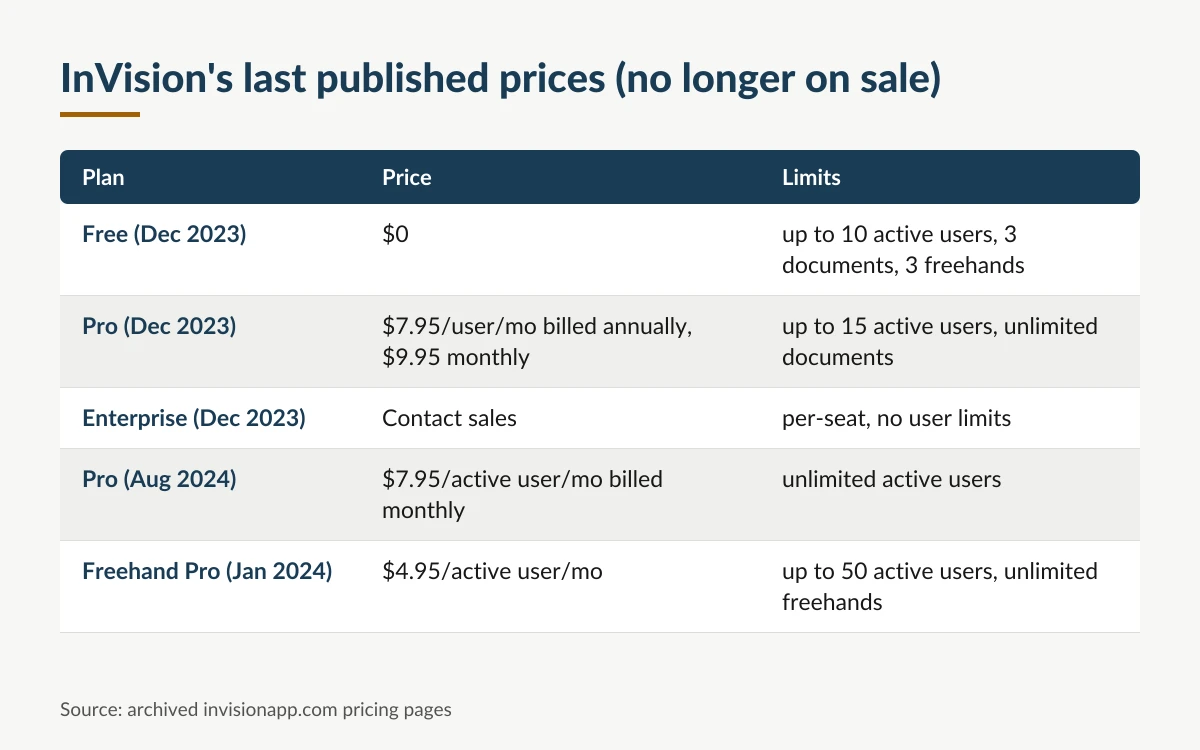
None of these plans can be bought today. The figures below are historical, taken from archived copies of InVision's own pricing pages, and they changed during the shutdown year.
InVision Cloud, December 2023
- Free - $0, up to 10 active users, up to 3 documents and 3 freehands.
- Pro - $7.95 per user per month billed annually, or $9.95 billed monthly; up to 15 active users; unlimited documents and archiving.
- Enterprise - contact sales; per-seat pricing with no user limits.
InVision Cloud, August 2024
After annual plans were withdrawn, Pro was listed at $7.95 per active user per month billed monthly, with unlimited active users. The Enterprise column had been removed: InVision said it could no longer offer annual subscriptions or Enterprise plans to new design customers.
Freehand, January 2024
Freehand had its own pricing page under the headline "Half the price of Miro and Mural": Free at $0 for up to 30 active users and 3 freehands, Pro at $4.95 per active user per month billed monthly for up to 50 active users and unlimited freehands, and customized Enterprise pricing.
What happened to your prototypes, boards and design systems
Everything stored in InVision was deleted. The help center warned that the company would not be able to recover any documents left in an account after the shutdown date, and that once documents were deleted all existing share links would stop working. Support staff could not export documents on a customer's behalf, and there was never a bulk export for prototypes, boards or DSM.
What survives is whatever you exported to your own machine before the end of 2024. These were the export formats InVision offered, each with a 4GB size limit:
- Prototypes - PDF, an offline HTML prototype, screen images in a .zip file, and comments as .csv. InVision said offline prototypes would keep working after December 31, 2024.
- Freehand - PNG files only, one board at a time, unless you used Miro's bulk migration with a paid Miro account.
- DSM - icons as .svg, design tokens as .json inside a .zip, pages saved to PDF, or screen captures. InVision noted that DSM content could not be exported in full and recommended backing up the local Sketch source files instead.
Check your downloads folder, not InVision
If an offline prototype .zip, a PDF or a folder of PNGs exists on a laptop, a shared drive or an old project archive, that is the only copy left. Embedded InVision prototypes in Miro (via the InVision by Miro marketplace app) were iframes and no longer load.
Freehand and Miro: what the move covered
Freehand subscribers got the most help. InVision's help center said Miro would honor a Freehand subscription by letting those teams use Miro at no additional cost for the rest of the Freehand term. Freehand documents created inside an InVision account did not transfer automatically, though.
Miro's help article on importing Freehand boards described two paths, both on Miro's Starter, Business, Education and Enterprise plans: exporting a single board from Freehand's Tools menu as a Miro backup file and importing it in Miro, or a bulk migration using a Freehand token valid for two weeks. Only boards under Free or Restricted licenses could be imported, and comments, emoji reactions and prototypes were not carried across.
That door is closed. Miro states that from December 31, 2024, at 11:59 PM EST, Freehand and all migration tokens were discontinued and invalidated. Boards that were moved before then live on in Miro; boards that were not are gone.
Billing, refunds and invoices
InVision's terms made subscriptions non-refundable. Annual customers kept their plan until the end of the billing period and then moved to an equivalent monthly plan. Anyone whose term ran past December 31, 2024 was told to contact their account manager (Enterprise) or support (self-serve) to discuss options, without a published refund formula.
Invoices were available inside the InVision account only until December 31, 2024, and InVision said it could not provide copies after that. If you need an old InVision invoice for accounting, look in the email inbox that received billing receipts or in your card or bank statements.
Where to go instead
InVision's own advice was to start a Miro account for anything that lived in Freehand, and to use Figma together with Miro for the prototyping work, since Miro integrates with Figma.
- For clickable prototypes, design handoff and design systems: Figma covers what Prototypes, Inspect and DSM did in one tool. There is no official path to import an old InVision prototype into Figma, so rebuild from your source design files.
- For whiteboards, workshops and wireframing: Miro is the direct successor to Freehand and the destination invisionapp.com now redirects to.
- For old offline HTML prototypes: keep the exported folder and open it locally; it does not need InVision to run.
We cover Figma's current plans, seat rules and AI credits in depth in our Figma review, and new users can start with the beginner's guide.
What InVision got right and wrong
What it did well
- Made clickable prototypes from static screens easy for designers who did not write code.
- Gave product teams a single shared link for stakeholder review and comments.
- Freehand was a capable, cheaper whiteboard, priced at half of Miro and Mural by InVision's own claim.
Where it fell short
- A workflow split across separate products that browser-based design tools later combined in one place.
- No bulk export for prototypes, boards or DSM, even during the shutdown year.
- Exports capped at 4GB per download and DSM content could not be exported in full.
- Everything was deleted at the end, including share links that teams had pasted into tickets and documentation for years.
Sources
- InVision CEO letter on the design collaboration shutdown (Wayback, Jan 2024) ↗
- InVision help center shutdown FAQ (Wayback, Jun 2024) ↗
- InVision best practices for offboarding (Wayback, Dec 2024) ↗
- InVision Cloud pricing (Wayback, Dec 2023) ↗
- InVision Cloud pricing (Wayback, Aug 2024) ↗
- Freehand pricing (Wayback, Jan 2024) ↗
- Miro acquires Freehand from InVision ↗
- Miro help: Importing Freehand boards to Miro ↗
- TechCrunch: InVision valued at $1.9 billion ↗
- Silicon Republic: InVision shutting down ↗
Frequently asked questions
Is InVision still available?
No. InVision shut down on December 31, 2024, across all plans including Enterprise. invisionapp.com now redirects to miro.com and there is no way to sign up or log in.
Can I recover my InVision prototypes or Freehand boards?
No. Accounts and all their data were permanently deleted after the shutdown, and InVision said it could not recover documents. Only files you exported locally before then, such as offline HTML prototypes, PDFs, PNGs or .zip screen images, still exist.
Do old InVision share links still work?
No. InVision stated that share links would stop working for every type of document after December 31, 2024, and embedded prototypes in tools like Miro no longer load.
Did Miro buy InVision?
Not the whole company. Miro announced on November 6, 2023 that it had acquired Freehand, InVision's whiteboard, along with its brand, customers and team. Prototypes, Inspect and DSM were simply discontinued.
Was I refunded for an unused InVision subscription?
Not automatically. InVision's terms made subscriptions non-refundable; customers whose term extended past December 31, 2024 were told to contact support or their account manager. All paid subscriptions were cancelled on that date and no further payments were collected.
What replaced InVision?
InVision itself recommended Miro for whiteboarding and Figma plus Miro for prototyping. Figma covers prototypes, developer handoff and design systems; Miro took over Freehand.
Can I import an InVision prototype into Figma?
There is no official import path. Rebuild the prototype in Figma from your original design files, using any exported PDF or screen images as a reference.
Key takeaways
- InVision shut down on December 31, 2024, and invisionapp.com now redirects to miro.com.
- All accounts, documents and share links were deleted; only files exported locally before the shutdown survive.
- Miro bought Freehand in November 2023, but Freehand and its migration tokens also ended on December 31, 2024.
- Last known Pro pricing was $7.95 per user per month; none of it can be bought today.
- InVision's own recommendation for former users: Miro for whiteboards, Figma plus Miro for prototyping.
More in Services & Software
Browse Services & Software