IPVanish VPN review: pricing, features and what its 2026 transparency report actually proves
IPVanish's Q2 2026 transparency report shows 13 legal requests answered with zero user data handed over, backing a no-logs claim a Schellman audit already certified. Here is the pricing, the features and the fine print.
IPVanish is not the loudest name in VPNs, but in 2026 it is one of the few making a testable claim rather than a marketing one. On July 7, 2026 the company published its Q2 2026 transparency report, and it is the kind of document worth reading before you read any feature list.
This review works from that report outward: what IPVanish actually did with the data requests it received, whether an independent audit backs the no-logs policy those requests tested, and then the ordinary questions — what it costs, how fast it is, and where the fine print bites.
Why look at IPVanish now
A VPN's job is to sit between you and the internet and forget everything it sees. Every provider says it does this; the interesting question is what happens when a court, a copyright holder or a government asks for the record. IPVanish's answer in 2026 is documented, dated and audited, which is more than most rivals can say.
Two things make this a good moment to evaluate it: a no-logs audit that closed in early 2025, and a fresh transparency report covering the second quarter of 2026. Read together they turn "we don't keep logs" from a slogan into something with evidence behind it. The rest — unlimited devices, a large server fleet, competitive multi-year pricing — is the reason to stay once the privacy question is settled.
The Q2 2026 transparency report
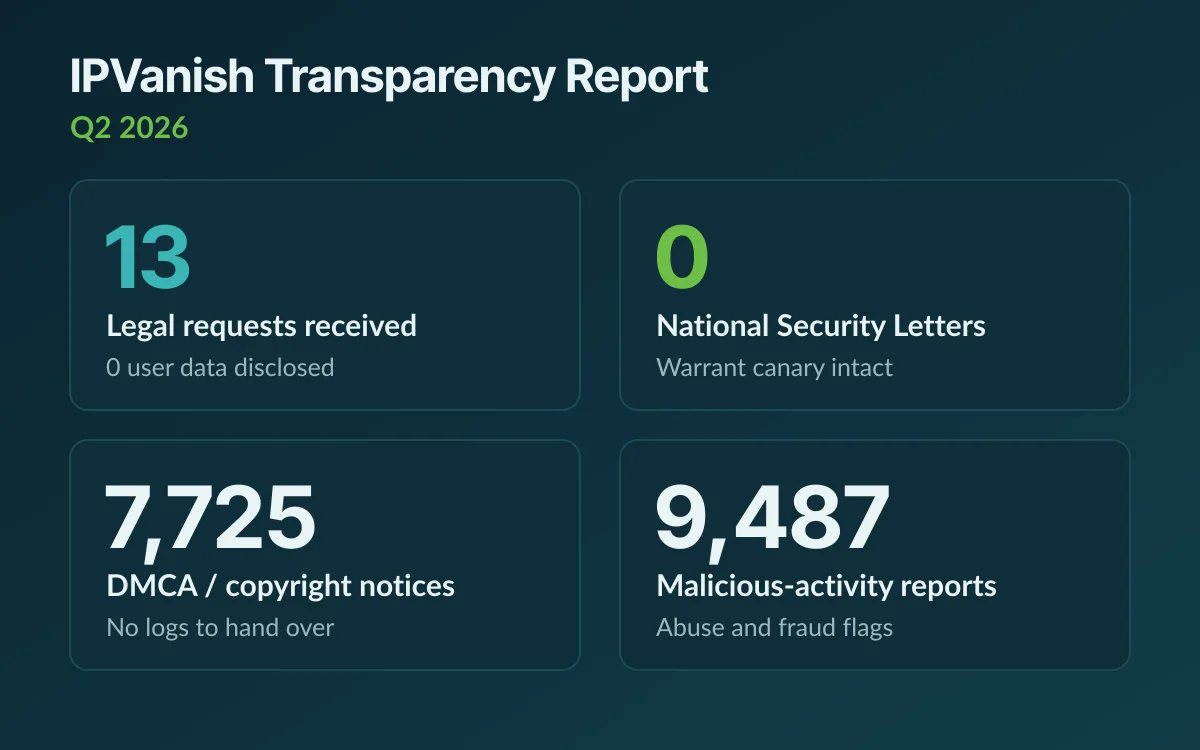
IPVanish published its transparency report for the second quarter of 2026 on July 7, 2026, through its blog and Trust Center. In that quarter it received 13 requests from government, law-enforcement and civil entities. It disclosed no user data in response to any of them.
Volume-wise the bigger numbers are the automated ones: 7,725 DMCA copyright notices and 9,487 malicious-activity reports were processed during the quarter. None of those resulted in identifiable user information being shared, because on a no-logs network there is no record tying an IP session back to a subscriber. IPVanish also reported receiving zero National Security Letters.
The point of the report
A transparency report only means something if the underlying network cannot answer the requests it lists. Thirteen legal requests met with zero disclosures is only credible because there is, by design, nothing to disclose — which is exactly what the audit below set out to verify.
The no-logs audit that backs it up
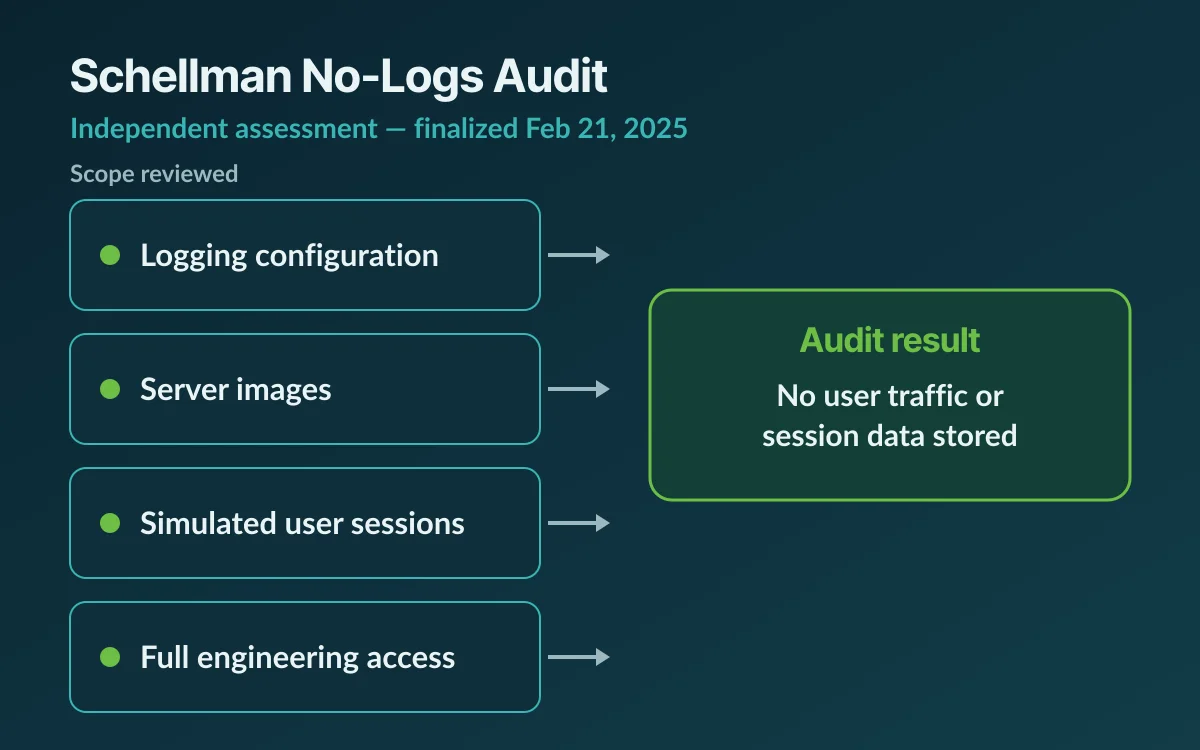
A report is a claim; an audit is a check on that claim. IPVanish's no-logs policy was independently assessed by Schellman Compliance, LLC, with the engagement finalized on February 21, 2025. It was the company's second such audit, not a one-off.
The audit covered nine areas, including logging configuration, server images and simulated user sessions, with the auditors granted full engineering access rather than a guided tour. It found no user traffic or session data stored at any point. It also confirmed that IPVanish's abuse-detection systems run entirely in memory and retain only anonymized aggregate statistics — the mechanism that lets the company field DMCA and abuse reports without ever building a per-user log.
The transparency report released alongside that audit, covering January to March 2025, logged 35 legal requests with zero user data disclosed — the same pattern the Q2 2026 report continues. Keep the two events separate in your head: the audit is the Feb 2025 verification, the reports are the recurring quarterly disclosures.
Pricing, and the renewal jump to watch
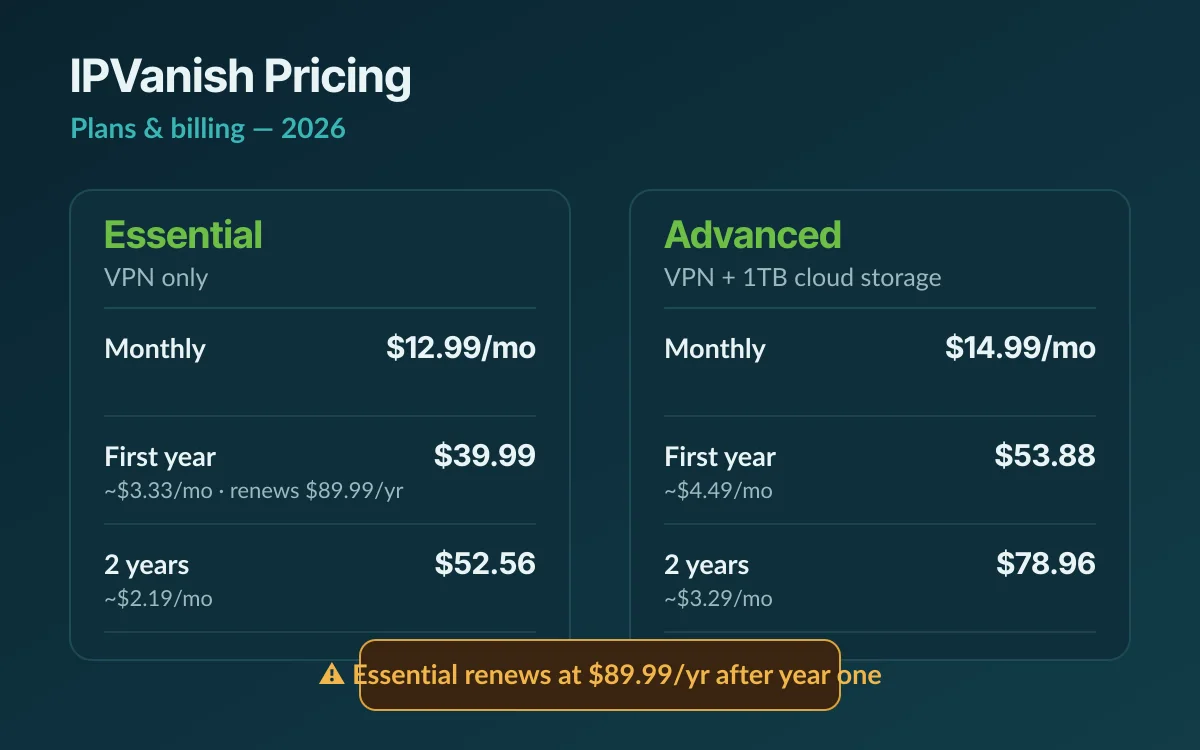
IPVanish sells two tiers. Essential is VPN only; Advanced is the same VPN plus 1TB of secure cloud storage. Both include every core feature — there is no artificial gating of speed, servers or device count between them.
Essential (VPN only)
- Monthly: $12.99/mo
- 1-year: $39.99 for the first year (about $3.33/mo), then renews at $89.99/year
- 2-year: $52.56 total (about $2.19/mo)
Advanced (VPN + 1TB cloud storage)
- Monthly: $14.99/mo
- 1-year: $53.88 total (about $4.49/mo)
- 2-year: $78.96 total (about $3.29/mo)
Read the renewal line
The Essential 1-year plan is cheap because $39.99 is a first-year promotional price; it renews at $89.99. That is more than double. If price is why you signed up, either take the 2-year plan at $52.56 or set a calendar reminder to reassess before renewal.
One more piece of fine print: the 30-day money-back guarantee applies only to yearly and longer plans, not to monthly billing, and your card is charged in full immediately at purchase rather than after a trial. Buy monthly and there is no refund window; buy annually and you have 30 days to change your mind.
Features and security
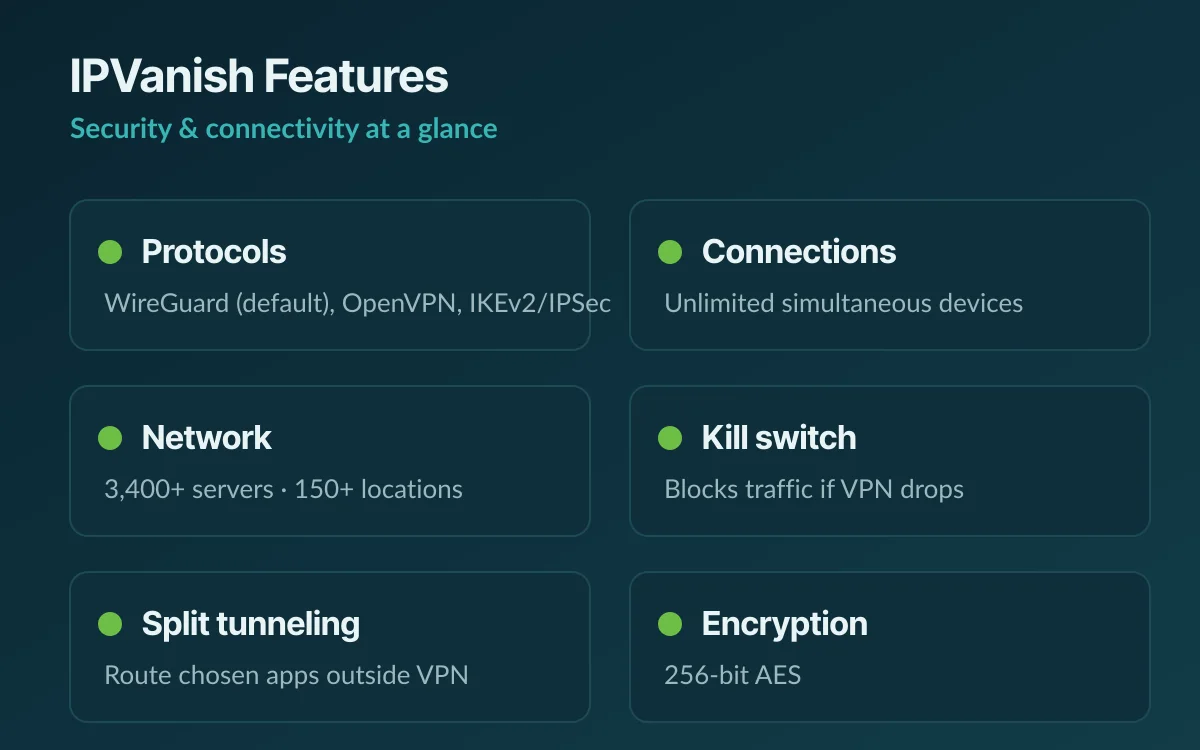
The headline feature is unlimited simultaneous connections: no plan caps the number of devices you can protect at once, which is unusual and genuinely useful for households or anyone with a drawer full of gadgets.
Under the hood, IPVanish runs 256-bit AES encryption across 3,400+ servers in 150+ locations, and permits P2P and torrenting throughout. It supports three protocols — WireGuard as the default, plus OpenVPN and IKEv2/IPSec — using AES-256 or ChaCha20 encryption depending on the protocol.
The safety net held up in testing. The kill switch cut the connection within a second in every one of five manual disconnect tests, so a dropped tunnel does not silently leak traffic. Split tunneling worked too, letting you route selected apps outside the VPN — handy for a banking app that dislikes foreign IPs while everything else stays encrypted.
- Unlimited simultaneous device connections on every plan
- 3,400+ servers across 150+ locations
- WireGuard, OpenVPN and IKEv2/IPSec, with AES-256 or ChaCha20
- Kill switch and split tunneling, both verified in testing
- P2P and torrenting allowed network-wide
Speed and streaming
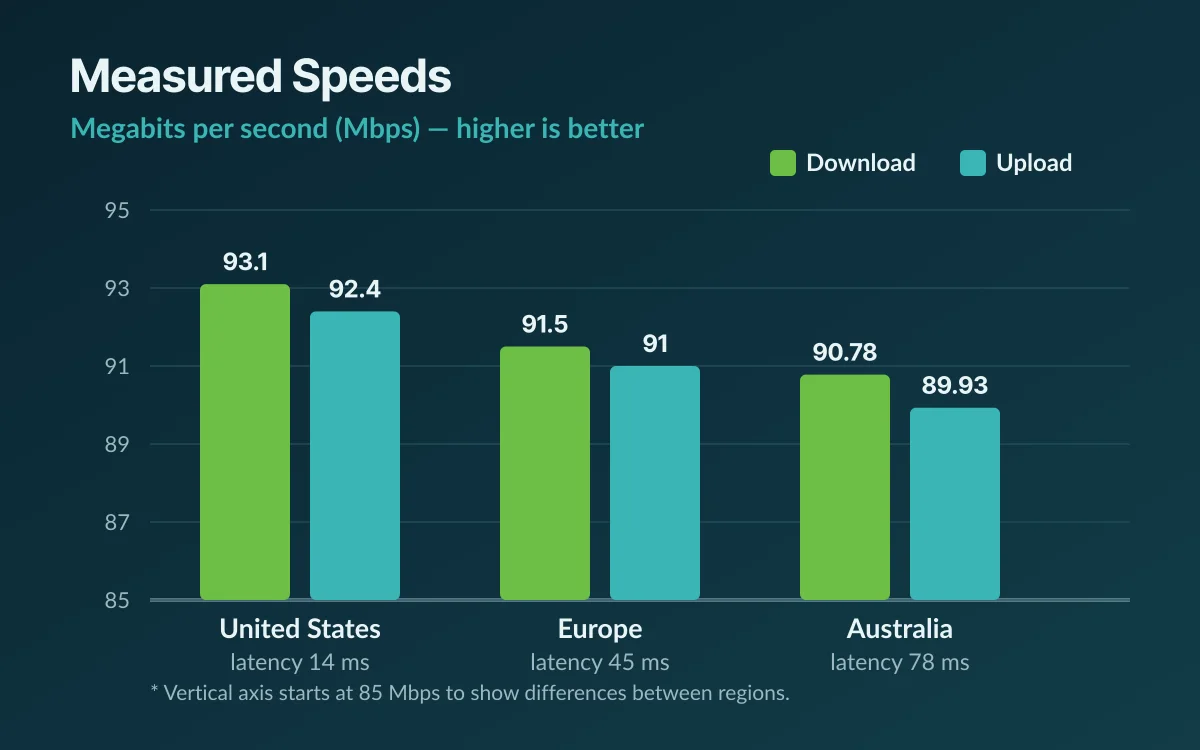
Speed is where WireGuard earns its keep. On a nearby US server, testers measured 93.1 Mbps down, 92.4 Mbps up and 14ms latency. Distance costs surprisingly little: a European server returned 91.5 Mbps down, 91.0 Mbps up at 45ms, and an Australian server still managed 90.78 Mbps down, 89.93 Mbps up at 78ms.
That consistency — barely a few Mbps lost between the US and Australia — matters more than any single peak number, because it means the VPN is not the bottleneck for streaming or large downloads regardless of which region you connect to.
On streaming, IPVanish reached Netflix and other major platforms during testing, and lists Spotify, YouTube and Sling TV among supported services. Combined with network-wide P2P support, it covers the two use cases most people actually buy a VPN for.
The jurisdiction question
IPVanish is headquartered in the United States, a member of the Five Eyes intelligence-sharing alliance, and is owned by Ziff Davis. For some buyers that is a dealbreaker on principle, and it is a fair concern to raise.
The counter-argument is the one this whole review is built on: jurisdiction determines who can compel disclosure, but a no-logs architecture determines whether there is anything to disclose. A US company that a court can lawfully order to hand over records still hands over nothing if the records were never created — which is precisely what the Schellman audit checked and the transparency reports keep demonstrating. Where you land on that is a judgment call, not a technical one.
Who it is for
IPVanish is a strong fit if you want a fast, audited, no-logs VPN and you protect a lot of devices — the unlimited-connection policy alone can undercut per-device rivals for a busy household. The 2-year Essential plan at about $2.19/mo is the value pick.
Look elsewhere if a US, Five-Eyes jurisdiction is a hard no for you, or if you only want a single month with the option of a refund — monthly billing is excluded from the money-back guarantee. And go in with the Essential renewal price ($89.99) in mind rather than the promotional first-year figure.
Frequently asked questions
How much does IPVanish cost in 2026?
Essential (VPN only) is $12.99/mo monthly, $39.99 for the first year (about $3.33/mo) then $89.99 on renewal, or $52.56 for two years (about $2.19/mo). Advanced, which adds 1TB of cloud storage, is $14.99/mo monthly, $53.88 for one year (about $4.49/mo) or $78.96 for two years (about $3.29/mo).
Does IPVanish really keep no logs?
Its no-logs policy was independently audited by Schellman Compliance and finalized on February 21, 2025, its second such audit. The auditors had full engineering access to logging configuration, server images and simulated sessions, and found no user traffic or session data stored at any point. The Q2 2026 transparency report then showed 13 legal requests answered with zero user data disclosed.
How many devices can I connect at once?
As many as you like. Every IPVanish plan allows unlimited simultaneous device connections with no per-account cap, which is rare among major VPNs.
Is there a money-back guarantee?
Yes, 30 days — but only on yearly and longer plans. Monthly billing is excluded, and your card is charged in full immediately at purchase. If you want a refund option, buy an annual plan, not a monthly one.
Can IPVanish unblock streaming and handle torrents?
In testing it reached Netflix and other major platforms, and lists Spotify, YouTube and Sling TV as supported. P2P and torrenting are permitted across the whole server network.
How fast is IPVanish?
Testers measured about 93 Mbps down on a nearby US server and still over 90 Mbps down on servers in Europe and Australia, with latency from 14ms locally to 78ms to Australia. The consistency across regions is the notable part.
Sources
Pricing, feature and performance figures in this review are drawn from independent testing and reporting rather than vendor marketing copy.
Key takeaways
- IPVanish's Q2 2026 transparency report (July 7, 2026) recorded 13 legal requests with zero user data disclosed, plus 7,725 DMCA and 9,487 abuse notices processed and no National Security Letters.
- The no-logs claim behind that is backed by a Schellman audit finalized February 21, 2025 that found no stored user traffic or session data.
- Essential runs $2.19/mo on a 2-year plan; watch the 1-year plan's jump from $39.99 to an $89.99 renewal.
- Unlimited simultaneous connections, 3,400+ servers, WireGuard speeds above 90 Mbps across regions, and a sub-second kill switch.
- It is US-based and Five-Eyes; the no-logs architecture, not the jurisdiction, is what determines whether there is anything to hand over.
More in Virtual Private Network
Browse Virtual Private Network