Logseq Review 2026: The OG vs Database Split, New Features, and What Sync Costs
Logseq split into two products in 2026: file-based 'Logseq OG' and a new SQLite database version with typed properties and paid, invite-only real-time sync. Here's what changed, what it costs, and which version to run.
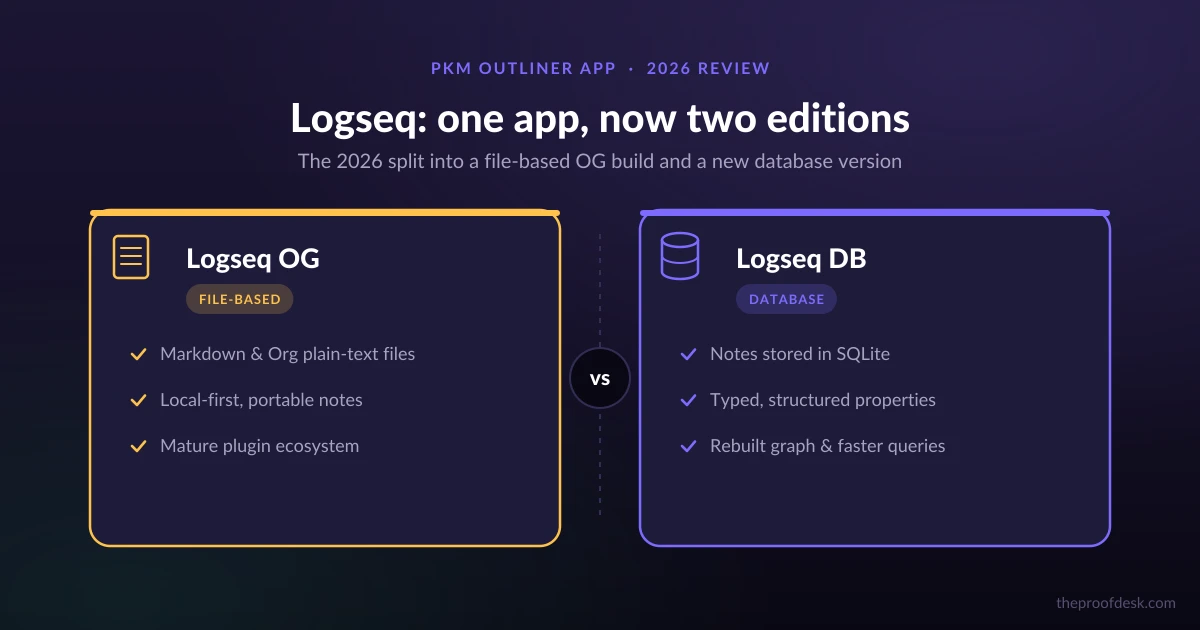
For years Logseq was the easy answer to one question: what is a free, privacy-first, local-Markdown place to think? It stored everything as plain Markdown files on your own disk, linked blocks bidirectionally like Roam Research, and cost nothing. In 2026 that simple story got more complicated.
On April 24, 2026 the team announced that Logseq is splitting into two separate products. 'Logseq OG' keeps the original file-based Markdown model, while a rebuilt 'Logseq' moves to a local SQLite database with typed properties, a new graph view, and an optional paid real-time sync. This review explains exactly what changed, what each version can and cannot do, what the new sync costs, and which version you should actually run.
The 2026 split: two products, one name
Logseq now ships as two distinct apps. The reason the team gave is blunt: maintaining a Markdown-file architecture and a database architecture inside a single app meant every feature had to be built twice. Splitting them lets the database version move fast without breaking the file-based one.
- Logseq OG — the original file-based app that reads and writes Markdown graphs directly on disk.
- Logseq (DB version) — a rebuild that stores your graph in a canonical local SQLite database and is now the main version going forward.
OG is in maintenance mode
Logseq OG will only receive maintenance: security patches and dependency updates. It will not get new features. If you stay on OG, treat it as a stable tool that is done growing, not one that will keep adding capabilities.
Logseq OG vs the database version
The clearest way to understand the two products is by where your notes actually live. In OG, the Markdown files on disk are the source of truth, so you can hand-edit them in any text editor and sync them with any file service. In the DB version, a local SQLite database is the authoritative store.
That change has a real consequence: in the DB version you can no longer hand-edit the underlying files, because they are not the source of truth anymore. Markdown export and mirroring still work (more on that below), but the plain-files-are-everything model belongs to OG.
What you gain by moving to the database
- Typed properties instead of loose text metadata.
- Tags that behave like inheritable classes rather than plain labels.
- Dashboard-style queries and a rebuilt graph view.
- A cleaner data model that unifies pages and blocks into 'nodes'.
What you give up
- Direct hand-editing of the underlying files.
- The it-is-just-Markdown-folders simplicity that made OG easy to trust and back up.
- Feature stability — the DB version is beta software (see the caveats section).
What the database version adds
The 2.0.1 beta of the database version shipped on July 13, 2026, and the releases since then have built out a genuinely different app from OG. The headline additions:
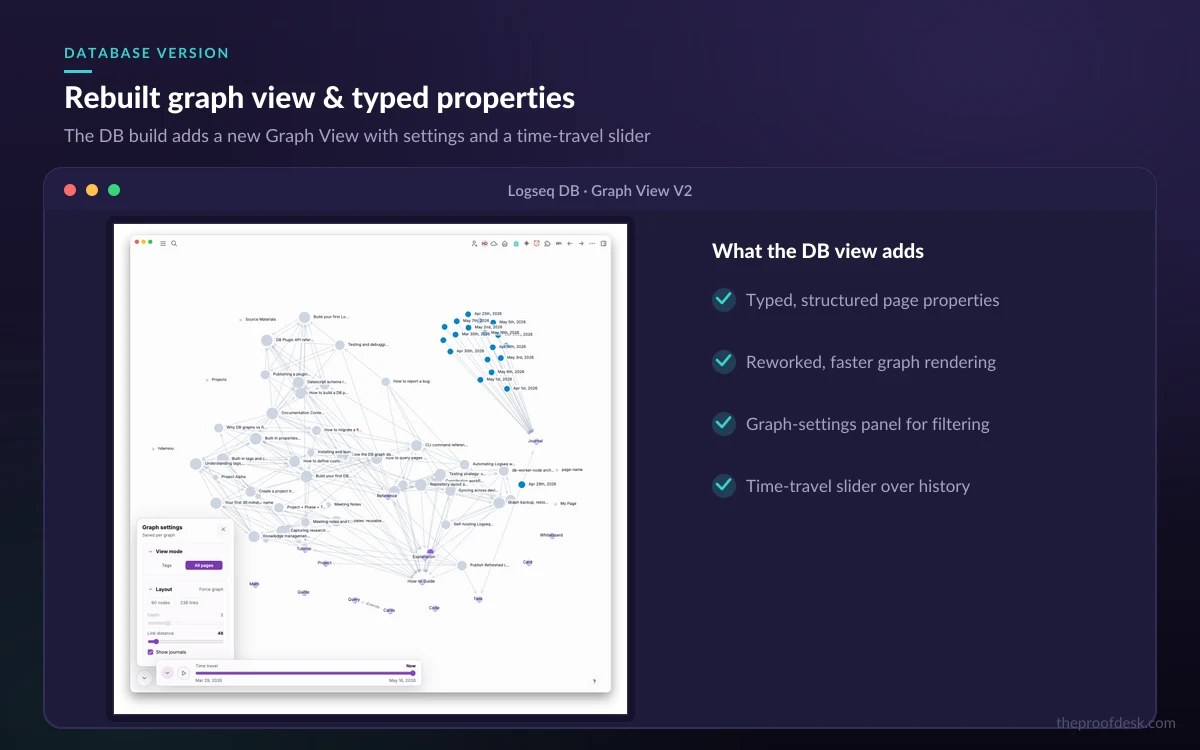
- Unified 'nodes' — pages and blocks share one underlying object model.
- Typed properties: Text, Number, Date, Checkbox, URL and Node, plus an Asset type with a thumbnail picker added in May 2026.
- Tags that act as inheritable classes, so a tag can carry structure down to everything under it.
- Dashboard-style queries for building live views over your graph.
- Logseq Publish for sharing read-only pages.
- A new iOS app, with an Android app still in development.
Two updates from mid-2026 are worth calling out because they address the biggest fears about leaving plain files behind. The April 26 update prioritized sync reliability, a CLI for doing real work against a graph, and smoother performance on large graphs. The May 16 update added a one-way Markdown Mirror that writes the database graph to disk as Markdown so you can still grep it, version-control it, or open it in an external editor.
Markdown Mirror is one-way for now
The Markdown Mirror writes your DB graph out to disk as Markdown, which is great for grep, Git and external tooling. But two-way sync from those files back into the database is still in development. Do not treat the mirrored files as an editable copy yet.
Sync and pricing: what is actually paid
Logseq itself is free and open-source under AGPL-3.0. The confusion in 2026 is about sync, so here is the precise picture.
Real-Time Collaboration (DB version)
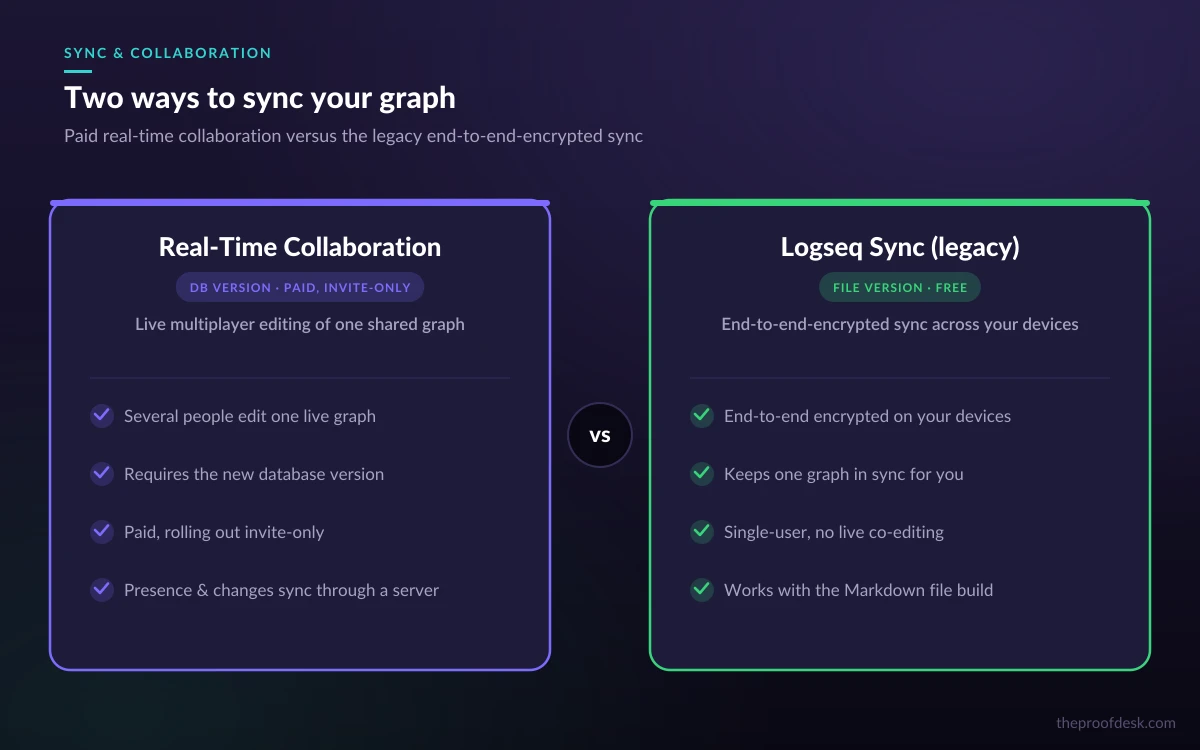
The database version's Real-Time Collaboration (RTC) sync is described as paid and invite-only at launch. No public price has been disclosed yet, so anyone quoting a specific monthly figure is guessing. Testers can request access by sponsoring the project through Open Collective.
Logseq Sync (legacy)
The legacy Logseq Sync is end-to-end encrypted: you set a password, your data is encrypted on your device, and only encrypted nodes ever reach Logseq's servers. That is the privacy posture long-time users expect.
The core app has not gone paid
Only RTC real-time collaboration sync is paid and invite-only. The outliner, backlinks, queries, flashcards, plugins and local storage remain free and open-source. Do not read the split as Logseq going commercial across the board.
The core feature set (still free on both)
Whichever version you run, the fundamentals that made Logseq popular are still here and still free:
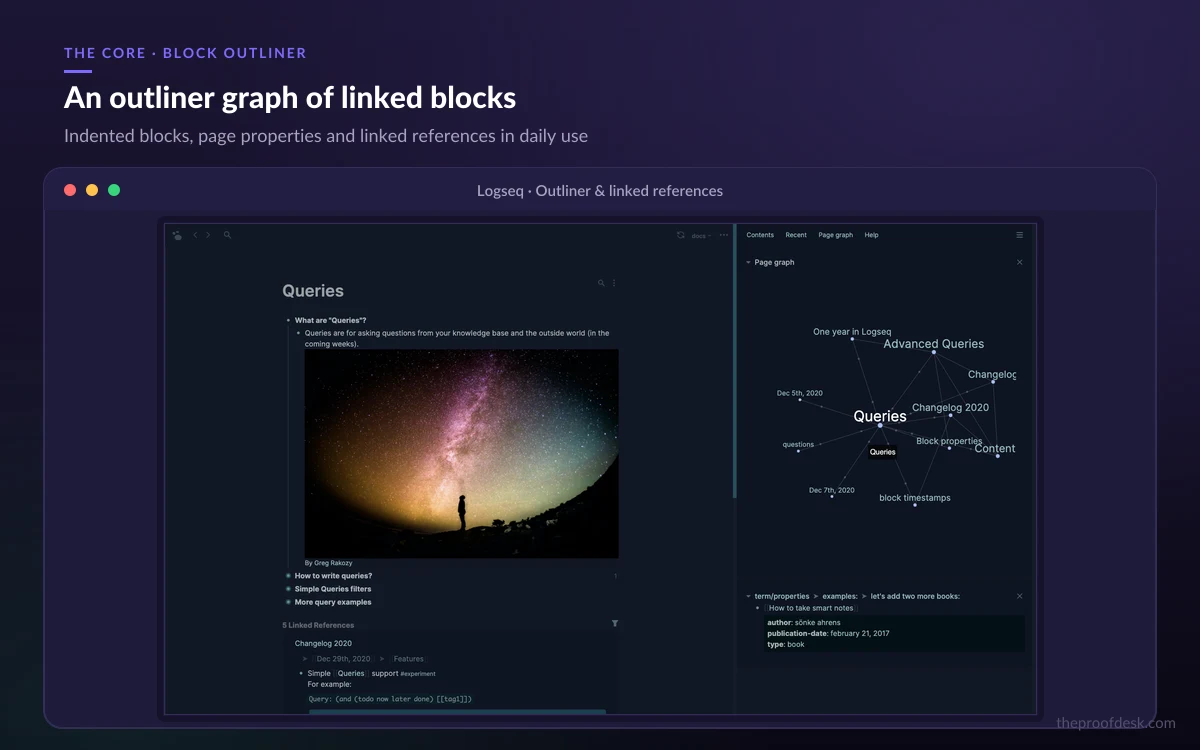
- A block-based outliner as the writing surface.
- Bidirectional linking with backlinks.
- PDF annotation.
- Task management.
- Spaced-repetition flashcards.
- Queries over your graph.
- A plugin and theme ecosystem.
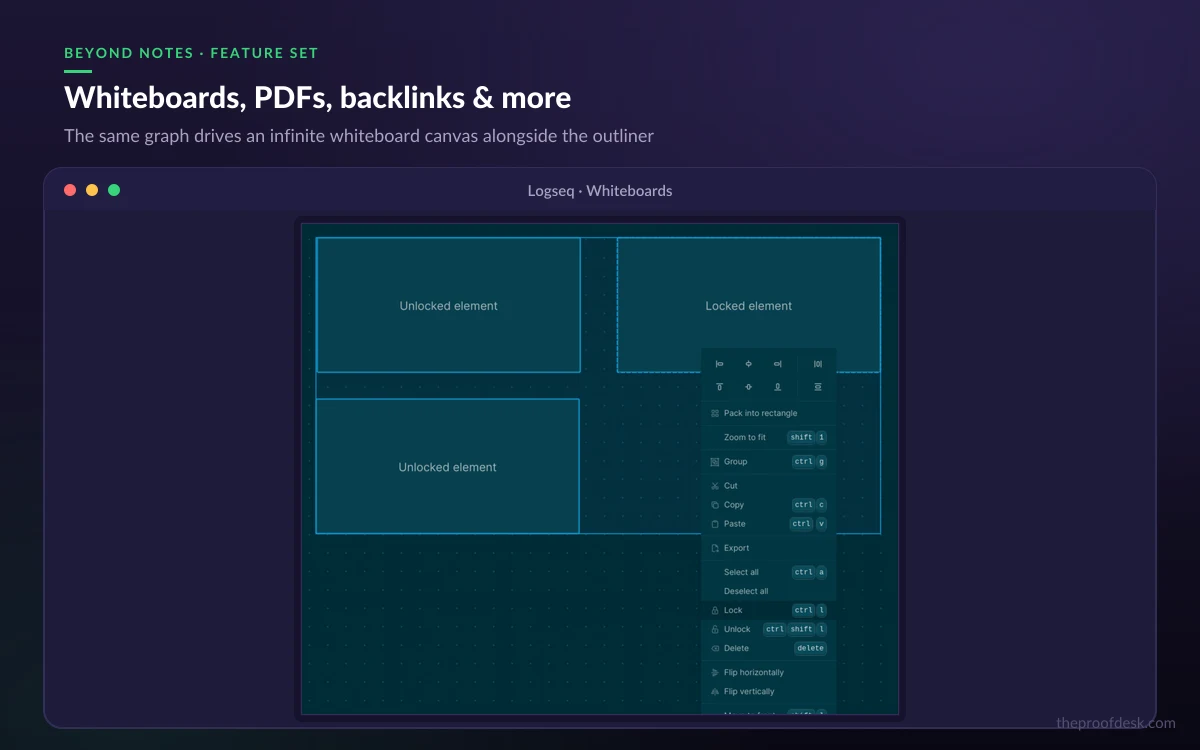
- Whiteboards.
It runs on macOS, Windows and Linux on the desktop, on iOS, and as a web app at app.logseq.com. An Android mobile app is in development.
The beta caveats you cannot ignore
The database version is beta software, and its own maintainers are clear that it carries a real risk of data loss. If you want to try it, do the safe thing: trial the newest build at test.logseq.com before migrating a real graph, and back up before you migrate anything you care about.
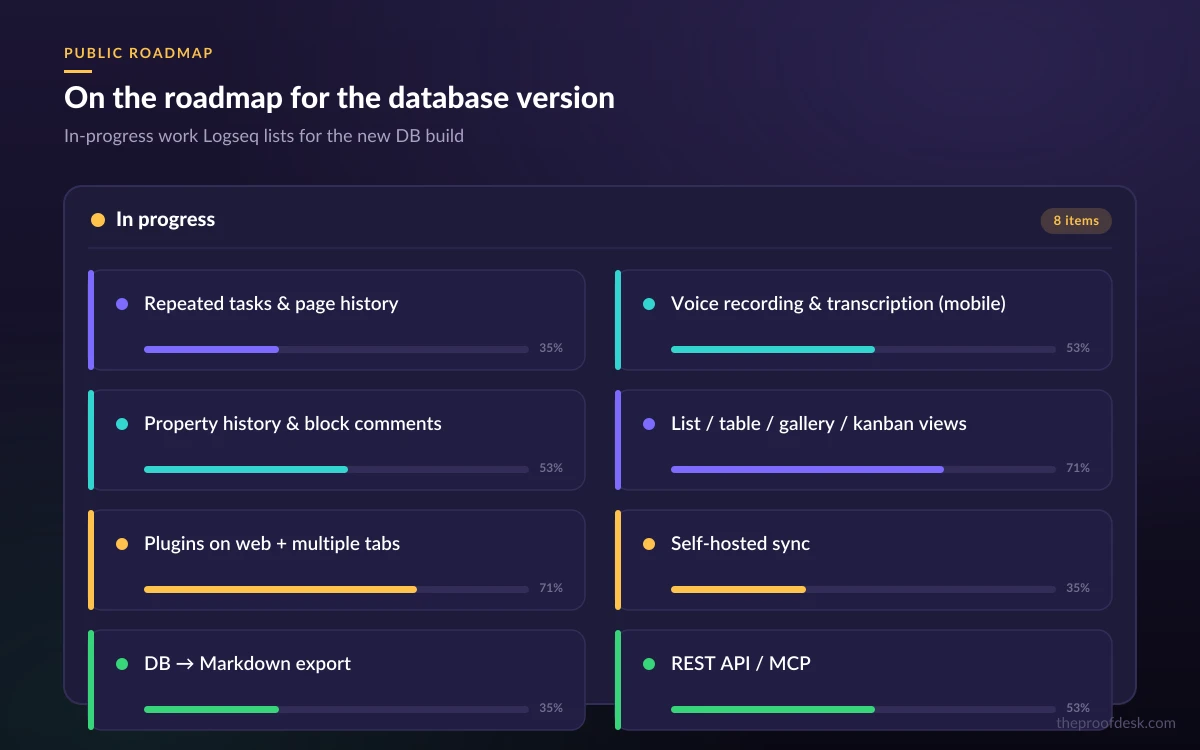
The public roadmap, hosted inside Logseq itself, still lists a long queue of in-progress work as of August 2026. That queue tells you what the DB version is missing today:
- Repeated tasks and page history.
- Property history and block comments.
- Plugin support on the web, and multiple tabs/windows.
- Export of a DB graph back to Markdown (beyond the current one-way mirror).
- Voice recording and audio transcription on mobile.
- List, table, gallery and kanban views.
- Self-hosted sync, and a REST API / MCP integration.
None of that is shipping yet. If any single item on that list is load-bearing for your workflow, the DB version is not ready for you.
Who should use which version
The decision is mostly about your appetite for risk and your attachment to plain files.
- Stay on Logseq OG if you depend on hand-editing Markdown, external file sync, or absolute stability — and you accept that no new features are coming.
- Try the DB version (via test.logseq.com first, with backups) if you want typed properties, the new graph view and dashboard queries, and you can tolerate beta rough edges.
- Wait a bit longer if you need repeated tasks, kanban/table views, self-hosted sync, or a real API — those are still on the roadmap.
If you are weighing Logseq against a paid outliner, our Roam Research review covers the other side of that trade-off; Logseq remains one of the free alternatives that undercuts Roam's subscription.
Frequently asked questions
Is Logseq free?
Yes. Logseq is open-source under AGPL-3.0 and free to use on both the OG file-based version and the new database version. The only paid element is the database version's Real-Time Collaboration sync, which is invite-only at launch.
How much does Logseq's real-time sync cost?
No public price has been disclosed. RTC sync for the database version is paid and invite-only at launch, and access is currently granted to testers who sponsor the project through Open Collective. Treat any specific monthly figure you see quoted as unverified.
What is the difference between Logseq OG and the new Logseq?
Logseq OG stores your notes as Markdown files on disk, which stay the source of truth and can be hand-edited. The new database version stores your graph in a local SQLite database, adds typed properties and a new graph view, and is where all new development happens. OG now receives only maintenance.
Can I still edit my Markdown files directly in the database version?
No. In the database version the SQLite store is authoritative, so hand-editing the underlying files is no longer supported. A one-way Markdown Mirror can write your graph to disk for grep, version control and external editors, but two-way editing from those files back into the database is still in development.
Is my data private with Logseq Sync?
The legacy Logseq Sync is end-to-end encrypted: you set a password, data is encrypted on your device, and only encrypted nodes reach Logseq's servers. Your graph also lives locally, so you are not required to sync at all.
Is the database version safe to use with my real notes?
Not yet without precautions. It is beta software with a real risk of data loss per its maintainers. Trial the newest build at test.logseq.com first and back up your graph before migrating anything important.
What platforms does Logseq run on?
macOS, Windows and Linux on the desktop, iOS on mobile, and a web app at app.logseq.com. An Android app is still in development.
Key takeaways
- In 2026 Logseq split into two products: file-based 'Logseq OG' (maintenance only, no new features) and a database-backed 'Logseq' that is now the main version.
- The database version replaces plain Markdown files with a local SQLite store, adding typed properties, inheritable tag classes, dashboard queries and a new graph view.
- The core app stays free and open-source (AGPL-3.0); only the database version's Real-Time Collaboration sync is paid and invite-only, with no public price disclosed yet.
- The DB version is beta with a real data-loss risk — trial it at test.logseq.com and back up before migrating a real graph.
- Stay on OG for plain-file editing and stability; move to the DB version for its new data model if you can tolerate missing roadmap features like repeated tasks, kanban views and self-hosted sync.
More in Services & Software
Browse Services & Software