Make.com Review 2026: New Prices, Credits, AI Agents and the Fine Print
Make raised its prices in October 2026. We break down the new Core, Pro and Teams costs, how credits are spent, AI Agent and Maia costs, and the no-refund fine print.
Make, the visual automation platform that used to be called Integromat, had a busy October 2026. On October 20 its Waves '26 keynote in Prague repositioned the product as "the glass box for the agentic era", with AI agent orchestration, an upgraded Maia assistant and a MakeOS waitlist. Within days, the plan prices on its pricing page had gone up by roughly a third on annual billing and roughly half on monthly billing.
This review looks at what Make actually costs after that increase, how its credit billing unit gets spent (including on checks that find nothing), what the AI features add to the bill, and the fine print on refunds, credit expiry and EU data handling. Every figure below is quoted from Make's help centre, its pricing FAQ or dated third-party price checks, and we say which is which.
Verdict in brief
Our verdict
Make is still one of the most capable visual automation builders you can buy: branching, routers, filters and error handlers are drawn on a canvas, and several of them cost nothing to run. But it is no longer the cheap option it was. Entry paid plans now start at $12 a month billed annually ($16 monthly), every polling check uses a credit even when it finds nothing, AI steps add token-based credits on top, and there is no cash refund. Start on the Free plan, measure your real credit burn, then buy.
- Best for: technical no-code users who need multi-step logic, data mapping and branching that would get expensive or awkward elsewhere.
- Watch out for: empty polling runs, AI token charges, extra credits at a 25% surcharge and credits that expire at the end of each term.
- Skip it if: you want a fixed bill with no usage maths, or you need a refund window to try a paid plan.
What Make is and who owns it
Make is a no-code platform for connecting apps into automated workflows, which it calls scenarios. You build a scenario on a canvas: a trigger module starts it, then action, search, router and aggregator modules pass data along, with filters deciding which paths run. Make says it connects to more than 3,000 apps; its integrations page currently advertises "3,500+ Integration Apps".
The company is part of Celonis, the process mining vendor, which bought Integromat on October 14, 2020 and renamed the product Make in 2022. Make describes Celonis as "valued at $13 billion". That ownership matters for two things in this review: the subscription terms are Celonis contract terms, and some of the Waves '26 roadmap items (Process Intelligence, Task Mining, Process Mining) are Celonis technology brought into Make.
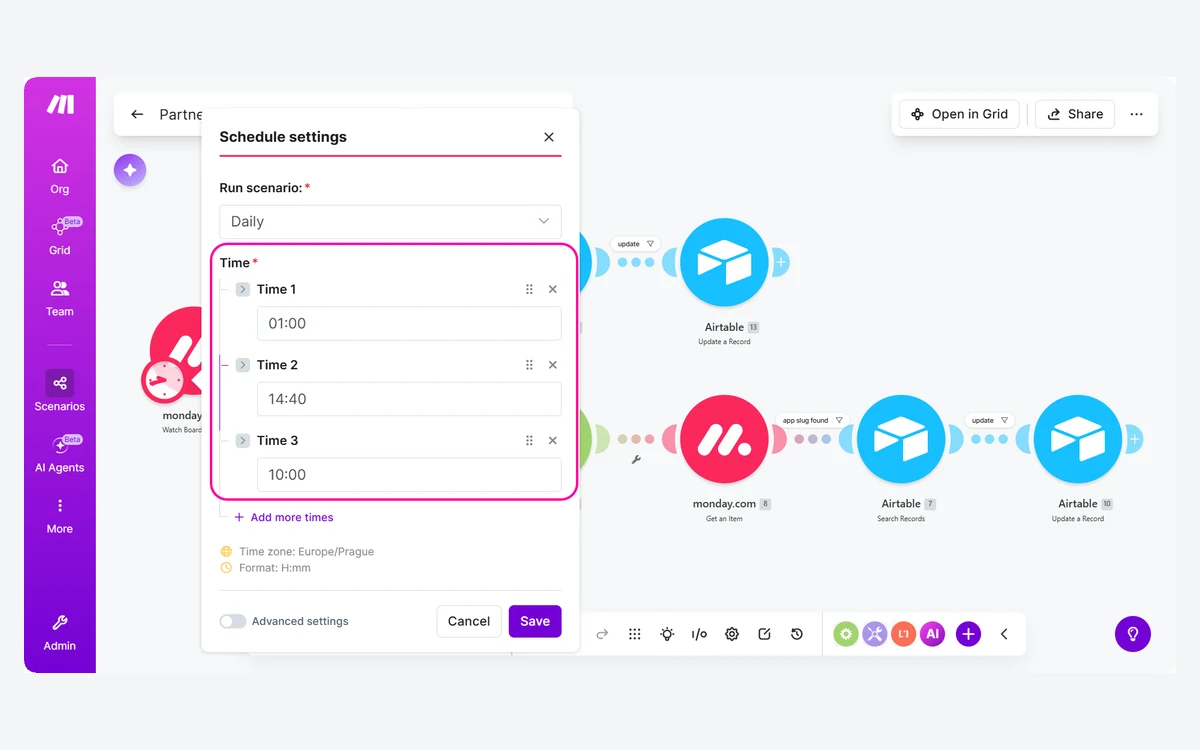
Scenarios run either on a schedule or instantly from a webhook. "By default, a scenario runs every 15 minutes", and "the minimum length of the interval depends on your plan". The Free plan's minimum is 15 minutes; a third-party plan breakdown from Gravity puts the minimum on paid plans at 1 minute.
Make pricing after the October 2026 increase
Make sells five plans: Free, Core, Pro, Teams and Enterprise. Paid plans are priced on a credit slider, so the price depends on how many credits a month you buy. Make's own pricing page renders prices in the browser and did not load for us, so the figures below come from two independent, dated readings of that page: Gravity on October 23, 2026 and The Automated Shop on October 28, 2026. They agree exactly. Confirm the live figure on make.com before you pay.
Entry tier: 10,000 credits a month
- Free: $0, 1,000 credits a month.
- Core: $16 billed monthly, or $12 a month billed annually.
- Pro: $28 billed monthly, or $21 a month billed annually.
- Teams: $51 billed monthly, or $38 a month billed annually.
- Enterprise: custom pricing.
How big the increase is
Before the change, the same 10,000-credit tiers were $9, $16 and $29 a month on annual billing and $10.59, $18.82 and $34.12 on monthly billing. That makes the increase about 31% to 33% on annual plans and about 49% to 51% on monthly plans. Make has not published an announcement about it that we could find, and some comparison sites still show the old figures. Make's own help centre still uses a "$9 plan" in one worked example, which is the pre-increase price.
- Core annual: $9 to $12 (+33%). Core monthly: $10.59 to $16 (+51%).
- Pro annual: $16 to $21 (+31%). Pro monthly: $18.82 to $28 (+49%).
- Teams annual: $29 to $38 (+31%). Teams monthly: $34.12 to $51 (+49%).
Higher credit volumes
Prices scale with the slider. Selected points from Gravity's October 23 reading, shown as monthly / annual-per-month:
- 40,000 credits: Core $51 / $38, Pro $94 / $69, Teams $175 / $129.
- 150,000 credits: Core $175 / $129, Pro $271 / $199, Teams $515 / $379.
- 300,000 credits: Core $321 / $237, Pro $474 / $349, Teams $900 / $663.
- 1,000,000 credits: Pro $1,321 / $973, Teams $2,472 / $1,821. Core is not offered at this volume.
Core tops out at 300,000 credits a month and Pro goes up to 8 million, per Make's November 2025 plan release note. On Core, annual billing still hands out credits monthly: "Only Pro and Teams plans have an annual package of credits", so a Pro annual subscriber can use 120,000 credits in a busy month instead of 10,000. Make's pricing FAQ also mentions a Start-up Plan offering 50% off for teams with fewer than 20 employees.
How Make credits are spent
Credits replaced operations as Make's billing unit on August 27, 2025, with existing operations converted 1:1. For ordinary modules nothing changed: "Non-AI apps: 1 operation equals 1 credit", and the same applies to third-party AI apps such as OpenAI, Anthropic Claude and Gemini when you call them with your own account.
- Triggers: "Trigger modules use 1 credit per run, regardless of whether they return data. Even when a trigger finds no new data, it still uses 1 credit for checking."
- Searches: 1 credit per run, "even when they return multiple bundles".
- Actions: 1 credit per input bundle processed, so an action fed 50 rows uses 50 credits.
- Aggregators: 1 credit for each aggregation.
- Make Code: "2 credits per second of execution time".
- Some Make AI Content Extractor modules: 2 or 10 credits per operation.
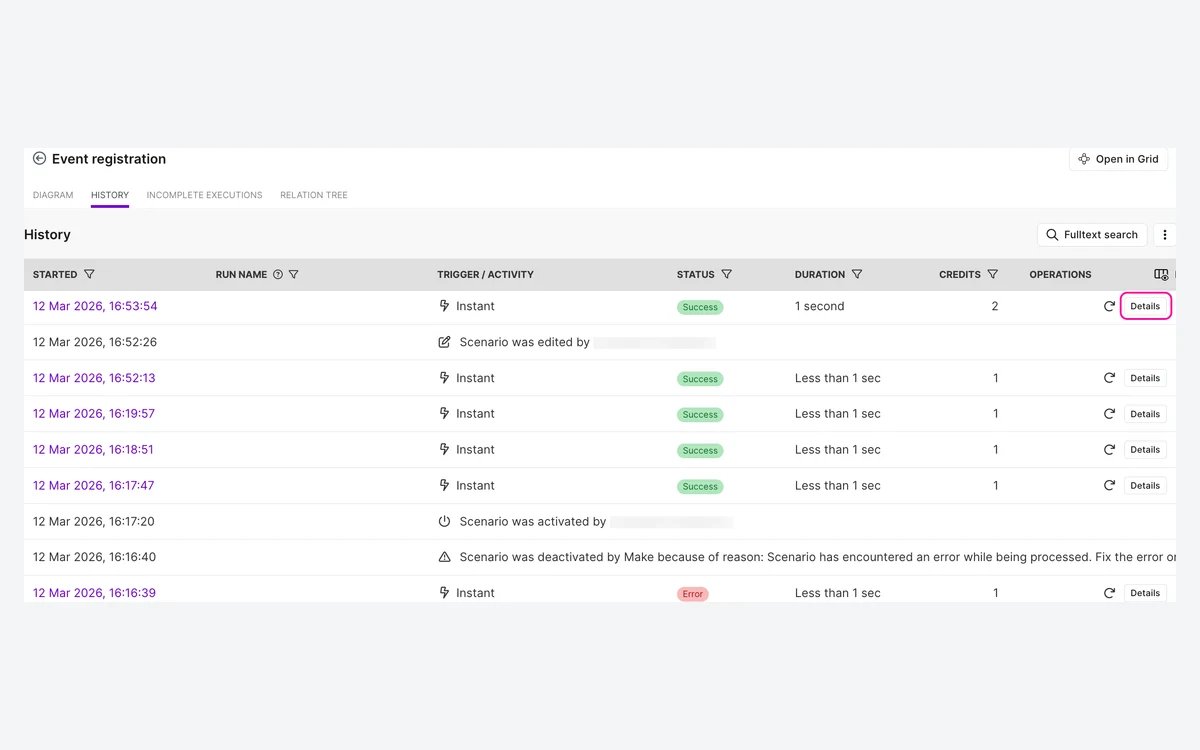
The empty-poll problem
The trigger rule is the one that catches people out. A scheduled scenario that checks a source every 15 minutes uses about 2,880 credits a month (4 checks an hour, 24 hours, 30 days) before it does any work at all. That alone is nearly three times the Free plan's 1,000 credits. Set the same scenario to check every minute and it uses about 43,200 credits a month, more than four times a 10,000-credit plan, even if nothing ever arrives. These are our estimates from Make's stated rule.
The fixes are simple: poll less often, run on a schedule that matches when data actually changes, or use an instant webhook trigger where the app offers one, so a run only starts when an event arrives.
What runs for free
Make's logic layer is a genuine strength here. These modules use zero credits: error handlers (Rollback, Break, Resume, Commit, Ignore), routers and filters, the Scenarios modules (Call a subscenario, Start a scenario, Return output, Customize run name) and Make Functions modules. Heavy branching costs you nothing extra; only the work done on each branch does.
Running out: extra credits, auto-purchase and expiry
When you use up your plan's credits, scenarios stop until more are added. Make's pricing FAQ says incoming webhooks queue up to the storage limit and polling scenarios resume from their last successful run.
- Surcharge: "Manually purchased extra credits include a 25% additional cost compared to the credits in your plan." They are sold in units of 1,000. (The pricing FAQ still says extras are sold at the plan's price; the help centre and the November 2025 release note say 25% more, and we go with those.)
- Auto-purchase: "When you use all of the credits in your subscription, Make automatically purchases 10,000 extra credits." It is capped at the number of credits in your subscription and only works with card payments.
- Data transfer: "Exhausting data transfer can trigger an auto-purchase even if there are still credits left." Each 10,000 credits licensed comes with 5 GB of data transfer and 10 MB of data storage.
- Failed payment: "If your payment fails, your scenarios pause until you update your payment method."
Credits do not roll over
"Credits expire at the end of the term." Extra credits last until the end of the current billing cycle on monthly plans, or the billing year on annual plans. On Core annual, regular credits reset monthly and any extra credits you bought expire at each monthly reset too.
Plan changes are handled more generously. On a downgrade, unused credits carry over for 30 days on a monthly plan or 365 days on an annual plan. On an upgrade, Make converts unused credits into a discount. Cancelling to Free is the exception: "We don't transfer your unused credits to that Free plan."
AI Agents, Maia and what AI costs in credits
Make now has three AI layers: AI modules you drop into a scenario, Make AI Agents that decide which tools to call, and Maia, an assistant that builds and edits scenarios from a chat. All of them can be billed through Make's own AI provider, which turns token usage into credits.
Make AI Agents
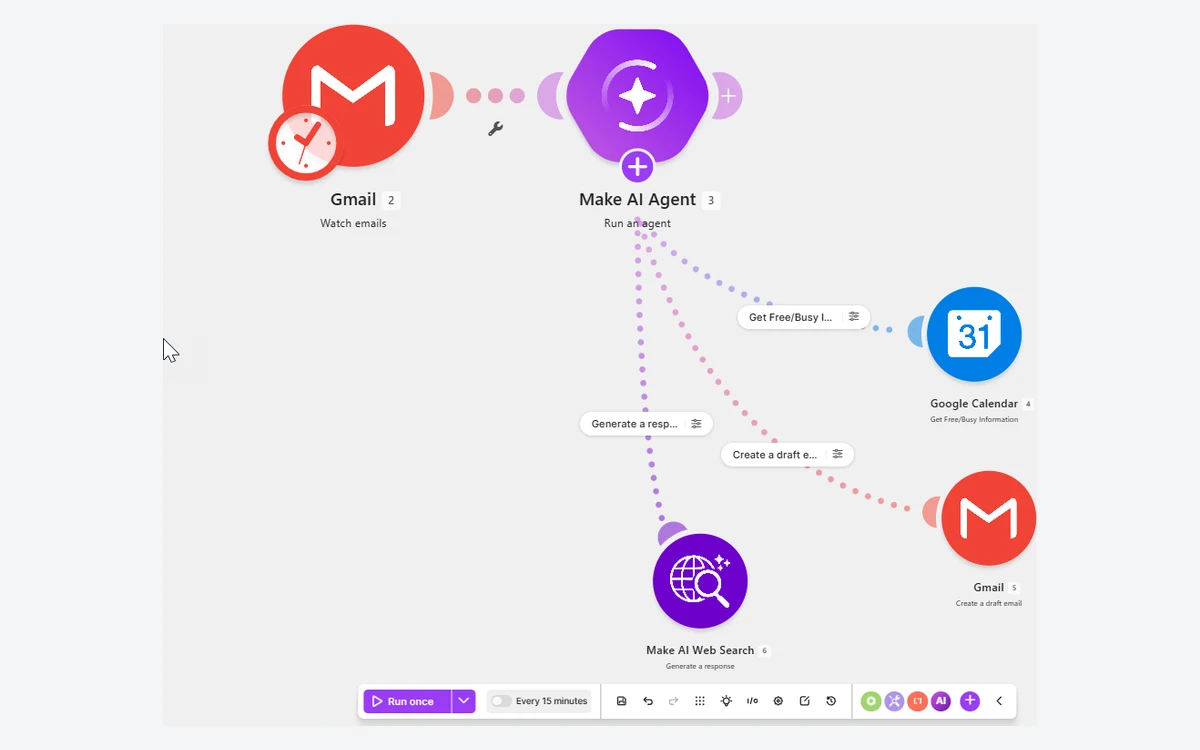
Agents live on the same canvas as everything else. A typical setup has a trigger such as a new Gmail message feeding a "Make AI Agent - Run an agent" module, which can call tools such as Google Calendar, a Gmail draft or Make AI Web Search. Running an agent costs "1 credit per operation + credits based on AI tokens" with Make's AI provider, or a flat 1 credit per operation if you connect your own AI provider. Each tool the agent calls adds its own credits, and knowledge files (PDF or DOCX) add 10 tokens per page plus token-based credits.
Make's AI provider token rates
Since August 25, 2026, Make prices its own AI provider with separate input and output rates. Small and Medium (both GPT-5 nano, at minimal and low reasoning) give 18,080 input tokens or 2,260 output tokens per credit; Large (GPT-5 mini) gives 3,616 input or 452 output tokens per credit. Make says this cut its own example step from about 0.6 credits to about 0.16 credits, a 73% reduction, and warns that the models and rates are subject to change.
As a rough guide, a step that sends 3,000 tokens and gets 500 back costs about 0.4 credits on Small and about 1.9 credits on Large, plus the 1 credit for the operation itself. Those are our calculations. Output tokens are the expensive side, so long generated replies cost far more than long prompts.
Bringing your own key is available on all paid plans, including Core since November 2025: "You pay Make for credit usage based on operations, and pay your AI provider for token usage." For heavy AI use that is usually the more predictable route, with one privacy catch covered below.
Waves '26: what shipped and what is still a promise
Make's October 20, 2026 keynote set out a vision of "the visual layer where agents do the majority of the work reliably, and humans stay in control", organised into four pillars: Discover, Build, Govern and Observe. Make's announcement post did not include any pricing or plan changes. It is worth separating what you can use today from what is roadmap.
- Available now: agent orchestration; an upgraded Maia with Plan mode, Memory and the ability to paste diagrams or screenshots; Knowledge; Custom Roles; Private Spaces; Make Grid; event subscriptions; audit logs for agents and MCP.
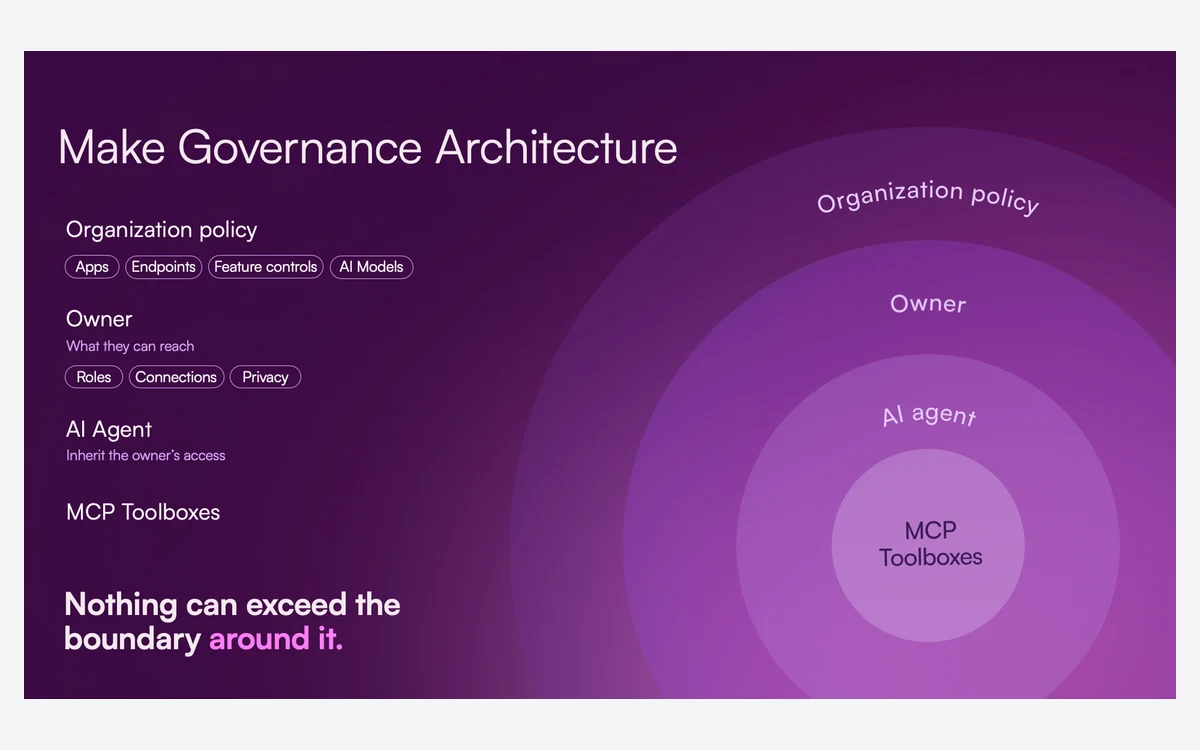
- Coming soon: human in the loop approvals, Functions, Endpoints, MCP toolboxes, organization policy, locked connections, data pinning, agent evals and AI spend tracking.
- Coming later: OpenTelemetry support.
- Waitlist only: Make Process Intelligence (powered by Celonis), Task Mining, Process Mining, and MakeOS, which has no launch date.
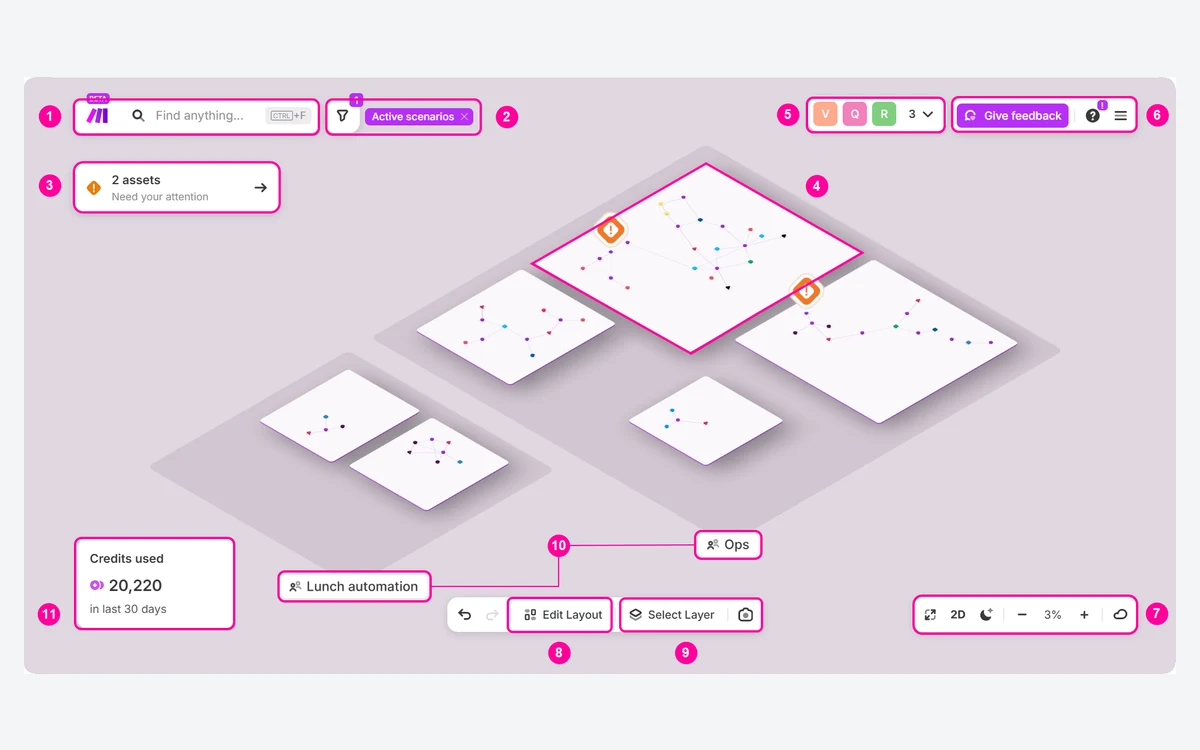
Make Grid is the most useful of the shipped items for cost control: it automatically maps every scenario, app and connection in an organisation and shows credit use over the last 30 days, which makes it easier to find the scenario quietly burning credits on empty polls. It still carries a Beta badge in Make's help screenshots and we found no separate price for it.
Plan limits that matter
Free
1,000 credits a month, 2 active scenarios, a 15-minute minimum interval, 5-minute maximum scenario execution time, 5 MB file size, 1 MB of data storage with one data store, one team and unlimited users. You can only have one free organization per account. Gravity adds that Free keeps logs for 7 days and has no Make API access.
Core, Pro and Teams
- Core: unlimited active scenarios, 40-minute maximum execution time, 100 MB file size.
- Pro: everything in Core plus full-text execution log search, credit usage flexibility, priority scenario execution and 250 MB files.
- Teams: everything in Pro plus multiple teams and team roles, shared scenario templates and 500 MB files. Below Teams "you can only have one team in your organization and you can't manage roles within that one team."
Enterprise
1,000 MB files, company SSO, ISO 27001 compliance support, credit overage protection, custom functions, per-team credit limits, priority support and a separate Celonis AWS environment. Make keeps webhook logs for 3 days on most plans and 30 days on Enterprise.
Two more limits worth knowing: the default scenario rate limit is 100 runs started per minute for instant triggers, and Gravity lists Make API limits of 60 requests a minute on Core, 120 on Pro, 240 on Teams and 1,000 on Enterprise.
Privacy, data zones and security
Each Make organization sits in a data zone: US1, US2, EU1 or EU2. For EU buyers the important caveat is that "selecting the EU1 or EU2 data zone does not automatically mean every request gets processed and stays in the EU." AI is where this shows: "bringing your own AI provider connection removes Make's EU guarantee entirely", and Make notes that "Claude Sonnet 4.6 and Opus 4.6 are served from a UK Bedrock region."
On security, Make says it has completed SOC 2 Type II and SOC 3 audits alongside GDPR adherence, runs an ISO 27001 certified information security program, and hosts its infrastructure on Amazon AWS private instances.
Refunds, cancellation and trials
No refunds
"Make has a no cash refund policy." The Celonis Make services terms say: "Except as expressly stated herein, Subscription Fees are non-refundable." The exceptions are narrow (termination over IP infringement or a substantial defect). Treat any paid plan, and especially an annual one, as money you will not get back.
Cancelling stops the next charge, and you keep the current plan until the end of the billing cycle. After that Make moves you to the Free plan, as long as you do not already own another Free organization, and unused credits are not carried across. You can also pause a subscription at any time instead of cancelling.
There is no standing free trial of the paid plans. The Free plan is the trial: 1,000 credits and 2 active scenarios is enough to build and measure one or two real workflows. Coupons occasionally include a trial of a paid plan.
Who should use Make, and how it compares with Zapier
Make suits people who think in flowcharts. Routers, filters, iterators and error handlers are visible on the canvas and the logic modules are free to run, so complex multi-branch scenarios stay cheap as long as the work on each branch is light. It is less friendly to complete beginners, and the credit model rewards people who will tune polling intervals and check run history.
- Choose Make if you need branching, data transformation and error handling, and you are willing to watch credit use.
- Use your own AI key if you run AI steps at volume, unless you depend on Make's EU data guarantee.
- Pick annual Pro over annual Core if your usage is spiky: Pro annual pools the year's credits, Core annual does not.
- Look elsewhere if you want a flat bill or need a refund window.
If you are weighing Make against Zapier, read our Zapier review at theproofdesk.com/zapier-review, which covers Zapier's 2026 pricing, task limits and AI costs in the same format. Our older Zapier vs Make comparison predates Make's credits and its new prices.
Frequently asked questions
How much does Make cost in 2026?
Make starts at $12 a month billed annually or $16 billed monthly for Core with 10,000 credits, as listed on its pricing page in late October 2026. Pro is $21 or $28, Teams $38 or $51, and the Free plan is $0 with 1,000 credits a month.
Did Make raise its prices?
Yes. Between mid and late October 2026 the entry tiers rose from $9, $16 and $29 annual to $12, $21 and $38, and from $10.59, $18.82 and $34.12 monthly to $16, $28 and $51. Make did not publish an announcement we could find, so older comparison pages may still show the lower prices.
Does Make charge for triggers that find nothing?
Yes. Make says a trigger uses 1 credit per run even when it finds no new data. A scenario polling every minute uses about 43,200 credits a month on checks alone, so use longer intervals or instant webhook triggers where possible.
What happens when I run out of credits?
Your scenarios stop until you add credits. You can buy extra credits in units of 1,000 at a 25% surcharge, or let Make auto-purchase 10,000 extra credits by card; extra credits expire at the end of the billing cycle.
Is the Free plan enough to try Make?
For one or two simple workflows, yes. It gives 1,000 credits a month, 2 active scenarios and a 15-minute minimum interval, but one scenario polling every 15 minutes uses about 2,880 credits a month, so test with instant triggers or a slower schedule.
Can I get a refund from Make?
No. Make has a no cash refund policy and its terms say subscription fees are non-refundable. If you cancel, you keep the plan until the end of the billing cycle and then drop to Free.
How much do Make AI Agents and Maia cost?
They are billed in credits. An agent run costs 1 credit per operation plus token-based credits on Make's AI provider, or a flat 1 credit per operation with your own AI key. Maia is unlimited on paid plans but each message uses credits, and Make's examples show around 140 to 160 credits per message.
Does choosing an EU data zone keep my data in the EU?
Not entirely. Make says the EU1 or EU2 zone does not guarantee every request stays in the EU, and connecting your own AI provider removes its EU guarantee completely.
Key takeaways
- Make's entry paid plans now cost $12 a month annually or $16 monthly (Core, 10,000 credits), up about 33% and 51% from October 2026's earlier prices.
- Every trigger check costs a credit even when nothing arrives, so polling intervals drive the bill more than the work itself.
- Routers, filters and error handlers are free to run, which keeps complex logic cheap.
- AI steps on Make's provider add token-based credits, and Maia messages have cost around 140 to 160 credits each in Make's examples.
- Extra credits carry a 25% surcharge, credits expire at the end of each term and Make gives no cash refunds.
- Many Waves '26 features, including MakeOS, human in the loop and MCP toolboxes, are still coming soon or waitlist only.
More in Services & Software
Browse Services & Software