Namecheap Review 2026: Real Pricing, Hosting Tiers and Free Domain Privacy
What Namecheap actually costs once the promo year ends: first-year teaser prices vs. renewal rates, free domain privacy, Stellar shared hosting plans, the refund rules, and the pending CVC Capital acquisition.
Namecheap built its name on cheap domains and a privacy-friendly reputation, and it still registers millions of names a year. But the headline prices you see on a search page are almost always first-year promos, and the number that matters for a domain you plan to keep is the renewal rate a year later.
This 2026 guide separates the teaser pricing from the standing cost, walks through what its Stellar shared hosting plans include, spells out the refund windows that trip people up, and covers the private-equity deal that could reshape the company. All figures are the ones shown at the time of research; confirm the exact number at checkout before you buy.
Domain pricing: the promo year vs. the renewal
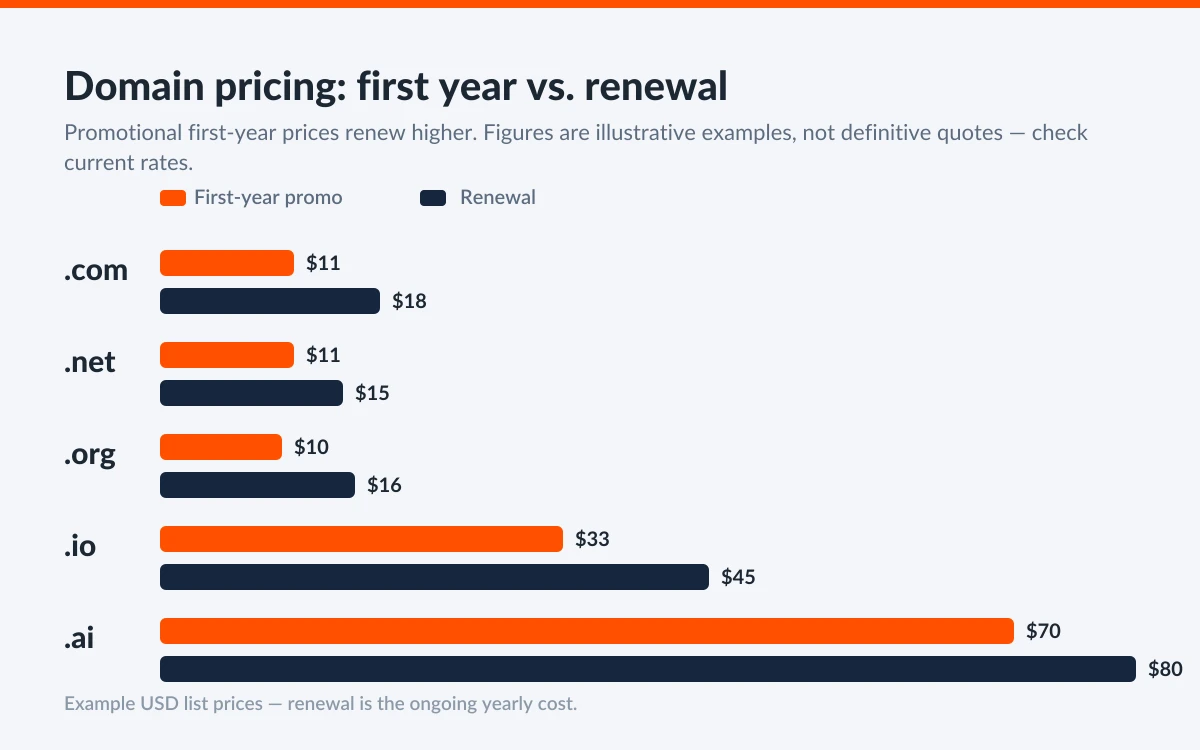
Namecheap's domain prices swing depending on which page you land on, because different pages run different promotions. The most important habit is to read two numbers, not one: the first-year price and the renewal price. A cheap first year on a name you renew for a decade is a rounding error next to the renewal you pay nine more times.
For a .com, the dedicated registration page showed a first-year price around $11.28 (billed as 25% off) renewing near $18.48. Namecheap's general domain-search landing page ran a lower teaser of $6.79/yr, but that one is flagged 'New customers only' and quoted against a $14.98/yr regular rate, so treat it as a sign-up offer rather than the standing price.
Other common extensions followed the same promo-then-renewal shape at the time of research:
- .net — around $12.48/yr first year, quoted against a $14.98/yr regular rate and renewing near $18.58.
- .org — around $8.48/yr first year (regular rate about $14.48), renewing near $18.98.
- .io — a first-year promo near $34.98 (advertised as 47% off), with a regular price around $65.98 and renewal near $75.98.
- .ai — about $89.98/yr, sold with a minimum two-year registration.
The $0.20 you didn't budget for
ICANN charges a mandatory annual fee of $0.20 for each domain registration, renewal or transfer. Namecheap adds it to the listed price for some domains at checkout, so the number in your cart can be a few cents above the advertised price.
Because the same extension can show different prices across pages in the same week, don't anchor on any single figure below. Read the first-year price and the renewal side by side on the actual product page, and expect the renewal — not the promo — to be your ongoing cost.
Free domain privacy, on by default
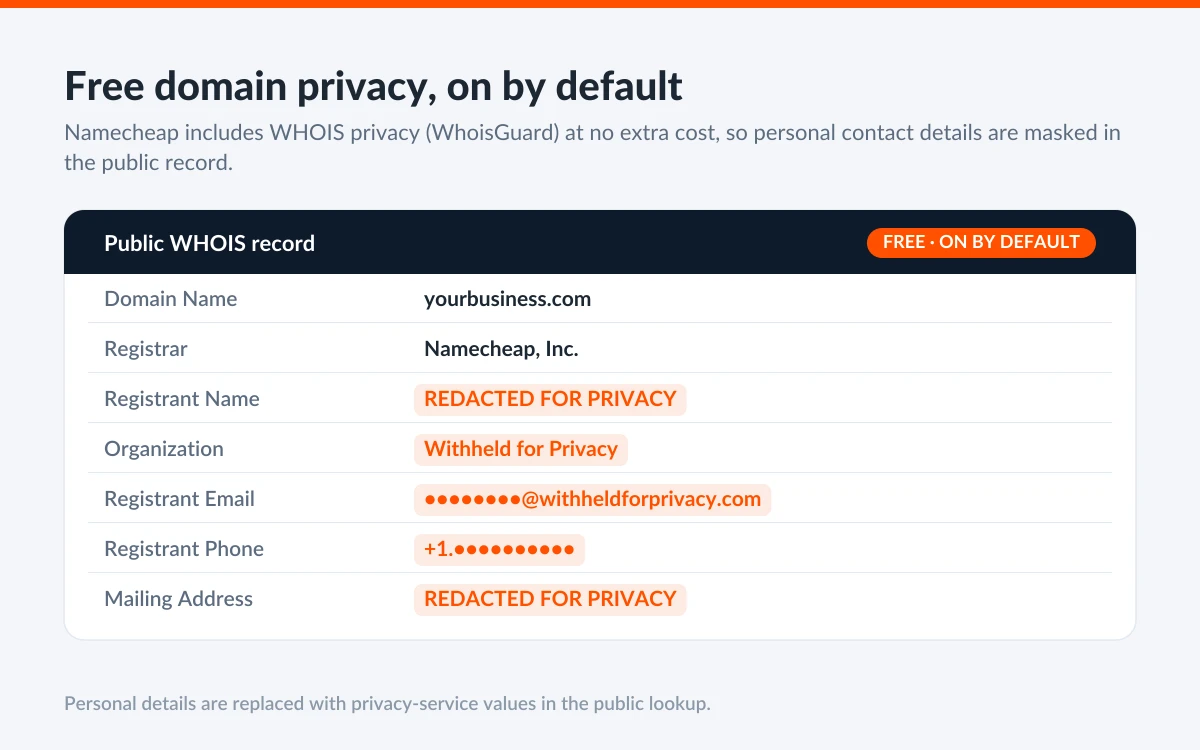
This is where Namecheap still earns goodwill. Domain privacy — which hides your name, address, email and phone number from the public WHOIS record — is bundled free with every eligible registration, and it stays free on renewal, transfer and reactivation rather than lapsing into a paid add-on after year one.
The subscription is added automatically in the cart, so you don't have to remember to tick a box. That matters because a public WHOIS record is a standing invitation to spam and social-engineering attempts, and some registrars quietly charge for the same protection.
A few extensions are excluded
Registry rules mean domain privacy isn't available on a handful of TLDs. It's free on most extensions, but check the specific one you're buying — if the cart doesn't add privacy automatically, that extension is likely one of the registry-mandated exceptions.
Stellar shared hosting: the three tiers
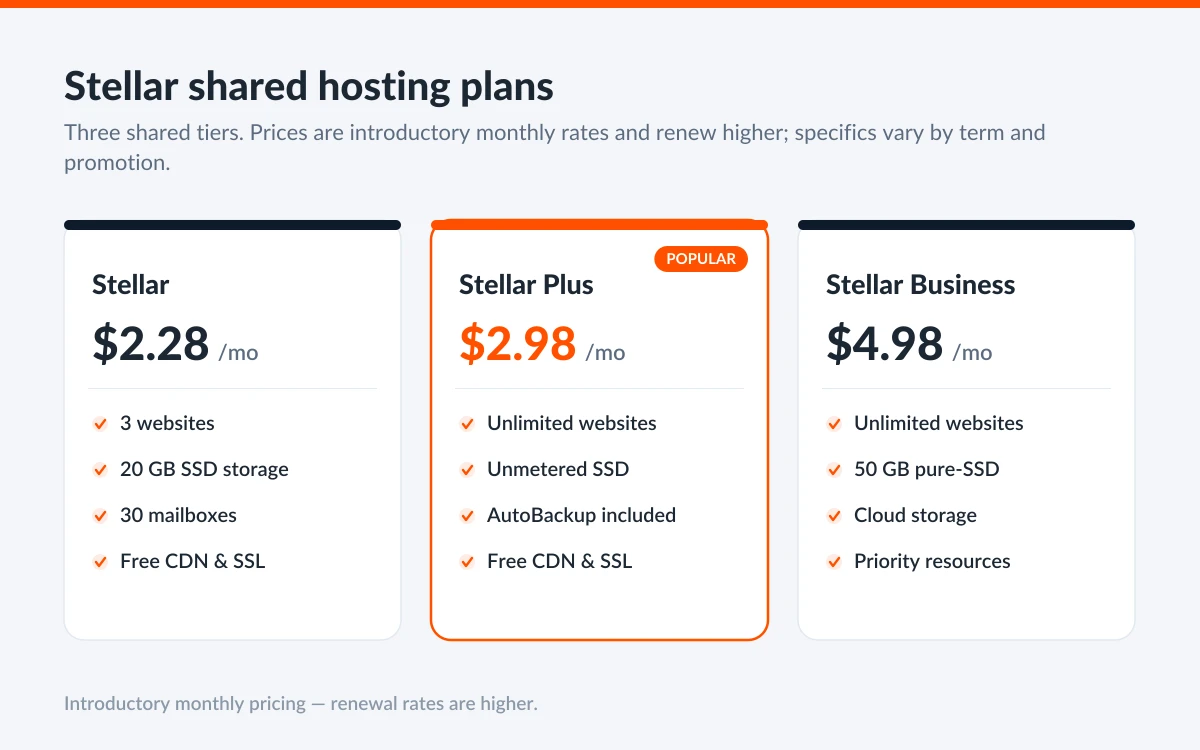
Beyond domains, Namecheap sells budget shared hosting under the Stellar brand. Three tiers cover most small-site needs, each offered with a 30-day trial before the monthly rate kicks in.
- Stellar — 3 websites, 20 GB SSD storage and 30 mailboxes; a 30-day trial at $0.00, then about $2.28/mo.
- Stellar Plus — unlimited websites, unmetered SSD storage, unlimited mailboxes and AutoBackup; 30-day trial, then about $2.98/mo.
- Stellar Business — a 50 GB cloud-storage tier aimed at busier sites; 30-day trial, then about $4.98/mo.
Every Stellar plan bundles two things worth noting: 50 free Standard SSL certificates for one year, set up automatically, and one free non-premium domain for the first year (one domain per hosting plan). For a first small site, that combination lowers the real entry cost.
Read the monthly rate as a snapshot
The $2.28 / $2.98 / $4.98 monthly prices are what showed after the 30-day trial at the time of research. Namecheap doesn't clearly mark whether these are promotional or standing renewal rates, so treat them as the price shown today, not a locked-in cost for years two and beyond.
What to expect on uptime
Namecheap's own knowledge base says you can 'expect 100% uptime' on its hosting servers, but it explicitly clarifies that this is not a formal SLA guarantee. Outages from DDoS attacks, power failures or hardware faults can still happen, and there's no contractual credit tied to a downtime threshold.
In practice that means budget shared hosting here is fine for personal sites, blogs and small projects, but if you need a written uptime commitment with service credits, that's a different — and pricier — class of hosting than Stellar.
Refunds: the windows that catch people out
Namecheap's refund rules are specific and worth reading before you buy, because the eligibility conditions are narrow.
Domains
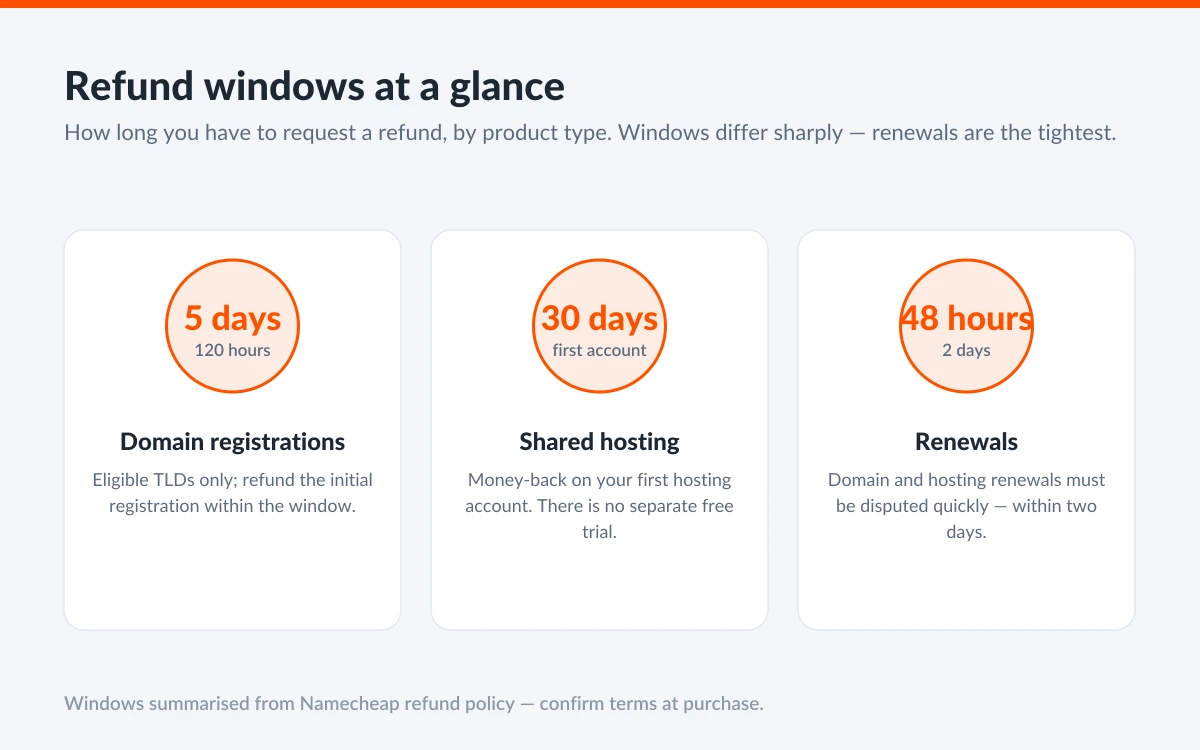
Registrations and renewals are treated as final, with one exception: you can request cancellation within 5 days (120 hours) of registration for a valid reason. Premium domains are non-refundable, full stop.
Hosting
Shared hosting carries a 30-day money-back guarantee, but only for first-time shared-hosting customers who start the account without using the 30-day trial. You are not eligible for a refund if you've opened a second Namecheap account, or if you previously created an account, canceled it and signed up again. Hosting renewals are refundable only if canceled within 48 hours of the renewal, dedicated servers are refundable (excluding license prices) within one week of delivery, and third-party software licenses are non-refundable.
The trial-vs-refund trap
Because the 30-day money-back guarantee applies only to accounts started without the 30-day trial, choosing the free trial can waive your right to a straight refund later. Pick one path deliberately rather than opting into both.
The CVC Capital acquisition to watch
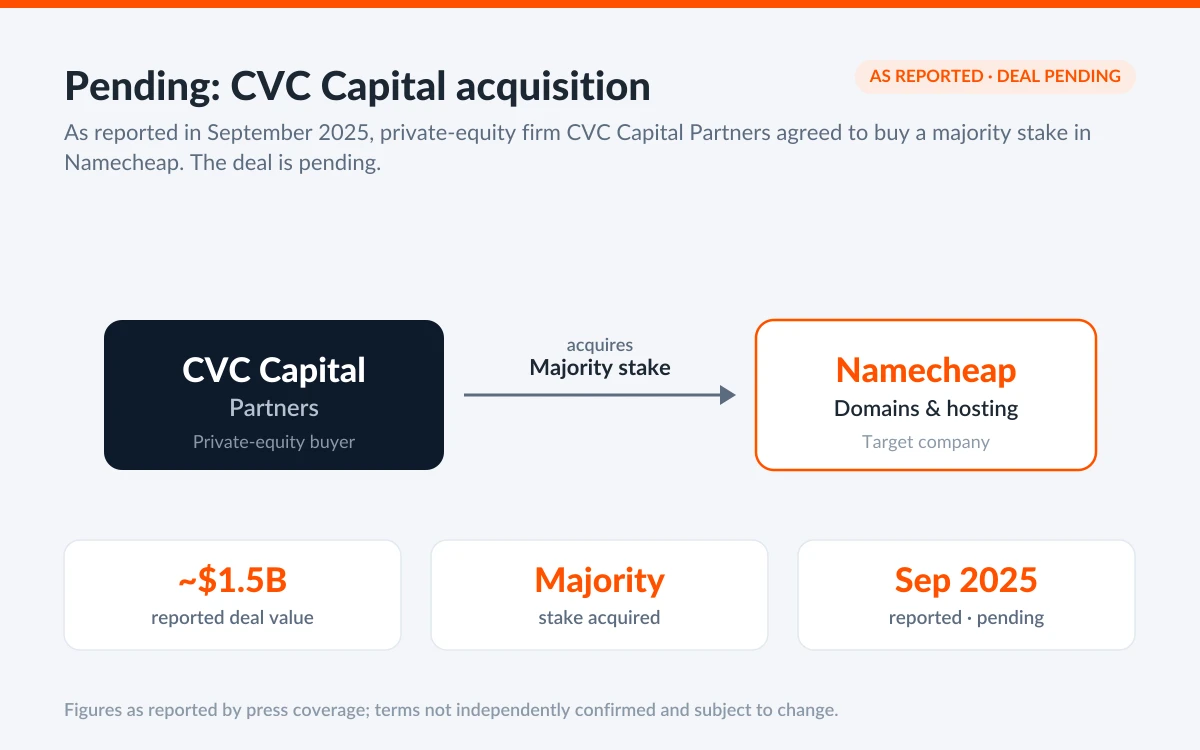
In September 2025, trade publication DomainNameWire reported that private-equity firm CVC Capital Partners was finalizing a deal to acquire a majority stake in Namecheap, valuing the company at roughly $1.5 billion including debt. As of that reporting the deal was described as pending rather than closed, and the account came from secondary trade press, not a Namecheap-owned announcement.
Why it belongs in a buyer's guide: private-equity ownership often shifts a company's incentives toward margin, and registrars under new financial owners have historically revisited renewal pricing, add-on bundling and free features. Nothing here is a prediction — but the free domain privacy and the low renewal rates that make Namecheap attractive are exactly the levers a new owner might reconsider. If those matter to you, register longer terms while today's terms hold and keep an eye on renewal notices.
Frequently asked questions
Is Namecheap's cheap price the price I keep paying?
Usually not. Most headline prices are first-year promos. A .com advertised around $6.79 to $11.28 for the first year renews closer to $18 a year, and the same promo-then-renewal pattern applies across .net, .org, .io and other extensions. Always read the renewal price next to the first-year price.
Does Namecheap really include domain privacy for free?
Yes, for most extensions. Domain privacy is bundled free and added automatically in the cart with every eligible registration, renewal, transfer and reactivation — it doesn't turn into a paid add-on after year one. A handful of TLDs are excluded because of registry rules, so confirm it's added for the specific extension you're buying.
Can I get a refund on a domain I just bought?
Only within a tight window. Domain registrations and renewals are final except within 5 days (120 hours) of registration for a valid cancellation reason. Premium domains are non-refundable entirely.
How does the hosting money-back guarantee work?
Shared hosting has a 30-day money-back guarantee, but only for first-time shared-hosting customers who did not start with the 30-day trial. You lose eligibility if you opened a second account or canceled a previous account and signed up again. Renewals are only refundable within 48 hours.
What do the Stellar shared hosting plans include?
Stellar covers 3 websites, 20 GB SSD and 30 mailboxes (about $2.28/mo after a trial); Stellar Plus adds unlimited sites, unmetered storage, unlimited mailboxes and AutoBackup (about $2.98/mo); Stellar Business is a 50 GB tier (about $4.98/mo). All three include 50 free Standard SSL certificates for a year and one free non-premium domain for the first year.
Does the CVC Capital deal change anything for customers today?
Not directly, yet. DomainNameWire reported in September 2025 that CVC Capital Partners was finalizing a majority-stake purchase valuing Namecheap near $1.5 billion, but as reported it was pending and came from trade press rather than Namecheap itself. It's worth watching because new ownership can eventually affect renewal pricing and free features.
Key takeaways
- Judge a domain by its renewal price, not its first-year promo — most extensions roughly double after year one.
- Free domain privacy, added automatically for most TLDs, is Namecheap's standout value and stays free on renewal.
- Stellar shared hosting is genuinely cheap and bundles SSL and a free first-year domain, but the monthly rates are a snapshot, not a locked-in guarantee.
- Refund windows are narrow: 5 days for domains, 30 days for hosting only if you skip the trial and it's your first account.
- Watch the pending CVC Capital acquisition — private-equity owners can revisit exactly the pricing and free features that make Namecheap attractive.
More in Services & Software
Browse Services & Software