OpenAI Launches ChatGPT Wallet: Dots Agents Can Now Pay for You, One Face ID Check at a Time
ChatGPT Wallet lets OpenAI's dots agents buy things with your card, using one-transaction network tokens and a biometric approval on every purchase. Who can use it, how it works, and what is still missing.
OpenAI announced ChatGPT Wallet on Friday, November 13, 2026. It is the first time the company's AI agents can actually spend money on your behalf: the dots agents introduced at OpenAI's developer conference in late September can now find items, put them in a merchant's checkout and pay with a card you have saved.
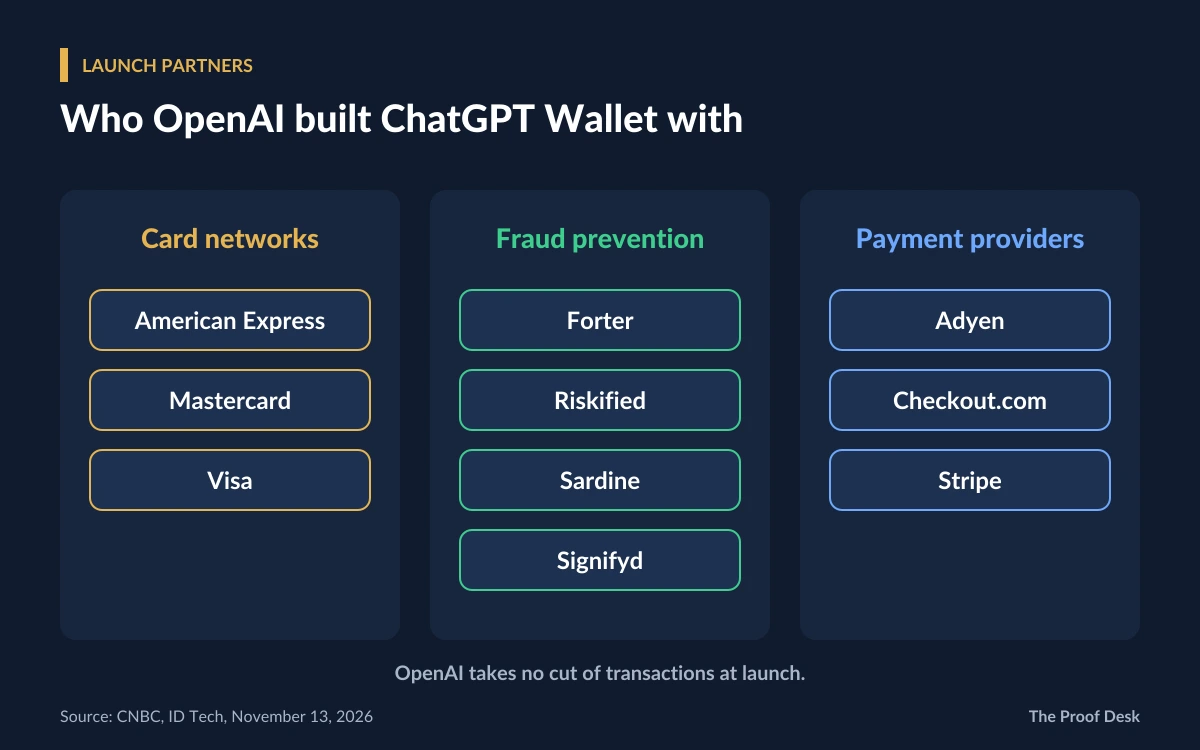
The feature was built with American Express, Mastercard and Visa, and it is rolling out now to ChatGPT Pro subscribers in the US. The design leans hard on two safeguards - the agent never sees your real card number, and you approve every single purchase with Face ID or a fingerprint. The gaps are just as clear: it is Pro-only, US-only and dots-only, there is no preapproved spending yet, and some of the biggest merchants are blocking agents outright.
What ChatGPT Wallet is
ChatGPT Wallet is a place to save a payment card that your dot can use when it shops for you. OpenAI describes it as "the first wallet that lets agents pay without access to users' actual card details." Instead of handing the agent a card number, the card network issues a stand-in credential for each purchase.
Wallet holds no cash balance and no cryptocurrency. It is a layer over the cards you already have, so your existing card rewards and dispute protections carry over. OpenAI is not taking a cut of transactions at launch.
Who can use it right now
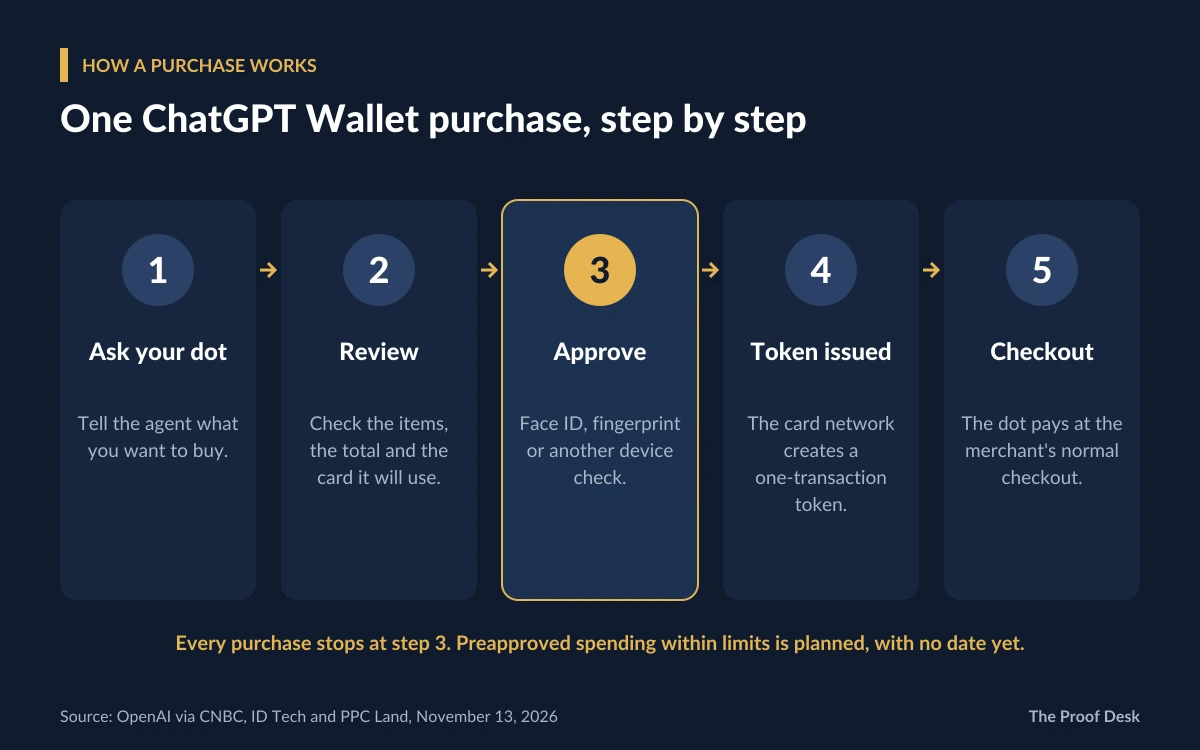
Availability at launch is narrow. You need all of the following:
- A ChatGPT Pro subscription.
- To be in the US and aged 18 or older.
- An eligible US-issued card with a US billing address.
- A dot - Wallet only works inside dot conversations. OpenAI's Help Center says it "isn't available in Chat, Work, or standalone Codex threads".
Wallet was built with American Express, Mastercard and Visa. OpenAI's help docs also list Chase cards as eligible, but only for the primary cardholder - authorized users cannot add them. Card eligibility details beyond that, including debit cards, are covered on OpenAI's help page for Wallet, so check there before assuming your card qualifies.
Not supported: ChatGPT Plus and free users (no timeline given), anyone outside the US, and dots in the EEA, Switzerland and the UK. "We're starting with limited availability to ChatGPT Pro users, so we can learn from real-world use," OpenAI said.
How a purchase works
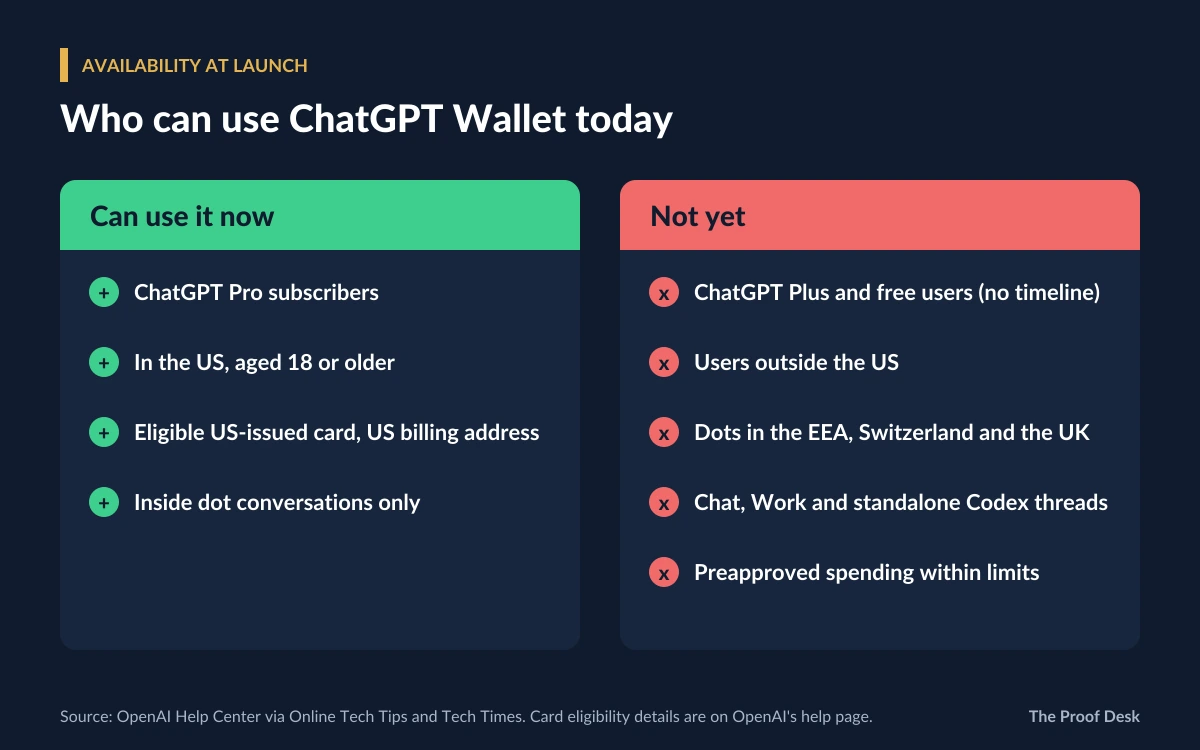
Setup happens once: you save an eligible card to Wallet, and your bank may ask you to verify the card at that point. After that, a purchase runs like this:
- You ask your dot to find what you want.
- The dot gathers the items and shows you the items, the total and the card it will use.
- You approve the purchase with a device security check such as Face ID or a fingerprint scan.
- The payment network issues a payment token for that one transaction, with its own card number, security code and expiration date.
- The dot completes the merchant's normal checkout with that token.
"Each approval creates a clear record of the purchase the user authorized the agent to make," OpenAI said. That record matters, because the biometric check is the human step that separates an agent's suggestion from a charge on your card.
What the agent sees, and what the merchant gets
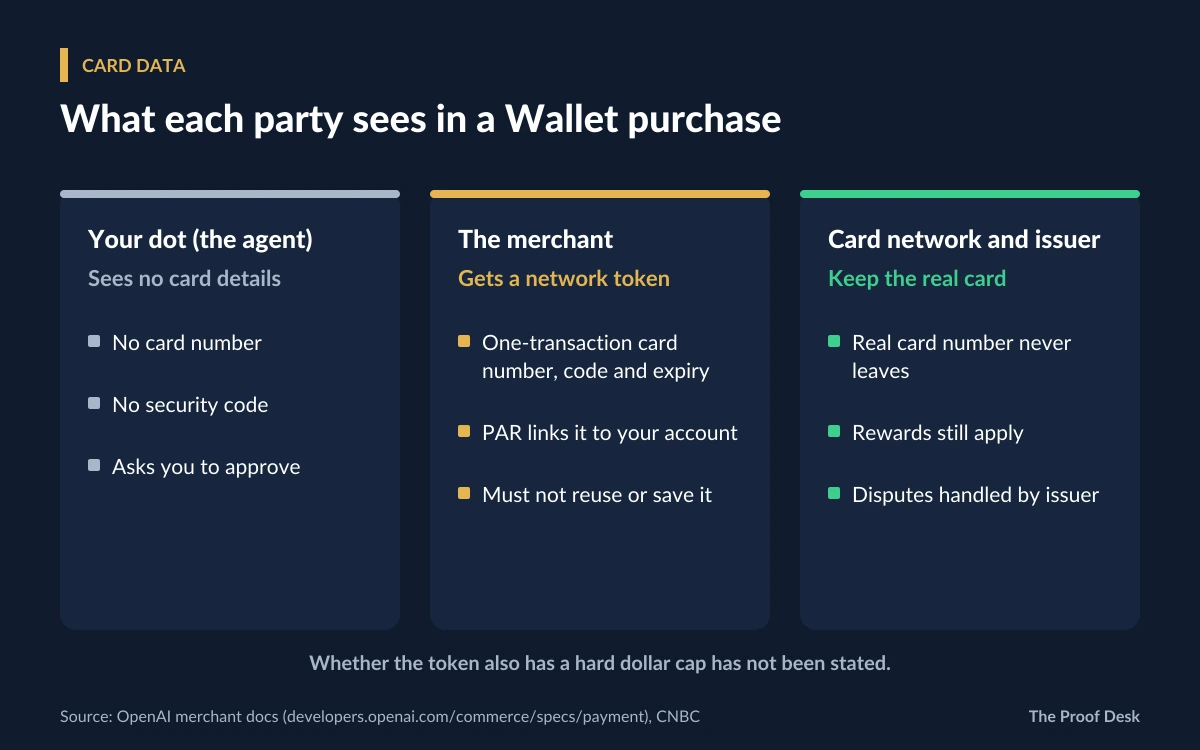
The dot never sees your full card details. The merchant does not get them either: it receives a network token instead of the card number. OpenAI's merchant documentation tells sites to "use the Payment Account Reference (PAR) to associate the token with the underlying payment account" - so a store can still recognize a returning customer without holding the real number.
The token is scoped to the purchase you approved. Because "the customer consents only to the specific transaction", OpenAI tells merchants not to reuse or save that payment credential for a separate purchase. Subscriptions are allowed if the merchant's existing checkout supports them, but the merchant has to get your consent for recurring charges.
One thing no source states is whether the token also carries a hard dollar cap beyond the single-transaction scope, so do not assume one.
Partners and protections
Beyond the three card networks, OpenAI lined up fraud-prevention partners Forter, Riskified, Sardine and Signifyd, and payment providers Adyen, Checkout.com and Stripe. American Express calls this its first "Agentic Commerce Experiences" integration.
"It just makes sense to watch it, start it in a contained environment, and then keep rolling from there," said Luke Gebb, EVP and global head of innovation at American Express. Mastercard's Sherri Haymond put it this way: "An agent making a purchase should strengthen, not bypass, the trust built into payments."
If something goes wrong, the normal card rules apply. Merchants remain responsible for delivery and returns, and billing disputes go to your card issuer, with dispute protection for eligible cases such as defective items.
The legal grey area
The CFPB has not issued guidance on AI agents under Regulation Z (credit cards) or Regulation E (debit cards). It is unsettled whether a mistaken purchase that you approved with Face ID counts as "unauthorized use". Read the review screen carefully before you approve.
What merchants need to do - and who is saying no
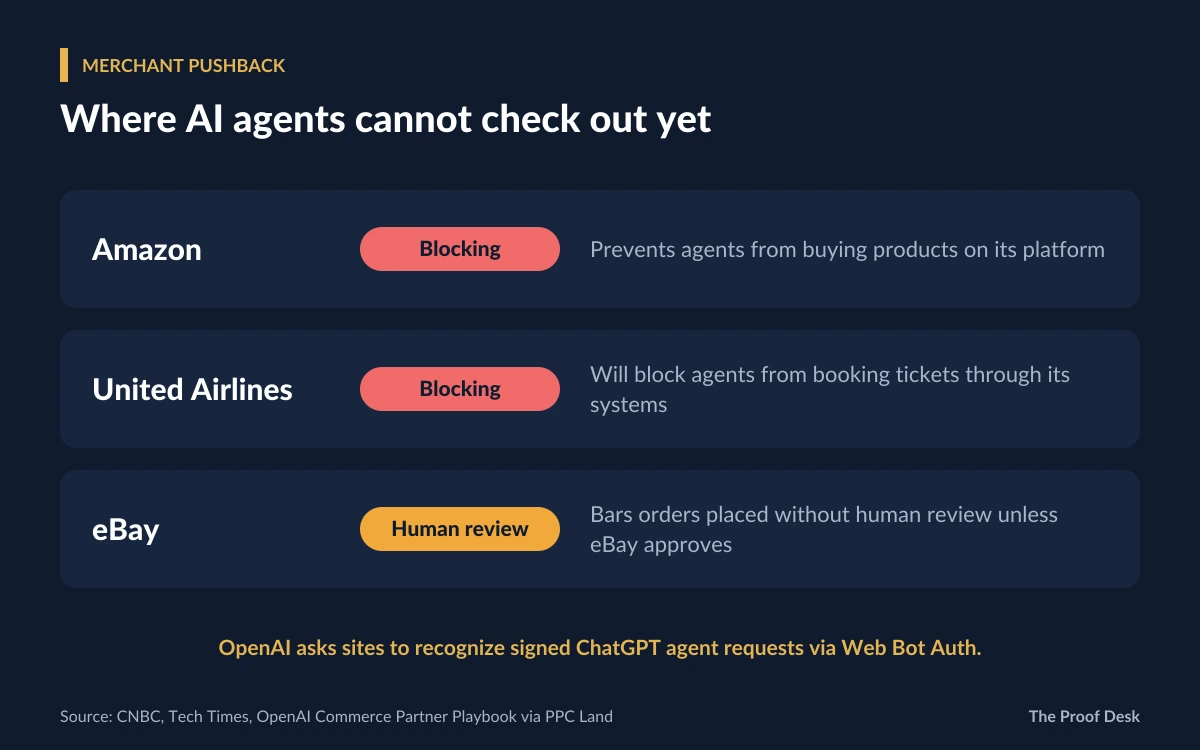
OpenAI says "ChatGPT Wallet works out of the box with existing checkout pages and payment forms", and that browser access needs no plugin or product feed. The catch is bot defenses. OpenAI warns that "ChatGPT's cloud browser can set off these systems by accident and cause purchases to fail", and its Commerce Partner Playbook asks sites to recognize signed ChatGPT agent requests through Web Bot Auth. Merchants can also read signals such as ASN, IP country, locale, time zone and user agent from the Forwarded HTTP header.
Not every merchant wants in. United Airlines said it will block agents from booking tickets through its systems, and Amazon prevents agents from buying products on its platform. eBay's user agreement bars flows that place orders without human review unless eBay approves them.
"It's going to take time for the ecosystem to build the right infrastructure," said Chaya Nayak, who leads product for monetization and payments at OpenAI. "Really, who we are speaking to here is the networks and the merchants."
What is still missing
- Preapproved spending: delegated purchases within limits you set - spending caps, categories, time periods - are planned with "enhanced safeguards", but there is no date. Today every purchase needs your approval.
- Wider access: no timeline for Plus or free users, or for users outside the US.
- Answers on the token: whether it has hard amount caps or expiry beyond one transaction is not stated.
- Insurance clarity: whether Amex Agent Purchase Protection covers Wallet purchases has not been said.
- Security testing: no independent prompt-injection testing of Wallet has been reported.
Why it matters
ChatGPT has more than 1.2 billion weekly active users and nearly 100 million paying users as of the end of Q3. Wallet follows OpenAI's move away from its earlier Instant Checkout feature and a revamped shopping experience in March. Moving from recommending products to paying for them is the step that turns an assistant into a buyer, and OpenAI is starting with its smallest, most engaged audience while the card networks and merchants catch up.
For background on the agents themselves, see our coverage of DevDay 2026, where dots were introduced, and our ChatGPT plan comparison.
Frequently asked questions
Can I use ChatGPT Wallet on the Plus or free plan?
No. At launch it is limited to ChatGPT Pro subscribers in the US, and OpenAI has given no timeline for Plus or free users.
Does the agent see my card number?
No. The card network issues a one-transaction payment token with its own number, security code and expiry, and that is what the dot and the merchant receive.
Can my dot buy things without asking me?
Not today. Every purchase requires a Face ID, fingerprint or similar device check. Preapproved spending within limits is planned but has no date.
Can I pay from a normal ChatGPT chat?
No. Wallet only works inside dot conversations, not in Chat, Work or standalone Codex threads.
What happens if an item arrives broken?
The merchant handles delivery and returns, and billing disputes go to your card issuer, as with any card purchase. Your card's existing dispute protections apply to eligible cases.
Does OpenAI charge a fee per purchase?
Not at launch. OpenAI is not taking a cut of Wallet transactions for now.
Sources
- OpenAI - Introducing ChatGPT Wallet ↗
- OpenAI Help Center - Making purchases with ChatGPT Wallet ↗
- OpenAI developers - Commerce payment spec ↗
- CNBC - OpenAI's ChatGPT Wallet lets dots make purchases ↗
- PPC Land - OpenAI hands its AI agents a wallet ↗
- Tech Times - Face ID approval is the sole human check ↗
- ID Tech - Security check on every agent purchase ↗
Key takeaways
- ChatGPT Wallet, announced November 13, 2026, lets OpenAI's dots agents pay for purchases with a saved card.
- Launch access is ChatGPT Pro, US, 18+, an eligible US-issued card, and dots only.
- Agents never see the real card number; each purchase uses a one-transaction network token.
- Every purchase needs a Face ID or fingerprint approval; preapproved spending has no date.
- Amazon and United Airlines are blocking agents, and eBay requires human review.
More in Tech News
Browse Tech News