ChatGPT.com Review 2026: What Each Plan Actually Gets You
A close read of chatgpt.com in August 2026: five consumer price points, which models each tier reaches, real context limits, privacy defaults and business seat costs.
chatgpt.com is the front door to OpenAI's models, and in 2026 it stopped being a simple choice between free and twenty dollars. There are now five consumer price points, two of them called Pro, and the differences between them are less about features than about how much you are allowed to use.
This review works from OpenAI's own pricing page, help center and policies rather than from summaries of them. Where OpenAI publishes a number, it is quoted here. Where OpenAI deliberately declines to publish one — and for chat limits, it mostly does — that is said plainly instead of filled in with a figure from somewhere else.
One warning up front: two OpenAI pages currently contradict each other about who can build custom GPTs. That discrepancy is flagged in its own section rather than resolved, because there is no honest way to resolve it from the outside.
What chatgpt.com actually is
chatgpt.com is the hosted web app for OpenAI's consumer and business chat products. A subscription there buys access to models, tools and usage allowance inside that app and its mobile clients. It is not the API, which is billed separately per token and shares no allowance with your ChatGPT plan.
What a paid tier unlocks falls into four buckets, and it is worth keeping them separate because the plans differ on each one independently:
- Model access — which of the GPT-5.6 variants your account can select at all.
- Usage allowance — how much you can send before you are throttled or cut off.
- Context window — how much text the model can hold in one conversation.
- Tooling — connectors, scheduled tasks, memory depth, Codex and agent surfaces.
A common mistake is paying for a higher tier to get a capability that is actually on every tier, just with a smaller allowance. Most of what follows is about telling those two cases apart.
Plans and prices in August 2026
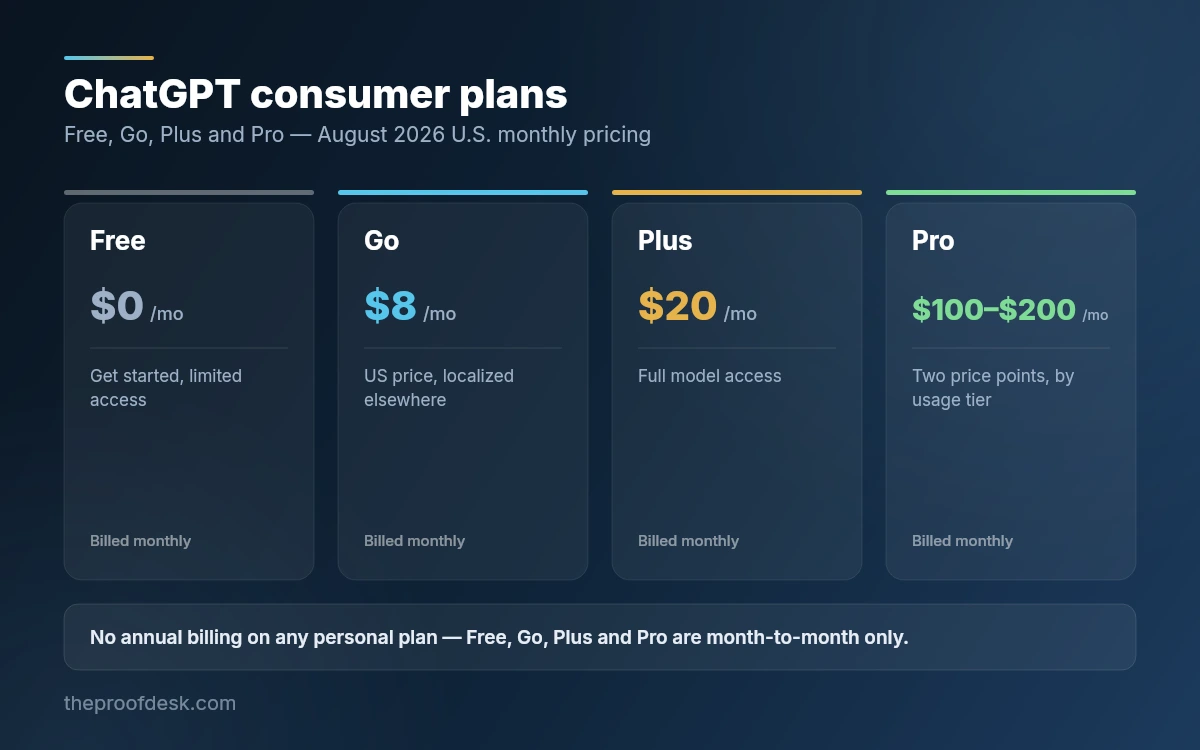
- Free — $0/month. Unlimited everyday text chats on GPT-5.6 Luna, with limited uploads and slower image generation.
- Go — $8/month in the US. OpenAI notes that "Go pricing is localized in some markets," so the figure differs by country.
- Plus — $20/month, billed monthly.
- Pro — $100/month. Added on 9 April 2026 as a middle option.
- Pro — $200/month. The original and still the highest-usage tier.
The two Pro tiers are not a feature split. OpenAI's help center is explicit: "Both Pro tiers include the same core capabilities. The main difference is usage allowance: Pro $100 unlocks 5x higher usage than Plus, while Pro $200 unlocks 20x usage than Plus." If you are hitting limits, the $100 tier is the cheaper answer; if you are not, neither Pro tier gives you anything Plus lacks.
There is no annual discount on consumer plans
OpenAI states: "Currently, we do not support annual billing or the option to pay for multiple months in advance for ChatGPT Go, Plus, or Pro subscriptions." Annual pricing exists only on business seats. If a site offers you a discounted yearly ChatGPT Plus subscription, it is not selling you one.
ChatGPT Go began as a regional experiment — India in August 2025 at ₹399/month, then Indonesia and a widening list of countries — and went global on 16 January 2026, when OpenAI announced it was "rolling out everywhere ChatGPT is available."
Which models each plan can reach
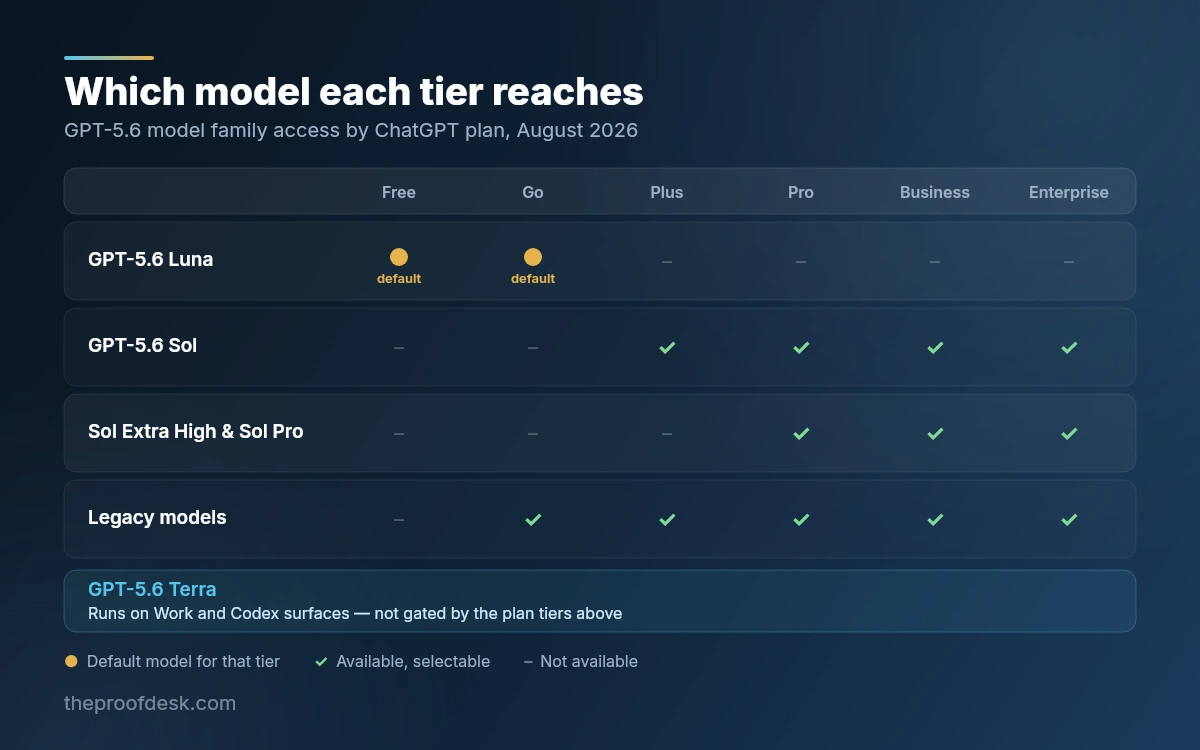
The GPT-5.6 family arrived across August 2026 and split into named variants rather than a single flagship. The gate between free and paid is now a model name:
- GPT-5.6 Luna — the default for Free and Go, and the model behind Think on those tiers.
- GPT-5.6 Sol — Plus, Pro, Business and Enterprise only.
- GPT-5.6 Sol at Extra High reasoning — Pro, Business and Enterprise, but not Plus.
- GPT-5.6 Sol Pro — the Pro model option, also on Business and Enterprise.
- GPT-5.6 Terra — the Work and Codex surfaces; Free and Go reach it only there, in limited form.
- GPT-5 Thinking Mini — available on every tier, expanded on Plus and effectively unlimited on Pro.
- Legacy models — retained for Plus, Pro, Business and Enterprise; not offered to Free or Go.
OpenAI puts it without hedging: "Logged-out users do not have access to GPT-5.6 Sol. Free and Go users do not have access to GPT-5.6 Sol. Their default model is GPT-5.6 Luna, which also powers Think." If the specific reasoning quality of Sol is what you want, $8 does not buy it — $20 is the entry price.
Model turnover has been quick enough to matter when you plan around it. GPT-5.1 was retired on 11 March 2026, and the 5.3 and 5.4 lines came and went inside the same year. A workflow pinned to one model name on chatgpt.com has a shelf life of months, not years.
Limits and context windows
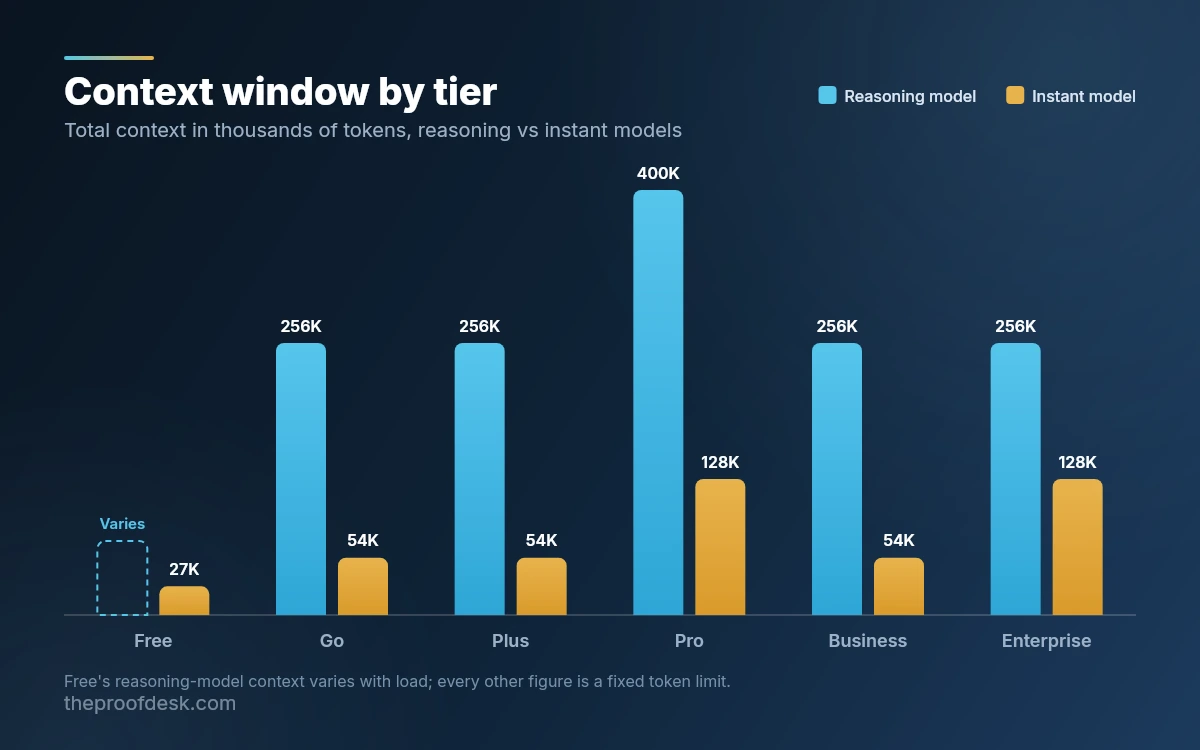
Context window is the one hard number OpenAI publishes across every tier. Totals from the pricing comparison table, for the instant and reasoning model classes respectively:
- Free — 27K instant, and "Varies" on reasoning.
- Go — 54K instant, 256K reasoning.
- Plus — 54K instant, 256K reasoning.
- Pro — 128K instant, 400K reasoning.
- Business — 54K instant, 256K reasoning.
- Enterprise — 128K instant, 256K reasoning.
Read those as ceilings on the whole conversation, not on your paste. OpenAI's footnote is worth internalising: "ChatGPT manages a shared context window to understand your request, track the conversation, retrieve relevant information, and generate responses. The portion available for user input is smaller than the total window." The page's own input estimates run well below the totals — about 40 pages on a 54K window, about 680 pages on Pro's 400K.
Message limits are a different story, because OpenAI has stopped publishing them for consumer plans. The current language is qualitative: "Free and Go users have unlimited everyday text chats, subject to abuse-prevention safeguards. Separate limits continue to apply to file uploads, image generation, voice, data analysis, and other tools." The pricing page marks the same cells "Unlimited*" with the footnote "Usage must be reasonable and comply with our policies."
Only Business publishes real numbers
For ChatGPT Business, OpenAI documents allowed local messages per 5-hour window on Standard seats: GPT-5.6 Sol 10–100, GPT-5.6 Terra 25–200, GPT-5.6 Luna 250–2,000. Premium seats get 5x that and no 5-hour window at all. Enterprise is described as "virtually unlimited messages for eligible base models." No equivalent figures exist for Free, Go, Plus or Pro.
Deep research is metered but not published either. OpenAI says only that "Deep research usage varies by plan. Your in-product usage counter shows your remaining tasks. For plans with a fixed monthly allowance, it resets every 30 days from the date of your first use." Specific per-plan task counts circulate widely online; none of them appear on an OpenAI page, so treat the in-app counter as the only reliable source for your own account.
Privacy: what the defaults actually do
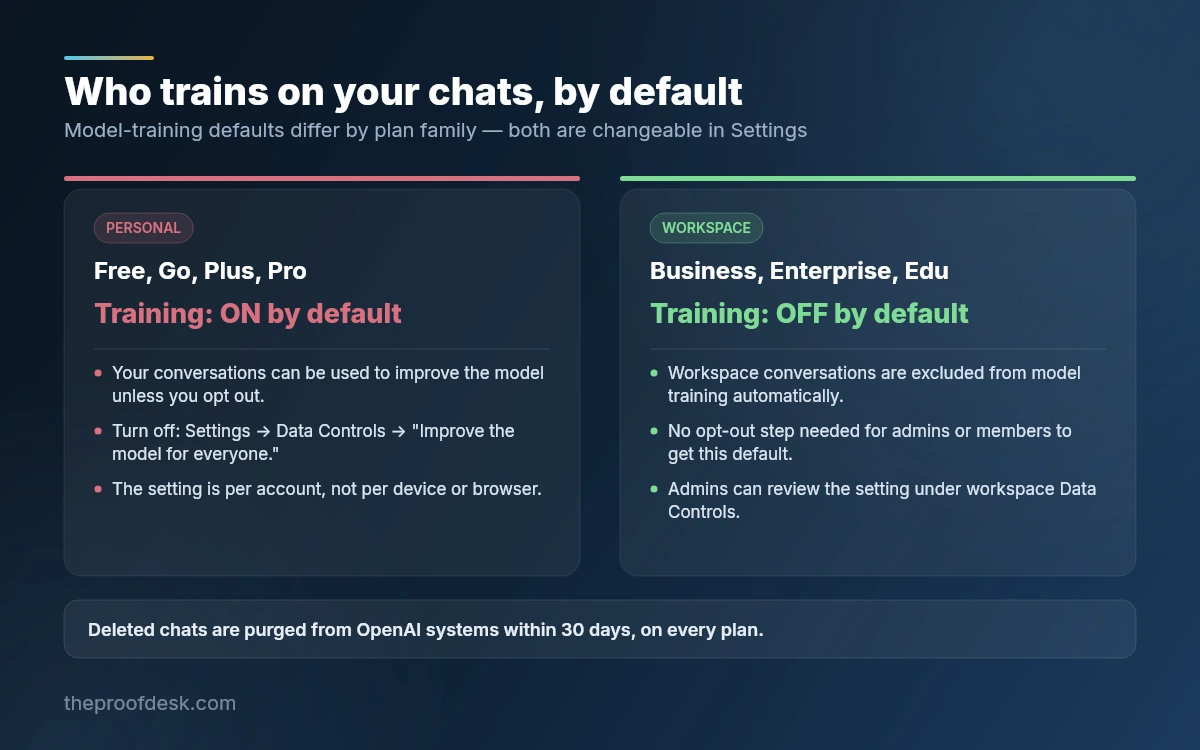
On a personal account, paying does not opt you out of training. OpenAI states: "If you are on a ChatGPT Plus, ChatGPT Pro or ChatGPT Free plan on a personal workspace, data sharing is enabled for you by default, however, you can opt out of using the data for training." A $200/month Pro subscription has the same default as a free account.
Turning it off takes one toggle, and OpenAI documents the exact path: "navigate to Your Profile > Settings > Data Controls > Improve the model for everyone > Switch off the toggle. Once you opt out, new conversations will not be used to train our models. As a separate control, this can also be applied to Voice mode." Note the word new — the switch is not retroactive.
Business plans invert the default: "By default, we do not train on any inputs or outputs from our products for business users, including ChatGPT Business, ChatGPT Enterprise, and the API." The same split governs connectors — data pulled from a connected app may be used for training on Free, Go, Plus and Pro if the training toggle is on, and is excluded by default on Business, Enterprise and Edu.
Deletion is documented at 30 days across tiers. On Free, Plus and Pro, a deleted chat "is removed from your account immediately and scheduled for permanent deletion from OpenAI systems within 30 days, unless we are required to retain it for legal or security reasons." Team, Enterprise and Edu carry the same 30-day window.
That legal carve-out has not been hypothetical. The blanket retention order from the New York Times litigation ended on 26 September 2025, and OpenAI said it had "returned to our standard data retention practices." A later update, dated 16 December 2025, describes a narrower ongoing obligation: "we are obligated to comply with the Magistrate Judge's order while we continue to fight this invasion of user privacy... The data we are making accessible to comply with this order has undergone a de-identification process intended to remove or mask PII." That December 2025 entry is the most recent statement OpenAI has published on its own litigation page; anything more current circulating about the case is not confirmed there.
Business and Enterprise seats
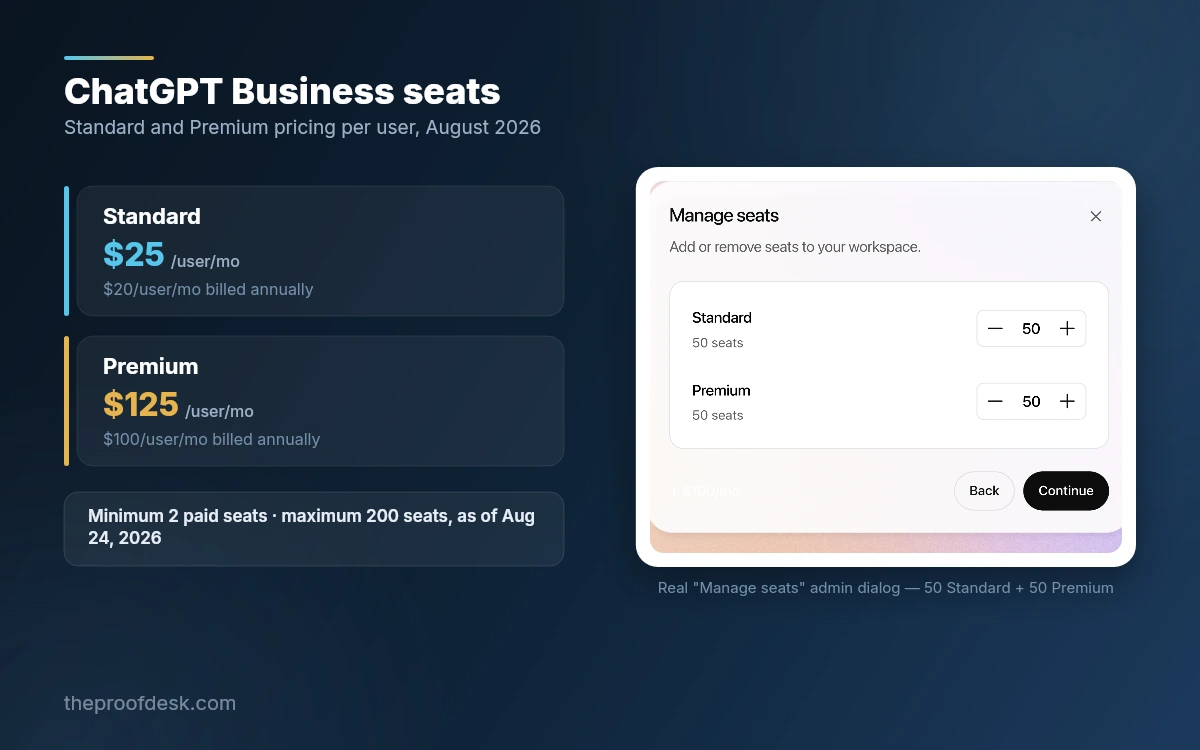
ChatGPT Team was renamed ChatGPT Business in August 2025, and a second seat class landed a year later — Premium seats became available on Business on 25 August 2026. Current per-user pricing:
- Standard seat — $25/user/month, or $20/user/month billed annually.
- Premium seat — $125/user/month, or $100/user/month billed annually.
- Minimum — "A workspace requires at least two paid seats, which can be any combination of Standard and Premium seats."
- Maximum — as of 24 August 2026, 200 paid Standard and Premium seats total per Business subscription.
- Enterprise — no list price; "Contact our sales team to discuss enterprise pricing," with credit-based and token-based options available.
The premium seat is the only place in the consumer-to-business range where the 5-hour rolling window disappears entirely, which is the real product being sold at $125. If a handful of people in a team are the ones actually hitting caps, mixing seat classes is cheaper than upgrading everyone.
Two things to plan around before committing. Seats are non-refundable — "Unused ChatGPT seats are non-refundable once the workspace has committed to the seat count for that billing cycle" — so buy to current headcount rather than projected. And nonprofits should not pay list: OpenAI offers "up to a 75% discount on ChatGPT Business or ChatGPT Enterprise" through OpenAI for Nonprofits.
What changed in 2026
If you last looked at chatgpt.com a year ago, these are the changes that alter a buying decision:
- 16 January 2026 — ChatGPT Go rolled out globally at $8/month in the US, creating a real tier between free and Plus.
- 11 March 2026 — GPT-5.1 retired, beginning a fast run of model replacements through the year.
- 9 April 2026 — a $100/month Pro tier arrived alongside the $200 one.
- 26 April 2026 — the Sora web and app experiences were discontinued; the Sora API follows on 24 September 2026.
- 9 July 2026 — the app directory was migrated to the Plugin directory.
- 15 July 2026 — custom instructions expanded to 5,000 characters, up from 1,500, on Plus, Pro, Business, Enterprise and Edu.
- August 2026 — the GPT-5.6 Luna, Sol and Terra variants rolled out, with Luna becoming the Free and Go default.
- 25 August 2026 — Free accounts capped at three active scheduled tasks; webhook-triggered tasks closed to Free and Go.
The Sora removal is the one most likely to catch someone out. If video generation is what you were subscribing for, it is no longer part of what chatgpt.com sells, and no tier restores it.
Unresolved: who can build custom GPTs
OpenAI's pricing table lists "Create & share GPTs" as available on Go, Plus and Pro. Two help center articles say the opposite: "New GPT creation and publishing are not available on personal ChatGPT accounts, including Free, Go, Plus, and Pro," with creation limited to Business, Enterprise and Edu workspaces subject to permissions. Both are official OpenAI pages and they disagree. The two help articles agree with each other and were updated more recently, which makes the pricing-table cell the likelier stale one — but if custom GPTs are your reason for subscribing, confirm inside the product before you pay.
Billing, cancelling and refunds
There is no free trial of Plus or Pro. OpenAI's plan pages go straight from the free tier to a paid call to action, and no trial period is documented anywhere in the help center. The free tier is the trial.
Cancelling is self-service — Settings, then Billing, then Cancel plan — and OpenAI is blunt about what it does and does not do: "Canceling stops future renewals. It does not automatically refund previous charges." Paid features stay live until the end of the billing period you already paid for, and the cancellation has to land "at least 24 hours before your next billing date" to stop the next charge.
Refunds are discretionary in most of the world and statutory in some:
- General rule — "Accidental purchases are generally eligible for a refund if you contact us within 14 days of the charge."
- Processing — 5–7 business days for purchases made on chatgpt.com, 10 business days via Google Play.
- EU, UK and Turkey — "you are eligible for a prorated refund if you cancel your subscription within 14 days of purchase."
- Republic of Korea — a full refund within 7 days if the service was not used in that time, otherwise pro-rated.
- Business seats — non-refundable once the seat count is committed for the billing cycle.
On eligibility: the terms of use published 1 January 2026 set the floor at "at least 13 years old or the minimum age required in your country," with parental permission required under 18. ChatGPT is offered in roughly 200 countries and territories, and OpenAI warns that "accessing or offering access to our services outside of the countries and territories listed below may result in your account being blocked or suspended" — relevant if you plan to use a VPN to reach it from an unsupported market.
Who should pay for what
Stay on Free if your use is everyday text. Unlimited chat on GPT-5.6 Luna is a genuinely capable free tier, and the things it withholds — Sol, legacy models, generous uploads — are things most casual users never reach for.
Go at $8 is the weakest value in the lineup for anyone choosing on capability. It raises your instant context from 27K to 54K and lifts tool allowances, but it does not unlock GPT-5.6 Sol, which is the capability people actually upgrade for. It makes sense mainly in markets where localized pricing puts it far below $8 and Plus is out of reach.
Plus at $20 remains the default recommendation. It is the cheapest seat that reaches Sol, legacy models and a 256K reasoning context, and for steady daily work it is rarely the limits that bite.
Pro at $100 is a throttling fix, not a capability upgrade — with the exception of Extra High reasoning and the 400K context, which Plus does not get. Buy it when you are being cut off, not in anticipation. Pro at $200 only earns its place at genuinely heavy volume, since it buys 20x Plus usage against the $100 tier's 5x.
Move to Business the moment more than one person is involved, and not only for administration. At $25 per seat it costs more than Plus, but it flips the training default to off, which no amount of money buys on a personal plan without remembering to set a toggle. That alone justifies the difference for anything work-related.
Sources checked
Every figure above was taken from an OpenAI-operated page in August 2026. Prices and limits on chatgpt.com change often — check these before acting on anything here:
Frequently asked questions
How much does ChatGPT cost per month in 2026?
Free is $0, Go is $8, Plus is $20, and Pro comes in $100 and $200 tiers — all per month. Business seats are $25 per user monthly or $20 annually for Standard, and $125 monthly or $100 annually for Premium. Enterprise pricing is quoted by sales rather than published.
Is there an annual plan that makes ChatGPT cheaper?
Not for individuals. OpenAI states it does not support annual billing or prepayment for Go, Plus or Pro. Annual billing exists only on Business seats, where it cuts a Standard seat from $25 to $20 and a Premium seat from $125 to $100 per user per month.
Does OpenAI train on my chats, and how do I stop it?
On personal Free, Go, Plus and Pro accounts it does by default. Switch it off at Your Profile → Settings → Data Controls → "Improve the model for everyone." The change applies to new conversations only, and there is a separate control for Voice mode. Business, Enterprise and Edu workspaces are excluded from training by default with nothing to toggle.
Is there a free trial of ChatGPT Plus or Pro?
No. There is no trial period for any paid tier; the free plan serves that purpose. Since cancelling never triggers an automatic refund, the smallest way to test a paid tier is to subscribe for one month and cancel at least 24 hours before the renewal date.
Can I get a refund if I subscribed by mistake?
Usually yes, if you move quickly. OpenAI says accidental purchases are "generally eligible for a refund if you contact us within 14 days of the charge," processed in 5–7 business days for chatgpt.com purchases. Residents of the EU, UK and Turkey have a statutory prorated refund within 14 days, and Korean residents a full refund within 7 days if the service went unused. Business seats are never refundable once committed.
What happens to my data when I delete a chat?
It leaves your account immediately and is scheduled for permanent deletion within 30 days, on every tier — unless OpenAI is legally required to retain it. That exception was exercised during the New York Times litigation, so treat 30 days as the normal case rather than a guarantee.
Is ChatGPT Go worth $8 instead of Plus at $20?
Only if the $12 difference matters more than model access does. Go does not unlock GPT-5.6 Sol — Free and Go both default to Luna — so Go buys a bigger instant context window and higher tool allowances, not better reasoning. Anyone upgrading for output quality should go straight to Plus.
Key takeaways
- Five consumer prices now exist — $0, $8, $20, $100 and $200 — and the two Pro tiers differ only in usage allowance, at 5x and 20x Plus respectively.
- GPT-5.6 Sol is the real paywall: Free and Go both default to Luna, so $20 Plus is the entry price for OpenAI's better reasoning models on chatgpt.com.
- Training on your conversations is on by default on every personal plan including $200 Pro; only Business, Enterprise and Edu are excluded by default.
- OpenAI no longer publishes numeric message caps for consumer tiers — only ChatGPT Business gets documented per-5-hour ranges, so the in-app counter is your only reliable guide.
- There is no free trial and no annual discount for individuals, and cancelling never refunds a charge you have already paid.
- Sora is gone from chatgpt.com as of 26 April 2026; no subscription tier brings video generation back.
More in Artificial Intelligence
Browse Artificial Intelligence