Rytr Review 2026: 9 Dollars a Month and Its Real Limits
Rytr stayed cheap while every rival moved upmarket. Unlimited costs 9 dollars a month, the free tier gives 10,000 characters, and long-form output is still the weak spot.
Almost every AI writing tool moved upmarket over the last two years. Jasper went after brand teams, Copy.ai turned itself into a go-to-market platform, and Writesonic now sells AI search visibility from 79 dollars a month. Rytr stayed exactly where it was: a text box, a list of templates, and an unlimited plan for the price of a sandwich.
That makes it either the best value left in the category or a tool that quietly stopped keeping up, and which one depends entirely on what you write. This review covers what Rytr charges in August 2026, what each plan actually unlocks, where the output holds and where it falls apart, and the FTC order that briefly made the company a cautionary tale.
What Rytr is, and what it is not
Rytr is a template-driven writing assistant. You pick a use case, type a short brief, choose a tone, and it returns a few variants you can keep editing in the same document. The company advertises more than 40 use cases and over 20 tones, and says 8 million people have signed up. Nothing about the interface has been reinvented for the agent era, and that is the point: the whole product is one screen you already understand.
- More than 40 use case templates, covering blog outlines, product descriptions, ad copy, emails and social posts.
- Over 20 tones, plus a tone of voice match feature that copies the style of a sample you supply.
- A built-in plagiarism check, metered per month rather than unlimited.
- A Chrome extension that puts the same generator inside the boxes you already type into.
- Support for 35 or more languages, though the pricing table reserves the full list for the top plan.
What Rytr is not is a research tool. It does not read the live search results, does not cite sources, and does not check whether a claim is true. Rytr also does not advertise which model sits behind the editor, so you cannot pick one, and you cannot assume the frontier release you saw in the news is what answers your prompt. The marketing leans on scale instead: 8 million sign-ups, 25 million hours saved, 500 million dollars of writing costs avoided. Those are company figures with no methodology attached, and none of them tell you how the tool handles your brief. Treat everything it produces as a first draft written by someone who has never seen your product.
What the three plans cost in 2026
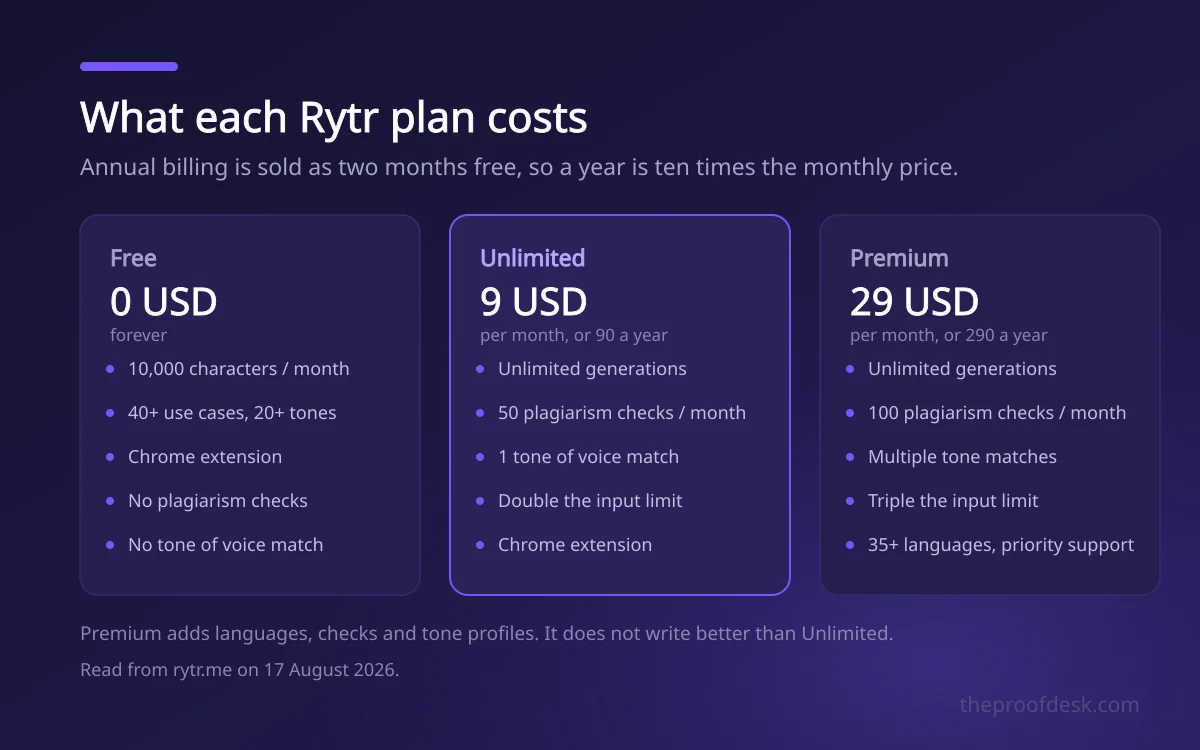
Rytr sells three tiers. Free gives you 10,000 characters a month with the full template and tone list, which is enough to test the tool properly rather than a demo that stops after one generation. Unlimited removes the character cap for 9 dollars a month, or 90 dollars if you pay for the year, which the site prices as 7.50 a month. Premium is 29 dollars a month, or roughly 290 dollars a year, shown as 24.16 a month. Annual billing is sold as two months free rather than a percentage, so the yearly figure is simply ten times the monthly one. The extra 20 dollars does not buy better writing. It raises plagiarism checks from 50 to 100 a month, allows several saved tone profiles instead of one, triples the character limit on what you can paste in as input, unlocks the full language list and adds priority support. If you write in English and rarely run a plagiarism check, Unlimited is the same product for a third of the money.
What the pricing page does not sell
There is no team tier and no seat pricing, so a second writer means a second subscription, and there is no API plan, which rules out wiring Rytr into your own product. Set that against Copy.ai at 29 dollars a month for its chat tier and Writesonic starting at 79 on annual billing, and the position is clear. Rytr is the last mainstream AI writer still priced for one person doing their own marketing.
Where the output holds up
Short-form copy is where Rytr earns its keep. Product descriptions, ad variants, subject lines, meta descriptions, social captions and outline scaffolding all come back usable, and the speed matters more than polish when you need thirty variations of the same line. The tone control is genuinely useful here, because short copy lives or dies on register rather than on structure.
Long-form is the known weak spot, and it has been for years. Push past the first few hundred words and drafts start repeating ideas, drifting off the brief and reaching for the same stock openings. Because there is no research layer, every statistic, price and product claim it writes is invented unless you supplied it, so a finished article needs a fact pass that costs more time than the drafting saved. Writers who need sourced long-form usually end up paying several times more elsewhere.
Who the nine dollar plan is for
A solo marketer filling a content calendar, a store owner rewriting a few hundred product listings or a freelancer producing ad variants will earn the subscription back in a week. An agency that needs shared brand voices, an SEO team that wants briefs built from live search results, and anyone whose output has to be factually defensible are all buying the wrong tool, and no amount of prompting fixes a missing research layer. So spend the free 10,000 characters on the worst job you actually have rather than the easiest one. If that job is fifty product descriptions, Rytr looks like a bargain. If it is a 2,000 word guide that has to be accurate, you will hit the ceiling before the free tier runs out.
The FTC order that came and went
In September 2024 the Federal Trade Commission filed a complaint over Rytr's Testimonial and Review use case, arguing that the feature produced detailed reviews full of specifics the user never supplied, so anyone who published them would almost certainly be posting something false. A final consent order followed in December 2024 and barred Rytr from selling a service dedicated to generating consumer reviews.
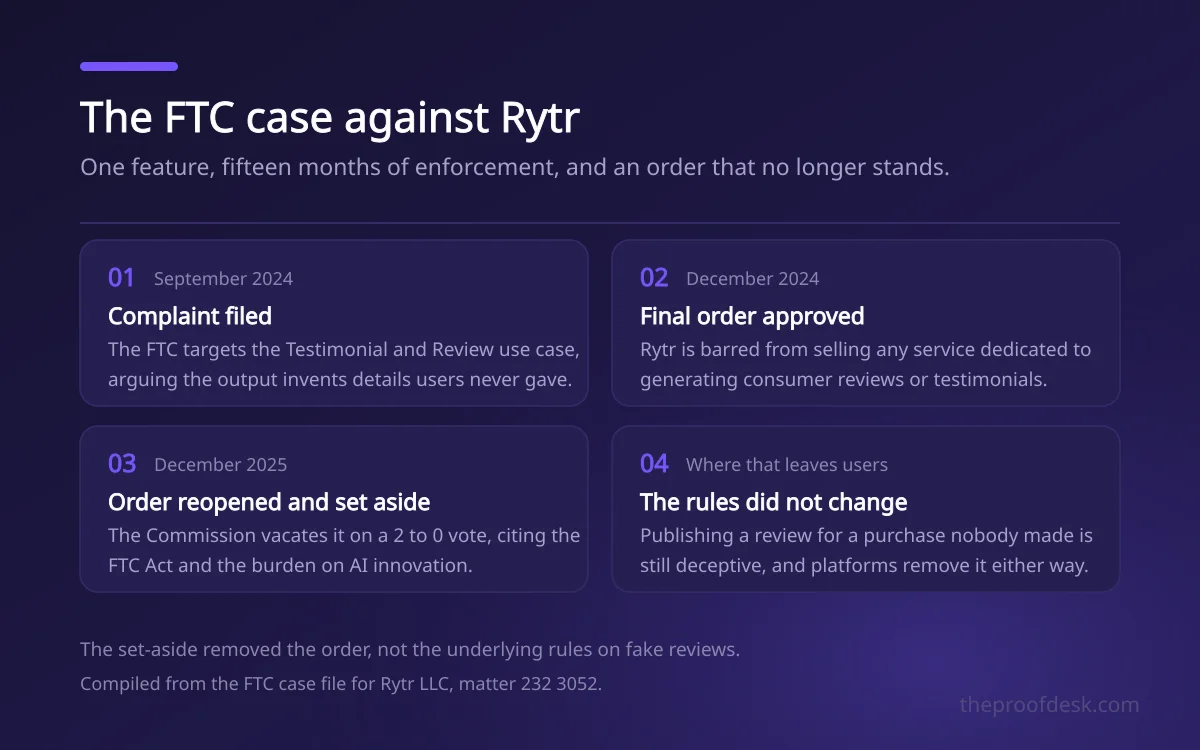
That is not where it ended. In December 2025 the Commission reopened and set the order aside on a 2 to 0 vote, saying the original complaint did not meet the legal requirements of the FTC Act and that the order placed an undue burden on AI innovation under the administration's AI Action Plan. The practical lesson has not changed for anyone using the tool. The order is gone, but publishing a review for a purchase nobody made is still deceptive on its own terms, and platforms remove it regardless of what any agency does.
Key takeaways
- Unlimited costs 9 dollars month to month or 90 dollars a year, and it exists mainly to remove the 10,000 character cap.
- The free plan is a real trial, with the full set of templates and tones rather than a crippled demo.
- Premium at 29 dollars buys languages, more plagiarism checks and extra tone profiles, not better writing.
- Use Rytr for short-form copy; long drafts drift and repeat, and nothing it writes is fact-checked.
- The FTC order over the review generator was set aside in December 2025, but faking testimonials is still deceptive.
More in Artificial Intelligence
Browse Artificial Intelligence