PrivadoVPN Review 2026: A Budget VPN That Quietly Moved to Iceland
PrivadoVPN is cheap and has a genuinely useful free tier, but in 2026 it relocated its legal home from Switzerland to Iceland. We review the price, the free plan and the features under that new footing — and flag the missing no-logs audit.
PrivadoVPN sells itself on two things: a price that undercuts almost every big-name rival, and one of the more usable free tiers in the business. Both claims mostly hold up. But the most important change to PrivadoVPN in 2026 has nothing to do with its feature list — it is where the company is now legally based.
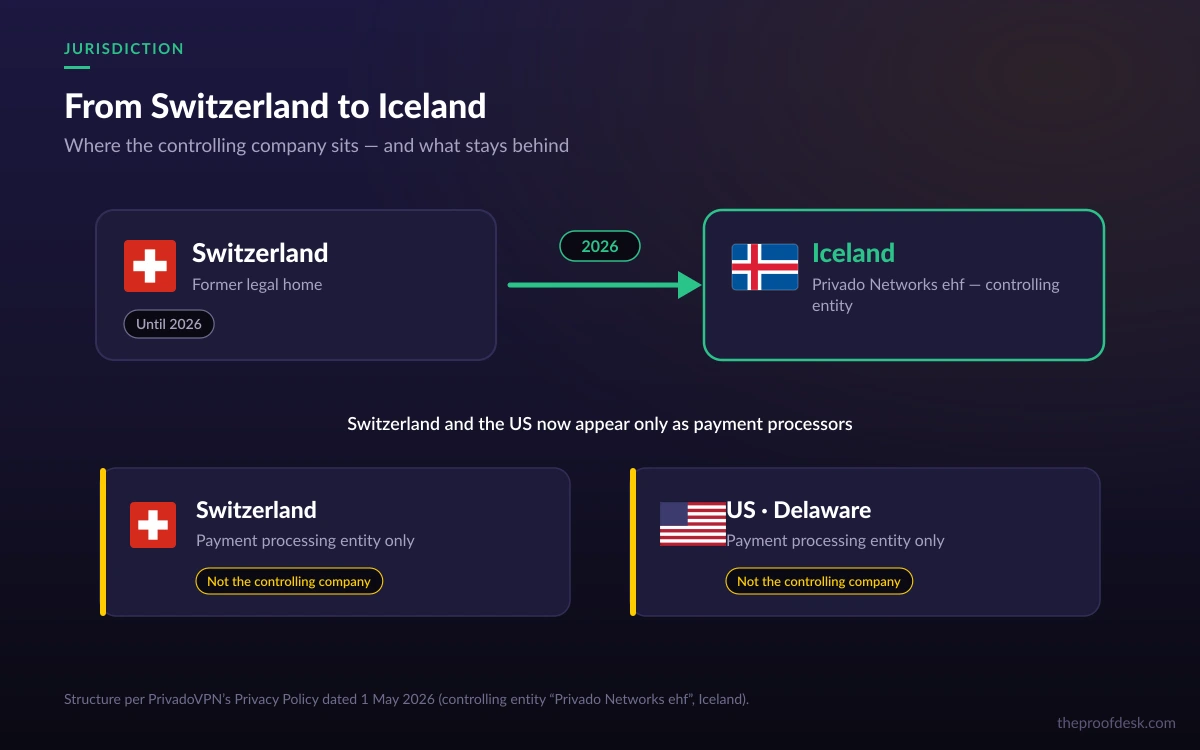
Sometime before its Privacy Policy update of 1 May 2026, PrivadoVPN moved its controlling entity from Switzerland to Iceland. For a privacy product that is not a footnote: buyers of a no-logs VPN are partly buying a jurisdiction, and the ground under this one shifted. This review looks at the plans, the free tier and the features, but it starts with that move, because it is the thing that should shape how much you trust the rest.
The quiet move from Switzerland to Iceland
For years PrivadoVPN's pitch leaned on being Swiss. Switzerland has strong consumer-privacy law and no mandatory data-retention regime for VPNs, and the company said as much. Its current Privacy Policy tells a different story.
The policy, last updated 1 May 2026, names the data controller as Privado Networks ehf — an Icelandic entity ("ehf" is Iceland's private-limited-company suffix). Data is described as processed in Iceland, Switzerland, the EEA and the United States, and the retention clauses now cite Icelandic bookkeeping law (Log um bokhald, No. 145/1994). The Swiss company and a Delaware LLC still appear, but only as payment-processing entities.
Why the move
Switzerland proposed expanding its surveillance law in a way that would have pushed VPN providers to identify users and retain data. Several privacy-focused providers reacted publicly. PrivadoVPN's relocation of its controlling entity to Iceland fits that pattern, even though the company has not made a loud announcement of it.
There is a loose end worth knowing about. PrivadoVPN's own marketing pages still describe the company as "based in Switzerland ... because they offer some of the strongest consumer privacy protections." That directly contradicts the current, dated Privacy Policy. We are not going to silently pick one version for you: the binding legal document says Iceland, the marketing copy still says Switzerland, and the two have not been reconciled on the site. Treat the Privacy Policy as the current fact and the marketing line as stale.
Plans and pricing
Pricing is where PrivadoVPN is easiest to like. The long-term plans are among the cheapest of any mainstream VPN, and they bundle three extra months on top of the term you pay for.
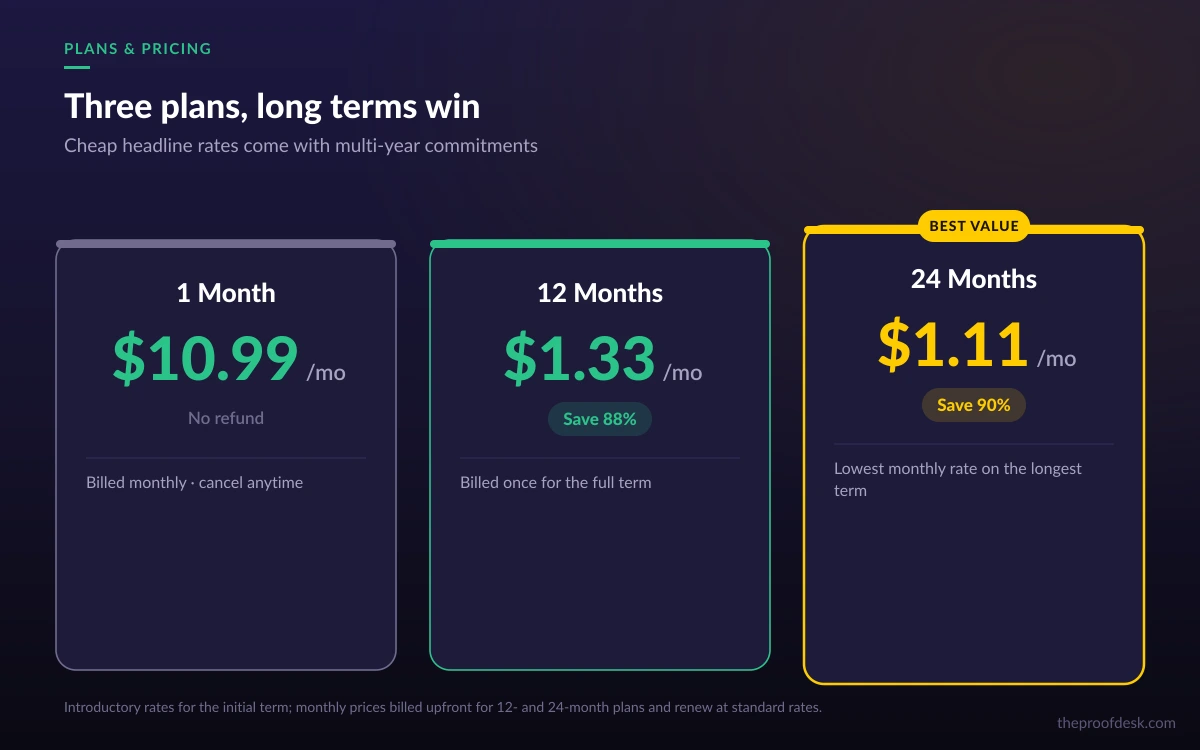
- 1-month plan: $10.99/month. Note the catch below — this plan is not refundable.
- 12-month plan ('12 Month Unlimited VPN + 3 FREE'): $1.33/month, marketed as 'Save 88%', with a 30-day money-back guarantee.
- 24-month plan ('24 Month Unlimited VPN + 3 FREE'): $1.11/month, marketed as 'Save 90%', with a 30-day money-back guarantee.
- Optional add-on: Antivirus for $1.99/month on the 12- and 24-month plans.
As with every VPN priced this way, the monthly figures are the effective rate after paying the whole term up front, and the 'Save 88%/90%' framing is measured against the $10.99 monthly price. The renewal price is not always the same as the introductory one, so check the figure at checkout before you commit to two years.
The refund fine print
The 30-day money-back guarantee applies to the 12- and 24-month plans only. The 1-month plan is explicitly non-refundable — the site's own structured data marks it MerchantReturnNotPermitted. If you want a trial-with-a-safety-net, buy a long-term plan and cancel within 30 days, not the monthly one.
Paid plans allow 10 simultaneous device connections, let you install the app on unlimited devices, unlock the full server list and include a SOCKS5 proxy.
The free plan: genuinely useful, genuinely limited
PrivadoVPN's free tier is one of the better ones, because it does not throttle you to uselessness or force a trial clock. But it is deliberately narrower than the paid product, and it helps to know exactly how.
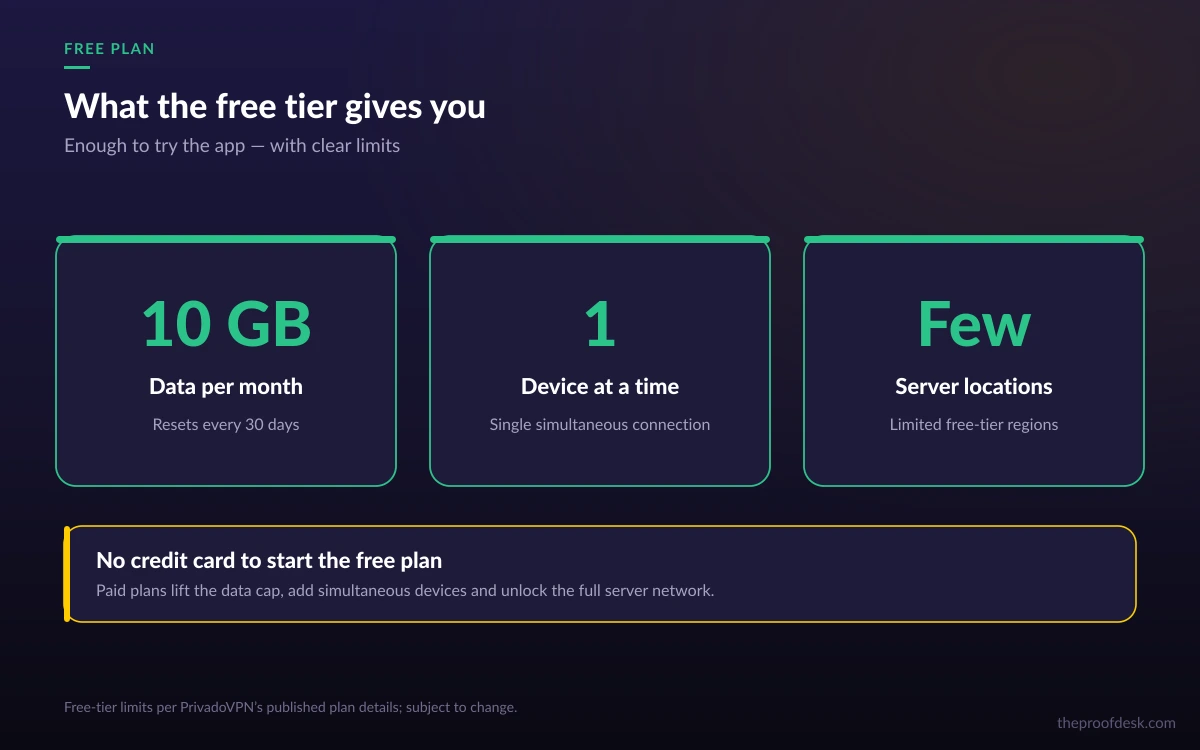
- 10 GB of data every 30 days. When you hit the cap you either upgrade or fall back to a small set of free 'emergency' servers.
- A handful of server locations only, not the full list.
- One device at a time.
- No SOCKS5 proxy.
For light use — occasional public-WiFi protection, a bit of geo-shifting, testing whether the apps suit you — 10 GB a month is workable. For streaming, large downloads or covering a household of devices, you will run through the cap quickly and the single-device limit will bite. Do not conflate the free tier's constraints with the paid plans; they are different products that share an app.
Features and protocols
On protocols, PrivadoVPN covers the modern bases. It supports OpenVPN, IKEv2/IPSec and WireGuard, and it offers manual configuration generation for WireGuard and OpenVPN if you want to set up a router or a device without the app.
For server reach, PrivadoVPN's static server table lists 48 countries and 65 cities. Worth being precise here: the company does not publish an exact total server count anywhere static. The 'hundreds of servers' phrasing on its site is its own marketing language, and the live city/server counters on the page are populated by JavaScript, so we are citing the country and city figures we could count directly rather than a headline server number the company never fixes in place.
What comes bundled on paid plans
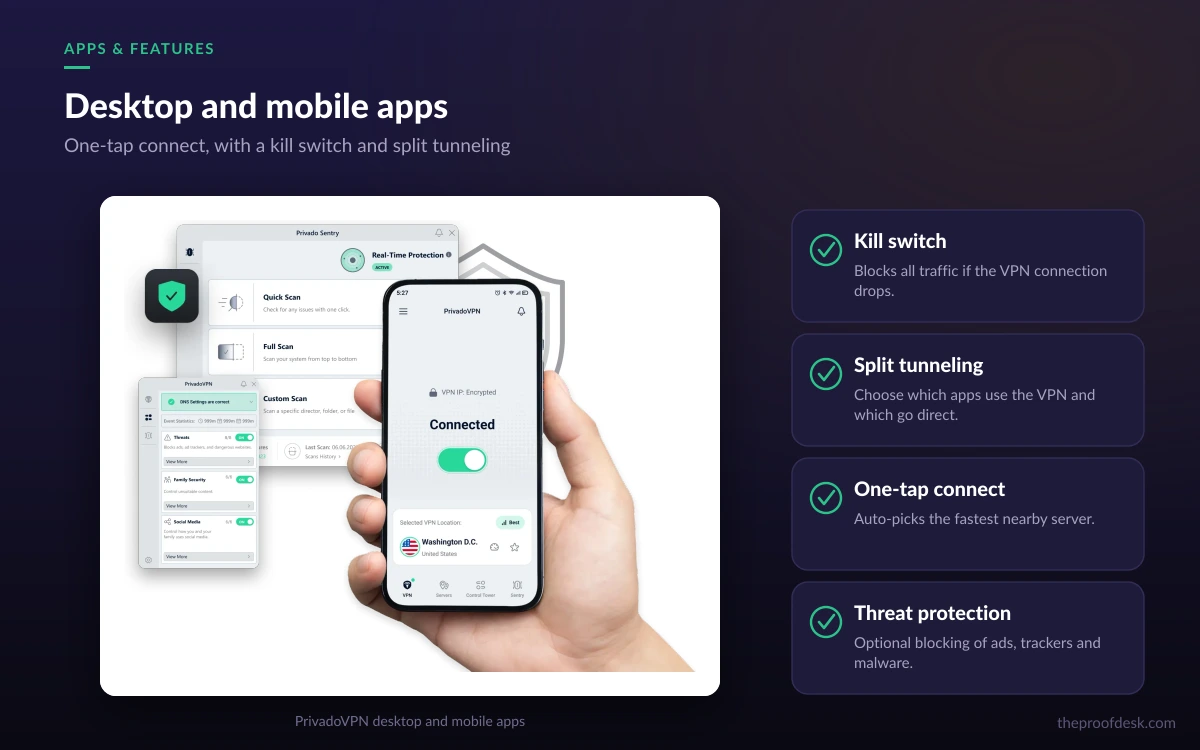
- A kill switch that keeps traffic inside the encrypted tunnel, including when the connection is not being actively monitored.
- Split tunneling, so you can pick which apps route through the VPN and which bypass it.
- Ad Blocker, Threat Prevention, Parental Controls, Smart DNS and an Email Relay.
- Apps for Windows, macOS, iOS, Android, Fire TV, Android TV, tvOS, plus Chrome, Edge, Firefox and Brave extensions.
Privacy and the audit that isn't there
PrivadoVPN makes the standard claim: 'we don't track any of your online activity.' A no-logs promise is only as good as the evidence behind it, and this is where PrivadoVPN falls short of its stronger rivals.
As of this review, PrivadoVPN has not published an independent, third-party no-logs audit on any page we could find. That matters more given the jurisdiction move: a relocation to Iceland can be a sound privacy decision, but it is a claim about the legal environment, not proof of what the servers actually store. Providers such as NordVPN, ExpressVPN and Proton VPN have commissioned repeated external audits; PrivadoVPN, at least publicly, has not. If an audited no-logs policy is a hard requirement for you, that gap should weigh heavily.
The honest summary
The Iceland move is a reasonable answer to a real regulatory threat, and the retention language is now tied to ordinary Icelandic bookkeeping law rather than anything VPN-specific. But 'trust the jurisdiction' is not the same as 'trust the verified behaviour.' Without an audit, you are taking the no-logs claim on the company's word.
Streaming and everyday use
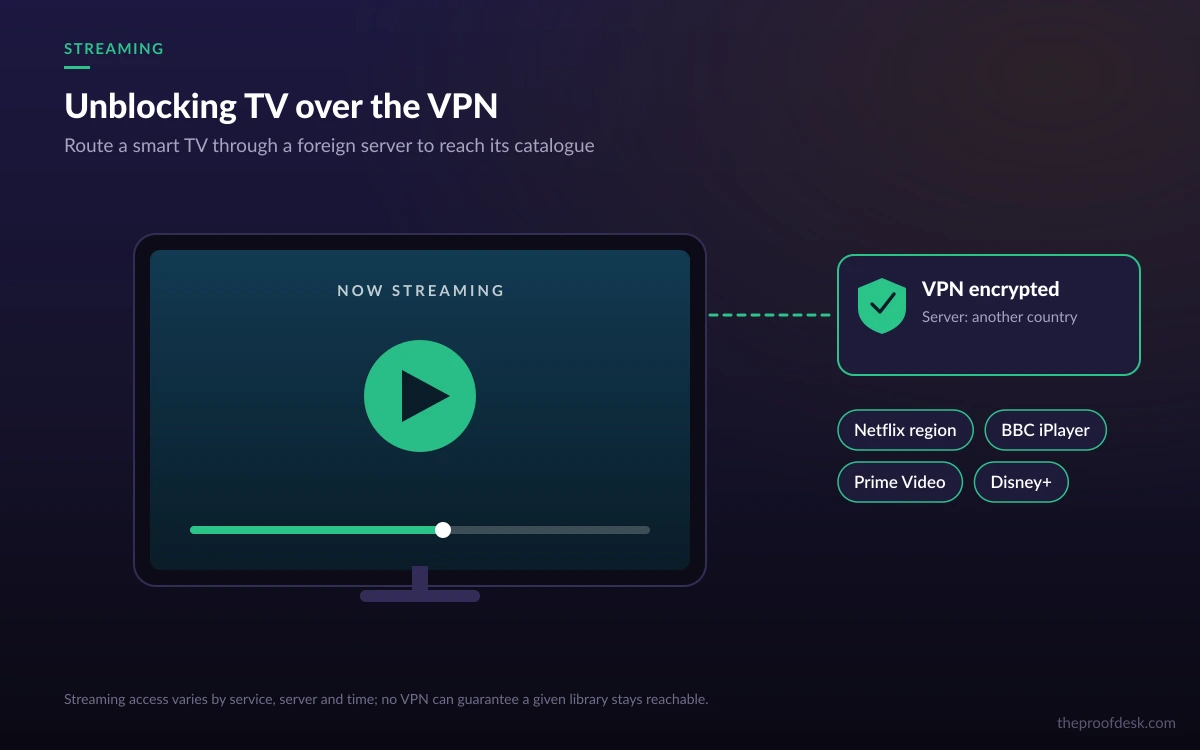
PrivadoVPN markets itself as a 'Best Netflix VPN' and says it can unblock regional Netflix catalogues by routing your IP through a chosen server location. Streaming unblocking is a moving target for every VPN — services actively fight it — so treat any such claim as 'works often, not always,' and lean on the money-back guarantee on the long plans if that is your main reason for subscribing.
For the everyday jobs most people actually buy a VPN for — encrypting traffic on public networks, shifting your apparent location, blocking trackers and ads — PrivadoVPN's paid tier is a competent, cheap option. The 10-device allowance and unlimited installs make it easy to cover a whole household, and the app spread is wide enough that most of your devices are supported.
Frequently asked questions
Where is PrivadoVPN based now?
Its current Privacy Policy, updated 1 May 2026, names the controller as Privado Networks ehf, an Icelandic company. Switzerland and a Delaware LLC remain only as payment-processing entities. Some of PrivadoVPN's older marketing pages still say 'based in Switzerland,' which contradicts the current policy — treat the dated Privacy Policy as the authoritative version.
How much does PrivadoVPN cost?
The 1-month plan is $10.99/month. The 12-month plan works out to $1.33/month and the 24-month plan to $1.11/month, each including three extra months. Antivirus is an optional $1.99/month add-on on the two long-term plans.
Is there a free version?
Yes. The free plan gives you 10 GB of data every 30 days, a limited set of server locations, one device connection and no SOCKS5 proxy. It is fine for light use but not for streaming or covering multiple devices.
Can I get a refund?
Only on the long-term plans. The 12- and 24-month plans carry a 30-day money-back guarantee; you contact customer support for a full refund. The 1-month plan is explicitly non-refundable, per the site's own structured data.
Has PrivadoVPN's no-logs claim been independently audited?
Not that we could find. PrivadoVPN states it does not track your activity, but we found no published independent third-party no-logs audit on any of its pages. That is a meaningful gap compared with several larger competitors.
How many devices can I use at once?
Paid plans allow 10 simultaneous connections and let you install the app on unlimited devices. The free plan is limited to one device at a time.
Key takeaways
- In 2026 PrivadoVPN's controlling entity moved from Switzerland to Iceland (Privado Networks ehf); its Privacy Policy of 1 May 2026 is the authoritative source, even though marketing pages still say Switzerland.
- Pricing is a genuine strength: $1.11-$1.33/month on the long plans, versus $10.99 monthly.
- Refunds apply to the 12- and 24-month plans only (30 days). The 1-month plan is non-refundable.
- The free tier is useful but narrow: 10 GB/30 days, one device, limited servers, no SOCKS5.
- The biggest caveat is the absence of a published independent no-logs audit — you are trusting the claim, not verified behaviour.
More in Virtual Private Network
Browse Virtual Private Network