Private Internet Access Review 2026: Prices, Renewals and Real Limits
A close look at Private Internet Access in 2026: what each plan actually renews at, the 30-day refund rules, unlimited devices, three Deloitte audits, and where PIA falls behind on speed and streaming.
Private Internet Access has been around long enough to have a track record rather than a launch pitch. It is one of the cheapest VPNs on a long term, it puts unlimited devices on a single subscription, and it has been subpoenaed in open court and produced nothing. Those are unusually concrete claims for this category.
It also carries three things buyers should weigh before subscribing: a US corporate home in a country with no data-retention shield, ownership by Kape Technologies, and speed results that independent testers keep describing as mid-pack. This review works through the pricing as it actually renews, the plan limits, the privacy record, and the places where PIA is genuinely weaker than its rivals.
All prices and policy wording below were read directly from PIA's own pages on 28 August 2026. VPN pricing is promotional and changes often, so treat the figures as a snapshot and check the order page before you buy.
What Private Internet Access is in 2026
PIA is a consumer VPN with desktop apps for Windows, macOS and Linux, mobile apps for iOS and Android, browser extensions for Chrome, Opera and Firefox, and support for routers, Android TV and Fire TV. The apps are open source, which is rarer in this market than the marketing implies: PIA states that "PIA's apps are all open-source, meaning you can inspect our code any time you like."
The company is registered in the United States. Its about page gives the address as "PIA Private Internet Access, Inc. 2590 Welton St. Suite 200 Denver, CO 80205 United States" and frames the US base as deliberate: "Private Internet Access is based in the United States to offer our customers the best possible VPN service." Whether that is a feature or a flaw depends entirely on your threat model, and the privacy section below takes it seriously rather than waving it away.
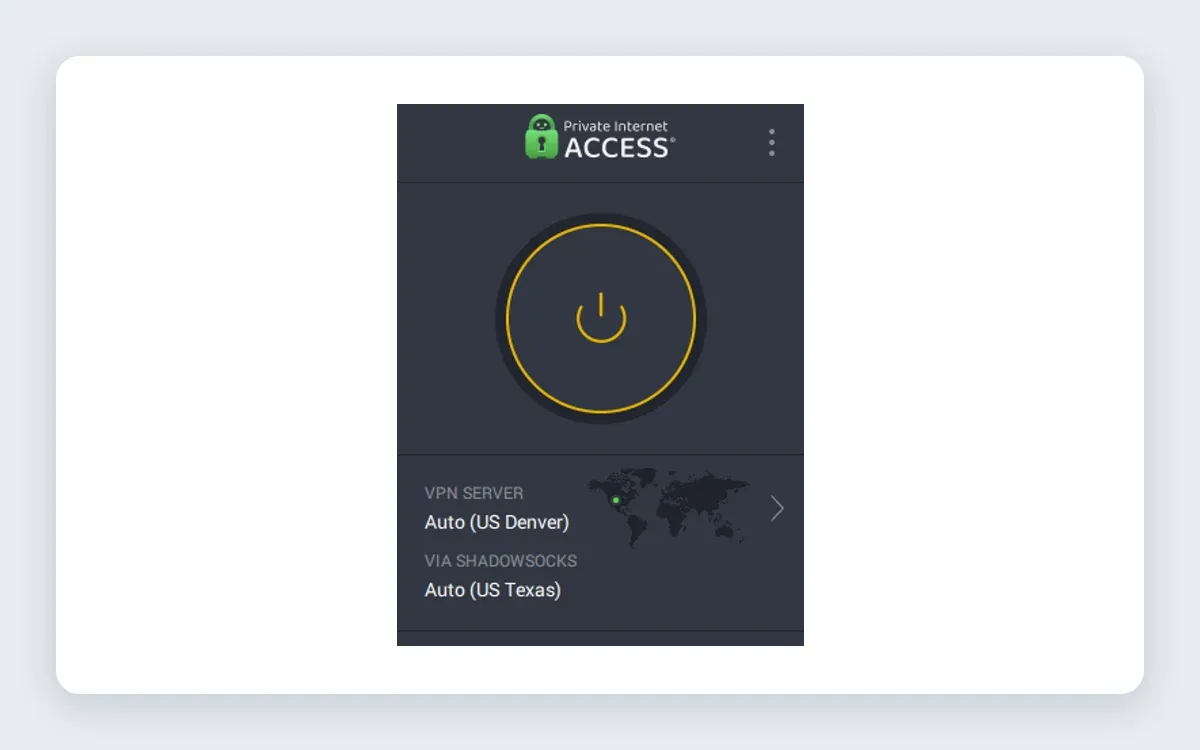
The app itself is deliberately plain. One large power button, the current server underneath, and everything else pushed into a settings window. That suits people who connect and forget; people who want a dashboard of live statistics will find it sparse.
Pricing: what you pay now and what you pay at renewal
PIA does not publish a static price table anywhere. Its own help centre says only that three website subscriptions exist at any time and then directs you to "Visit the PIA order page to view current subscription and add-on prices." That matters, because the order page is promotional and the promotion changes the maths.
On 28 August 2026 the order page was running a "Campus SALE: 83% Off" banner and showed three plans:
- 1 month — $11.95/mo, described on the card as "Autorenews at $11.95 monthly".
- 1 year — $3.99/mo, described as "Billed at $47.88 first year and then autorenews annualy at $47.88".
- 3 years + 3 months extra — $2.03/mo, roughly $73.08 charged up front for the 36-month term, described as "Autorenews at $79 every 3 years".
The renewal detail that actually matters
PIA is unusual in not hiding a renewal cliff. The annual plan renews at the same $47.88 it charged the first year, and the three-year plan renews at $79 for another three years — about $2.19 a month. Most rivals advertise a low first term and then renew at a much higher standard rate. Here the second term is close to the first.
One caveat worth stating plainly: PIA appears to vary its plan lengths by visitor, region or campaign. Security.org's PIA page, dated 7 August 2026, lists a $11.99 monthly price, a six-month plan at $7.50/month and a "2-Year + 4 Months Free" plan at $56.94 — a structure that did not appear on the order page we loaded, which offered only one-month, one-year and three-year terms. If the page you see does not match the figures above, that is why. Read your own checkout screen before you pay.
Add-ons are handled the same way. PIA's order page says only that "These add-ons can be selected under your order's details on the checkout page," and no static price for the dedicated IP or the antivirus add-on is published on the site. Security.org reports the dedicated IP at $5 per month on a monthly plan falling to $2.50 per month on a two-year plan, and antivirus at $4.50 per month falling to $1.45 per month on a two-year plan, but those are third-party figures we could not confirm against a live PIA checkout. Budget for them as an unknown until you reach the payment step.
Refunds, trials and cancellation
The guarantee is 30 days, and the conditions are stricter than the headline. PIA's money-back guarantee page states: "we offer a 30-day money-back guarantee on all our plans... Note: to qualify for our money-back guarantee, you must be a new user who has purchased a plan in the previous 30 days and who hasn't requested a refund in the previous 3 months. Money-back guarantee does not apply to Apple App store subscribers."
The help centre adds two more exclusions. Purchases made with gift cards or through third-party deal sites are non-refundable. And if PIA contacts you to verify your account during the refund process, "you must respond within 30 days. Failure to do so will forfeit your refund eligibility." Refunds must be requested through a support ticket, and PIA warns it "may take 5–10 business days or more for the refund to appear in your account."
- Bought on the PIA website with a card or PayPal — 30-day refund, requested by support ticket.
- Bought through the Apple App Store — not covered; you must go to Apple Support, which grants refunds at its own discretion.
- Bought through Google Play — cancel in your Google Play account first, then contact PIA.
- Bought via a gift card or a deal site — no refund at all.
- Refunded once already in the last three months — not eligible again.
There is no free trial on the website. There is one in the mobile apps: PIA's iOS purchase guide says "You can choose from a 7-day free trial with an annual subscription, or select See Other Plans to choose a monthly subscription without a free trial." That is a real way to test the service for nothing, but note the trade-off — an App Store subscription is exactly the purchase route excluded from the 30-day guarantee.
Devices, servers and bandwidth
Connections are unlimited. PIA's help centre is unambiguous: "Private Internet Access (PIA) allows an unlimited number of simultaneous connections on a single subscription." Bandwidth is uncapped too — the money-back guarantee page promises "Unlimited bandwidth to stream, game, and torrent as much as you want."
A stale claim still on the site
The pricing page's own SEO meta description still reads "for up to 10 devices simultaneously." That is old copy that contradicts both the marketing body text and the help centre. Unlimited is the current, operative policy; the 10-device line is a leftover, not a limit anyone should plan around.
Coverage is 91 countries. PIA's most recently updated help article says it "offers server locations in 91 countries, including standard, streaming-optimized, city-level, and virtual locations," while the homepage still says 90. Notably, PIA no longer publishes a server count at all. Where it used to advertise tens of thousands of servers, it now talks about 10 Gbps hardware and city-level coverage instead — including servers in all 50 US states, which is genuinely unusual and useful if you need a specific state's IP.

Features that earn their place
PIA's settings window is where the product stops being plain. The sidebar alone runs to ten sections, and several of them hold features that competitors charge more for or do not offer.
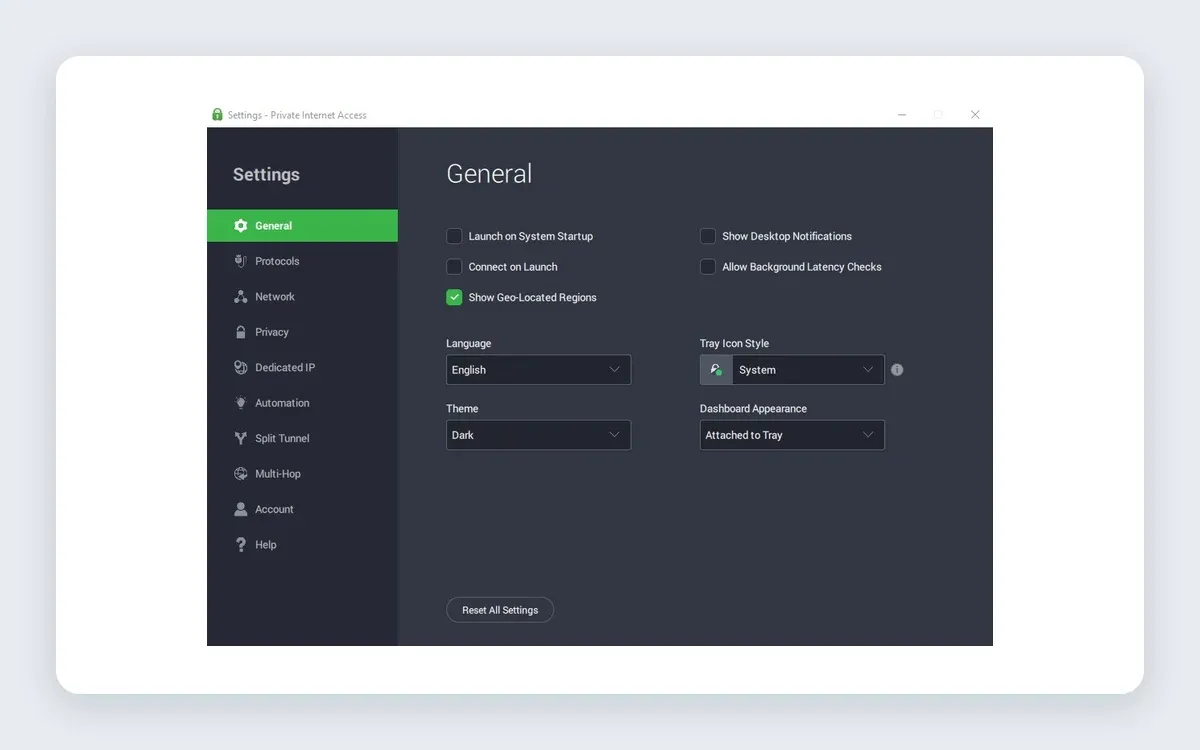
- Kill switch — on by default. Windows also gets an Advanced Kill Switch that "makes a VPN connection a requirement for internet access. It works even when the PIA app is closed."
- MACE — DNS-level ad, tracker and malware blocking. It sinkholes blocked domains rather than filtering in the browser, so it works across every app on the device.
- Split tunnelling — per-app and per-IP rules, either bypassing the VPN or requiring it, with DNS behaviour configurable on Windows and Linux.
- Port forwarding — available on selected servers, aimed squarely at torrent throughput.
- Multi-hop and obfuscation — route through a second server via Shadowsocks (encrypted) or SOCKS5 (unencrypted, manual setup), or wrap traffic in SSL so it reads as ordinary HTTPS to your ISP.
- Identity Guard — monitors up to two email addresses against breach databases. PIA says this "comes with your PIA subscription," so unlike the dedicated IP and antivirus it costs nothing extra.
On protocols, PIA ships WireGuard and OpenVPN, both open source, and exposes more of their configuration than most consumer apps bother to. You can pick the transport, the remote port, the data encryption cipher and the MTU rather than accepting whatever the app decides.
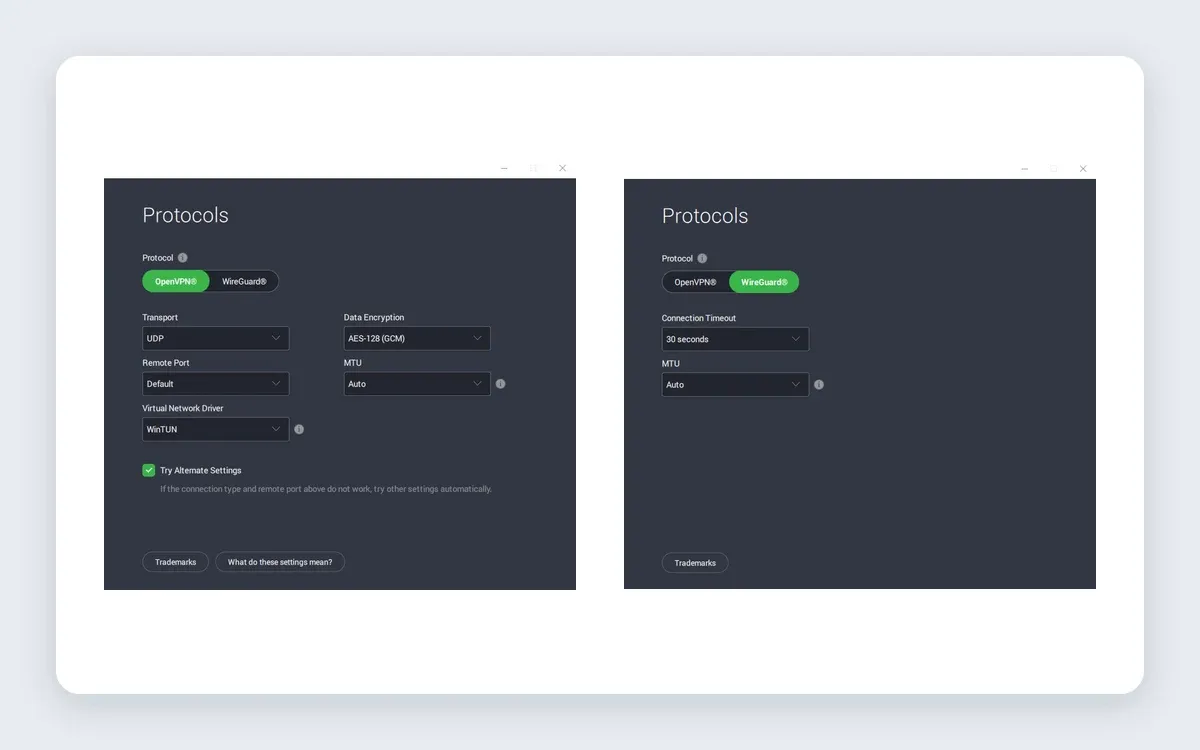
The asymmetry in that screenshot is the point. WireGuard is fast because it does not offer choices, and OpenVPN is configurable because it needs to be. If you have no idea what MTU means, leave both on Auto and use WireGuard.
Streaming and torrenting
PIA supports P2P on every server — "Enjoy full support for torrenting on every PIA VPN server" — and pairs that with port forwarding, which is the combination torrent users actually want. On this use case PIA is a strong pick, and the unlimited-device policy means the seedbox, the laptop and the router can all be covered by one subscription.
Streaming is the weaker half. PIA maintains dedicated streaming-optimised locations, which you find by typing "streaming" into the server search rather than by browsing a separate tab.
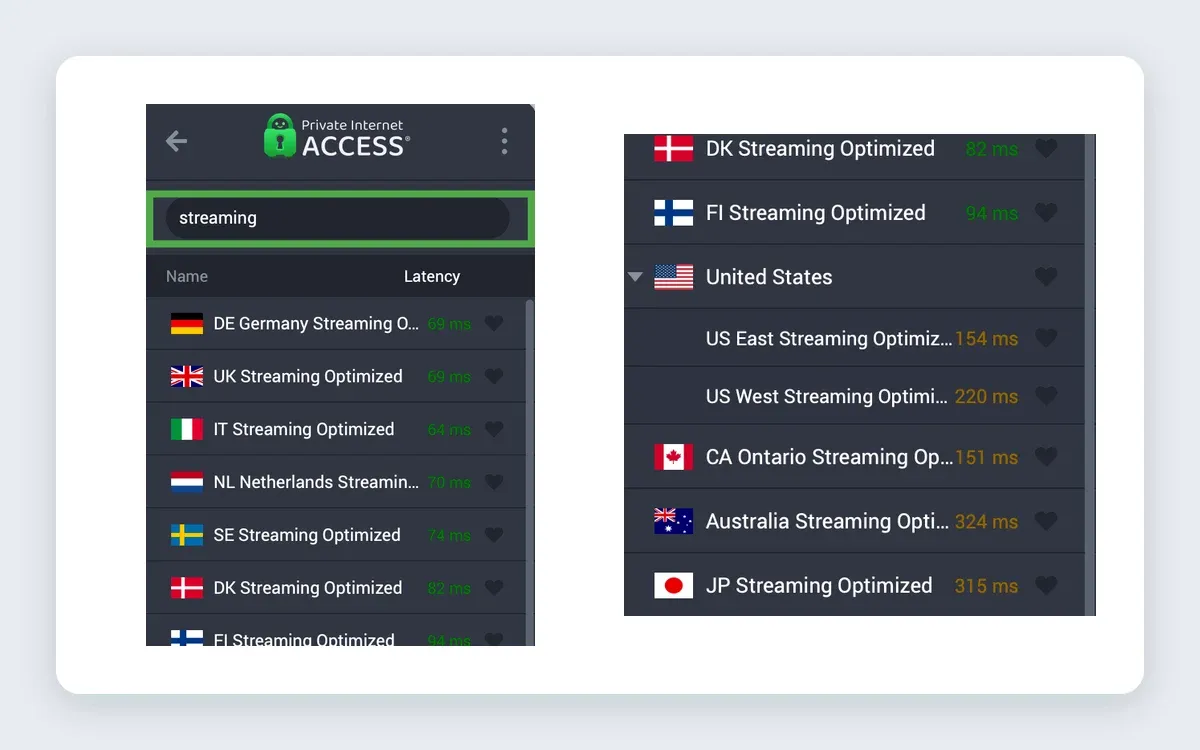
Whether they work is another matter. CyberInsider, updating its review on 4 February 2026, reports that "Private Internet Access hasn't consistently performed well for streaming in my past tests — Netflix, in particular, has been hit or miss." Cloudwards found the same pattern: it reached Netflix Japan but "the connection was too slow to load any TV shows or movies," and Disney+ and Hulu "would not load at all" during testing. If unblocking a specific catalogue is your main reason for buying a VPN, test it inside the 30-day window and be ready to ask for the refund.
Privacy: the court record, the audits, and the jurisdiction
PIA's no-logs page describes a narrow data footprint: "The only personal information we keep on file is the email address you use to sign up for our service, your payment details, and your ZIP code (required for US tax purposes)." All servers are stated to run from RAM.
The evidence behind that claim is stronger than most. Deloitte Audit Romania has now completed three independent reviews of PIA's infrastructure under the ISAE 3000 (Revised) assurance standard, the most recent examining "how our configurations, management systems, and dedicated IP technology align with our long-standing no-logs policy," following earlier audits PIA dates to 2022 and 2024. We could not pin the exact completion date of the third audit from PIA's own page, which carries only an "Updated on Feb 24, 2026" stamp.
There is also a court record, which is rarer than an audit. PIA's transparency report — last updated 6 August 2026, covering Q2 2026 — logs 4 subpoenas, 2 warrants, 7 other government or civil requests and 6 foreign or informal requests, with zero logs produced against every one. The company points back to being "subpoenaed for user activity logs in 2016 and 2017" and producing nothing. TorrentFreak reported a second courtroom instance in 2018, in which PIA's general counsel testified "that he was not able to produce any useful information ... as VPNs do not retain logs of users' internet activities."
The jurisdiction question
PIA is a US company, and the US has no law preventing authorities from compelling a business to begin logging a specific customer going forward. A no-logs policy protects data that was never collected; it does not by itself prevent a future order. The audits and court record show PIA had nothing to hand over on the days it was asked. Both facts are true at once, and neither cancels the other.
CyberInsider puts the concern directly: PIA operates "in a jurisdiction where the US government can legally force businesses to log customer data and provide this to authorities," and adds that strict US copyright enforcement makes it "a questionable choice for certain use cases." If your threat model includes a US state actor, a provider based in Switzerland or Panama removes a variable that no audit can remove.
Where PIA falls short
Three criticisms recur across independent reviews, and all three are fair.
- Speed. CyberInsider's February 2026 testing on a Seattle server returned 299 Mbps and concluded "this is definitely slower than average" and that "with PIA servers in the United States, it is clear that this is not a fast VPN." Cloudwards saw US speeds hold up better than international ones, with "significant dips in speed in South Africa" and weaker international download results than rivals.
- Streaming reliability, covered above — inconsistent on Netflix, and outright failures on Disney+ and Hulu in Cloudwards' testing.
- Ownership. PIA is owned by Kape Technologies, which also acquired ExpressVPN in 2021. PIA's own about page does not mention Kape anywhere, which is itself a transparency gap for a company that markets on transparency. CyberInsider lists being "part of a large VPN conglomerate (Kape Technologies)" as a drawback, and Cloudwards notes "some users have expressed concerns about this change" since the 2019 acquisition.
Add to those a smaller irritation: PIA hides add-on pricing behind the checkout flow and varies plan structures between visitors. Neither is dishonest, but both make it harder to compare PIA against a competitor without starting a purchase.
Who should buy it
PIA is a good fit if you want broad, cheap coverage across a lot of devices and you care more about a demonstrated privacy record than about topping a speed chart. A household with a dozen devices, a torrent user who wants port forwarding on every server, or someone who needs an IP in a specific US state will all get more from PIA than from a pricier rival.
Look elsewhere if your priority is reliably unblocking a particular streaming catalogue, if you want the fastest possible long-distance connection, or if non-US jurisdiction is a hard requirement. Those are the three areas where the money buys something PIA does not sell.
The practical route in: take the three-year term if you are confident, since the renewal stays close to the intro price and the maths is genuinely good, but test streaming and speed in the first week so the 30-day guarantee is still available if it disappoints.
Frequently asked questions
Does Private Internet Access get more expensive when it renews?
Barely, which is unusual for this market. The order page states the annual plan is "Billed at $47.88 first year and then autorenews annualy at $47.88," and the three-year plan "Autorenews at $79 every 3 years" — about $2.19 a month against the $2.03 intro rate. The monthly plan renews at the same $11.95. There is no large second-term price jump of the kind most VPN vendors apply.
How many devices can I use on one subscription?
Unlimited. PIA's help centre states it "allows an unlimited number of simultaneous connections on a single subscription," with unlimited bandwidth as well. You may still see an old "up to 10 devices" line in the pricing page's search-engine description; that is stale copy, not the current policy.
Is there a free trial, or only a refund?
Both, but not on the same purchase. The website has no trial and relies on the 30-day money-back guarantee. The iOS and Android apps offer a 7-day free trial with an annual subscription. The catch is that App Store purchases are explicitly excluded from the 30-day guarantee, so refunds on that route go through Apple at Apple's discretion.
What disqualifies me from the 30-day refund?
Four things. Buying through the Apple App Store, buying with a gift card or through a third-party deal site, having already taken a PIA refund within the previous three months, and failing to answer PIA's verification message within 30 days — the last of which "will forfeit your refund eligibility." Refunds are requested by support ticket and can take 5–10 business days or more to appear.
Has PIA's no-logs claim ever actually been tested?
Yes, in court and by auditors. PIA was subpoenaed for user activity logs in 2016 and 2017 and produced none, and in a 2018 federal case its general counsel testified he "was not able to produce any useful information." Deloitte Audit Romania has completed three ISAE 3000 (Revised) reviews of the infrastructure, and PIA's Q2 2026 transparency report shows zero logs produced against 19 requests of all kinds.
Does being a US company undermine the privacy claim?
It is a real limitation, not a fatal one. The US can compel a company to start logging a named user going forward, which no past audit can prevent, and CyberInsider flags this as making PIA "a questionable choice for certain use cases," particularly given strict US copyright enforcement. What the audits and court record do establish is that PIA held nothing to surrender when it was asked. If a non-US jurisdiction is a hard requirement for you, choose a Swiss or Panamanian provider instead.
Key takeaways
- Renewal prices barely rise: the annual plan renews at the same $47.88, the three-year at $79 for another three years.
- Unlimited devices and unlimited bandwidth on every plan, with servers in 91 countries and all 50 US states.
- The no-logs claim is backed by three Deloitte ISAE 3000 audits and by producing nothing under subpoena in 2016, 2017 and 2018.
- US jurisdiction and Kape Technologies ownership are genuine trade-offs that auditing cannot remove.
- Independent testers rate speed as below average and streaming as inconsistent — test both inside the 30-day window.
- The 30-day guarantee excludes App Store purchases, gift cards, deal-site purchases and anyone refunded in the past three months.
More in Virtual Private Network
Browse Virtual Private Network