Reflect Review 2026: Reflect Open vs Classic, Pricing, AI and Privacy
A Reflect review for November 2026: the free, open-source Reflect Open for Mac, $9.99 iPhone and iPad pricing, bring-your-own-key AI, what happened to end-to-end encryption, Reflect Classic at $10 a month, and how it compares with Obsidian, Capacities and Mem.
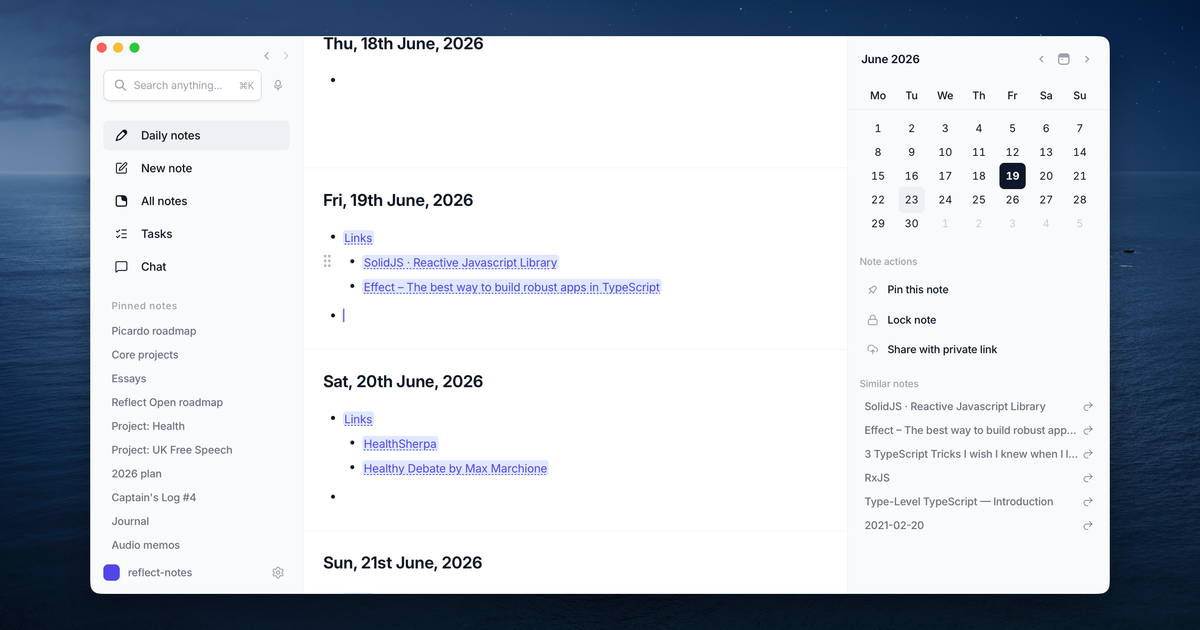
Reflect is now two apps. Reflect Open, launched on July 14, 2026, is a free, open-source, local-Markdown notes app for Mac with paid iPhone and iPad apps and bring-your-own-key AI. Reflect Classic, the end-to-end-encrypted cloud app that made the name, is still maintained at $10 a month billed annually, but new development has moved on.
This review covers what each version costs in November 2026, what Reflect Open does well, what it gave up in encryption, platforms and integrations, how moving from Classic works, and how it stacks up against Obsidian, Capacities, Mem, Roam and Logseq.
What Reflect is in late 2026
If you last looked at Reflect in 2025, you remember a polished, end-to-end-encrypted, cloud-synced notes app with daily notes, backlinks and built-in AI, sold as one plan for $10 a month billed annually. That product still exists, but it is no longer the one Reflect is building.
On July 14, 2026, founder Alex MacCaw published "Reflect Open" and wrote: "Today we're making the biggest change to Reflect since we launched. We've rebuilt it from the ground up for the age of AI." The result is a local-first, open-source app built on plain Markdown files. The original app was renamed Reflect Classic. It is still maintained, but the company says "Reflect Open is where new development is happening".
- Reflect Open - MIT-licensed, local Markdown files, free on Mac, paid iPhone and iPad apps, AI through your own API key, sync through iCloud Drive or Git.
- Reflect Classic - the original cloud app with its own end-to-end encryption, a web app, publishing, Kindle sync, integrations, an API and an MCP server. $10 a month billed annually.
Two products, one name
Most Reflect reviews on the web describe Classic. Features such as end-to-end encryption, the web app, publishing, Google and Outlook calendars, Kindle sync, Readwise and Zapier belong to Classic. Do not assume Reflect Open has them.
MacCaw calls the move "the classic innovator's dilemma": a free desktop app may eat into the subscription business. The team also says the rebuild took about two weeks once it was tested with a new AI coding model. Development has been fast since. Version 0.16.0 shipped as stable on October 25, 2026, and 0.17.0-beta.5 landed on November 2.
Pricing: free on Mac, paid on iPhone and iPad
Reflect Open has the simplest pricing in this category: the Mac app is free with no subscription and no account. You pay only if you want the iPhone and iPad app, and possibly your AI provider.
- Mac (Reflect Open): free. The homepage says "No subscription required."
- iPhone and iPad (Reflect Open): Reflect Pro Monthly $9.99 or Reflect Pro Yearly $99.00 as App Store in-app purchases in the US. Other countries see local App Store pricing.
- AI (Reflect Open): optional, through your own OpenAI, Anthropic, Google or OpenRouter key. Your provider bills you directly.
- Reflect Classic: $10 a month billed annually, one plan with everything included, plus a 14-day free trial with no credit card.
The old reflect.app/pricing page now returns a 404. Current prices sit in the pricing section of the homepage, and the iOS price is shown only on the App Store. We found no free trial for the Reflect Open mobile subscription, so treat it as pay to use.
Classic subscribers get mobile free for a year
Paid Reflect Classic subscribers can claim one year of the Reflect Open iPhone and iPad app at no charge. Claiming it does not cancel the Classic subscription.
What Reflect Open does well
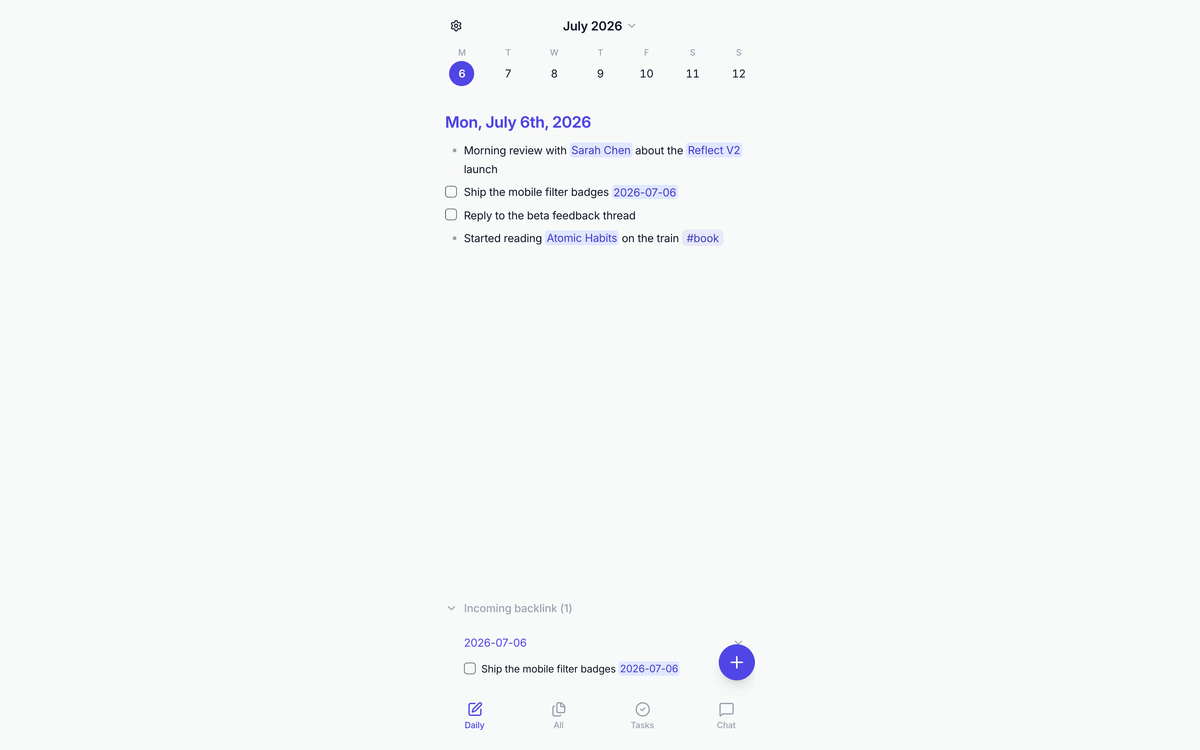
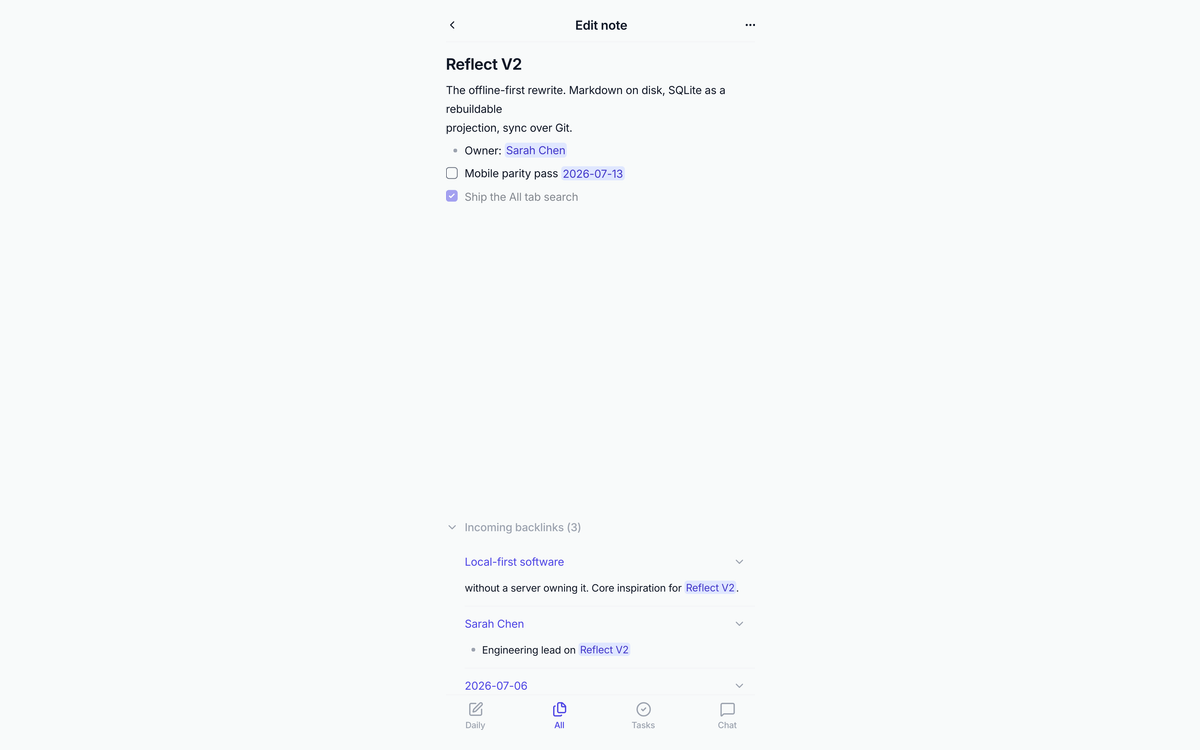
Reflect Open keeps the habits that made Reflect popular and drops most of the cloud plumbing. Everything lives in a folder of plain Markdown files that you can open in any editor, put in Git, or back up however you like.
Daily notes and backlinks
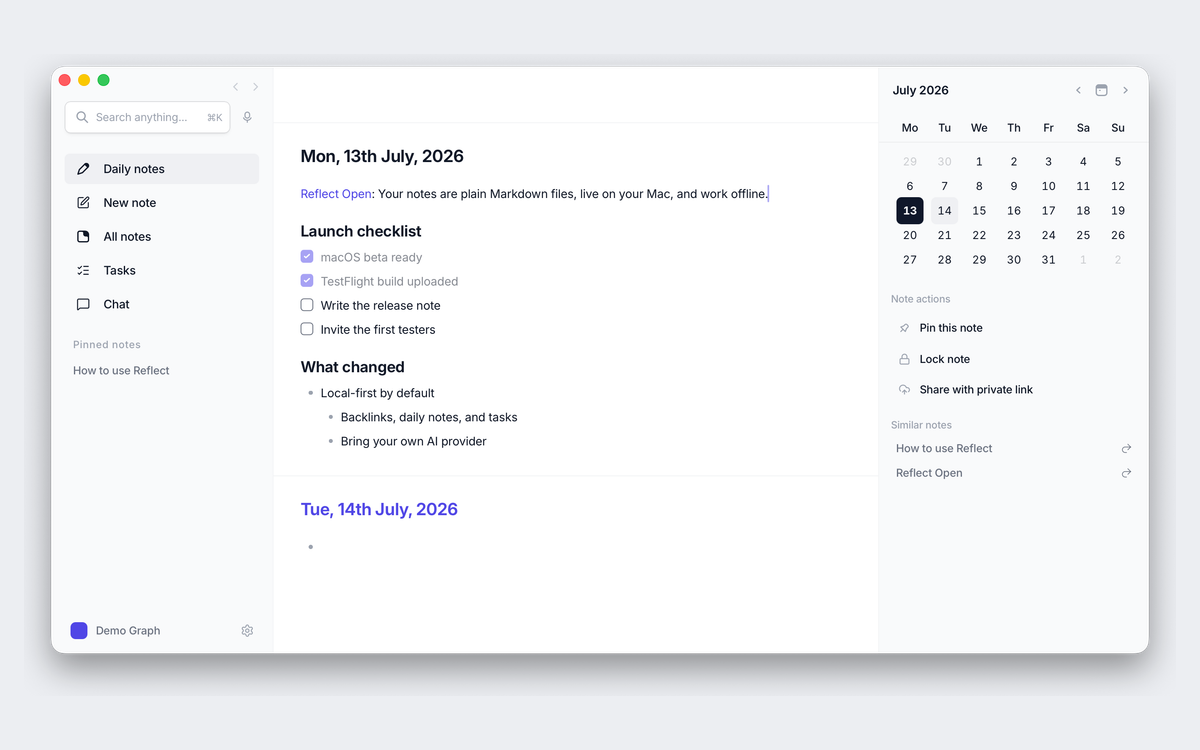
The app opens on today's note, and quick capture goes there by default. Type [[ to link to another note, and every note shows what links back to it. A Similar notes panel suggests related notes you did not link by hand.
Tasks, calendar and people
Markdown checkboxes anywhere in your notes are collected into a task view where you can search, schedule, complete and archive them. Apple Calendar events appear next to the daily note, and Apple Contacts can feed people notes. Classic connected to Google, iCloud and Office 365 calendars; Open uses Apple's own calendar and contacts.
Audio, templates and a CLI
You can record audio and have it transcribed into the daily note through a speech-to-text provider you set up. There are templates. There is also a command-line tool (reflect today, reflect search, reflect show) that suits people who already work in a terminal or with coding agents.
reflect today
reflect search "quarterly plan"
reflect show "Project Atlas"
Web clipping
The Reflect Capture Chrome extension clips pages into your notes. Safari support is still an open request on GitHub, so Safari users currently have no clipper.
AI: bring your own key
Reflect Open does not sell AI. Instead you connect your own key from OpenAI, Anthropic, Google or OpenRouter, and in the words of the homepage, "Requests go directly to your provider." Press Cmd+J to ask questions about your notes, and answers cite the source notes they came from. You can also select text and rewrite, summarize, translate or run a saved prompt on it.
This is cheaper than a bundled AI tier if you use AI lightly. You pay the provider's per-token rates and nothing to Reflect. Heavy users may pay more than a flat plan would cost. The catch is setup: you need an account and a key with a provider, and the app does not pick a model for you.
Classic worked differently. It ran OpenAI, Anthropic and Google models on Reflect's account, capped paid users at 100k tokens a day (about 400k characters), and let you remove the cap with your own key. Classic also has an MCP server, so coding agents such as Claude Code, Codex and Cursor can search, read and, since April 28, 2026, edit Classic notes.
Keep notes out of AI
Add private: true to a note's front matter and Reflect Open keeps that note's content away from AI and other external services. That flag does not stop Git backup, which copies the whole folder, private notes included.
Privacy, encryption and sync
This is the biggest change between the two products, and the one most likely to matter to long-time users.
Classic encrypts every note on your device with XChaCha20-Poly1305 before it reaches Reflect's servers, and Doyensec audited the setup in 2021. The exceptions: published notes are decrypted on the server, and text or audio you send to the AI features goes to the AI provider.
Reflect Open "does not add its own end-to-end encryption layer." There is no Reflect server involved at all. The privacy doc says "No Reflect-hosted server exists in any path: there is no product analytics and no account." Your notes are ordinary files on your Mac, in iCloud Drive, or in a Git repository. Official release builds do send scrubbed crash diagnostics to Sentry.
- iCloud Drive sync: simple, and covered by end-to-end encryption if you turn on Apple's Advanced Data Protection where it is available.
- Git or GitHub: versioned backup and history, but your notes sit in plain text in that repository unless you encrypt it yourself.
- Offline: works fully offline, because nothing depends on a server.
In short, Classic protects your notes with its own encryption. Open protects them by not holding them. Which one is safer depends on how well you secure your Mac, your iCloud account and any Git host you use.
Two smaller details. On-device semantic search uses a small local model that is not available on Intel Macs or iOS. If you use audio transcription, the recording goes to OpenAI or Google.
Platforms and what is missing
The July launch post said there was no iPad app and no Windows build. Both statements are out of date. The iPhone and iPad app arrived on the App Store in August, and October releases added experimental Windows and Linux builds.
- Mac: stable, signed and notarized, with Apple Silicon and Universal builds. The App Store listing requires macOS 13 and an M1 or later chip.
- iPhone and iPad: on the App Store, iOS and iPadOS 16 or later. It also runs on visionOS.
- Windows and Linux: experimental, unsigned builds (.exe, .deb, .AppImage) since version 0.15 and 0.16.
- Android: none, and the README says Android is "out of scope for now".
- Web app: none.
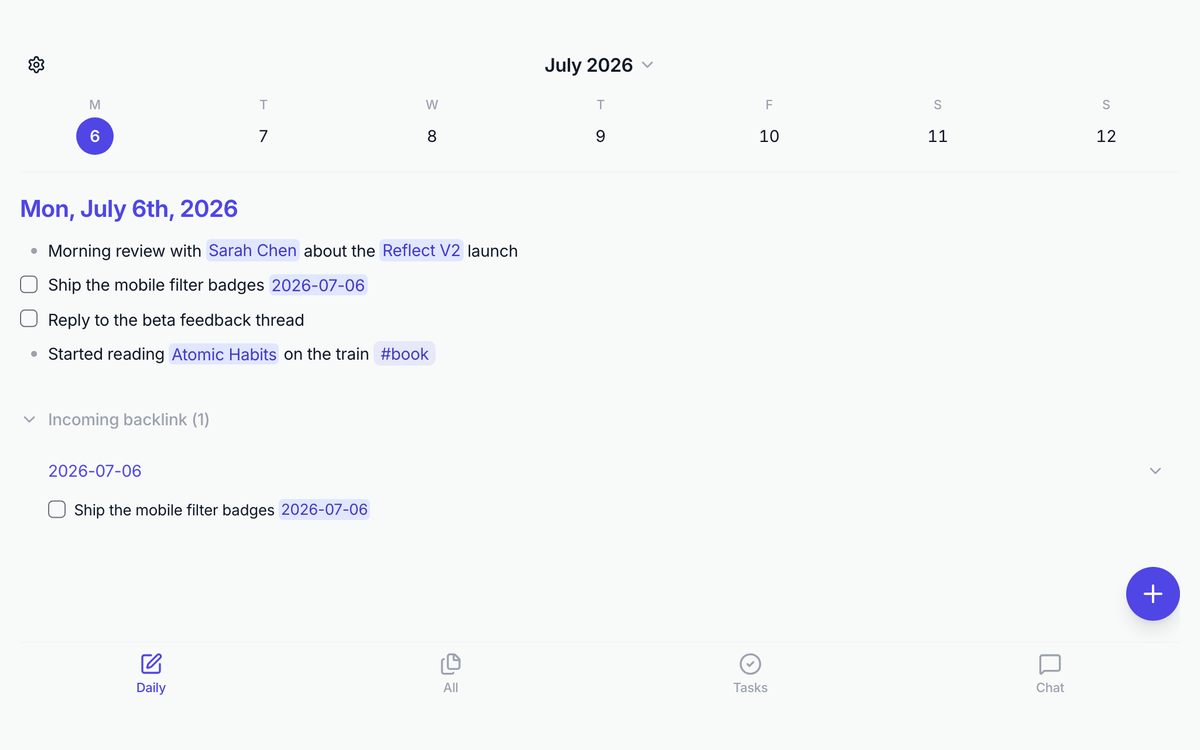
Some Classic features have not come across: publishing notes to a public URL, a web app, several integrations, and a plugin API, which is also out of scope for now. The most-requested items on GitHub show where it still feels unfinished: Windows, Linux and Android support, faster and more reliable GitHub sync on iOS, right-to-left writing, and a desktop-style iPad layout.
The App Store rating for Reflect Open is based on a single review, so it tells you nothing yet. The Classic iOS app has 4.6 out of 5 from 88 ratings.
Reflect Classic: still maintained, no longer the future
Reflect Classic is still a capable product, and the company says there is no deadline to leave. It runs on Mac, on the web in Chrome and Safari, and on iPhone and iPad. Its strengths are the ones Open gave up:
- End-to-end encryption by default, independently audited.
- Web access from any computer, plus Chrome and Safari web clippers.
- Kindle highlight sync (US Kindle stores only, through the Chrome extension, every five hours), plus Readwise and Zapier integrations.
- Google, iCloud and Office 365 calendars and Google Contacts backlinking.
- Publishing notes to a public URL.
- An OAuth API, though note endpoints can only append, because note contents are encrypted.
- An MCP server so coding agents can work with your notes.
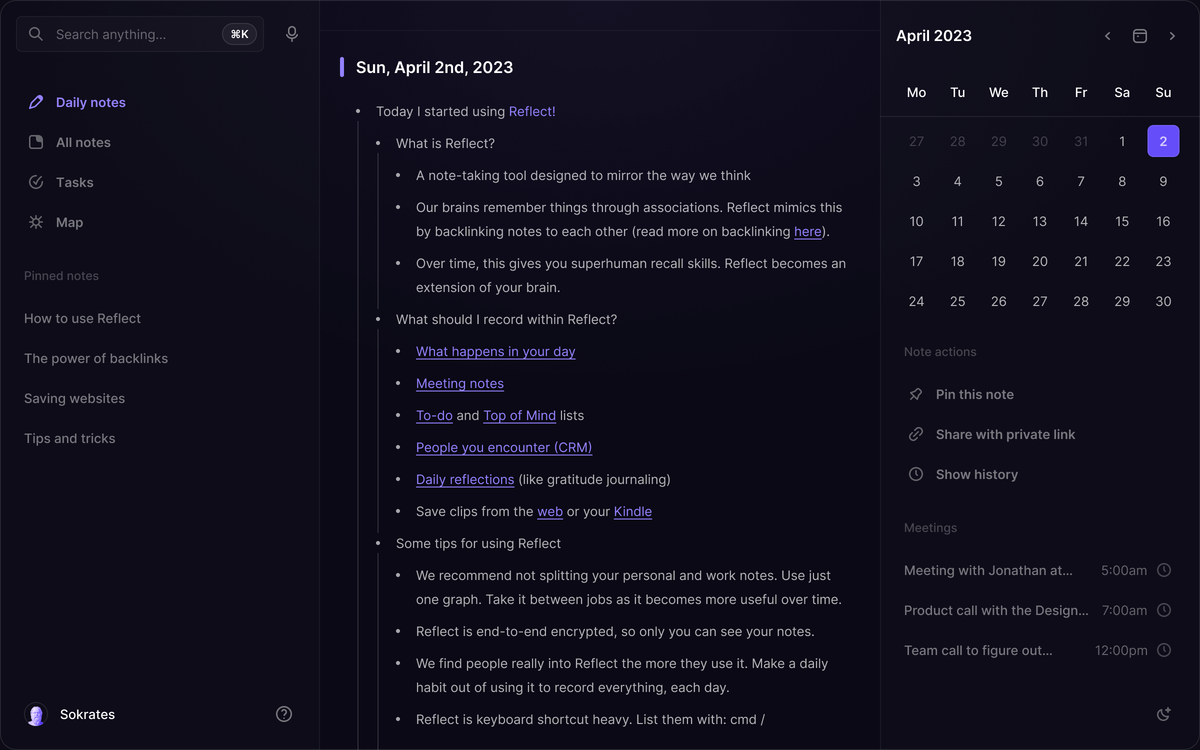
The risk is direction. The Classic iOS app was last updated on May 24 with "Fix some bugs." New features go into Open. If you pay for Classic today, you are paying for a maintained product, not a growing one.
Moving from Classic to Open
Reflect Open can import a copy of your Classic notes without changing the originals, so you can try it while Classic keeps running. Paid Classic subscribers can also claim a free year of the mobile app.
The import leaves some things behind: account settings, integrations, AI conversations, note history and published URLs. If you rely on published notes or Kindle sync, keep Classic until Open covers them. Classic also exports to Markdown, HTML, JSON and CSV, so leaving the Reflect family entirely is straightforward.
Reflect vs Obsidian, Capacities, Mem, Roam and Logseq
Reflect Open now competes most directly with Obsidian, because both store notes as local Markdown. The others are cloud apps or graph-style outliners.
- Obsidian: free core app with a huge plugin ecosystem and Android support. Optional Sync costs $4 a month billed annually and Publish $8 a month billed annually. Reflect Open is simpler, with daily notes, tasks and AI built in and nothing to configure, but it has no plugins.
- Capacities: object-based cloud notes with a free tier and Pro at $9.99 a month or $8.33 a month billed annually. Better if you want structured note types; Reflect Open is better if you want plain files.
- Mem: AI-first cloud notes at $9 a month for Plus and $29 a month for Pro. Mem bundles the AI; Reflect Open makes you bring your own.
- Roam Research: around $15 a month or $165 a year according to third-party listings. A powerful outliner, but expensive next to a free Reflect Open on Mac.
- Logseq: also open source and local-first, with an outliner model rather than Reflect's document-style notes.
Our Obsidian, Capacities, Roam Research and Logseq reviews cover each of these in depth, and our Notion vs Obsidian comparison explains the cloud-versus-local trade-off.
Verdict: who should use which Reflect
For a Mac user who wants daily notes, backlinks and AI without another subscription, Reflect Open is one of the best deals in note-taking right now. It is free, fast, open source, and your notes are files you own. Add $99 a year only if you need it on iPhone or iPad.
It is still a young product. Releases come out every few days, Windows and Linux are experimental, there is no Android or web app, and privacy now depends on your own iCloud or Git setup rather than Reflect's encryption.
- Choose Reflect Open if you use a Mac or iPhone, like plain Markdown, and are comfortable adding your own AI key.
- Stay on Reflect Classic if you need built-in end-to-end encryption, a web app, publishing, Kindle sync or Google and Outlook calendars, and accept that it is in maintenance mode.
- Look elsewhere if you need Android, a plugin ecosystem or team collaboration.
Frequently asked questions
Is Reflect free?
Yes, Reflect Open is free on Mac with no subscription or account. The iPhone and iPad app costs $9.99 a month or $99 a year on the US App Store, and AI usage is billed by your own provider. Reflect Classic is $10 a month billed annually.
Is Reflect Open end-to-end encrypted?
No, Reflect Open does not add its own end-to-end encryption. Notes are local Markdown files. If you sync through iCloud Drive, you can turn on Apple's Advanced Data Protection for end-to-end encryption; Git backups are as private as the repository you push to. Reflect Classic is end-to-end encrypted.
Does Reflect have a free trial?
Reflect Classic has a 14-day free trial with no credit card. Reflect Open does not need one on Mac because it is free, and we found no free trial listed for the paid iPhone and iPad subscription.
Does Reflect work on Windows, Linux or Android?
Reflect Open has experimental, unsigned Windows and Linux builds as of October 2026. Neither Reflect Open nor Reflect Classic has an Android app, and Android is out of scope for Open for now.
Which AI providers does Reflect Open support?
OpenAI, Anthropic, Google and OpenRouter, using your own API key. Requests go straight from the app to that provider, and notes marked private: true are excluded.
Will my Reflect Classic subscription keep working?
Yes. Reflect says it will keep maintaining Classic and fixing bugs, with no deadline to move. Paid Classic subscribers can claim one year of the Reflect Open mobile app for free, and claiming it does not cancel Classic.
What does not transfer when I move from Classic to Open?
Account settings, integrations, AI conversations, note history and published URLs stay behind. The import copies your notes and leaves the Classic originals unchanged.
Is Reflect open source?
Reflect Open is, under the MIT license, with its code on GitHub at team-reflect/reflect-open. Reflect Classic is closed source.
Key takeaways
- Reflect Open is free on Mac; the iPhone and iPad app is $9.99 a month or $99 a year.
- AI in Reflect Open uses your own OpenAI, Anthropic, Google or OpenRouter key and is billed by that provider.
- Reflect Open has no end-to-end encryption of its own; privacy depends on local files, iCloud Advanced Data Protection or your Git host.
- Reflect Classic keeps E2EE, the web app, publishing, Kindle sync and integrations at $10 a month billed annually, but it is in maintenance mode.
- There is no Android app for either version, and Windows and Linux builds of Reflect Open are still experimental.
More in Services & Software
Browse Services & Software