Roam Research Review 2026: Is the $15/Month Note App Still Worth Paying For?
Roam Research invented mainstream bidirectional links, then charged for them. In 2026, with Obsidian, Logseq and Tana free, is the $15/month Pro or $500 Believer plan still worth it? Our full pricing review.
Roam Research is the app that taught a generation of note-takers what a bidirectional link is. When it launched in 2019, the idea that any note could automatically surface every other note that mentioned it felt like magic, and for a couple of years Roam was the tool that serious researchers, writers and 'tools for thought' obsessives swore by. That reputation carried it to a reported $200 million valuation in 2020.
Seven years later the landscape looks very different. The core outliner-plus-backlink model Roam pioneered is now available for free in Obsidian and Logseq, and AI-native newcomers like Tana have taken the mindshare Roam once owned. Yet Roam still charges $15 a month, with no permanent free tier. This review looks at exactly what that subscription buys you in 2026, what you can now get for nothing elsewhere, and who should still pay.
What Roam Research actually is
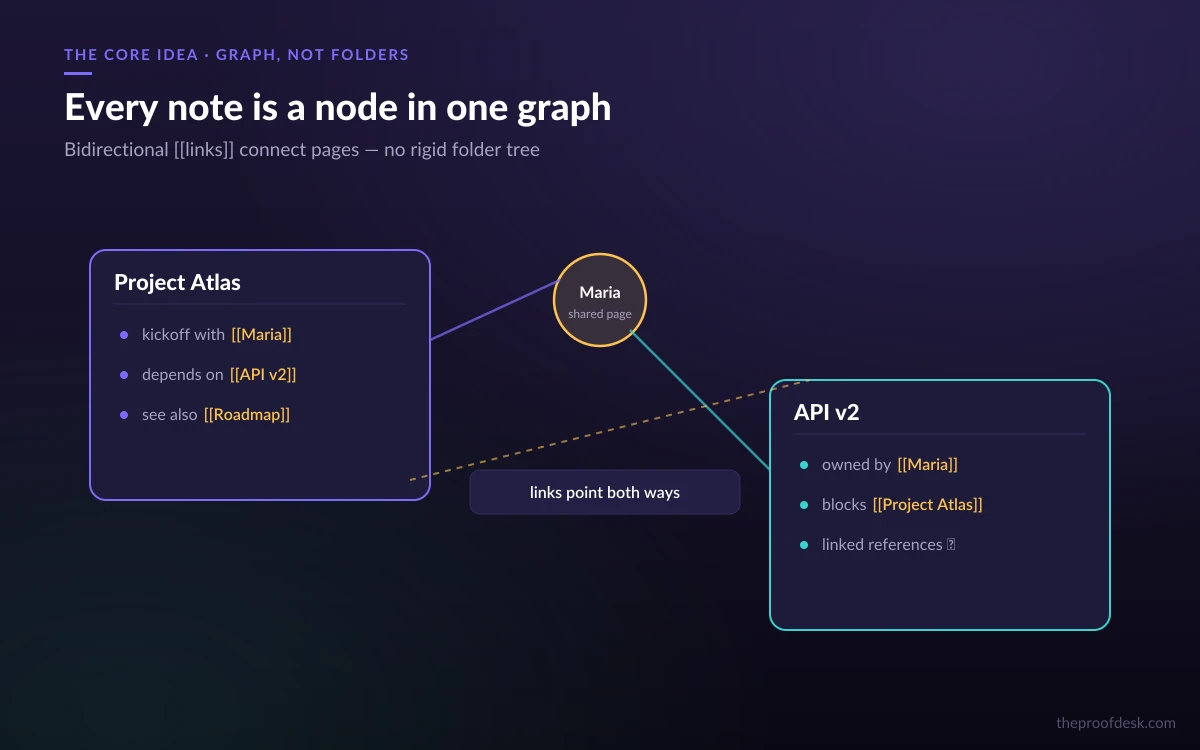
Roam Research is a networked note-taking and knowledge-management app built on a directed graph rather than a folder tree. Instead of filing notes into nested folders, you write in an outliner made of bullet-point blocks, and you link ideas together with double-bracket page links and block references. Every link is bidirectional: create a link to a page and that page automatically shows the note you linked from, so connections build up without any manual filing.
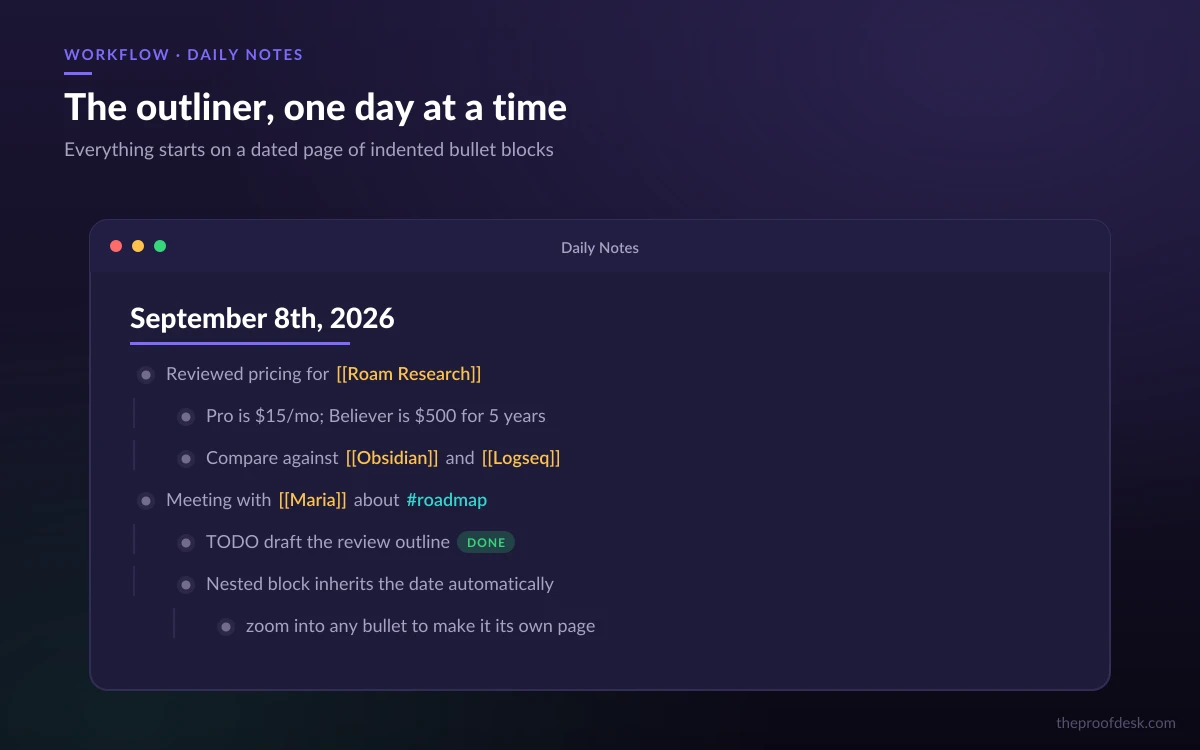
The daily notes page is the app's front door. Most Roam users dump thoughts, tasks and meeting notes into a dated page each day, then link out to concept pages as they write. Over time the graph fills in, and the visual graph overview shows the web of connections between your notes. It is a genuinely different way of working from a traditional documents-and-folders app.
Roam launched in 2019 as a California-based product, and it was the tool that introduced mainstream users to bidirectional links and block references — features that Obsidian, Logseq and Tana later built on. Understanding that history matters, because a lot of what made Roam special has since been copied, often into free software.
The short version
Roam is an outliner with automatic bidirectional links, block references and a graph view. The mechanics are excellent. The question in 2026 is whether they are worth a subscription when the same mechanics ship free elsewhere.
Roam Research pricing in 2026
Roam keeps its pricing deliberately simple, and deliberately without a free tier. There are two paid plans plus a discount program, and a trial to test the water.
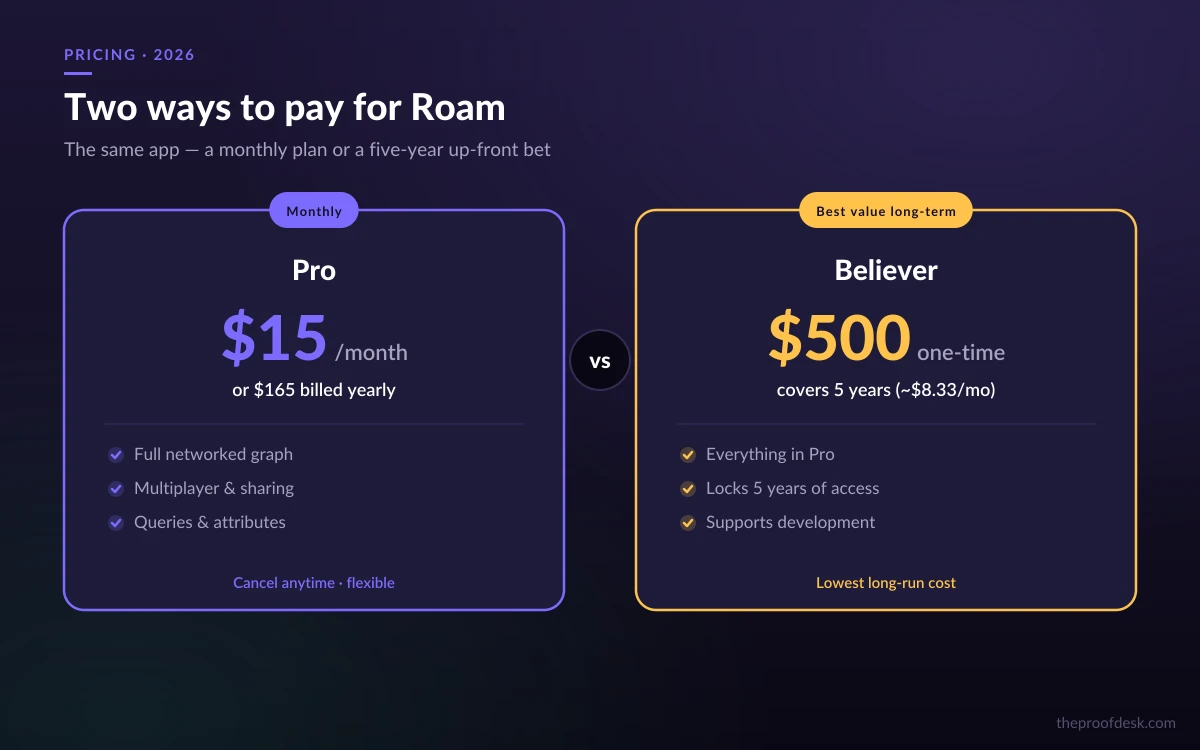
Pro — $15/month
The standard plan is $15 per month, or $165 per year if you pay annually. That annual price works out to about $13.75 a month, roughly an 8% discount over paying monthly. Pro includes the full feature set: unlimited graphs, unlimited blocks, daily notes, bidirectional links, block references, Datalog queries, roam/js custom extensions, public graphs and the native mobile apps.
Believer — $500 once, for 5 years
The Believer plan is a one-time payment of $500 that covers five years of access. Spread across those five years that is about $8.33 a month, or $100 a year — a meaningful saving over Pro if you are confident you will still be using Roam in half a decade. Believer includes everything in Pro plus early access to new features, community calls with the team and priority support. It is aimed squarely at people who have already decided Roam is their permanent home.
Watch the Believer math
Believer is $500 one-time for five years — about $8.33/month. Some low-quality listing sites garble this into a $41.67/month figure by dividing $500 by 12 instead of 60. Do not let that scare you off; the effective cost is lower than Pro, not higher.
Scholars Program and the trial
There is no permanent free tier. New users get a 31-day free trial before they have to choose Pro or Believer. Separately, a Scholars Program offers discounted pricing for academic researchers, users under 22, and people facing financial hardship — worth applying for if you fit any of those categories, because it can bring the cost down substantially.
- Pro: $15/month, or $165/year (~$13.75/month).
- Believer: $500 one-time for 5 years (~$8.33/month, $100/year).
- Trial: 31 days free, no permanent free tier.
- Scholars Program: discounts for researchers, under-22s and financial hardship.
What the subscription still gets you
Paying for Roam is not paying for nothing. Several things remain genuinely stronger or simpler here than in the free alternatives, and if any of them matter to you the price starts to make sense.
- Multiplayer graphs: real-time collaboration on a shared graph works out of the box, with no self-hosted sync server to run.
- Native mobile apps: proper iOS and Android apps are included, rather than being a paid add-on or a community project.
- The roam/js ecosystem: a mature library of community extensions lets you reshape the app without writing everything yourself.
- Datalog queries: Roam exposes a genuinely powerful query language over your graph, going well beyond simple tag filters.
- Zero setup: hosted sync, backups and cross-device access just work, which is the whole point for people who do not want to be their own sysadmin.
That last point is the quiet argument for Roam. Its free rivals are local-first, which is a strength for ownership and privacy but a cost in convenience: you have to arrange your own sync and, often, your own mobile setup. Roam sells the managed, collaborative, no-fuss version of networked notes.
What is now free elsewhere
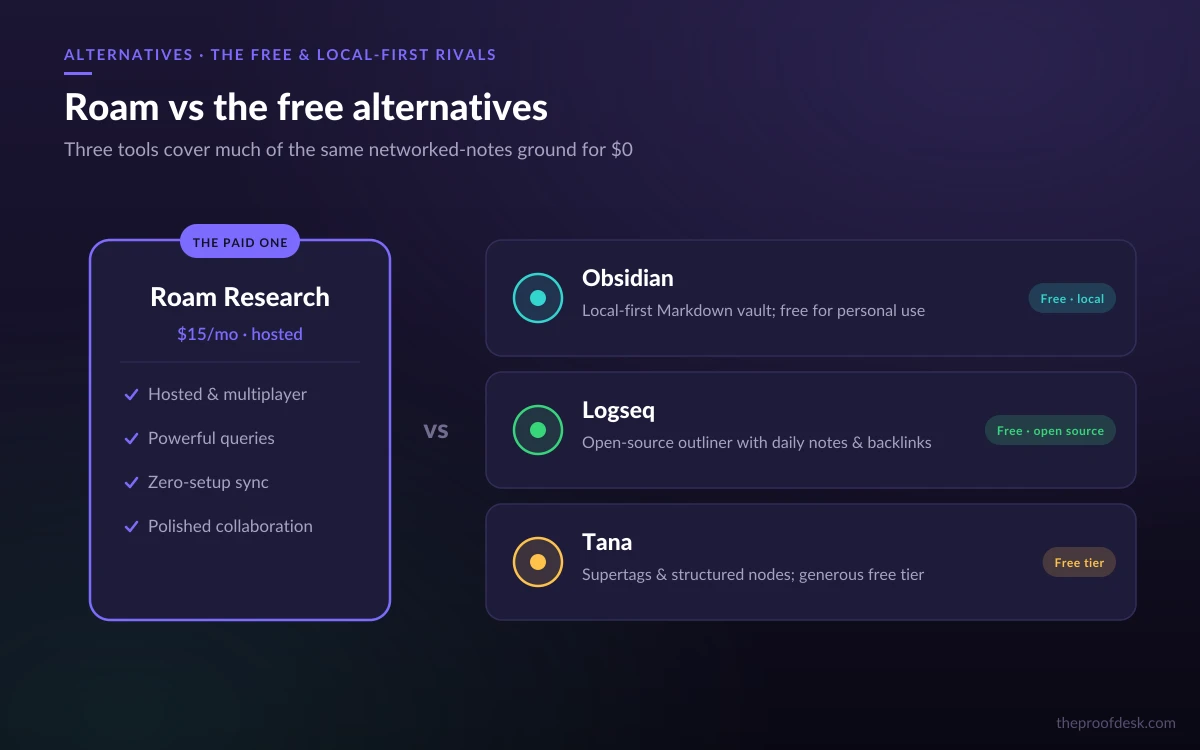
The uncomfortable truth for Roam is that the headline features it invented are no longer exclusive. By 2026 Roam retains a smaller, passionate user base but has lost significant ground to free, local-first competitors, and more recently to AI-native tools.
Obsidian
Obsidian gives you bidirectional links, a graph view and a huge plugin ecosystem, all free for personal use, storing your notes as plain Markdown files on your own disk. Its paid options are optional add-ons (sync and publish) rather than a gate on the core app. For most individual note-takers, Obsidian is the default recommendation and the main reason to think twice about paying Roam.
Logseq
Logseq is the closest free clone of Roam's specific outliner-plus-daily-notes workflow. It is open source, local-first, and free, and if what drew you to Roam was the block-based outliner and daily journaling, Logseq replicates that experience almost beat for beat at no cost.
Tana
Tana is the newer challenger that has pulled away much of the 'tools for thought' energy Roam once commanded. It layers structured 'supertags' and AI features on top of the outliner model, and it is the tool a lot of former Roam power users have migrated to. It is the clearest sign that Roam is no longer the default choice for the audience it created.
So is Roam worth it in 2026?
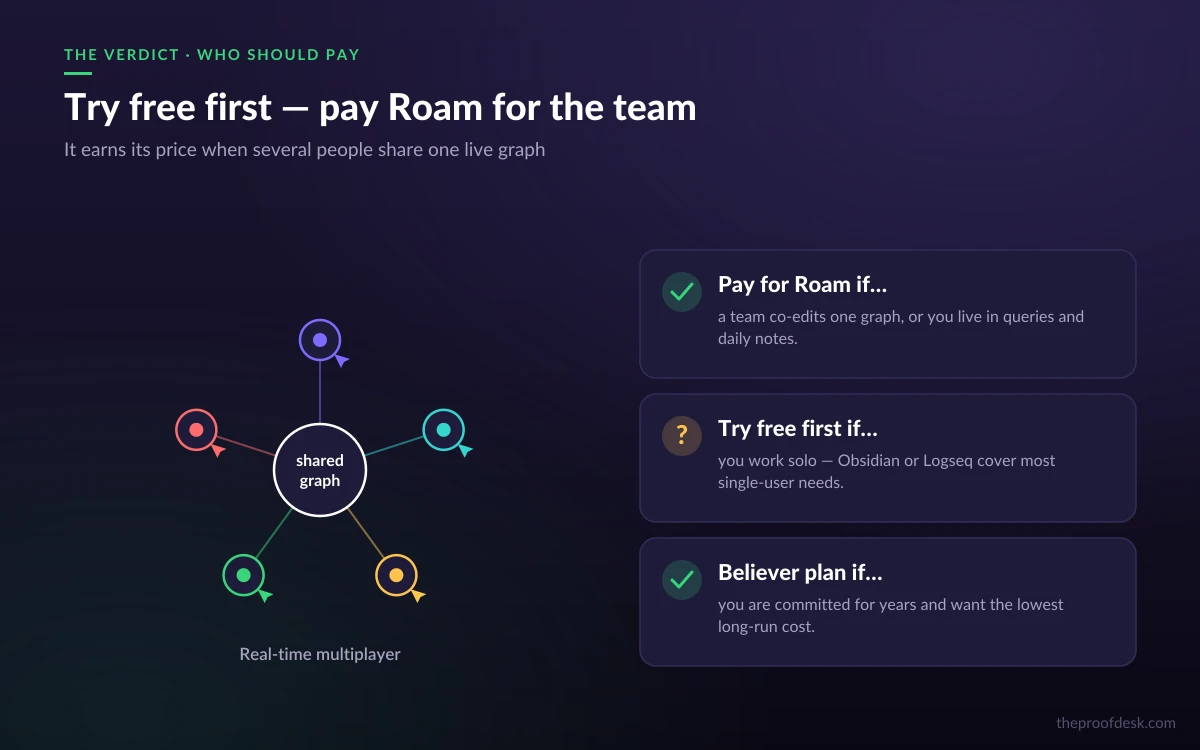
For most people trying networked notes for the first time, no — start with Obsidian or Logseq, which give you the same core mechanics for free and let you decide whether this way of thinking suits you before spending anything.
Roam earns its price in a narrower set of cases: if you need real-time multiplayer on a shared graph without self-hosting, if you rely on Datalog queries or the roam/js extension ecosystem, or if you simply want a hosted, native-mobile, zero-maintenance experience and value your time more than $15 a month. If you are already a committed Roam user, the Believer plan is the cheaper long-run way to stay.
Bottom line
Roam is a great tool at a hard-to-justify price for newcomers, and a fair price for the specific people who need its collaboration, query power and hosted convenience. Try the free rivals first; pay Roam only when you know what you are paying for.
Frequently asked questions
How much does Roam Research cost?
Roam costs $15/month on the Pro plan, or $165/year if billed annually (about $13.75/month). The alternative Believer plan is a one-time $500 payment covering five years, which works out to roughly $8.33/month.
Is there a free version of Roam Research?
No. Roam has no permanent free tier. New users get a 31-day free trial, after which they must choose the Pro or Believer plan to keep using the app.
What is the difference between the Pro and Believer plans?
Both include the full feature set. Pro is billed monthly or yearly at $15/$165. Believer is a single $500 payment for five years and adds early access to new features, community calls with the team and priority support. Believer is cheaper per month if you stay five years.
Are there discounts for students or researchers?
Yes. Roam runs a Scholars Program offering discounted pricing for academic researchers, users under 22, and people facing financial hardship. You apply directly, and it can reduce the cost significantly.
What free alternatives to Roam are there?
Obsidian and Logseq are the main free, local-first alternatives; both offer bidirectional links, a graph view and daily notes at no cost. Tana is a newer AI-native outliner that many former Roam users have moved to. For first-time users these are usually the better place to start.
Can you collaborate with others in Roam?
Yes. Roam supports multiplayer graphs with real-time collaboration built in, with no self-hosted sync server required. This hosted collaboration is one of the clearest things you still pay Roam for that the free local-first rivals do not match as easily.
Key takeaways
- Roam Research costs $15/month (or $165/year) on Pro; the Believer plan is $500 once for five years (~$8.33/month).
- There is no free tier — just a 31-day trial — plus a Scholars Program discount for researchers, under-22s and hardship cases.
- The bidirectional links and outliner Roam pioneered are now free in Obsidian and Logseq, and Tana has taken much of its former audience.
- Roam still justifies its price for multiplayer graphs, Datalog queries, the roam/js ecosystem and hosted, native-mobile convenience.
- For newcomers, try the free rivals first; pay for Roam only once you know which of its exclusive strengths you actually need.
More in Services & Software
Browse Services & Software