Rocket.net Review: The Cloudflare-Powered Managed WordPress Host, Weighed Against Its Own Pitch
Rocket.net calls itself the fastest managed WordPress host in the world, built on Cloudflare Enterprise. We break down its plans, pricing, real inclusions, its 2025 tie-up with hosting.com, and the free WP Umbrella deal — and where the marketing outruns the fine print.

Rocket.net sells a single, confident idea: managed WordPress hosting that is fully done for you and, in its own words, "the fastest WordPress hosting in the world." The whole platform runs on Cloudflare's Enterprise network, and the homepage now leads with built-in support for ChatGPT, Gemini, and Claude alongside the usual speed and security promises.
It is a young company with a fast-moving 2025 and 2026: a headline tie-up with hosting.com, a spot on the Inc. 5000, and a free WP Umbrella integration rolled out to every hosted site. That is a lot of momentum, and momentum is exactly the sort of thing that hides where the actual value sits.
This review works from Rocket.net's own pricing page, terms of service, and support docs to lay out what you pay, what you get, and which parts of the pitch are marketing figures rather than contractual guarantees.
What Rocket.net actually is
Rocket.net is a managed WordPress host founded in 2020 by Ben Gabler, whose background runs through HostGator, the HostNine/Host9 reseller platform he built, and later roles at GoDaddy and StackPath. The legal entity behind the brand is onRocket.com, LLC.
The defining technical choice is that every site sits on Cloudflare's Enterprise CDN and WAF rather than a bolt-on plugin or a lower tier. That is where the speed and security story comes from: edge caching, a managed web application firewall, and malware protection are part of the platform, not an upsell.
It is positioned squarely at agencies and creatives who want the WordPress operations handled — migrations, backups, updates, and support — instead of running their own stack. If you want raw control over the server, this is not that; if you want to stop thinking about the server, that is the entire pitch.
The short version
A Cloudflare Enterprise-backed managed WordPress host aimed at agencies and creators, with fully-managed operations and support baked into every plan. Fast and hands-off by design; not a place to tinker at the infrastructure level.

The speed claims, read carefully
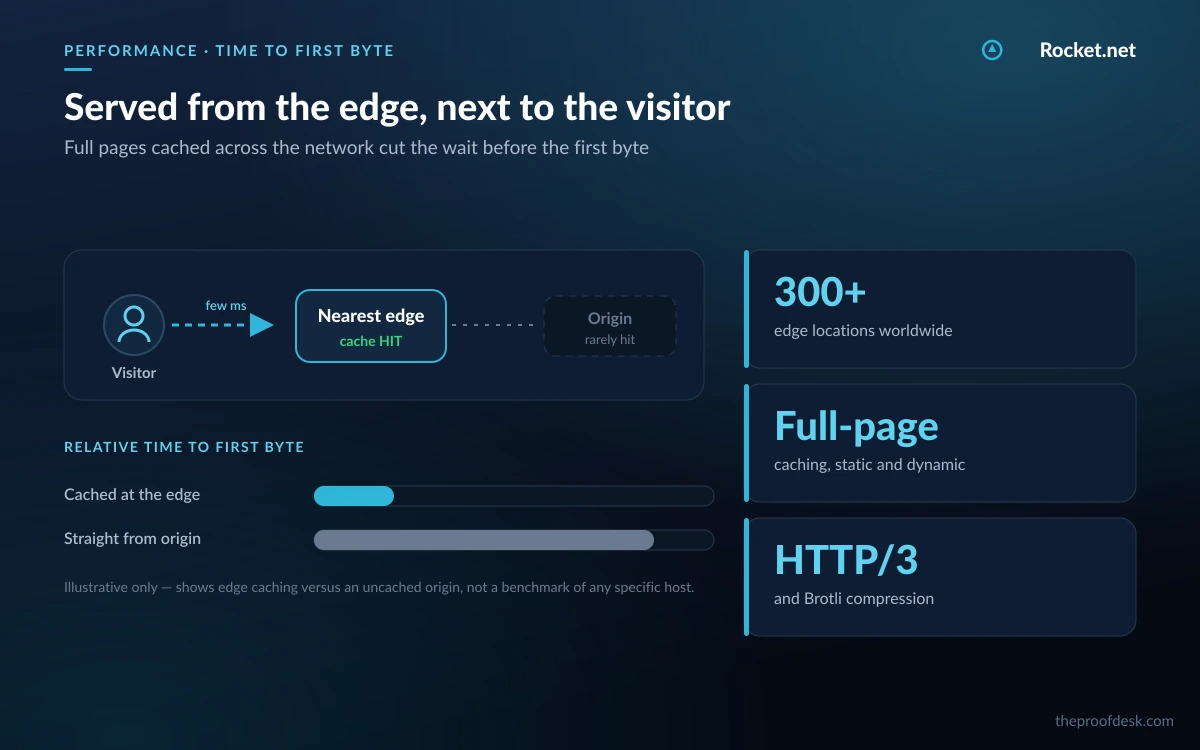
Rocket.net's headline is that it is the fastest WordPress host in the world, and the homepage backs it with a time-to-first-byte figure: roughly 83ms on average against competitors it lists between about 142ms and 625ms.
Treat that as a vendor benchmark, not an independent one. The methodology and the named competitors are not fully spelled out, so the honest reading is "Rocket.net claims ~83ms TTFB," not "Rocket.net has been independently measured at ~83ms." The architecture — Cloudflare Enterprise edge in front of every site — is a genuine reason to expect strong TTFB, which is different from a proven leaderboard position.
The plan attribute that matters more for real workloads is unlimited PHP workers on the managed tiers. PHP worker limits are where cheaper managed hosts quietly throttle busy sites, so removing that ceiling is a substantive inclusion rather than a slogan.
Marketing vs. measured
The 99.99% uptime and ~83ms TTFB numbers appear as plan attributes and homepage claims. Neither is written as a contractual, credit-backed SLA in the terms of service — so read them as targets Rocket.net markets, not guarantees you can invoice against.
Plans and pricing
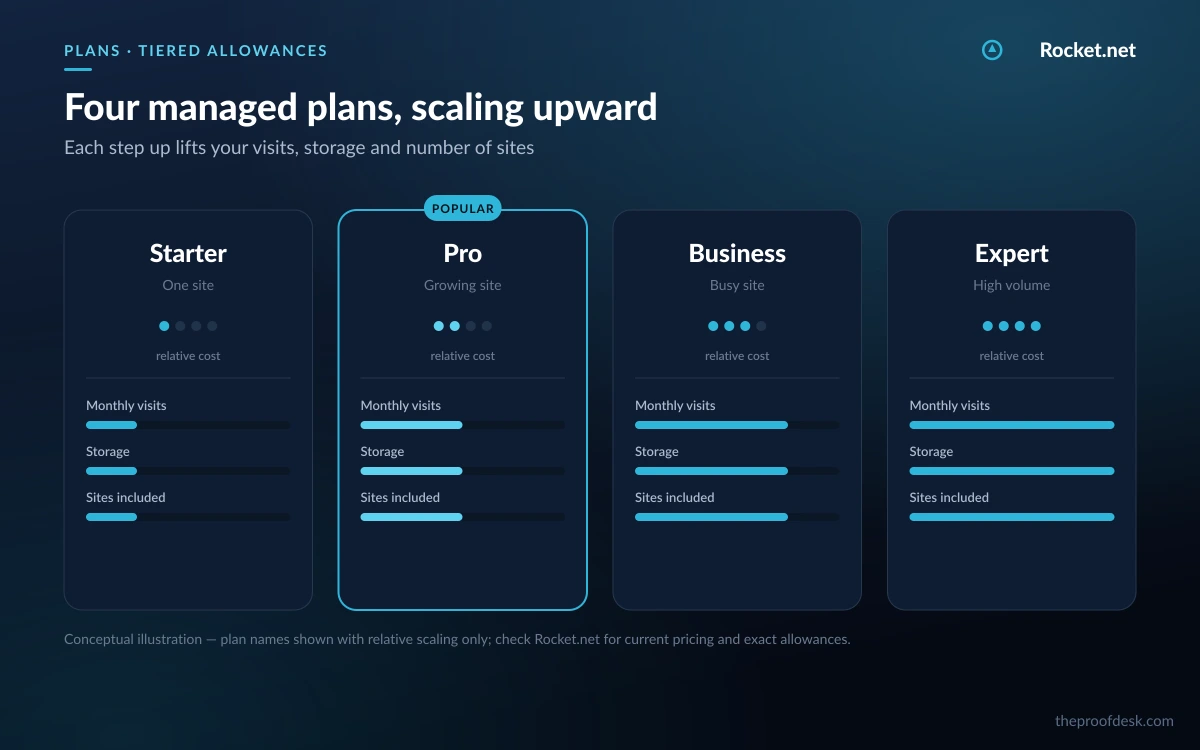
The core managed lineup has four tiers. Prices below are the standard monthly rate, with the intro rate in brackets; annual billing gives you two months free.
- Starter — $30/month ($25 intro): 1 WordPress install, 10GB storage, 50GB bandwidth, unmetered visitors, 30-day backup retention.
- Pro — $60/month ($50 intro): 3 installs, 20GB storage, 100GB bandwidth.
- Business — $100/month ($83 intro): 10 installs, 40GB storage, 300GB bandwidth.
- Expert — $200/month ($166 intro): 25 installs, 50GB storage, 500GB bandwidth.
Above that sit Agency tiers running from $100/month to $1,600/month (10 to 200 installs, 50GB–375GB storage, 200GB–3,500GB bandwidth) with an added Agency Toolkit, and Enterprise tiers from $649/month to $2,599/month with dedicated CPU cores, 64–256GB RAM, 1–2TB NVMe, a private Slack channel, and enterprise phone support.
Two things stand out. The storage allowances are modest — 10GB on Starter, 50GB even on Expert — so image-heavy or large-catalog sites will feel that ceiling before they feel a performance one. And the entry price is $30/month, which puts Rocket.net above budget managed hosts and in line with the premium managed crowd it benchmarks against.
Watch the ceilings, not just the price
Every plan advertises unmetered visitors and unlimited PHP workers, so the real limits you will hit are storage and bandwidth, not traffic. Size the plan to your media library, not your pageviews.
What every plan includes
The inclusions are consistent across the managed tiers, which is one of the cleaner parts of the offering — you are not buying basic security back one feature at a time.
- Free SSL and the Cloudflare Enterprise CDN on every site.
- Managed WAF, malware protection, and automated daily backups.
- Free migrations onto the platform.
- 24/7/365 support, every day of the year.
- PHP versions from 5.6 through 8.4, so legacy and current sites both run.
The 30-day backup retention on Starter is generous for an entry tier, and free migrations lower the cost of testing the platform with a real site rather than a throwaway one.
The hosting.com deal and what it signals
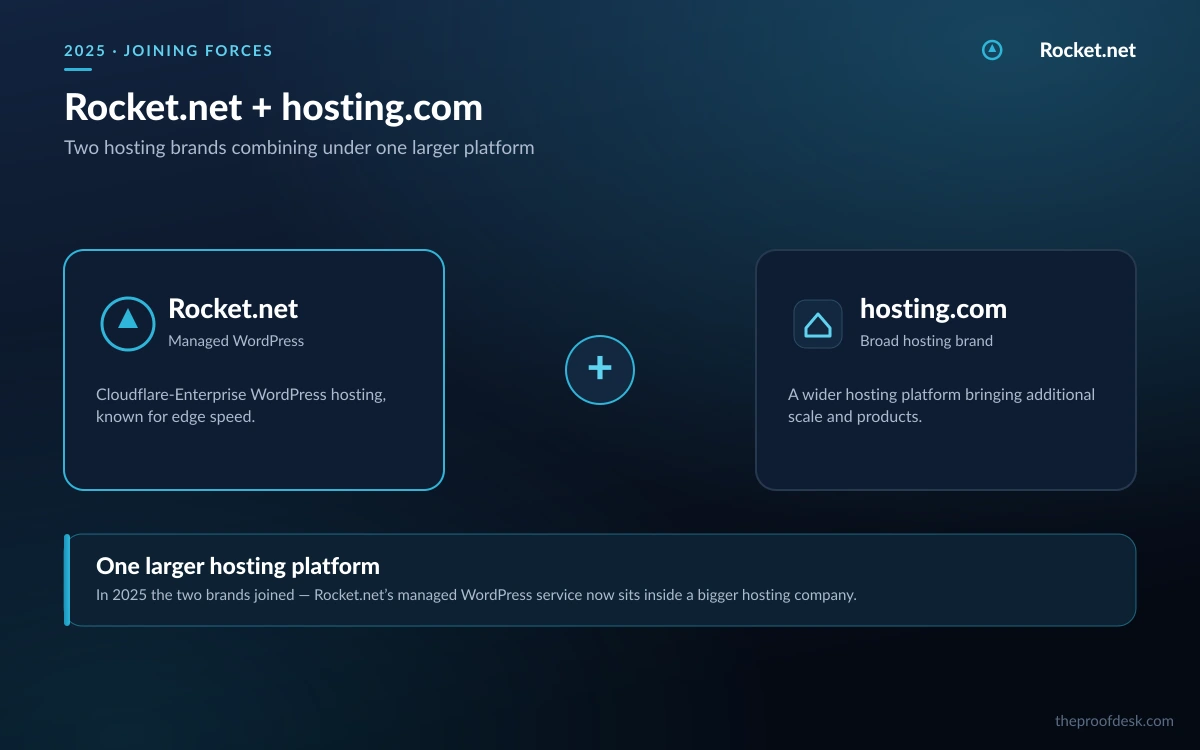
In August 2025, Rocket.net and hosting.com announced a combination. Hosting.com frames it as a partnership; third-party outlets described it as an acquisition. Either way, the combined entity hosts around 3 million websites, Ben Gabler became Chief Product Officer at hosting.com, and Jessica Frick — an Automattic and Pressable veteran — became General Manager of Rocket.net.
Gabler's stated aim was to make hosting.com "the one-stop shop where businesses, creators, and agencies can log in, create, grow, and succeed." For existing Rocket.net customers, the practical read is that the brand keeps its own general manager and identity while gaining the backing of a much larger platform — reassuring on stability, worth watching for how much the roadmap gets pulled toward the parent's priorities.
Rocket.net also placed 167th on the 2025 Inc. 5000 list of fastest-growing US companies. Growth that fast is a vote of confidence and a reason to check that support quality holds up as the customer base scales — the sort of thing worth confirming during a trial rather than taking on faith.
The free WP Umbrella integration
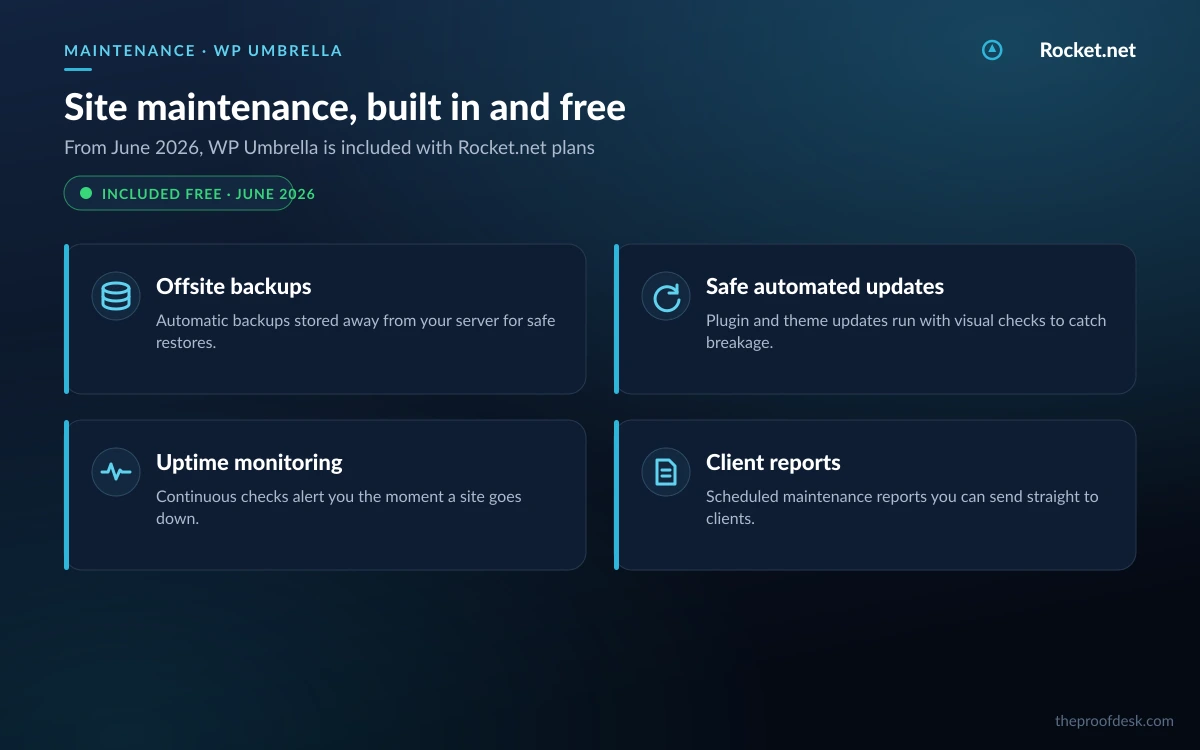
As of June 1, 2026, every Rocket.net-hosted site gets WP Umbrella for free — an integration Rocket.net describes as exclusive to its platform. WP Umbrella normally covers offsite backups, safe automated updates, uptime and performance monitoring, and client reports, which is a meaningful bundle for agencies managing many sites.
Read the boundary, though. The free tier is the WP Umbrella baseline; the Site Protect layer and the hourly backup add-on remain paid. New WP Umbrella signups can use the promo code shared in Rocket.net's support docs, but the headline is the free tier attached to hosting, not a free upgrade to everything WP Umbrella sells.
Why this matters for agencies
Offsite backups plus safe updates plus client reporting across a whole portfolio is exactly the maintenance overhead agencies usually pay a separate tool for. Getting the baseline bundled with hosting is a real cost offset — just not a full replacement for the paid Site Protect features.
Refunds, guarantees, and the fine print
Rocket.net advertises a 30-day money-back guarantee alongside a $1 special intro offer. The terms of service are blunt about the default: payments to onRocket.com, LLC are nonrefundable, except under that 30-day guarantee or for remaining funds on an annual prepayment cancelled within 90 days of signup.
The gap worth naming is the SLA. The 99.99% uptime figure lives on the pricing page as a plan attribute, not in the terms as legal language with remedies or service credits. If a guaranteed, credit-backed uptime SLA is a hard requirement for you, confirm it in writing before committing — the marketed number is not the same as a contract.
Who Rocket.net is for
It fits agencies and creators who want fast, fully-managed WordPress and value hands-off operations over server control — the WP Umbrella bundle and the consistent security inclusions make the portfolio case especially well. It fits sites where TTFB and edge delivery matter and where the modest storage ceilings are not a constraint.
It is a weaker fit if you need cheap hosting, large storage for media-heavy sites, root-level server access, or a contractual uptime SLA with credits. And if you specifically want a benchmark-proven speed champion, remember the fastest-in-the-world claim is Rocket.net's own — strong architecture is a good reason to expect speed, not a substitute for testing it on your own site during the 30-day window.
Frequently asked questions
How much does Rocket.net cost?
The managed lineup starts at $30/month for Starter (about $25/month on the intro rate) and runs $60, $100, and $200/month for Pro, Business, and Expert. Annual billing includes two months free. Agency plans run $100–$1,600/month and Enterprise plans $649–$2,599/month.
How many WordPress sites can I host?
Starter covers 1 install, Pro 3, Business 10, and Expert 25. Agency tiers scale from 10 up to 200 installs. Every plan advertises unmetered visitors, so the site count and storage — not traffic — are the limits to plan around.
Is the 99.99% uptime a guaranteed SLA?
Not in contractual terms. The 99.99% figure appears as a plan attribute on the pricing page, but Rocket.net's terms of service do not spell out an uptime SLA with service credits or remedies. Treat it as a marketed target and confirm any guaranteed SLA in writing if you need one.
Can I get a refund?
There is a 30-day money-back guarantee. Beyond that, payments are nonrefundable, except for remaining funds on an annual prepayment if you cancel within 90 days of signup. So the safe window to test the platform is the first 30 days.
What is the free WP Umbrella integration?
Since June 1, 2026, every Rocket.net-hosted site gets WP Umbrella's baseline free: offsite backups, safe automated updates, uptime and performance monitoring, and client reports. The paid Site Protect layer and the hourly backup add-on are still extra.
Did hosting.com acquire Rocket.net?
In August 2025 the two combined — hosting.com calls it a partnership, while some outlets reported it as an acquisition. The combined entity hosts about 3 million sites. Rocket.net keeps its brand and its own general manager, Jessica Frick, while founder Ben Gabler became hosting.com's Chief Product Officer.
Key takeaways
- Rocket.net is a Cloudflare Enterprise-backed managed WordPress host built for agencies and creators who want operations handled, not a place for server-level control.
- Managed plans run $30–$200/month with unmetered visitors and unlimited PHP workers; storage (10–50GB) and bandwidth are the real ceilings, not traffic.
- The "fastest in the world" and 99.99% uptime lines are marketed claims — no contractual, credit-backed SLA appears in the terms.
- The 2025 hosting.com combination and June 2026 free WP Umbrella integration add stability and agency value; use the 30-day guarantee to verify speed and support on your own sites.
More in Services & Software
Browse Services & Software