StrongVPN Review 2026: 12 Devices, Annual-Only Refunds and No Audit
StrongVPN costs $3.97/mo for year one, covers 12 devices and bundles SmartDNS, but refunds cover annual plans only, the kill switch is desktop-only and there is no audit.
StrongVPN is one of the older names in consumer VPNs, and in 2026 it sells itself as a three-in-one plan: "secure VPN, SmartDNS, and eSIM data access - all in one plan." The pitch rests on 12 simultaneous devices, a server network the company says it owns, and a first-year price of $3.97 a month.
The fine print is where this review spends its time. The 30-day money-back guarantee covers annual plans only, renewals are never refunded, the kill switch exists only on Windows and macOS, split tunneling only on Android, there is no native Linux app, and the no-logs policy has never been independently audited. StrongVPN is a US company owned by Ziff Davis.
Quick verdict
StrongVPN is a plain, dependable-looking VPN for someone who wants one annual bill, a generous 12-device allowance and native apps for Windows, macOS, iOS, Android and Fire TV. It is a weaker pick if you need a kill switch on your phone, per-app routing outside Android, a Linux client, port forwarding or any third-party proof of its no-logs claim.
StrongVPN at a glance
Price: $3.97/mo billed $47.69 for the first year, or $11.99 monthly. Devices: 12 at once. Network: 950+ servers in 35 countries and 59 cities. Refund: 30 days, annual plans only. Free trial: none for the VPN. Independent audit: none. Base: New York, USA (Strong Technology LLC, a Ziff Davis company).
What works
- 12 simultaneous connections on one subscription
- WireGuard and IKEv2 on the main apps, plus an OpenVPN scramble mode for restrictive networks
- StrongDNS SmartDNS bundled with every account, with a 7-day free trial of its own
- Solid router support, including preloaded Sabai routers with a 90-day satisfaction guarantee
- Automatic refunds within 30 days on the annual plan, with no partial-use conditions
What holds it back
- The money-back guarantee covers annual plans only, and renewal payments are never refunded
- Renewal price for the annual plan is not published
- Kill switch on Windows and macOS only, and on macOS only with OpenVPN or L2TP
- Split tunneling on Android only; no native Linux or Apple TV app
- No independent audit of the no-logs policy, and a US jurisdiction
- Shared IPs only: no dedicated IPs for new customers and no port forwarding
StrongVPN pricing in 2026
StrongVPN sells two terms and nothing longer. Its help centre puts it plainly: "There are 2 subscription term options, 1 and 12-month periods." There is no two- or three-year plan to chase a lower monthly figure.
- Annual plan: $3.97 per month, "Billed $47.69 first year", advertised as "Save 66%"
- Monthly plan: $11.99 per month
- Both plans include the VPN, StrongDNS and, while the promotion runs, a free aloSIM eSIM data plan
Prices were identical in the June 6 and September 17, 2026 homepage captures. The page shows a plain dollar sign and does not name a currency.
The renewal price is not on the page
"Billed $47.69 first year" implies the second year is billed at a different rate, but StrongVPN does not publish that figure anywhere we could read, so we will not guess it. What the help centre does say is that "All StrongVPN and StrongDNS packages are set to automatic renewal by default" and that the billing system "generates the invoice 7 days prior to renewal". Read that invoice: it is your first sight of the real second-year price, and a renewal payment cannot be refunded.
Two billing quirks are worth knowing. Alipay payments are not auto-charged, and "Our subscriptions cannot be renewed manually at the moment", so there is no way to top up a term in advance.
Payment methods and trials
StrongVPN accepts Visa, MasterCard, American Express, Discover, PayPal, Alipay and, inside the iOS app, Apple Pay through in-app purchase. The help centre lists no cryptocurrency option and warns that "we may not be able to refund gift cards".
There is no free VPN trial: "StrongVPN does not provide any free trial accounts". The only free trial is a 7-day one for StrongDNS, the SmartDNS service. For the VPN itself, the 30-day guarantee on the annual plan is the trial.
The refund fine print
The guarantee is generous in one way and narrow in another. StrongVPN offers "30 (thirty) days unconditional full refund guarantee for all annual subscriptions", with no data caps or usage conditions attached. But it names annual subscriptions only, and two other help articles tie the guarantee to annual plans as well. Treat the $11.99 monthly plan as non-refundable.
- Only the first payment qualifies: "Only initial payments are subject to refund. Renewal payments are non-refundable."
- No partial refunds and nothing after day 30: "We do not provide any partial refunds or refunds beyond the guarantee period."
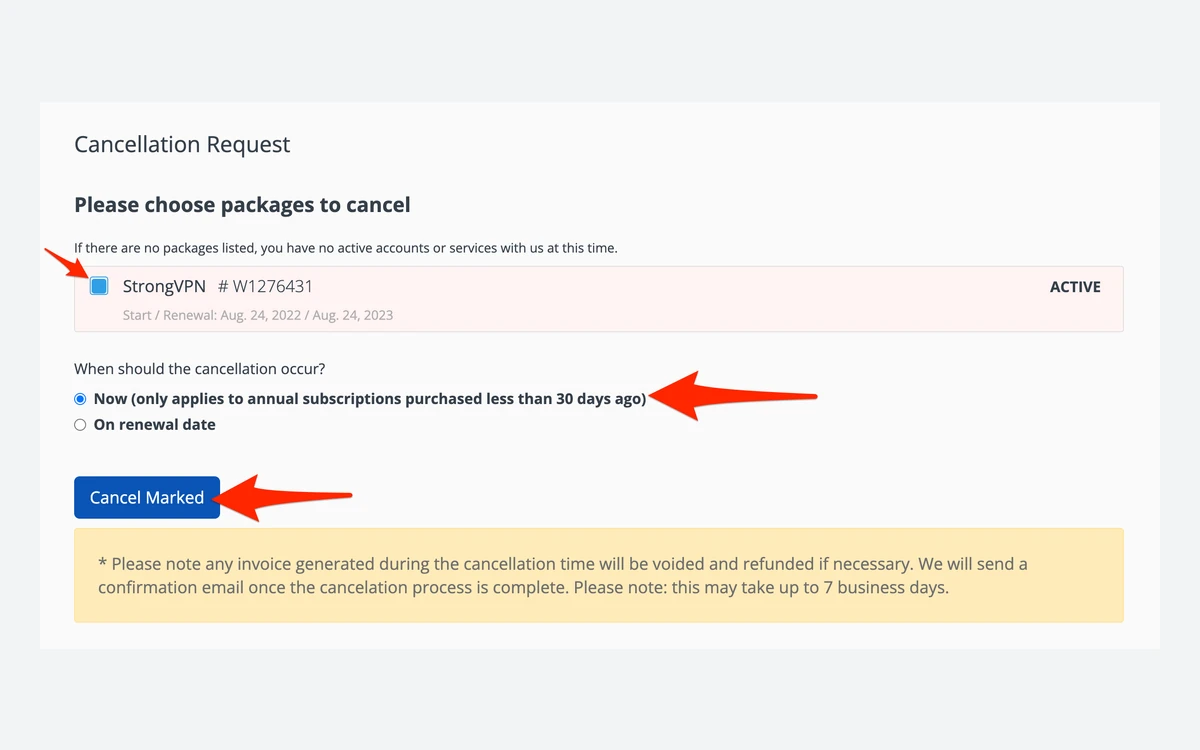
- The cancel request must be set to "Now". If you choose "On renewal", "the refund will not be granted".
- Apple Pay purchases are not refunded by StrongVPN's system: "The refund must be requested through your iTunes subscription."
- Gift card payments may not be refundable at all.
When the conditions are met, the refund is automatic. PayPal and Alipay refunds "will show on your balance immediately", card refunds "may take up to 7 business days", and Apple Pay refunds "are reported to take 1-3 business days".
Hardware follows different rules. "All StrongVPN routers come with a 90 days satisfaction and 1-year hardware guarantee", but shipping is not refunded and the buyer pays return shipping.
How to cancel and get your money back
Cancellation happens in the web Customer Area, not in the apps. The steps, from StrongVPN's help centre:
- Log in to the Customer Area on strongvpn.com.
- Open "VPN accounts" and choose "Cancel Request Form".
- Select the package and set the cancellation to "Now" (not "On renewal").
- Click "I don't want to protect my privacy" on the retention page.
- Pick a reason, then click "I still want to cancel".
- Wait for the confirmation screen; the refund is issued automatically if you are inside the 30 days.
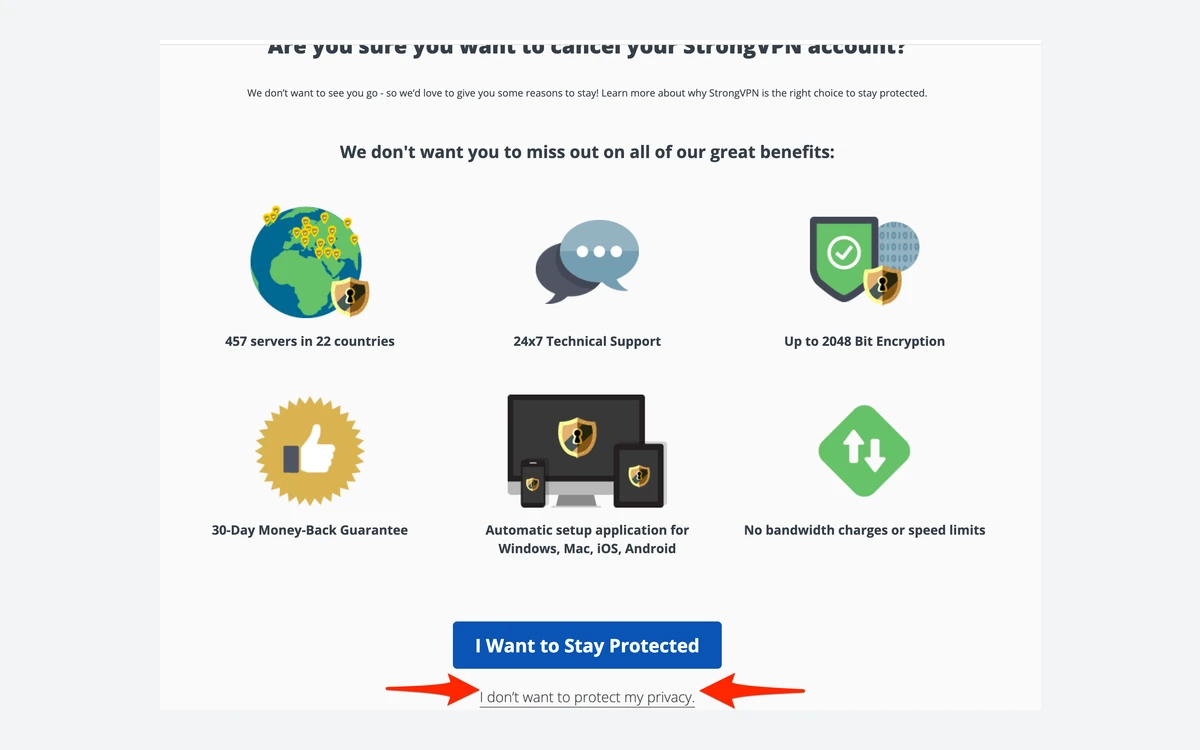
Expect a couple of retention screens along the way. They are not traps, but the "Now" versus "On renewal" choice is: picking "On renewal" only stops the next charge and forfeits the refund. If you paid through the iOS app, skip this form and request the refund from Apple instead.
Servers, protocols and encryption
The freshest help article, updated September 12, 2026, lists "950+ servers in 35 countries and 59 cities". The homepage says 950+ servers across "30+ countries", and an older help page still quotes 650+ servers in over 20 countries, which is out of date. That is a mid-sized network: enough for most travel and streaming regions, but well short of the country lists of the largest providers.
StrongVPN's headline claim is ownership: "We own our network of servers, meaning that your online browsing activity is always safe from third parties." That is the company's own statement and no third party has verified it.
Protocols
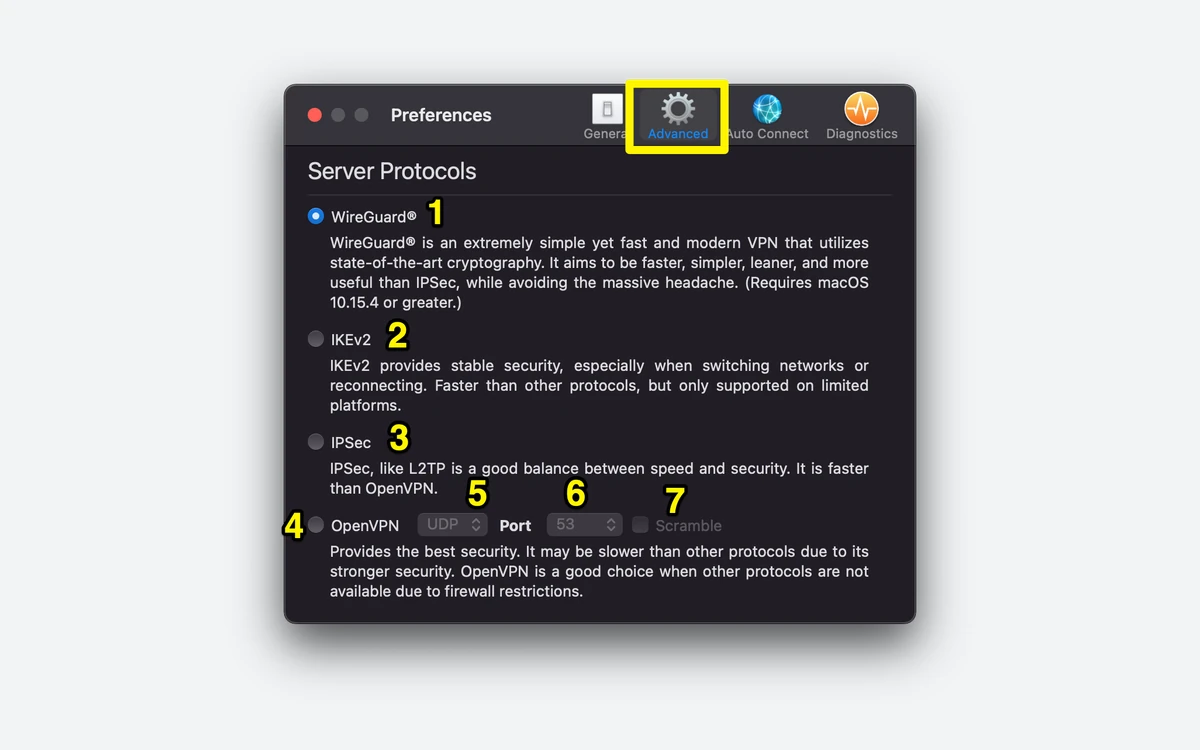
The supported list is long: "Wireguard, IKEv2, OpenVPN UDP/TCP, IPSEC, L2TP, SSTP, PPTP". Use WireGuard first and IKEv2 as the fallback, particularly on mobile. OpenVPN is the choice when you need the scramble mode described below. PPTP and L2TP are legacy protocols with known weaknesses and should be left alone.
- WireGuard: "Noise protocol framework, Curve25519, ChaCha20, Poly1305, BLAKE2, SipHash24, HKDF"
- IKEv2: "runs on UDP port 500"
- OpenVPN: ports 53, 123, 443, 1194 and 8293 on Android and macOS, port 1195 on Windows
- SSTP: "high-level security through an AES-256 SSL certificate"
Housekeeping is visible: StrongVPN upgraded the OpenVPN certificate on all V1.5 server profiles on September 23, 2025, so anyone using old manual OpenVPN configs should download fresh ones.
Apps and privacy features
StrongVPN has "apps for iOS, Android, macOS, Windows, Amazon Fire TV, and more". Chromebooks run the Android app from the Play Store. Linux has no native app: you set it up manually or with a WireGuard command-line script that "features a GUI interface if needed". Apple TV has no app either ("We do not yet have an Apple TV app available to use"), so the workaround is a VPN router.
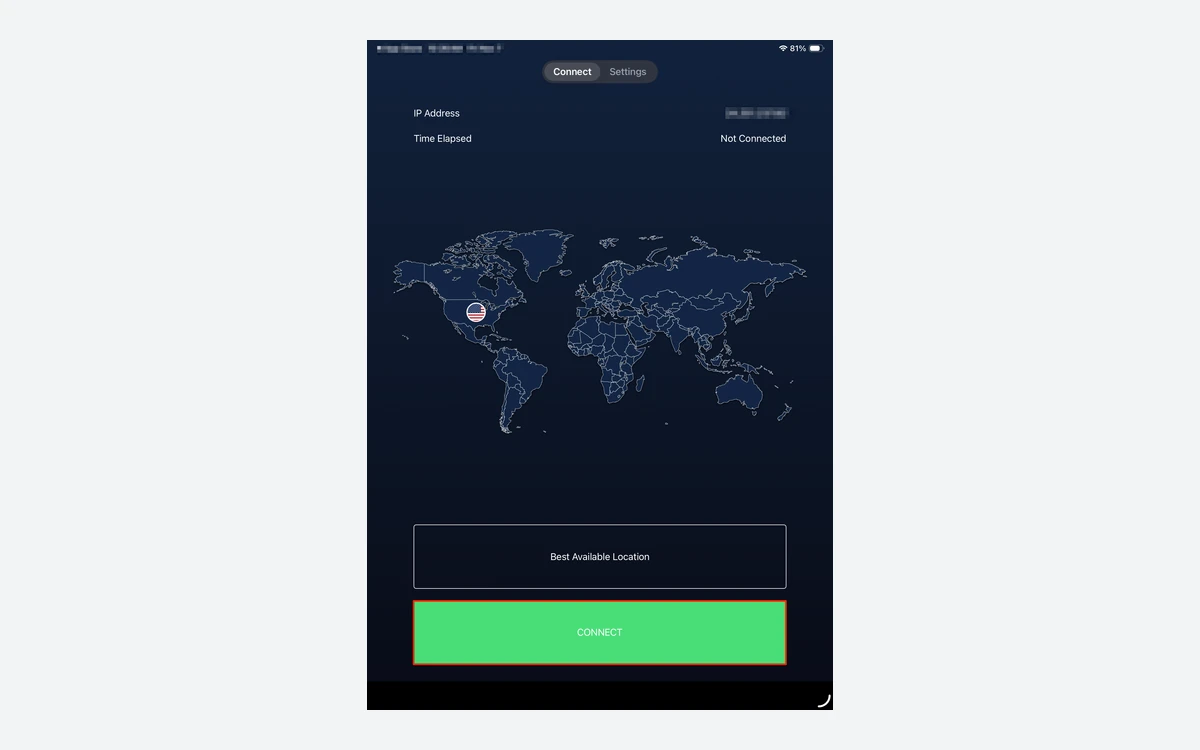
Feature coverage is uneven from one platform to the next, and that matters more than the protocol list.
Kill switch: desktop only
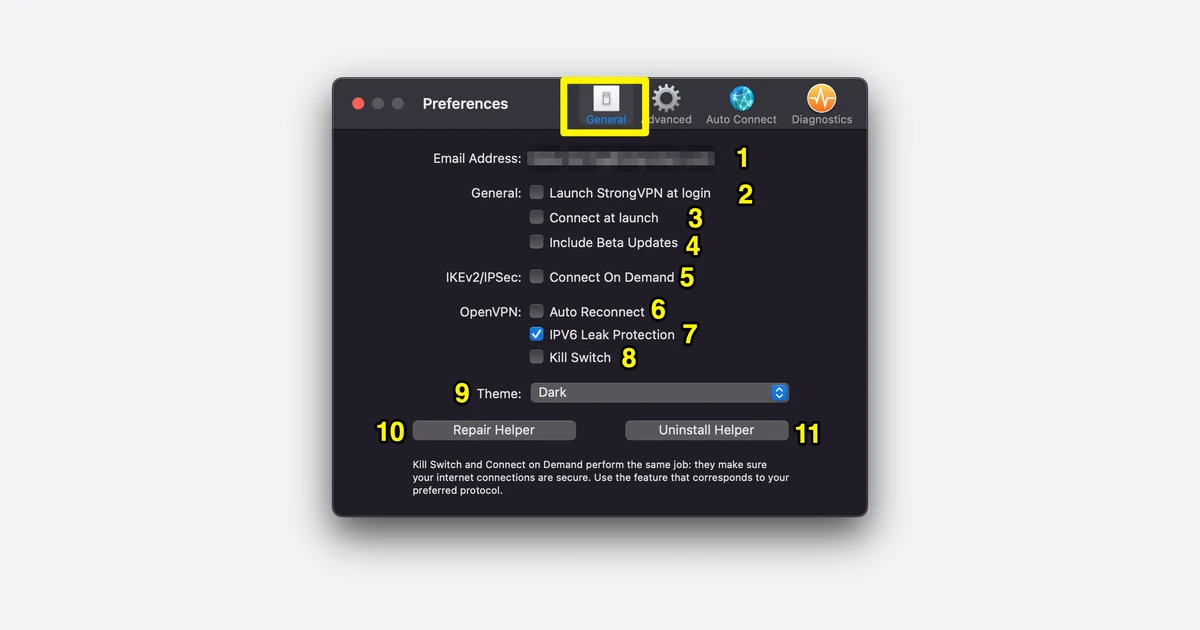
"StrongVPN currently has a Kill Switch mechanism in its Windows and macOS applications." On macOS it is "functional only while you have selected either OpenVPN or L2TP protocols", so a Mac user on WireGuard has no documented kill switch. For IKEv2 and IPSec, the macOS app offers Connect On Demand instead and says the two options "perform the same job". None is documented for iOS, Android or Fire TV.
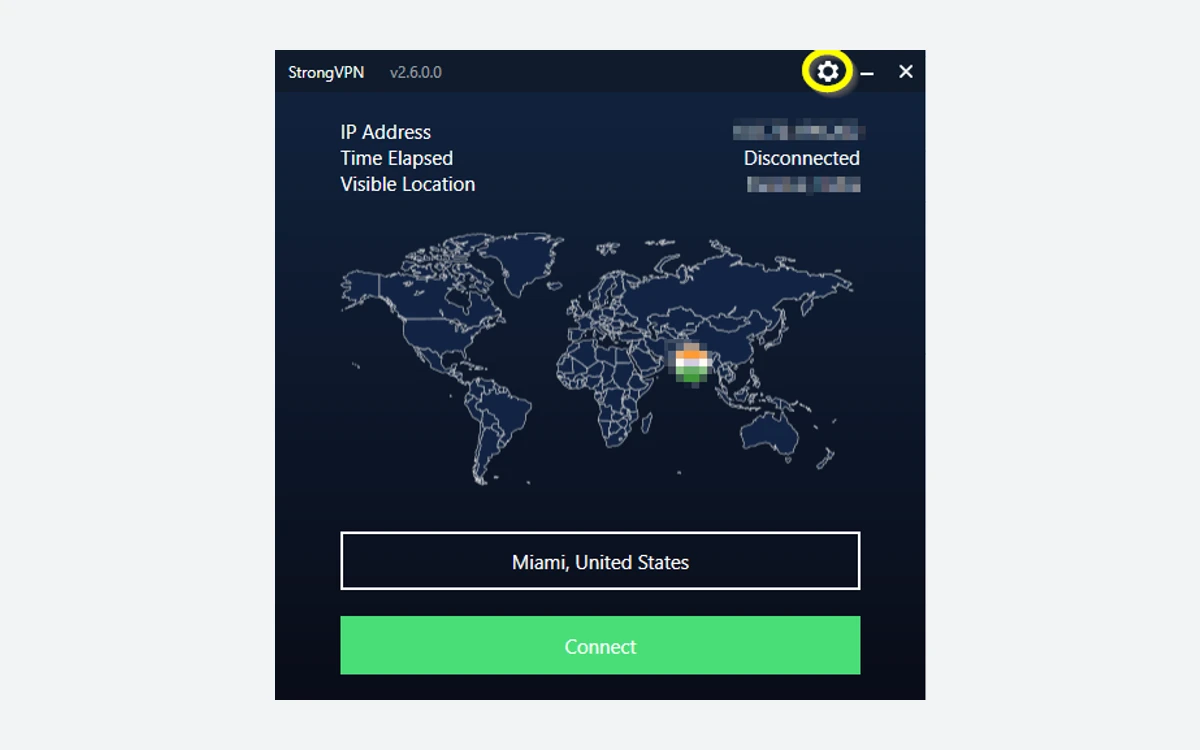
Split tunneling: Android only
Per-app split tunneling is documented only in the Android app, where you choose from "System Apps or User Apps". StrongVPN pitches it partly as a way around streaming services such as Amazon and Netflix "if they have blocked our VPN services".
Obfuscation
The "OpenVPN scramble feature hides or obfuscates the OpenVPN traffic", which helps on networks that block VPNs. It is available in the Windows, Android and macOS v2.x apps, the legacy v1 apps, and on DD-WRT and Sabai routers.
Routers
Privacy, logging and who owns StrongVPN
The privacy policy, last updated April 14, 2025, says: "We are a zero-logging VPN service, meaning we do not track or store your data while connected to our VPN service." The help centre adds that "StrongVPN does not keep any connection logs on our servers."
Account data is a different matter. Sign-up takes an email address and a payment method, and card buyers also hand over their full name, card details and billing address. The policy allows StrongVPN to keep personal data "for the duration of any period necessary to establish, exercise or defend any legal rights" and names processors including ZenDesk, SendGrid, WPEngine, MaxMind, UpSellit, Google reCAPTCHA and Vindicia.
No independent audit
Neither the privacy policy nor the help centre mentions a third-party audit, and we found none. StrongVPN's no-logs claim rests on its word alone, which puts it behind providers that publish audit reports.
US jurisdiction and Ziff Davis
StrongVPN is run by Strong Technology LLC, 114 5th Ave, New York, and the homepage footer reads "a Ziff Davis company". Its EU representative is J2 Global Ireland Limited in Dublin, and "The Federal Trade Commission has jurisdiction over our compliance with the EU-U.S. Data Privacy Framework". A US base means US legal process applies; without an audit, you cannot confirm there would be nothing to hand over.
Ownership has been stable, if busy around it. Encrypt.me merged into StrongVPN in 2021. On March 3, 2026, Ziff Davis agreed to sell its Connectivity division (Ookla, Speedtest, Ekahau, Downdetector and RootMetrics) to Accenture for $1.2 billion in cash. StrongVPN is not among the brands named in that deal, and the September 2026 homepage still describes it as a Ziff Davis company.
Streaming, torrenting and the eSIM bonus
Streaming is handled mostly by StrongDNS, "included with every account" and listed as supporting "140+ Services". StrongVPN also states that it "is not intended for bypassing copyright restrictions", and its own split tunneling article concedes that some services block its VPN. We have not tested specific catalogues, so treat unblocking as possible rather than promised.
Torrenting is allowed ("torrenting still works fine on the VPN"), but there is no port forwarding, which limits seeding. All current accounts use shared IPs: "We used to sell dedicated IP accounts, but we no longer do."
The free aloSIM eSIM is ending
New customers who sign up "through the StrongVPN website" qualify for a "Free 3GB plan" from aloSIM, with the promo code arriving "within 3-5 days". The catch is the deadline: "eSIM must be activated by: September 30, 2026". This review is dated September 29, 2026, so a sign-up today would likely receive its code after the deadline. Do not buy StrongVPN for the eSIM, and do not assume the offer will be renewed.
Who should buy StrongVPN
A good fit if you
- Want to cover up to 12 devices, including a router, on one annual bill
- Mostly use Windows or macOS, where the kill switch lives
- Want SmartDNS for smart TVs and consoles without paying extra
- Are happy to commit to a year and use the 30 days as your trial
Look elsewhere if you
- Need an audited no-logs policy or a non-US jurisdiction
- Want a kill switch or split tunneling on iPhone, or a native Linux app
- Need port forwarding or a dedicated IP
- Prefer month-to-month billing with a refund safety net
Sources and method
This review is based on StrongVPN's published documentation, not hands-on speed tests. strongvpn.com blocks automated visitors, so homepage prices and the privacy policy are quoted from Wayback Machine captures of September 17, 2026 and June 16, 2026. Help centre articles were read on September 29, 2026.
- Homepage (Wayback, 2026-09-17): https://web.archive.org/web/20260917032902/https://strongvpn.com/
- Privacy policy (Wayback, 2026-06-16): https://web.archive.org/web/20260616155521/https://strongvpn.com/privacy-policy/
- Refund policy: https://support.strongvpn.com/hc/en-us/articles/115003235814
- Subscription terms: https://support.strongvpn.com/hc/en-us/articles/360047462553
- Auto-renewal: https://support.strongvpn.com/hc/en-us/articles/115003027273
- Servers and protocols: https://support.strongvpn.com/hc/en-us/articles/360047653253
- Kill switch: https://support.strongvpn.com/hc/en-us/articles/360059298373
- aloSIM eSIM offer: https://support.strongvpn.com/hc/en-us/articles/49929646155291
- Ziff Davis Connectivity sale: https://finance.yahoo.com/news/ziff-davis-announces-definitive-agreement-120000032.html
Frequently asked questions
How much does StrongVPN cost in 2026?
$3.97 a month on the annual plan, billed $47.69 for the first year, or $11.99 on the monthly plan. StrongVPN does not publish the annual renewal price, so check the invoice it generates 7 days before renewal.
Does StrongVPN have a free trial?
No, not for the VPN. Only StrongDNS has a free 7-day trial. The 30-day money-back guarantee on the annual plan is the closest thing to a VPN trial.
Can I get a refund on the monthly plan?
Probably not. The guarantee is written for "all annual subscriptions" and renewal payments are never refunded, so assume a monthly payment is final.
How many devices can I use at once?
Up to 12 devices simultaneously on one subscription. A VPN router counts as one connection and covers everything behind it, including devices without an app such as Apple TV.
Has StrongVPN's no-logs policy been audited?
No. The privacy policy claims zero logging of VPN traffic, but no independent audit is published or mentioned anywhere in StrongVPN's documentation.
Does StrongVPN have a kill switch on iPhone or Android?
Not according to its documentation. The kill switch is in the Windows and macOS apps only, and on macOS it works only with OpenVPN or L2TP selected.
Does StrongVPN work on Linux?
Yes, but without a native app. You configure it manually or run StrongVPN's WireGuard command-line script, which has an optional GUI.
Key takeaways
- StrongVPN costs $3.97/mo billed $47.69 for the first year, or $11.99 monthly; the renewal price is not published.
- The 30-day refund applies to annual plans only, requires cancelling "Now", and never covers renewals; Apple Pay refunds go through Apple.
- 12 devices, 950+ servers in 35 countries, WireGuard and IKEv2, plus StrongDNS for streaming devices.
- Kill switch on Windows and macOS only, split tunneling on Android only, no Linux or Apple TV app.
- Zero-logging is claimed but unaudited, and the company is based in the USA under Ziff Davis.
- The free 3GB aloSIM eSIM bonus must be activated by September 30, 2026, so it is effectively over.
More in Virtual Private Network
Browse Virtual Private Network