VyprVPN Review: Chameleon Obfuscation, US Ownership and the 2018 Audit
VyprVPN sells its Chameleon protocol and self-owned network as tools to beat deep packet inspection. We weigh that against its 2023 move to US-based Certida LLC and a no-logs audit that still dates to 2018.
VyprVPN built its reputation on two things most VPNs do not have: a network the company says it owns and operates itself rather than renting, and Chameleon, an obfuscation protocol designed to slip past the deep packet inspection used to block VPNs in countries like China, Russia and Iran. For a traveller or a user behind an aggressive firewall, that is a genuinely differentiated pitch.
But a VPN review is not only about features. Since 2023 VyprVPN has been owned by Certida LLC, headquartered in Texas — squarely inside the United States and its Five Eyes intelligence-sharing arrangement — and the independent no-logs audit the service still points to was carried out back in 2018 and has not been repeated since. This review takes the marketing at face value, then holds it against the ownership, the jurisdiction and the paper trail so you can decide whether the obfuscation is worth it for your threat model.
What VyprVPN is, and who owns it now
VyprVPN is a consumer VPN service that has been around since the early 2010s, originally under Golden Frog. Its distinguishing claim has always been control over its own stack: rather than reselling third-party server capacity, the company presents itself as running the hardware and writing the software end to end, which it uses to justify its privacy and performance promises.
The ownership picture changed in 2023. VyprVPN's parent company is now Certida LLC, which by the company's own account 'operates its corporate headquarters in the state of Texas in The United States of America' and 'has worked closely with and shares the same vision as the founders of VyprVPN — Golden Frog.' That is a shift from a Swiss-incorporated operator to a US one, and jurisdiction is not a footnote for a privacy tool.
Why the jurisdiction matters
The United States is part of the Five Eyes intelligence-sharing alliance. That does not mean VyprVPN hands over data — the company says it never has — but it does mean a US court can compel disclosure of whatever data exists. For a no-logs VPN the practical protection comes from not retaining the data in the first place, which is exactly why the audit question below matters.
One clarification worth making up front: some write-ups float other corporate links for VyprVPN. The only ownership chain we can confirm from primary sources is Golden Frog to Certida LLC, as of 2023. We are not asserting anything beyond that.
Chameleon and the protocol lineup
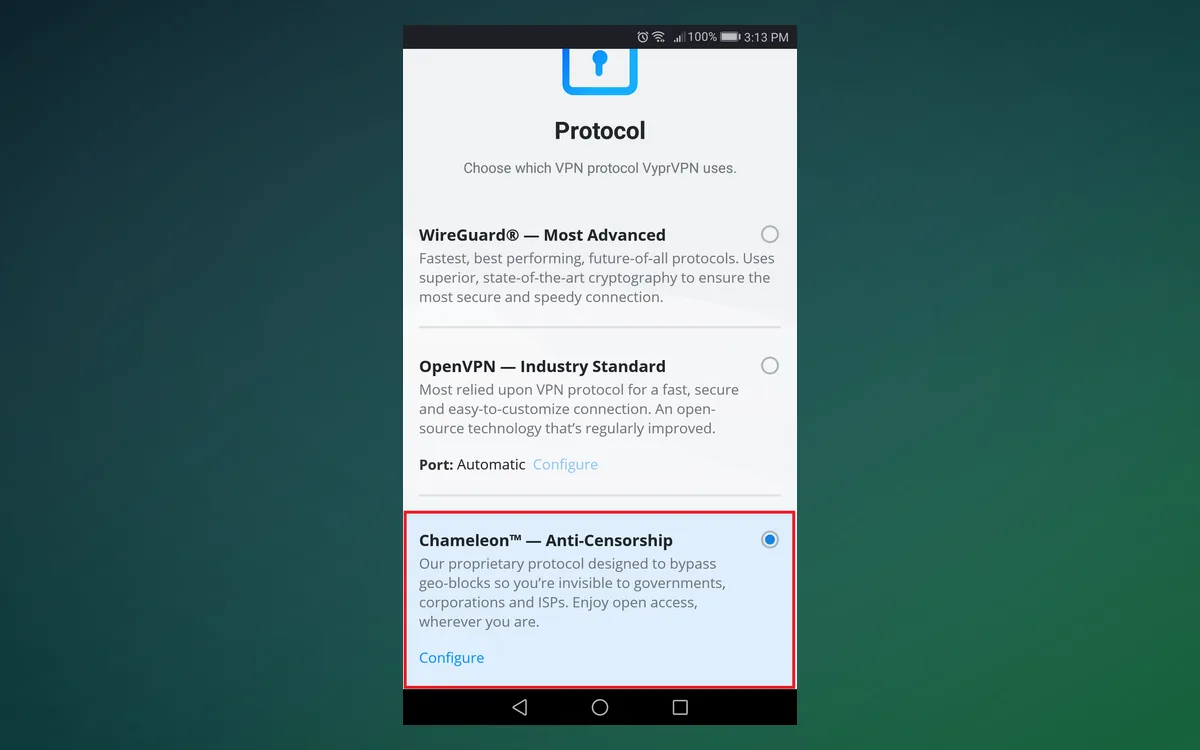
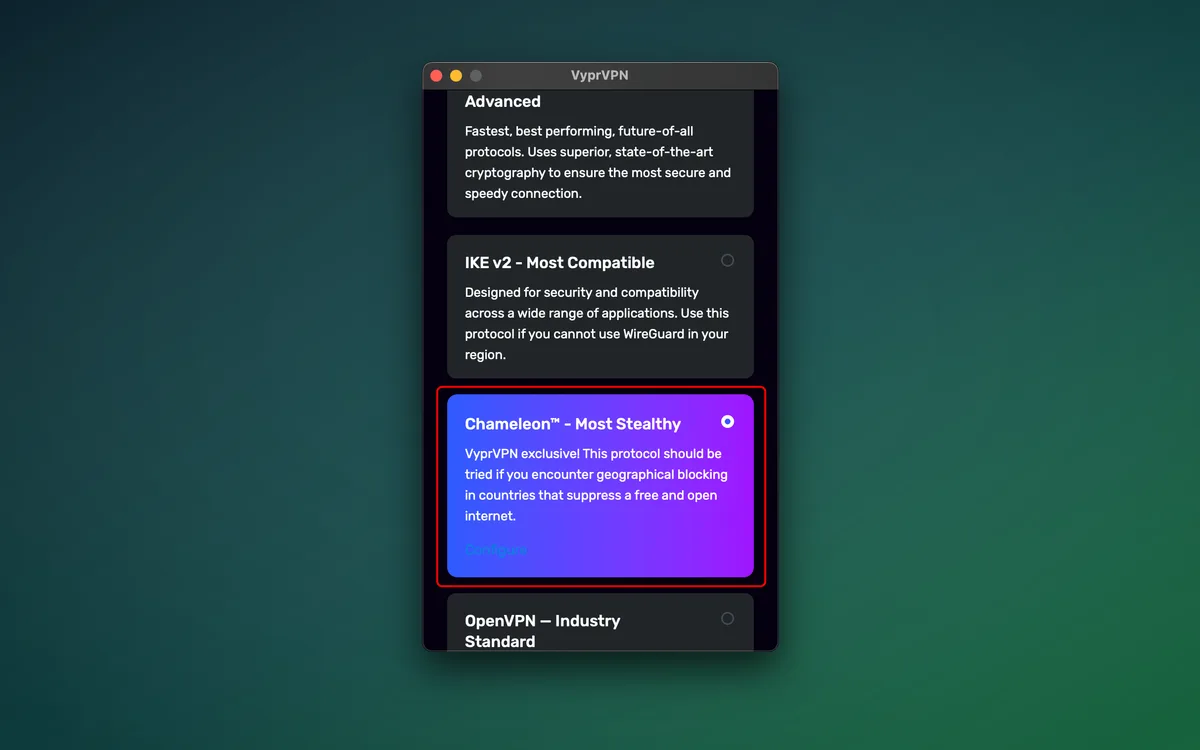
Chameleon is VyprVPN's headline feature. The company describes it as 'scrambling OpenVPN packet metadata to ensure it's not recognizable via deep packet inspection (DPI), while still keeping it fast and lightweight,' while 'using the unmodified OpenVPN 256-bit protocol for the underlying data encryption.' In other words, the encryption is standard OpenVPN; the obfuscation layer is what hides the fact that you are using a VPN at all.
VyprVPN positions Chameleon squarely at users 'being blocked in countries such as China, Russia, Iran, Thailand, and Syria.' If your reason for wanting a VPN is that a national firewall keeps knocking your connections down, this is the feature you are paying for, and it is one many bigger-name VPNs do not offer in the same form.
Smart IP
Chameleon ships with a companion feature called Smart IP, which rotates your server IP address mid-session without dropping the connection. It is enabled by default alongside Chameleon on select locations. The point is to make traffic harder to fingerprint and block, since the visible endpoint keeps changing while your session stays up.
The full protocol list
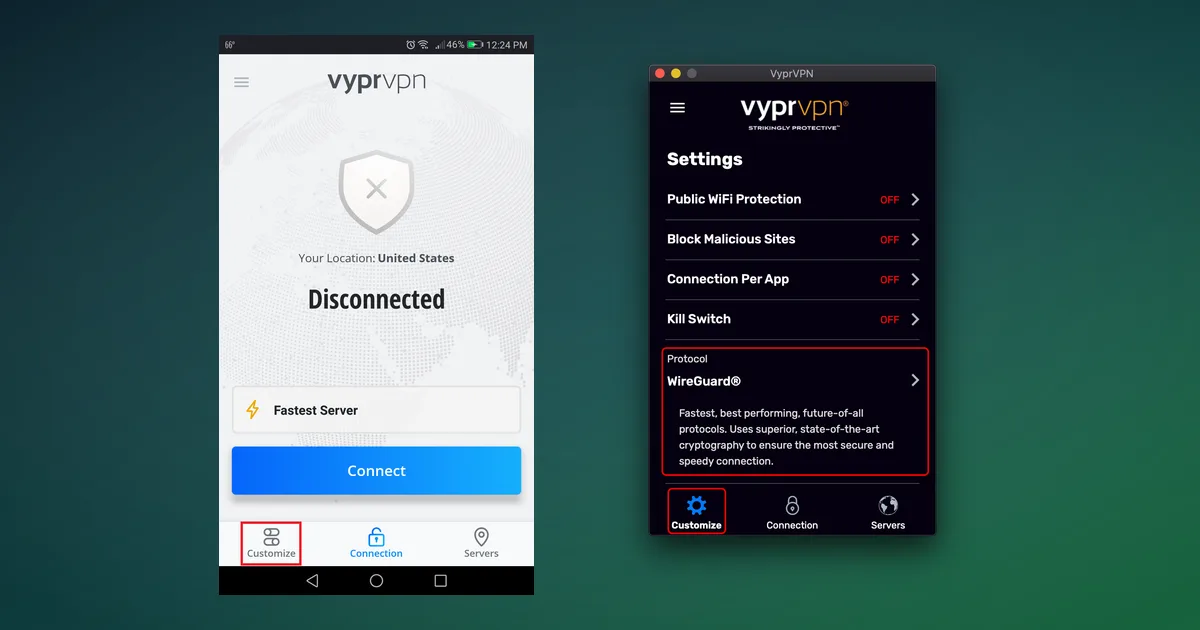
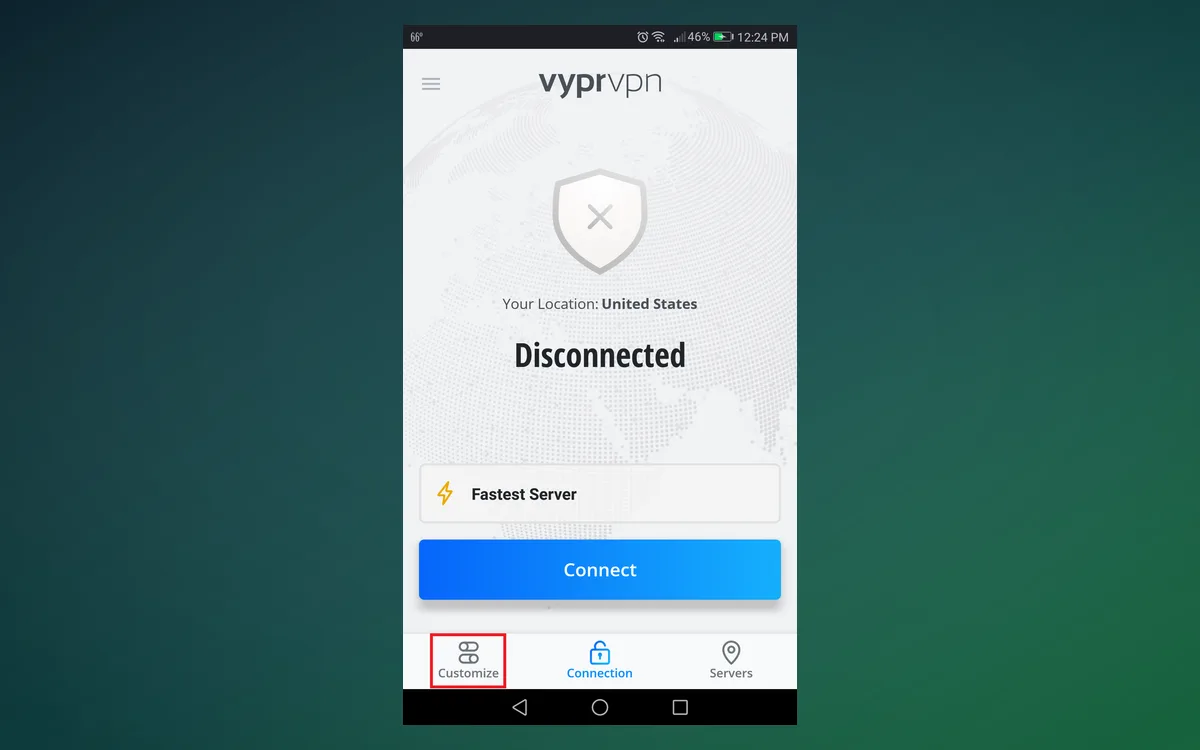
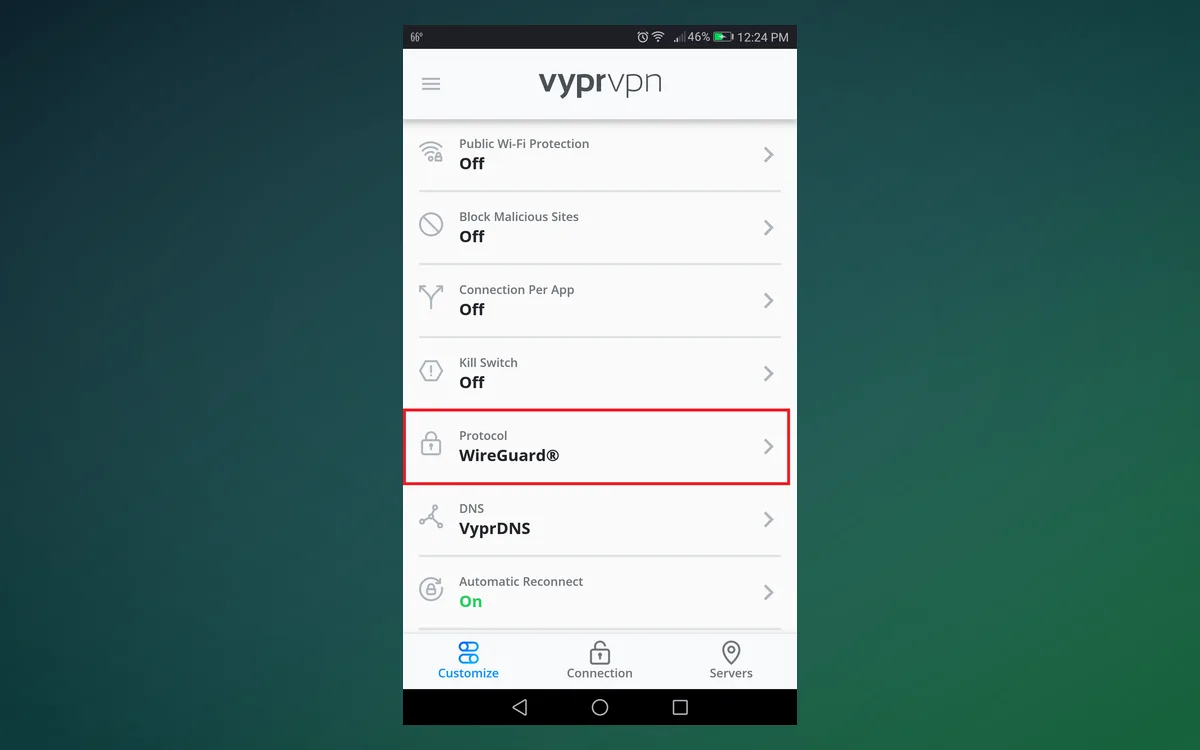
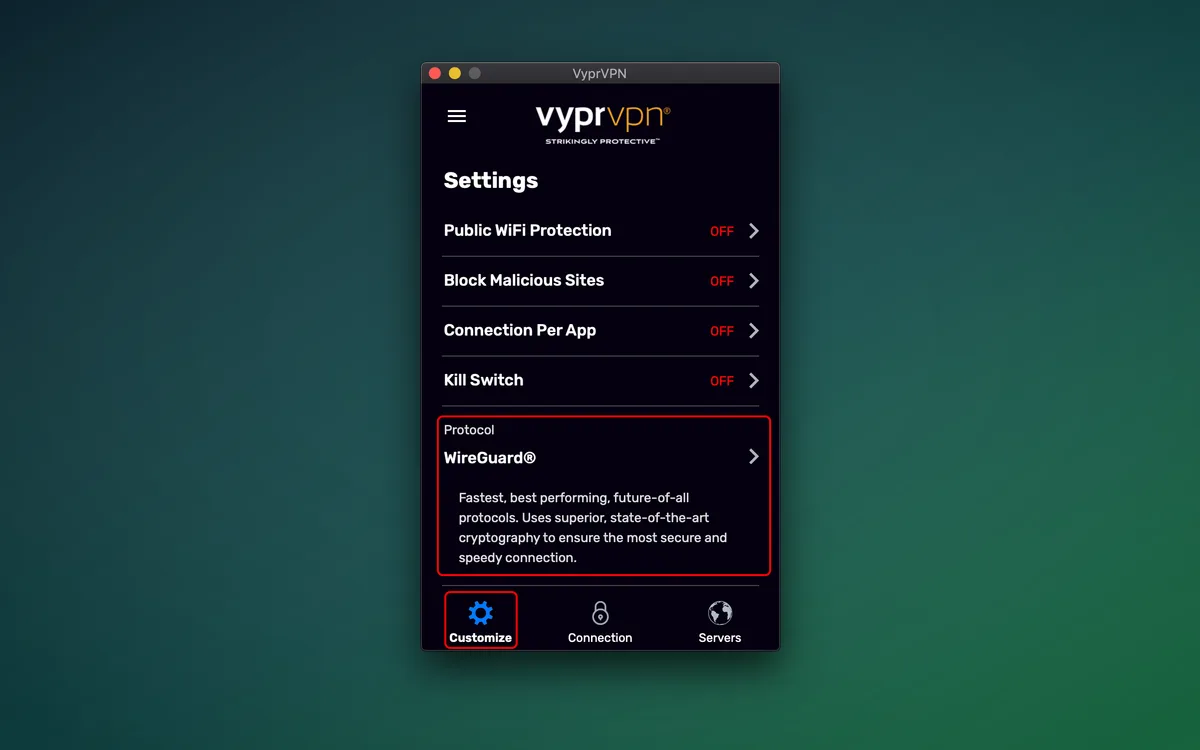
Beyond Chameleon, VyprVPN supports WireGuard, OpenVPN, IKEv2, L2TP/IPsec and PPTP. PPTP is explicitly deprecated — the company warns that 'our ability to assist with PPTP connection issues is extremely limited' — so treat it as legacy and reach for WireGuard for everyday speed or Chameleon when you need to defeat DPI.
- WireGuard — modern, fast default for most users
- OpenVPN — the mature, widely-audited standard
- Chameleon — OpenVPN wrapped in DPI-evading obfuscation
- IKEv2 — good for mobile and quick reconnects
- L2TP/IPsec — older but broadly compatible
- PPTP — deprecated, minimal support, avoid
Privacy, logging and the age of the audit
VyprVPN's no-logs language is unambiguous. The company states that 'no VPN sessions are associated with individual users,' that 'no personally identifiable information is collected or associated with VPN connections,' and that it does not 'keep logs of IP addresses, VPN sessions, time logs, website visits or any online activity.' It describes itself as 'an independently audited No Log VPN service' that 'retains no logs whatsoever of VPN user activity.'
The audit behind that 'independently audited' phrase was performed by Leviathan Security Group. That is a real, credible audit — but here is the catch that any honest review has to raise: it dates to 2018 and, per Comparitech's April 2025 review, has not been repeated since. A seven-year-old audit is not a fabricated one, and it is not nothing. It is, however, a snapshot of a service that has since changed owners and jurisdiction, which is precisely the situation where a fresh audit would carry the most weight.
The nuance on the audit
Flag it as stale, not false. Leviathan did audit VyprVPN's no-logs setup. But an audit predates the 2023 Certida transition entirely, so it cannot speak to how the service is run under its current owner. If a re-audit lands after this review, that materially strengthens the privacy case.
On disclosure, the policy is that 'your Personal Data is never released to others unless we are ordered by a court of competent jurisdiction to do so,' and that 'Certida has never sold any Personal Data, usage information, or any other information, and Certida will never do so.' That court-order carve-out is standard and honest, but it loops back to the jurisdiction point: a court of competent jurisdiction is now a US one.
Speed, servers and streaming
VyprVPN does not run one of the giant networks. Third-party figures — Comparitech's, updated April 2025 — put it at over 700 servers across roughly 70 locations. Precise country counts vary between sources (one says 62, another 64), so we will not commit to an exact number; the honest summary is 700-plus servers spread across about 70 locations, a mid-sized footprint rather than a sprawling one.
On raw speed, Comparitech's independent testing recorded a global average of 201.79 Mbps across New York, London and Hong Kong test points, describing it as comfortable for HD streaming and gaming. That is a solid result for a network this size, though as always your mileage depends on distance to the server and your own line.
Streaming
For streaming, Comparitech found Netflix works through the Chameleon protocol, though it sometimes needs region-dependent protocol switching to land in the right library. Hulu, BBC iPlayer, Amazon Prime Video and Disney+ were all accessible in testing. Results were mixed on regional platforms — ARD Mediathek worked, while France.tv, GloboPlay and 10play failed. If a specific regional service is your reason for subscribing, test it inside the refund window.
Third-party numbers, dated
The server counts, speeds and streaming results above come from Comparitech's April 2025 review, not from VyprVPN's own current figures, which were behind a Cloudflare/JavaScript gate at the time of writing. Treat them as approximate and recent rather than vendor-confirmed and live.
Platforms and device support
VyprVPN covers the mainstream platforms and then some. Officially supported are Windows 10/11, macOS 11 Big Sur and newer, Android 7.0+, iOS 13+, and Linux (Ubuntu/Mint via a manual WireGuard Go client). It also reaches Chrome OS 53+ through the Android app and Amazon Fire TV / Firestick from the 2nd generation onward — not the 1st-gen sticks.
Router support is a strong point, useful if you want to protect every device on a network at once or cover hardware that cannot run a VPN app directly. Supported router platforms include Tomato, DD-WRT, OpenWRT, AsusWRT and AsusWRT-Merlin, plus QNAP and Synology NAS devices.
- Desktop: Windows 10/11, macOS 11+, Linux (manual + WireGuard Go)
- Mobile: Android 7.0+, iOS 13+
- TV / streaming: Chrome OS 53+, Fire TV / Firestick 2nd-gen and newer
- Routers & NAS: Tomato, DD-WRT, OpenWRT, AsusWRT/-Merlin, QNAP, Synology
One thing not to expect: the official device-support page lists no browser extension. Rather than assume a hidden one exists, treat VyprVPN as an app-and-router VPN. If a lightweight browser-only proxy is what you want, that gap is worth knowing before you buy.
Pricing, connections and refunds
As of Comparitech's April 2025 figures — third-party and not vendor-confirmed, so treat them as approximate and check the current site — VyprVPN ran about $10.00/month monthly, roughly $5.00/month on the 12-month plan ($60/year), and around $3.00/month on the 24-month plan ($72 up front). An older aggregator cited $4/month for the annual tier instead of $5, so the annual price in particular has moved around. VPN promos change constantly; use these as a ballpark, not a quote.
On simultaneous connections there is a genuine discrepancy in the sources. VyprVPN's own support article — last edited June 2026 — states 'your VyprVPN account supports up to 10 simultaneous connections.' Comparitech's older review says 5 devices, 'reduced from previous 10.' We lead with the vendor's newer figure of 10, but flag that the two disagree; confirm the current limit before you rely on it for a houseful of devices.
The refund catch
VyprVPN offers a '30-day money-back guarantee for new accounts when you sign up from our website.' The important qualifier: subscriptions bought through iTunes or Google Play are not eligible for that guarantee — those get a 3-day free trial instead, and Apple purchases cannot be refunded by VyprVPN directly. If you want the 30-day safety net, subscribe on the website, not through an app store.
A small housekeeping flaw
Comparitech's review notes the Windows installer 'deploys an expired 2020 root certificate from previous owner Golden Frog, marked for All purposes rather than specific legitimate functions.' It is a sourced criticism we have not independently re-verified, and not a dealbreaker on its own — but it is the kind of leftover that a well-maintained client should have cleaned up after an ownership change.
Frequently asked questions
How much does VyprVPN cost?
As of Comparitech's April 2025 figures, roughly $10/month monthly, about $5/month on the annual plan and around $3/month on the two-year plan. These are third-party numbers, not a live vendor quote, and VPN pricing changes often — check the current site before subscribing.
How many devices can I use at once?
VyprVPN's own support page, last edited in June 2026, says up to 10 simultaneous connections. An older third-party review states 5, describing it as reduced from 10, so the sources conflict. Confirm the current limit if you plan to cover many devices.
Does VyprVPN keep logs?
The company says no — no IP addresses, VPN sessions, time logs, website visits or activity are logged. That claim was independently audited by Leviathan Security Group, but the audit dates to 2018 and has not been repeated since, so it predates the current ownership.
Can VyprVPN get past firewalls in China or Russia?
That is what the Chameleon protocol is built for. It scrambles OpenVPN packet metadata to evade deep packet inspection, and VyprVPN specifically markets it for users in China, Russia, Iran, Thailand and Syria. Success in heavily censored networks is never guaranteed, so test within the refund window.
Where is VyprVPN based, and is that a privacy risk?
Since 2023 it is owned by Certida LLC, headquartered in Texas, USA — a Five Eyes jurisdiction. The company says it has never sold user data and only discloses under a valid court order. The practical protection depends on how little data it retains, which is why the aging audit matters.
Can I get a refund if it doesn't work for me?
There is a 30-day money-back guarantee, but only for new accounts that sign up directly on VyprVPN's website. App Store and Google Play subscriptions are excluded and instead come with a 3-day free trial. Subscribe on the website to keep the 30-day option.
Key takeaways
- Chameleon plus Smart IP is the real reason to pick VyprVPN — it is purpose-built to defeat deep packet inspection where ordinary VPNs get blocked.
- Ownership moved to US-based Certida LLC in 2023, putting the service in a Five Eyes jurisdiction; weigh that against your threat model.
- The no-logs claim is audited, but by a 2018 audit that predates the current owner and has not been repeated — treat it as stale, not fake.
- Speed (~200 Mbps in testing) and streaming are solid; the network is mid-sized at 700+ servers across ~70 locations.
- Buy on the website, not an app store, to keep the 30-day money-back guarantee, and confirm the current device limit and pricing before you commit.
More in Virtual Private Network
Browse Virtual Private Network