Windscribe VPN Review 2026 – 10GB Free, Build-A-Plan Pricing and RAM-Only Servers
Windscribe gives away 10GB a month, sells Pro at $9/mo or $69/yr, and lets you buy single locations for $1 each. A look at what the free tier really covers, what the seizure record proves, and where the audit trail runs out.
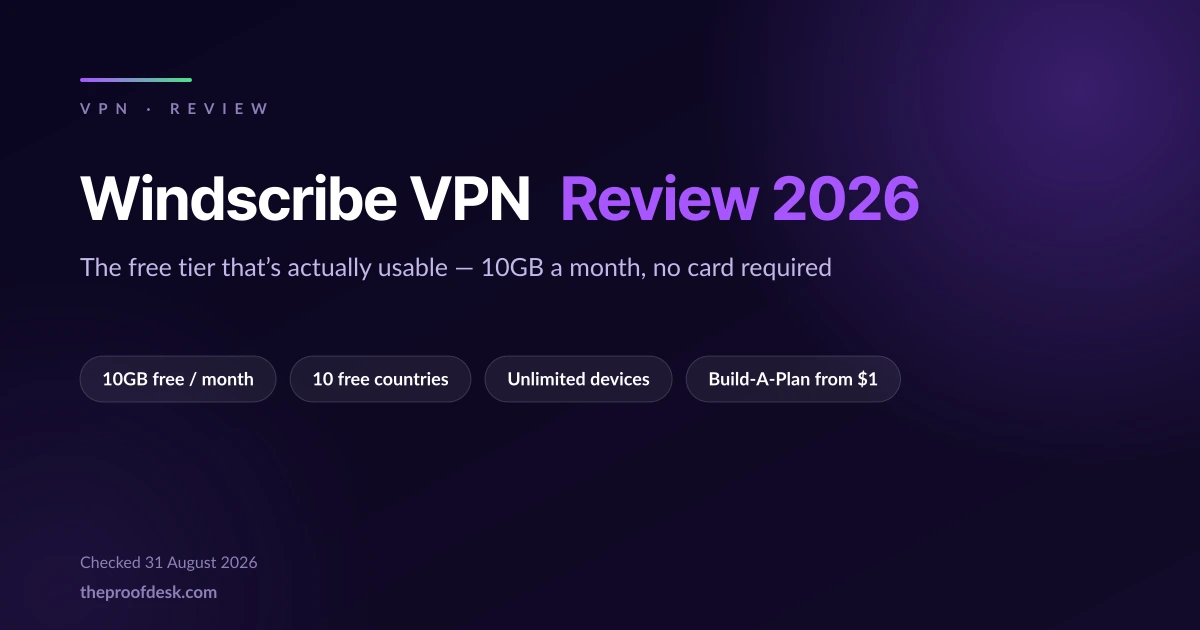
Most VPN free tiers exist to annoy you into paying. You get 500MB, one server, and a nag screen. Windscribe's free plan gives you 10GB a month across ten countries with no device limit, which is enough to actually live on if your needs are occasional — and that single decision shapes everything else about the company.
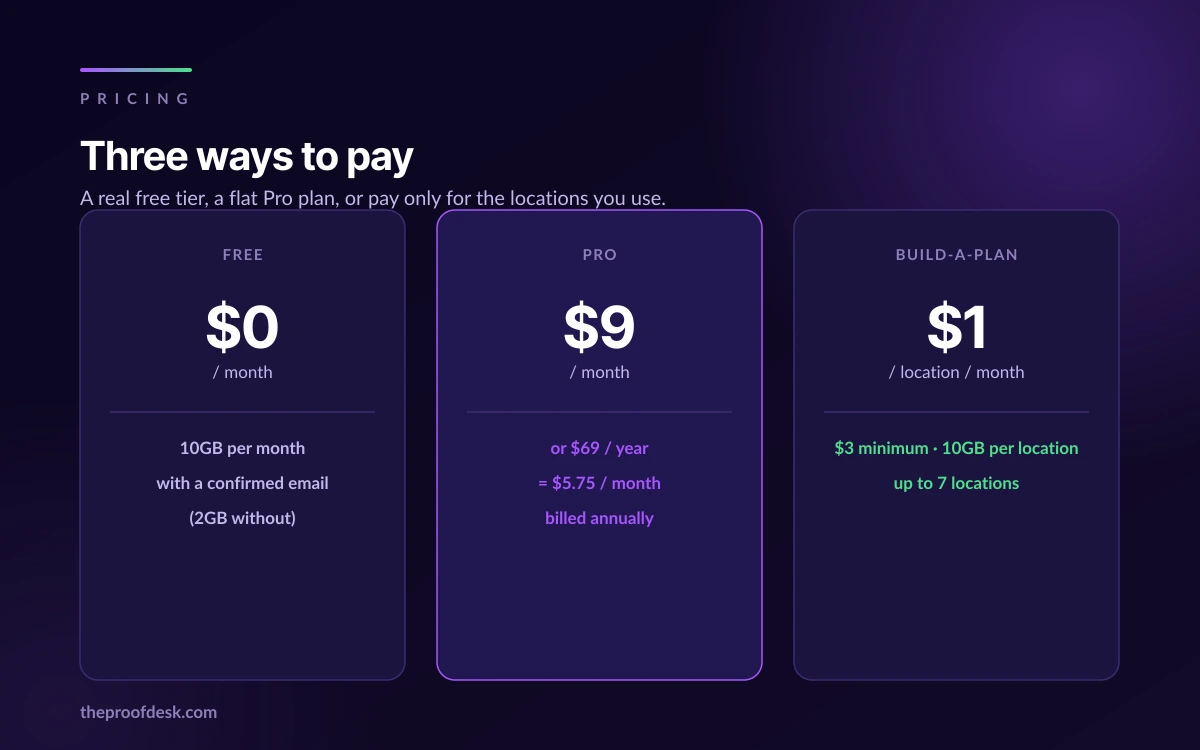
The paid side is unusual too. Pro is $9 a month or $69 a year, but Windscribe also sells VPN by the piece: $1 per location per month, $3 minimum, and you build the plan you need. Almost nobody else does this.
What follows is what Windscribe's own pages and policies say as of August 2026, what its server-seizure record actually demonstrates, and the two places where the story gets noticeably thinner than the marketing suggests.
The free plan is the product
Sign up with nothing but a username and you get 2GB of data a month. Add and confirm an email address and that jumps to 10GB. Windscribe is unusually blunt about why: the company says the trade is that it gets "to at least let us advertise to you in the form of one or two promo emails per month." Remove the email later and, per its own knowledge base, "it is permanently gone from our database immediately" — along with the extra 8GB.
There is a third lever most people miss. Posting about Windscribe from an X account permanently adds 5GB to the monthly allowance, and a referral programme stacks on top of that. A free account can therefore sit at 15GB a month indefinitely without anyone paying anything.
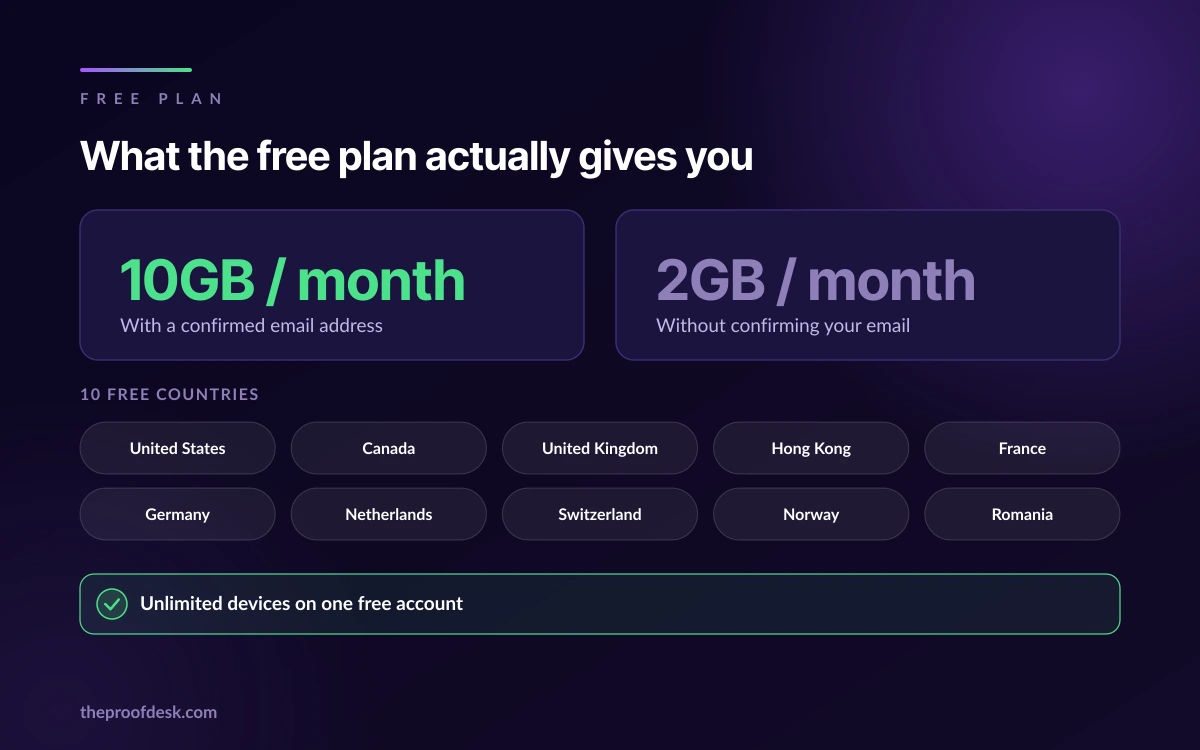
Free accounts reach ten countries: the United States, Canada, the United Kingdom, Hong Kong, France, Germany, the Netherlands, Switzerland, Norway and Romania. That is a genuinely useful spread — a European, a North American and an Asian exit, plus two privacy-friendly jurisdictions.
No device cap, free or paid
Windscribe does not meter connections on any tier. The company's wording is "unlimited personal devices on a single account. No hidden caps, no 'rank your devices' games." Where NordVPN gives you ten and ExpressVPN eight, Windscribe gives you a number it declines to state because there isn't one.
The catch is speed. Independent testing by Security.org in July 2026 found free-tier throughput "periodically dropping by up to 90 percent," roughly twice per three hours of use, which the testers attributed to server congestion. The free plan is generous on volume and unreliable on rate.
What Windscribe costs
Pro is $9.00 billed monthly, or $69.00 billed every 12 months, which Windscribe advertises as $5.75 per month. Both figures are USD and both renew automatically. Pro removes the data cap entirely and opens every location.
There is also a two-year Pro plan at $89.00 — about $3.71 a month — but it is not offered as a card on the upgrade page. It sits in the page's plan catalogue rather than the interface, so treat it as something that may surface in a promotion rather than a standing option you can rely on finding.
Build-A-Plan: VPN sold by the piece
This is Windscribe's genuinely distinctive idea. Instead of buying a subscription, you buy locations. Each one costs $1 per month and carries 10GB of bandwidth on top of your existing free allowance. The minimum purchase is $3, and you can select at most seven locations — beyond that Windscribe itself tells you "its cheaper to get our monthly Pro plan."
- $3/month — three locations, 30GB on top of your free 10GB.
- $5/month — five locations, 50GB extra. Still cheaper than most VPNs' headline monthly rate.
- $7/month — seven locations, the cap. At this point Pro's $9 for everything unlimited is the better buy.
- Build-A-Plan also unlocks router config downloads and the full R.O.B.E.R.T. blocklists, which the free tier does not get.
For someone who only ever needs a UK exit for football and a US exit for shopping, $2 a month is an honest price that no other major provider will quote you.
The refund window is tighter than most
Windscribe offers 7 days, not the industry-standard 30 — and it is conditional. Its policy states you are ineligible "if it has been more than 7 days OR you have used more than 10GB of traffic on the paid plan." Renewals cannot be refunded at all; only the original payment that started the subscription qualifies. Use the free plan as your trial, because the paid one barely is.
R.O.B.E.R.T. and the paid extras
R.O.B.E.R.T. is Windscribe's server-side blocker, and unlike most VPN ad-blockers it works at the DNS level for every device on the account, including ones that cannot run an extension. Blocklist categories cover malware, ads and trackers, social networks, porn, gambling, fake news, crypto mining and — with some self-awareness — competitors.
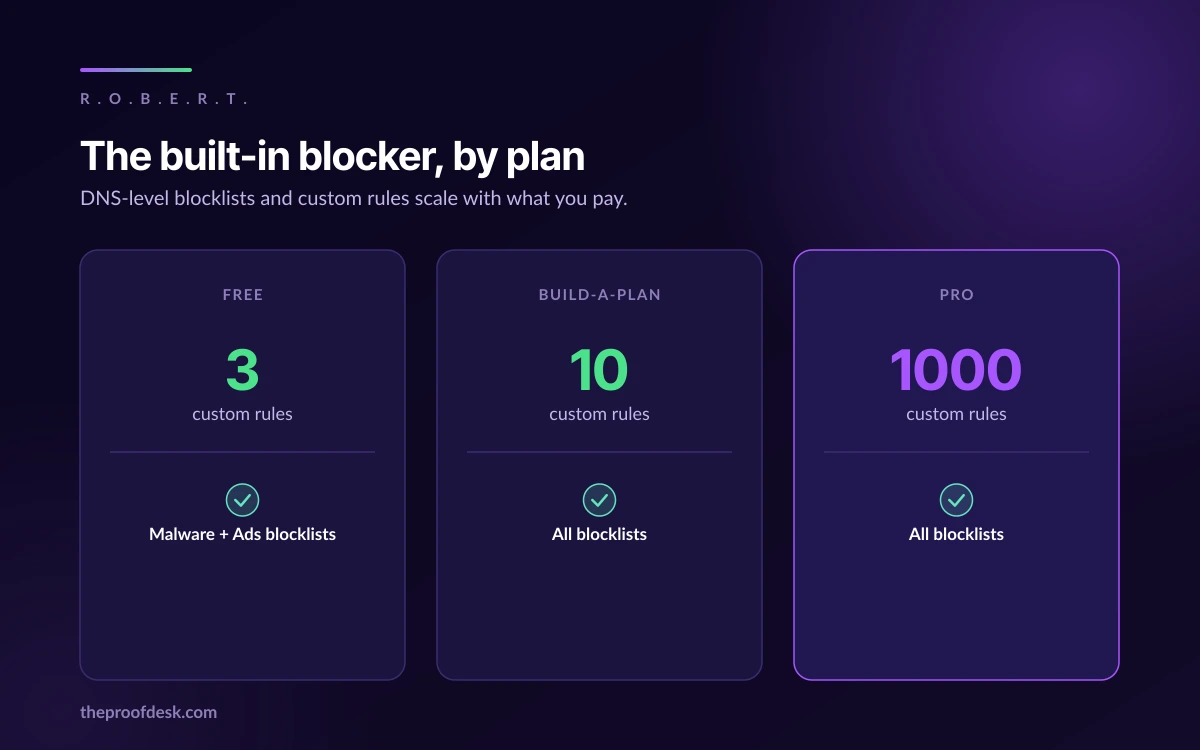
Entitlement is tiered rather than all-or-nothing. Free accounts get the malware and ad blocklists with 3 custom access rules. Build-A-Plan gets all blocklists and 10 rules. Pro gets all blocklists and 1,000 rules. That free-tier allocation is real functionality, not a teaser.
Streaming, port forwarding and static IPs
Windscribe maintains dedicated Windflix servers for streaming and tells users plainly that if one gets blocked, try another. Whether that works is where reviewers split hardest: TechNadu reports Windscribe "can reliably unblock Netflix, Hulu, Disney+, Max, BBC iPlayer, and more," while Security.org kept it off both its best-for-streaming and best-Netflix-VPN lists. Treat streaming as a maybe, and test it inside the seven-day refund window if it is your reason for buying.
Pro includes ephemeral port forwarding, granted a week at a time and then cleared. Permanent port forwarding requires a static IP add-on: $24 a year ($2/month) for a datacenter IP, or $96 a year ($8/month) for a residential one. Both require Pro or an unlimited-data plan, and P2P traffic is prohibited on residential IPs.
"Static" does not mean "yours alone"
Windscribe declines to sell truly dedicated IPs, and explains the reasoning rather than hiding it: "We do not offer dedicated IPs for privacy reasons... we allocate a single IP address to a handful of customers, so your activity can still be 'lost in the crowd.'" That is a defensible trade, but if you need an IP nobody else touches for an allowlist, this is not it.
Split tunnelling is available on the desktop and mobile apps, letting you route chosen applications outside the tunnel.
The privacy record, and what actually tested it
Windscribe Limited is registered in Ontario, Canada, with disputes governed by Ontario law and heard in Toronto. Canada is a Five Eyes member, which some buyers rule out on principle — though as the next few paragraphs show, jurisdiction has mattered less here than architecture.
The logging policy is specific about both halves. Windscribe keeps the total bytes you transfer in a 30-day period and a timestamp of your last activity on the network, used to enforce free-tier limits and clear out dead accounts. It states it does not store a historical record of VPN sessions, your source IP, or the sites you visited, adding that "one's browsing history should be taken to one's grave." Session data "resides only in server's memory while you're connected, and is immediately discarded by the VPN server when you disconnect."
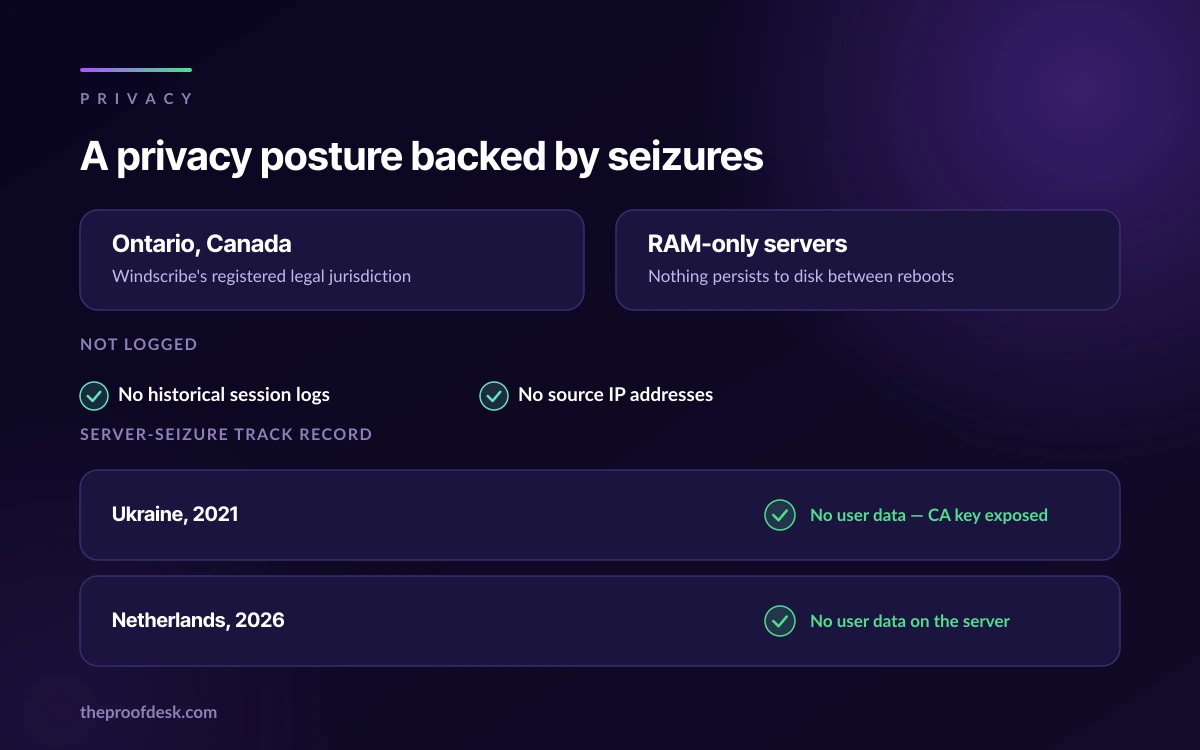
That claim has been tested in the least theoretical way possible. In July 2021 Ukrainian authorities seized two Windscribe servers. No user data was compromised because none existed — but an OpenVPN certificate authority key was exposed, because the servers were not encrypted at rest. Windscribe published the failure itself and rebuilt the fleet as RAM-only under a programme it called Operation FreshScribe.
Windscribe reports two sequels, both self-disclosed. Dutch authorities physically pulled a server from a rack in February 2026 without a warrant or prior request and found, in the company's telling, "a stock Ubuntu install running entirely in RAM — no hard drives, no logs, no user data." Separately, Greek authorities charged co-founder Yegor Sak personally over a breach allegedly routed through a Finnish Windscribe server; the case was dismissed on 11 April 2025 because there was no user data to produce.
Where the story thins out: the audit
Windscribe markets itself as "Audited & Court-Proven," and the court-proven half is well evidenced. The audited half is not. No page on windscribe.com that we could reach names an auditor, a scope, or a year — windscribe.com/audit returns a 404. Third-party reviews contradict each other and sometimes themselves, citing a 2018 full audit, a 2022 app audit and a 2024 infrastructure audit in the same article. Compared with Mullvad or ProtonVPN, which publish dated reports with named firms, this is a real gap.
Network, protocols and apps
Windscribe says it runs only bare-metal, dedicated servers "all actually located where they claim to be. No fake IP zones." In a market where large providers quietly pad their maps with virtual locations, a physical-only commitment is worth something.
Nobody at Windscribe agrees on the server count
Its feature page says "over 69 countries and 135+ cities." The upgrade page's comparison table lists 66 country rows. That same page's location data contains 72 countries. The homepage says "over 130 locations." The server-list page title says "190+ Locations." These are all first-party figures on the same site in the same week. The network is clearly large and clearly physical; the exact number is not something Windscribe has settled internally, so discount any specific figure you see quoted.
Six protocols are offered: WireGuard, OpenVPN over UDP and TCP, IKEv2, Stealth and WStunnel. The last two are the interesting ones. Stealth disguises OpenVPN traffic as HTTPS, and WStunnel tunnels VPN traffic over WebSockets — both aimed at networks that block VPNs outright, which makes Windscribe a reasonable pick for restrictive hotel, campus or corporate Wi-Fi.
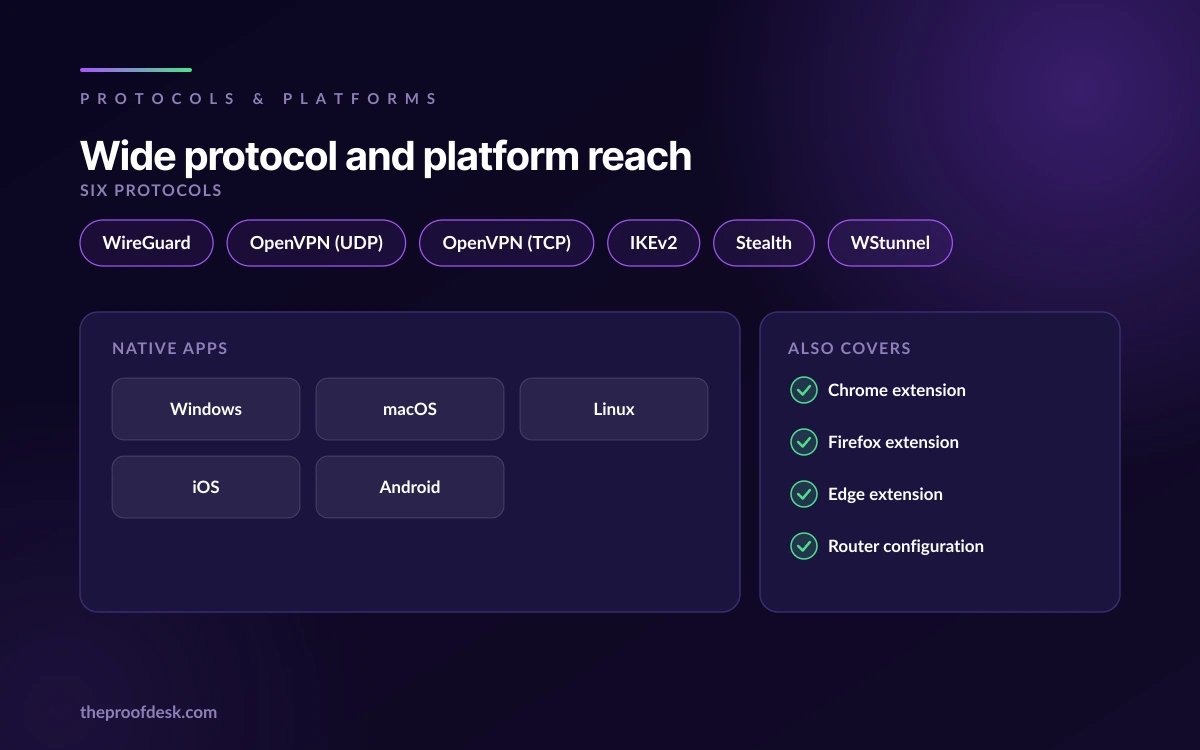
Apps cover Windows, macOS, Linux, iOS and Android, with extensions for Chrome, Firefox and Edge, plus builds for Fire TV, Huawei's AppGallery and an open-source Android release on F-Droid. Routers are supported through manual configs for OpenVPN, IKEv2 or WireGuard, but config downloads require Pro or Build-A-Plan — a free account cannot put Windscribe on a router.
On paid speeds, Security.org measured 91.8 Mbps down and 90.6 Mbps up on a nearby US server at 16ms, 85.3/82.1 Mbps in Europe at 52ms, and 68.4/61.7 Mbps to Singapore at 187ms. Solid rather than class-leading, with the expected falloff at distance.
Who should buy it
Windscribe is the strongest recommendation on the market for people who are not sure they need a VPN at all. The free tier is large enough to answer that question honestly over a few months, and it costs nothing to find out.
- Occasional users — 10GB, or 15GB with the X bonus, genuinely covers light travel and public Wi-Fi use.
- Households with many devices — no connection cap on any tier, including free.
- People with one or two specific needs — Build-A-Plan at $1 a location is unmatched value for a narrow use case.
- Users on restrictive networks — Stealth and WStunnel are built for exactly that.
- Technical users — open-source apps, an F-Droid build, manual configs and ephemeral port forwarding.
Look elsewhere if you want a published, dated no-logs audit from a named firm, if streaming is your primary reason for subscribing, or if you want a long refund window to evaluate at leisure. Mullvad and ProtonVPN answer the audit question more convincingly; the mainstream providers answer the streaming one more consistently.
Frequently asked questions
Is Windscribe's free plan really free, and what is the catch?
Yes, with no payment details required. The catch is 10GB a month rather than unlimited, ten countries rather than all of them, promotional email in exchange for 8GB of that allowance, and free-tier speeds that independent testing found can drop by up to 90 percent during congestion.
How much is Windscribe Pro, and what does it renew at?
$9.00 a month or $69.00 a year, in USD. Unlike most of the industry, that annual figure is not a discounted first year — it renews at the same $69, so there is no price jump to plan for. Build-A-Plan starts at $3 a month.
Can I get a refund from Windscribe?
Within 7 days of your first purchase, and only if you have used less than 10GB on the paid plan. Renewal payments are not refundable at all. This is stricter than the 30-day guarantee most competitors offer, so evaluate on the free plan first.
Does Windscribe keep logs?
It keeps your total bytes transferred over a rolling 30 days and a timestamp of your last activity, both used to enforce plan limits. It states it does not store session history, source IPs or browsing history. Two server seizures — Ukraine in 2021 and the Netherlands in 2026 — produced no user data, which is stronger evidence than most policies can offer.
Has Windscribe been independently audited?
Not in any way we could verify. Windscribe advertises itself as audited but names no auditor, scope or date on its own site, and its /audit URL returns a 404. Third-party reviews cite conflicting years. If a published audit report is a requirement for you, this is the weakest part of Windscribe's case.
How many devices can I use at once?
Unlimited, on every tier including free. Windscribe publishes no numeric cap, which makes it one of the few providers where a whole household on one account is the intended use rather than a workaround.
Does Windscribe work for Netflix?
Sometimes, via its dedicated Windflix servers, and reviewers openly disagree about how reliably. Windscribe's own advice is to try a different Windflix server when one stops working. If streaming is your main reason for subscribing, verify it within the seven-day refund window.
Key takeaways
- 10GB a month free with a confirmed email — 2GB without, and 15GB if you claim the 5GB bonus for posting on X.
- Pro is $9/month or $69/year ($5.75/month), and the annual rate renews at the same price rather than jumping after year one.
- Build-A-Plan sells VPN by the location at $1 each per month with a $3 minimum and a seven-location cap — nothing else on the market prices this way.
- Unlimited simultaneous devices on every tier, free included.
- Two server seizures, in Ukraine in 2021 and the Netherlands in 2026, produced no user data — the no-logs claim has been tested in practice.
- No verifiable independent audit: Windscribe names no auditor, scope or date, and its own /audit page 404s.
- The 7-day refund is void once you use 10GB, and renewals cannot be refunded — treat the free plan as the real trial.
More in Virtual Private Network
Browse Virtual Private Network