ZenMate VPN Review (2026): A Brand That Now Runs on CyberGhost
ZenMate still sells subscriptions in 2026, but its apps were retired in 2023 and folded into CyberGhost. Here is what you are actually buying, the pricing, and whether it beats buying CyberGhost directly.
ZenMate is one of the older names in consumer VPNs. It started in Berlin in 2013 as a free browser extension, built a following on simplicity, and was bought by London-based Kape Technologies in 2018. In 2026 its website is still up and still taking payments — which makes it easy to assume you are buying an independent, actively developed VPN.
You are not. In 2023 ZenMate announced that its own apps were being retired and its team folded into CyberGhost, another Kape brand. Paying ZenMate customers were told to log into the CyberGhost app instead. That single fact reshapes this entire review, so we put it first rather than burying it: the honest question is not “how good is ZenMate,” it is “what exactly are you paying for, and would you be better off buying CyberGhost directly.”
What ZenMate actually is in 2026
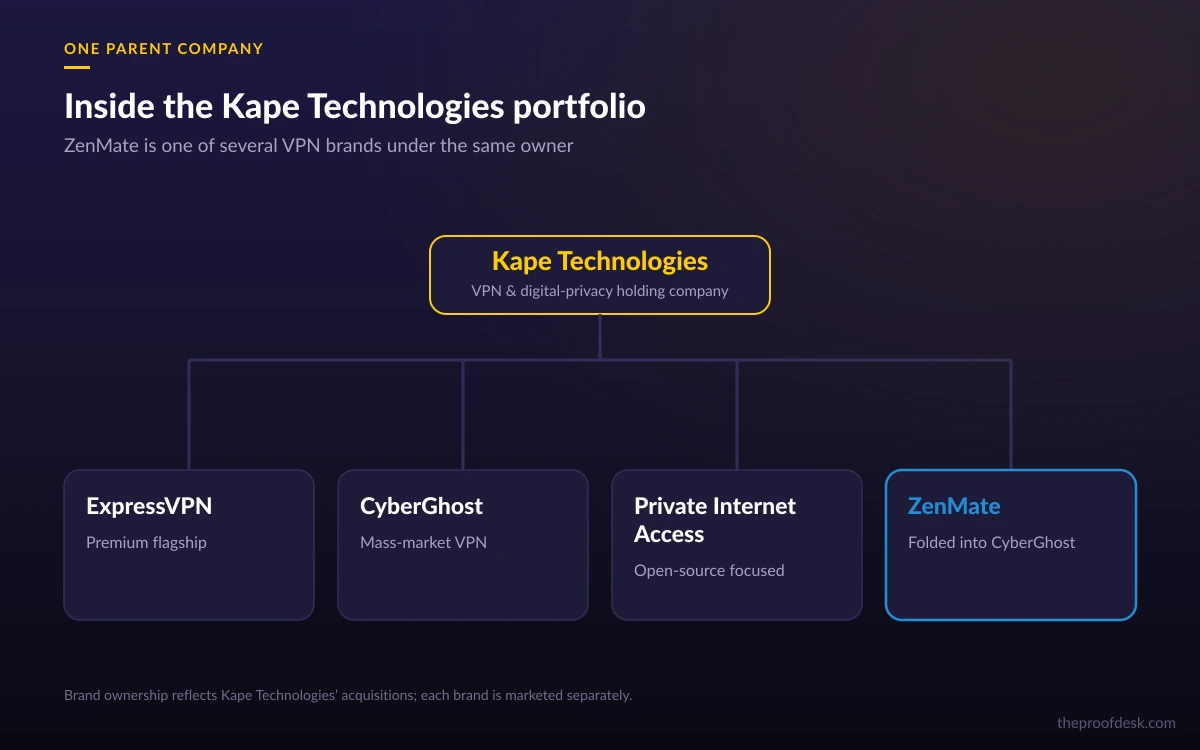
ZenMate launched in 2013 in Berlin as a free browser-extension VPN, aimed at people who wanted a quick way to unblock sites without installing a full desktop client. In 2018 it was acquired by Kape Technologies (formerly Crossrider) for a reported €4.8 million. Kape, headquartered in London, is the same company that owns ExpressVPN, CyberGhost, and Private Internet Access — so ZenMate has been part of a multi-brand VPN portfolio for years.
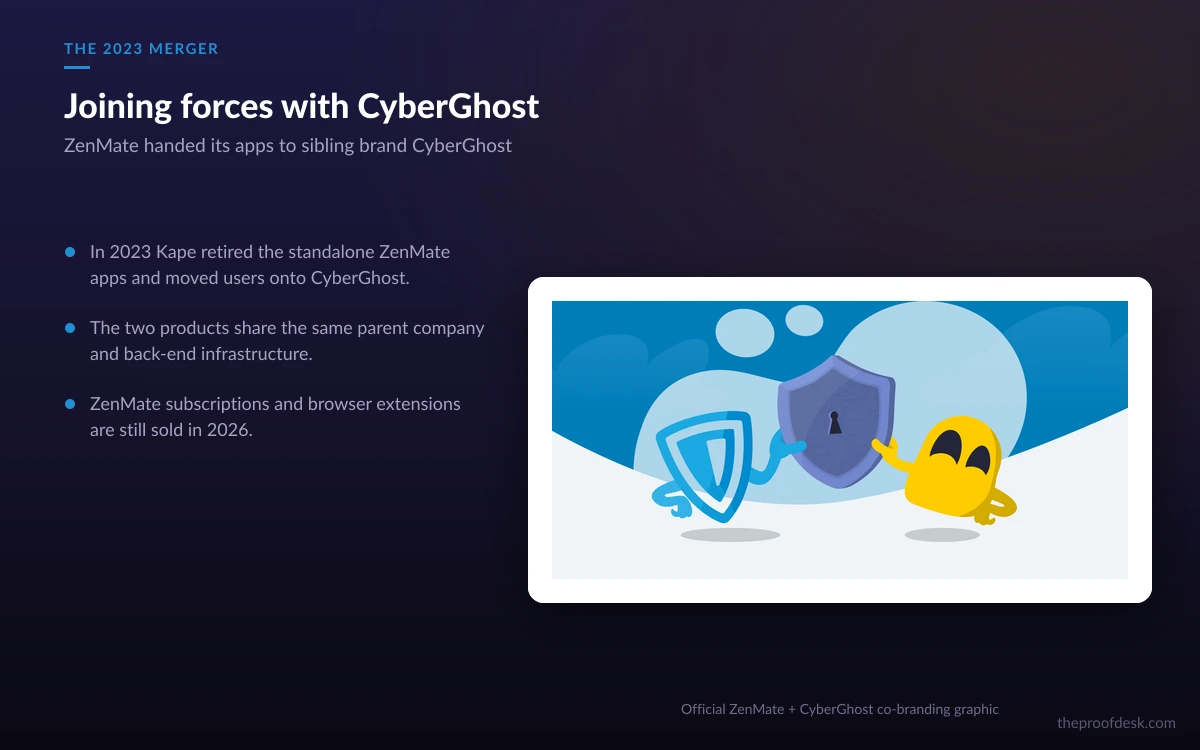
The decisive moment came in 2023. ZenMate's own blog post, “Important Changes to ZenMate,” announced that its developers were “joining forces with CyberGhost VPN.” New ZenMate signups stopped on March 16, 2023, the apps were supported only until May 1, 2023, and after that date “all ZenMate paying subscribers will need to log into a CyberGhost VPN app.” In plain terms: the standalone ZenMate app was discontinued and its users were migrated onto CyberGhost.
The one fact to hold onto
Per ZenMate's own announcement, its apps were retired in 2023 and paying subscribers were moved to the CyberGhost app. When you buy “ZenMate” today you are buying access to infrastructure and software that is now CyberGhost's, under an older brand name.
The support side confirms the wind-down. ZenMate's help center at support.zenmate.com now redirects to a generic Zendesk “help center closed” page — there is no live, ZenMate-specific support desk behind the brand anymore.
So why is the site still selling subscriptions?
This is the confusing part. Despite the 2023 merger announcement, zenmate.com is still live in 2026 and still sells subscriptions. The homepage even carries the “joining forces with CyberGhost” banner while presenting plans and a checkout as if nothing changed.
The most reasonable read is that ZenMate now operates as a legacy brand and billing front-end that provisions access to the CyberGhost network. You pay ZenMate, but the actual VPN you use is CyberGhost's app and servers. That is not inherently a scam — the underlying service is real — but it does mean the “ZenMate” layer adds a brand name and a separate checkout without adding an independent product.
For a buyer, the practical consequence is simple: evaluate ZenMate as a way to buy CyberGhost, and compare its price and terms against CyberGhost's own store rather than treating it as a distinct VPN.
Pricing and plans
A caveat before the numbers: ZenMate's own pricing page renders prices with JavaScript and could not be independently confirmed for this review. The figures below come from third-party aggregation (primarily Cloudwards, cross-checked against other review sites), so treat them as reported rather than vendor-verified, and confirm the live price at checkout before paying.
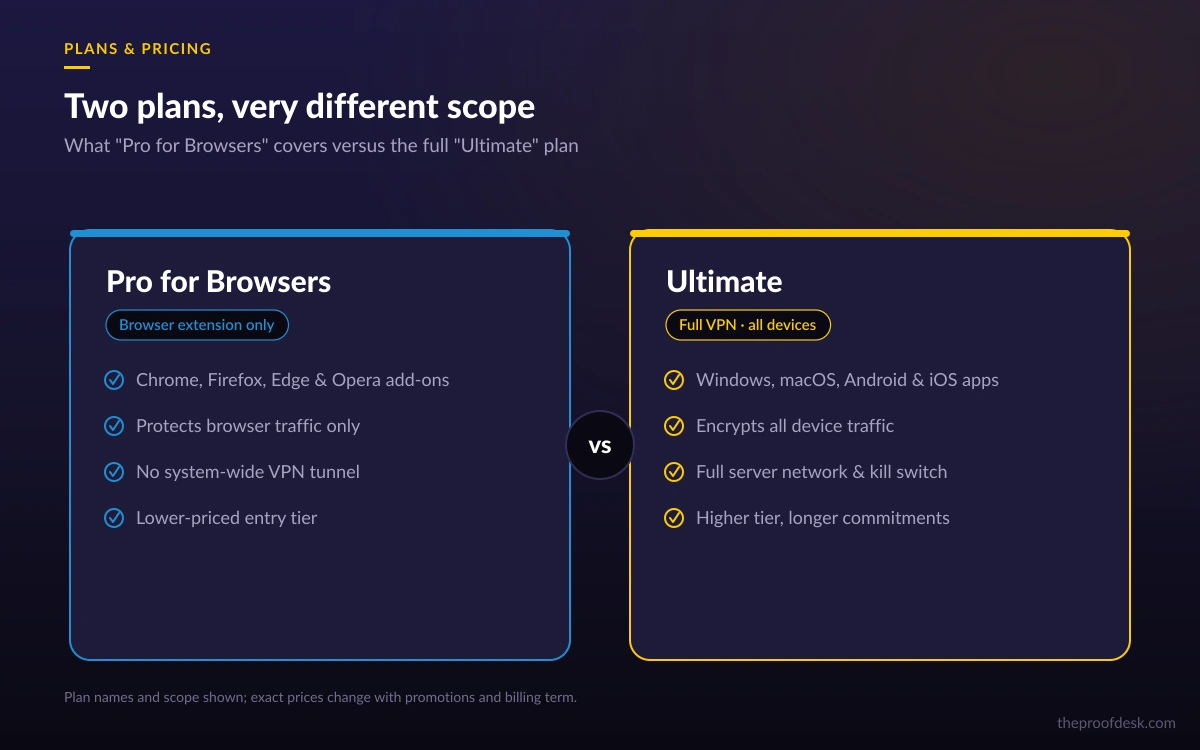
ZenMate has historically sold two tiers. “Pro for Browsers” covers the browser extension; “Ultimate” covers the full apps.
- Pro for Browsers — about $7.99/month monthly, roughly $3.19/month on a 6-month plan, and around $1.99/month on a 1-year plan (as reported by aggregators).
- Ultimate — about $10.99/month monthly, roughly $4.49/month on a 1-year plan, and around $1.64/month on a 3-year plan (as reported by aggregators).
- A 7-day free trial and a 30-day money-back guarantee are listed.
Watch the long-term math
As with most Kape VPNs, the headline monthly price only applies to a multi-year commitment billed upfront, and renewals are typically higher than the introductory rate. Since the 3-year Ultimate price is the only figure that looks genuinely cheap, you are effectively locking into three years to access what is CyberGhost's network.
Before committing, price CyberGhost's own long plans directly. Because ZenMate rides on CyberGhost, the deciding factor is usually which storefront gives you the lower effective price and the friendlier renewal terms for the same underlying service.
Network, apps, and security features
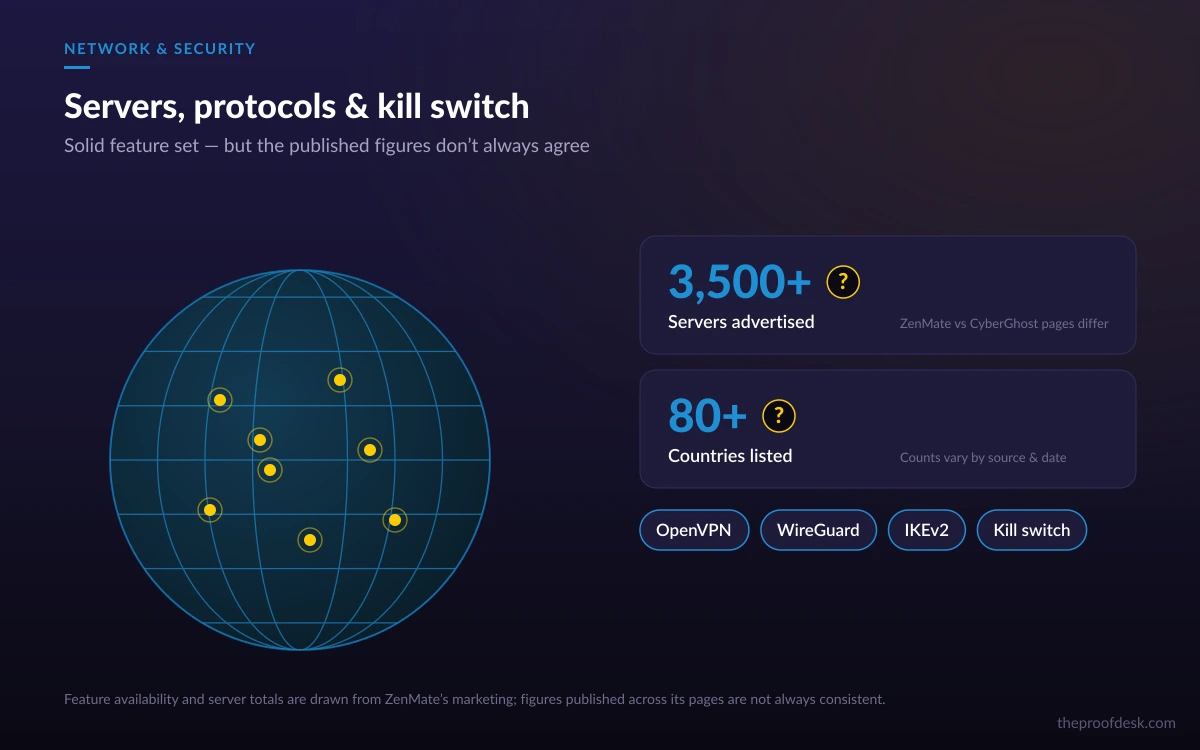
Here the sources openly conflict, which is itself worth knowing. ZenMate's homepage advertises “66+ server locations,” while Cloudwards reports “4,700+ servers across 81 countries” — the larger figure most likely reflects the underlying CyberGhost network the service now runs on. We present both rather than picking one.
The device limit conflicts the same way: ZenMate's homepage says “unlimited devices,” while Cloudwards states a cap of up to 99 devices per subscription. Either way the allowance is generous, but the marketing claim and the reviewed reality do not match.
Protocols and encryption
According to Cloudwards, the apps use OpenVPN and IKEv2 on desktop and OpenVPN and WireGuard on mobile, with AES-256 encryption in the apps and AES-128 in the browser extension. ZenMate's own homepage text names only OpenVPN, so if a specific modern protocol like WireGuard matters to you, confirm it is available on your platform before buying.
Extras
- A kill switch that Cloudwards reports is enabled by default.
- The paid browser extension bundles a malware blocker and a tracker blocker.
- “Split tunneling” is not true split tunneling — it is a limited allowlist feature in the browser extension only.
- Apps and extensions are listed for Chrome, Firefox, Edge, and Opera, plus desktop apps for Windows, Mac, and Linux, and mobile apps for iOS and Android. Free, feature-limited extensions exist for Chrome, Firefox, and Opera.
Privacy and logging: read the policy, not the banner
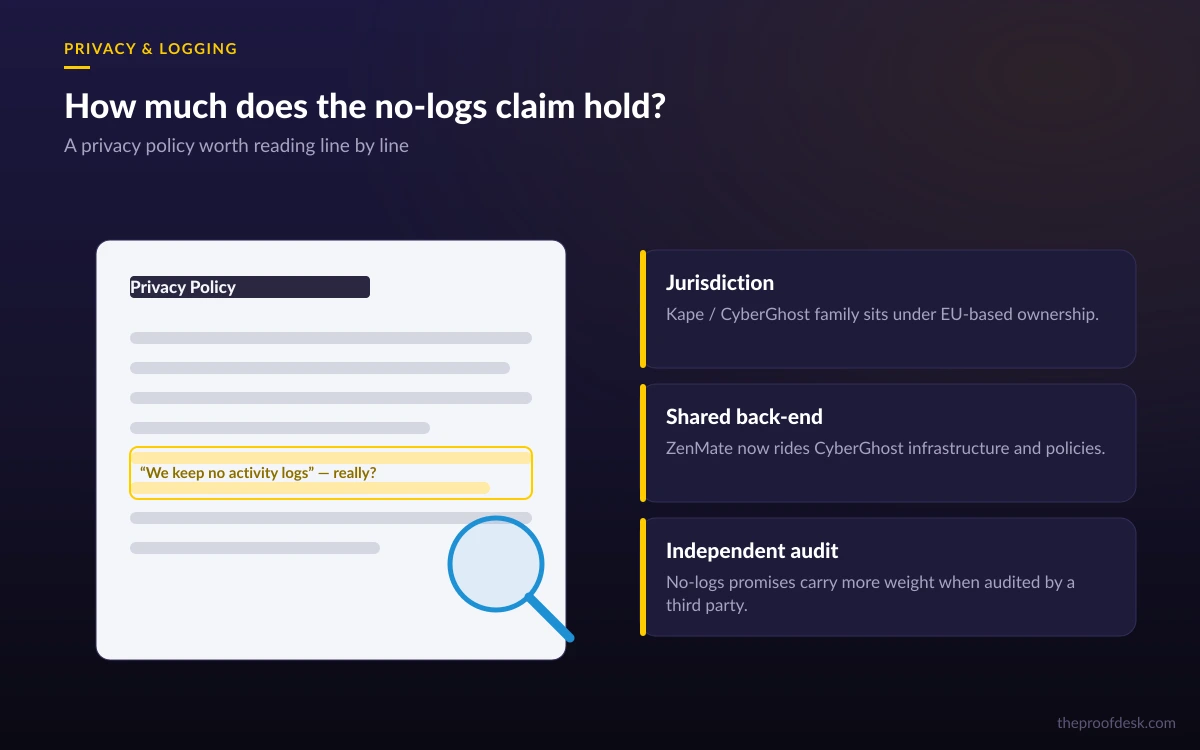
Privacy is where ZenMate needs the most scrutiny. Its own Privacy Policy does not make a clear no-logs claim. It states verbatim: “We use log files. We use such information to analyze trends, administer the Website, track users' movement around the Website, and gather demographic information.” The policy also discloses the use of Google Analytics.
That language is written around the website rather than the VPN tunnel, and Cloudwards separately reports ZenMate's VPN no-logs policy as “confirmed.” But — and this is the key point — no independent third-party audit of ZenMate's logging has ever been conducted. So the no-logs assurance rests on the company's word, not on outside verification.
One more thing to weigh
Kape Technologies, ZenMate's parent, also owns several VPN “review” websites alongside ExpressVPN, CyberGhost, and PIA. Independent commentators have flagged this as a conflict of interest, because it means some of the sites praising these VPNs share an owner with them. It is a reason to lean on independent sources when researching any Kape brand.
Streaming and torrenting
If unblocking streaming libraries is your main reason for a VPN, ZenMate is a shaky pick. Cloudwards reports that Netflix works only through dedicated streaming servers, with “limited success” unblocking Prime Video, Disney+, and Hulu. That is below what several mainstream VPNs — including CyberGhost itself, which markets streaming-optimized servers — deliver.
For torrenting the news is better: P2P is allowed on most servers, so the service is usable for downloading if the rest of the package suits you.
Is ZenMate worth buying in 2026?
The underlying VPN is real, because it is CyberGhost. So ZenMate is not a dead product you would be paying into for nothing. But it is a legacy brand whose own apps were retired in 2023, whose support desk is closed, and whose marketing figures (server count, device limit, protocols) do not line up with what reviewers actually find.
For most people the cleaner move is to buy CyberGhost directly. You get the same network, an app that is actively developed under its current name, CyberGhost's streaming-optimized servers, and a company you can hold to its own current terms — without the confusion of paying one brand to access another. ZenMate makes sense only in the narrow case where its checkout genuinely undercuts CyberGhost's for the same plan length, and even then you should confirm the live price and renewal rate before committing.
If strong, audited privacy is your priority, neither the missing no-logs audit nor the parent company's ownership of review sites will reassure you — and there are independently audited VPNs that will.
Frequently asked questions
Is ZenMate still a working VPN in 2026?
Yes, but not as a standalone product. Its own apps were retired in 2023 and paying subscribers were moved to the CyberGhost app. The site still sells subscriptions, but what you use is effectively CyberGhost's app and network under the ZenMate brand.
What happened to the ZenMate app?
ZenMate announced in 2023 that its developers were joining CyberGhost. New signups stopped on March 16, 2023, the apps were supported only until May 1, 2023, and after that date subscribers were told to log into a CyberGhost VPN app instead.
How much does ZenMate cost?
As reported by third-party aggregators, the Pro for Browsers tier runs about $7.99/month monthly down to roughly $1.99/month on a 1-year plan, and the Ultimate tier runs about $10.99/month monthly down to around $1.64/month on a 3-year plan. Prices are not independently confirmed on ZenMate's own JS-rendered page, so verify at checkout. A 7-day free trial and a 30-day money-back guarantee are listed.
Does ZenMate keep logs?
Its Privacy Policy explicitly says it uses log files and Google Analytics, and it does not make a clear no-logs claim for the service in that document. A reviewer reports the VPN no-logs policy as confirmed, but no independent third-party audit has ever been performed, so the assurance rests on the company's word.
Is ZenMate good for streaming Netflix?
Only partially. Reviewers report Netflix works through dedicated streaming servers, with limited success on Prime Video, Disney+, and Hulu. If streaming is your main goal, CyberGhost's own streaming-optimized servers are the more direct choice.
Should I buy ZenMate or CyberGhost?
For most people, CyberGhost directly. You get the same network with an actively developed app, streaming-optimized servers, and current support — without paying one brand to access another. Consider ZenMate only if its checkout is genuinely cheaper for the same plan length, and confirm the renewal price first.
Key takeaways
- ZenMate retired its own apps in 2023 and folded into CyberGhost; buying ZenMate today means buying access to CyberGhost's network under an older brand.
- The site still sells subscriptions, so treat it as a billing front-end for CyberGhost, not an independent VPN.
- Marketing figures conflict with reviews: 66+ vs 4,700+ servers, unlimited vs up to 99 devices, OpenVPN-only vs OpenVPN/IKEv2/WireGuard.
- The Privacy Policy admits it uses log files and Google Analytics, and there is no independent no-logs audit.
- For the same network with an actively developed app and better streaming, buying CyberGhost directly is usually the cleaner choice.
More in Virtual Private Network
Browse Virtual Private Network