Cloudflare Pages Review 2026: Unlimited Free Bandwidth, 500 Builds a Month and Why Cloudflare Says Start With Workers
Cloudflare Pages still hosts static sites free with unlimited bandwidth and 500 builds a month, but new features now go to Workers. Limits, Functions pricing, known issues and who should still pick it.
Cloudflare Pages is still one of the most generous places to host a static site. Requests for static assets and the bandwidth behind them are free and unlimited on every plan, the free tier includes 500 builds a month, and you can keep an unlimited number of preview deployments live. The catch in late 2026 is not the price. It is the direction of travel.
The Pages docs now open with a note that reads "Start new projects with Workers", and Cloudflare said in April 2025 that "all of our investment, optimizations, and feature work will be dedicated to improving Workers." This review covers what Pages actually gives you on the free and paid tiers, how Pages Functions are billed, which features have stayed on the Workers side, and who should still pick Pages. Every figure comes from Cloudflare's own docs, pricing pages and status page as checked on November 4, 2026.
What Cloudflare Pages is in 2026
Pages is Cloudflare's Git-connected hosting for static and JAMstack sites. You connect a GitHub or GitLab repository, Cloudflare builds it on every push, and the output is served from Cloudflare's network on a *.pages.dev subdomain or your own domain. Server-side code runs as Pages Functions, which execute on the Workers runtime and are billed as Workers requests.
Supported, but no longer where the work goes
In September 2024 Cloudflare said it planned to "bridge the remaining gaps between Workers and Pages and provide ways to migrate your Pages projects to Workers." By April 2025 it had done enough of that to change its advice: "Now that Workers supports both serving static assets and server-side rendering, you should start with Workers. Cloudflare Pages will continue to be supported, but, going forward, all of our investment, optimizations, and feature work will be dedicated to improving Workers."
The Pages docs overview repeats the point to anyone who lands there: "Are you sure you want to use Pages? Workers supports most Pages use cases and offers a broader feature set. It is Cloudflare's primary platform for building applications. Start new projects with Workers."
Is Pages being shut down?
No. We found no end-of-life or deprecation date for Pages, and it remains a supported product. Cloudflare said in 2023 that existing projects on Pages and Workers "will continue to work without users needing to lift a finger." What has changed is that new features land in Workers, and Cloudflare now publishes a guide for migrating Pages projects to Workers.
Pricing: what is free and what costs money
Pages has no price list of its own. Cloudflare's Functions pricing page is explicit: "On both free and paid plans, requests to static assets are free and unlimited. A request is considered static when it does not invoke Functions." The only thing that can cost money is Pages Functions, and "Requests to your Functions are billed as Cloudflare Workers requests."
- Static asset requests and bandwidth: free and unlimited on the Free plan and every paid plan.
- Workers Free: 100,000 requests per day, shared between Pages Functions and any Workers on the account, with 10 milliseconds of CPU time per invocation. The daily limit resets at midnight UTC.
- Workers Paid: a minimum charge of $5 per month per account, with 10 million requests included per month and $0.30 per additional million.
- Workers Paid CPU: 30 million CPU milliseconds included per month and $0.02 per additional million CPU milliseconds, with up to 5 minutes of CPU time per invocation (default 30 seconds).
- Data transfer: "There are no additional charges for data transfer (egress) or throughput (bandwidth)."
The free quota is shared. Cloudflare's own example: "you could use 50,000 Functions requests and 50,000 Workers requests to use your full 100,000 daily request usage." Calls your Function makes to bindings count too: requests to Pages Functions count towards the Workers quota, "including requests from your Function to KV or Durable Object bindings." When a free account runs past the daily limit, Cloudflare returns Error 1027, and you can configure whether the route fails open or fails closed.
Two different kinds of 'paid plan'
The build and custom-domain limits below depend on your Cloudflare zone plan (Free, Pro, Business or Enterprise). Workers Paid at $5 a month is a separate subscription: "Workers Paid plan is separate from any other Cloudflare plan (Free, Professional, Business) you may have." Upgrading to Workers Paid raises your Functions quota but does not give you Pro's 5,000 builds a month. We could not verify current zone plan prices for this review, so we do not quote them.
Plan limits that matter
Builds
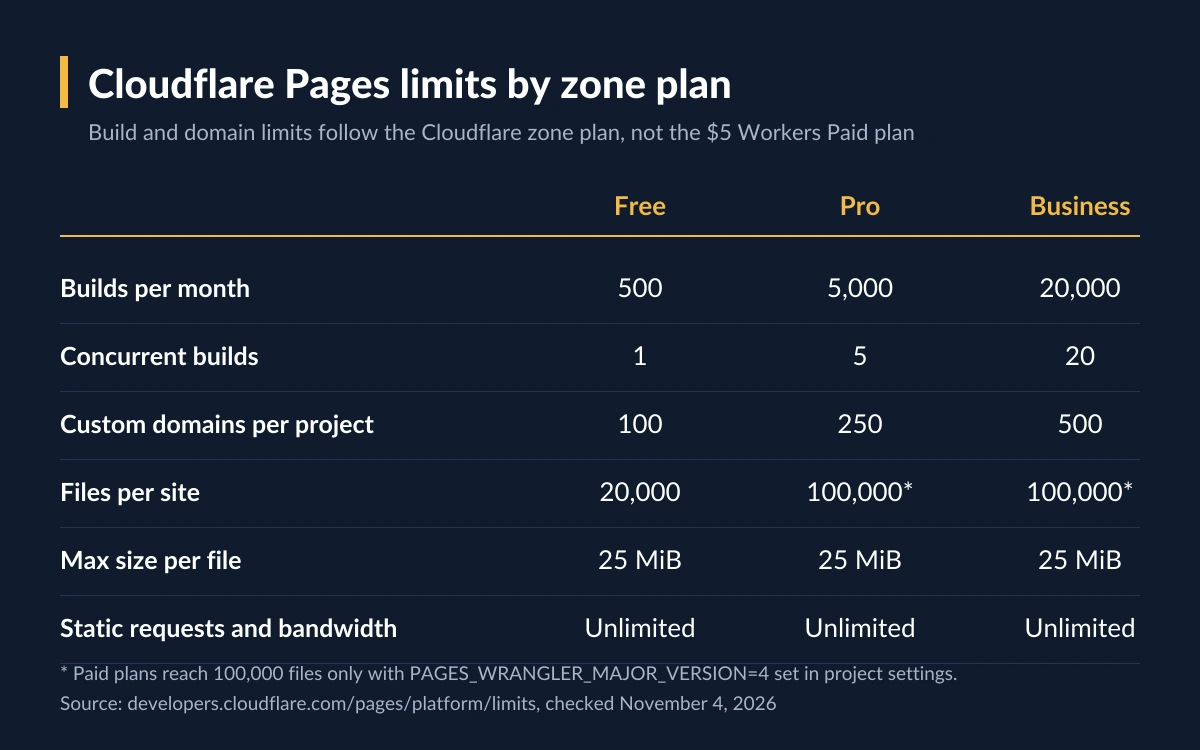
- Free: 1 build at a time, 500 builds per month.
- Pro: 5 concurrent builds, 5,000 builds per month.
- Business: 20 concurrent builds, 20,000 builds per month.
- Every plan: "Builds will timeout after 20 minutes. Concurrent builds are counted per account."
Sites, files and projects
- Files per site: up to 20,000 on the Free plan. Paid plans can have up to 100,000, but only after you set the environment variable PAGES_WRANGLER_MAJOR_VERSION=4 in the project settings.
- Single asset size: "The maximum file size for a single Cloudflare Pages site asset is 25 MiB."
- Projects: 100 per account, and "This limit is not routinely increased." The Workers project limit (100 on Free, 500 on paid plans) is counted separately.
- New accounts are limited in how many Pages projects they can create in their first 48 hours.
Domains, headers and redirects
- Custom domains per project: 100 on Free, 250 on Pro, 500 on Business and Enterprise (more via your account team on Enterprise).
- _headers: a maximum of 100 header rules, each header up to 2,000 characters.
- _redirects: up to 2,000 static and 100 dynamic redirects, 2,100 in total.
- Preview deployments and users: unlimited.
For a marketing site, a blog or a documentation site, the free limits are hard to hit. The two that bite in practice are the 25 MiB per-file cap, which rules out hosting large video or archive files as site assets, and the 20,000-file cap on Free, which a generated docs site with many versions can reach. The 500 builds a month works out to roughly 16 a day, which is enough for one team pushing to a single site but tight if many branches build on every commit.
Deploying: Git, Direct Upload and previews
There are three ways to get a site onto Pages: the Git integration, Direct Upload (with Wrangler or by dragging files into the dashboard), and C3 from the command line. For automatic builds, "GitHub and GitLab are currently the only supported platforms", so Bitbucket and self-hosted Git users have to build elsewhere and push the output with Direct Upload.
Choose the deploy method once
The choice is permanent for a project, in both directions: "If you choose Direct Upload, you cannot switch to Git integration later" and "If you deploy using the Git integration, you cannot switch to Direct Upload later." Changing your mind means creating a new project and moving the domain.
Direct Upload through Wrangler accepts up to 20,000 files of up to 25 MiB each. Drag-and-drop in the dashboard is capped at 1,000 files, which makes it a tool for quick tests rather than real sites. Each project can also have deploy hooks, each with a unique URL that triggers a build when it receives an HTTP POST, which is how headless CMS publishes usually kick off a rebuild.
Preview deployments
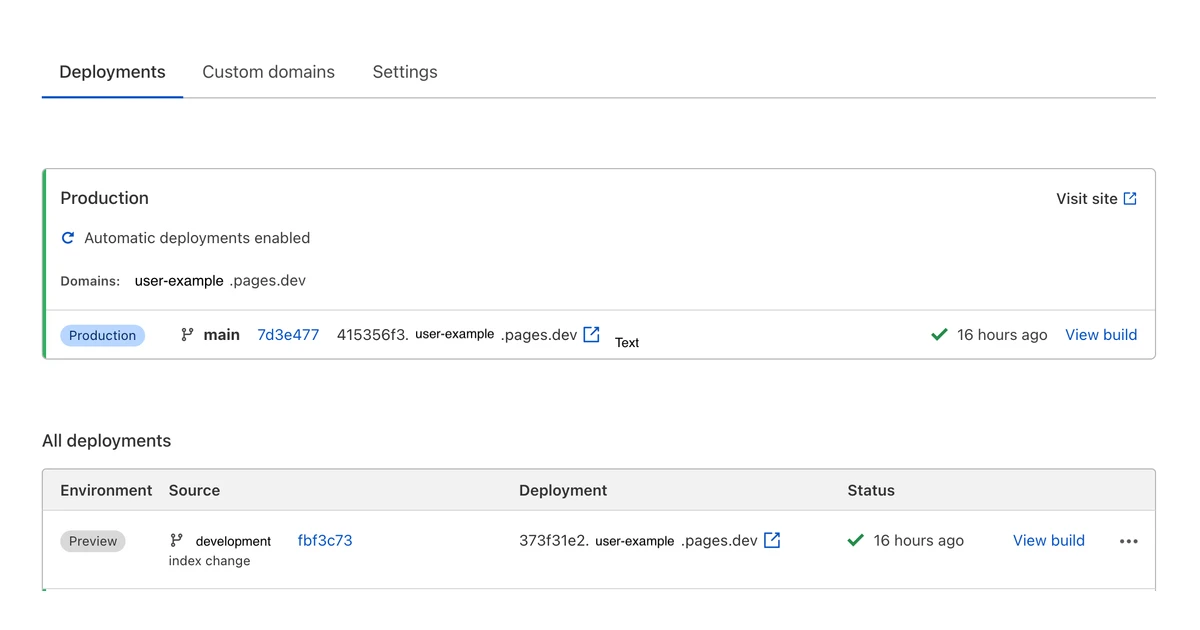
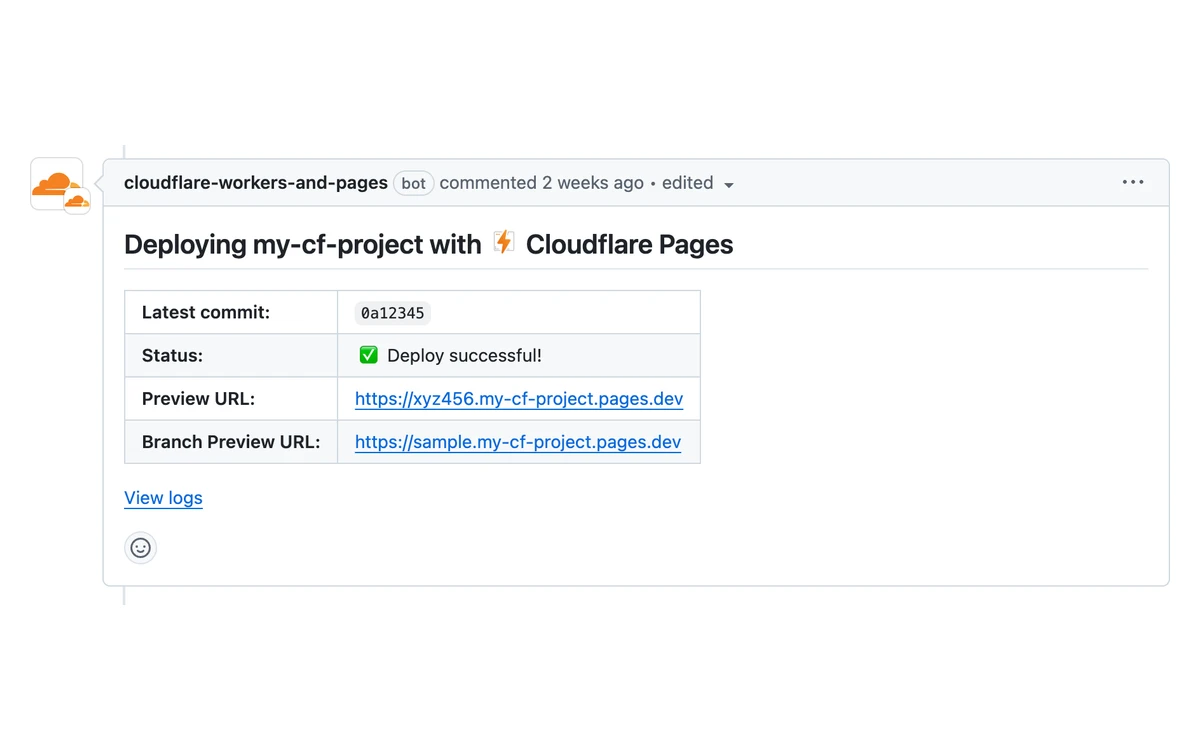
Every push to a non-production branch gets its own preview URL, and Pages also "creates an alias for git branch's name" that always maps to the latest commit of that branch. On GitHub, a bot comments on the pull request with both URLs. Two caveats: "By default, these deployment URLs are public", and commits or pull requests from forked repositories do not create a preview at all. Cloudflare Access can put previews behind a login, but it "will only protect your preview deployments" and not your *.pages.dev domain or custom domain.
Rollbacks
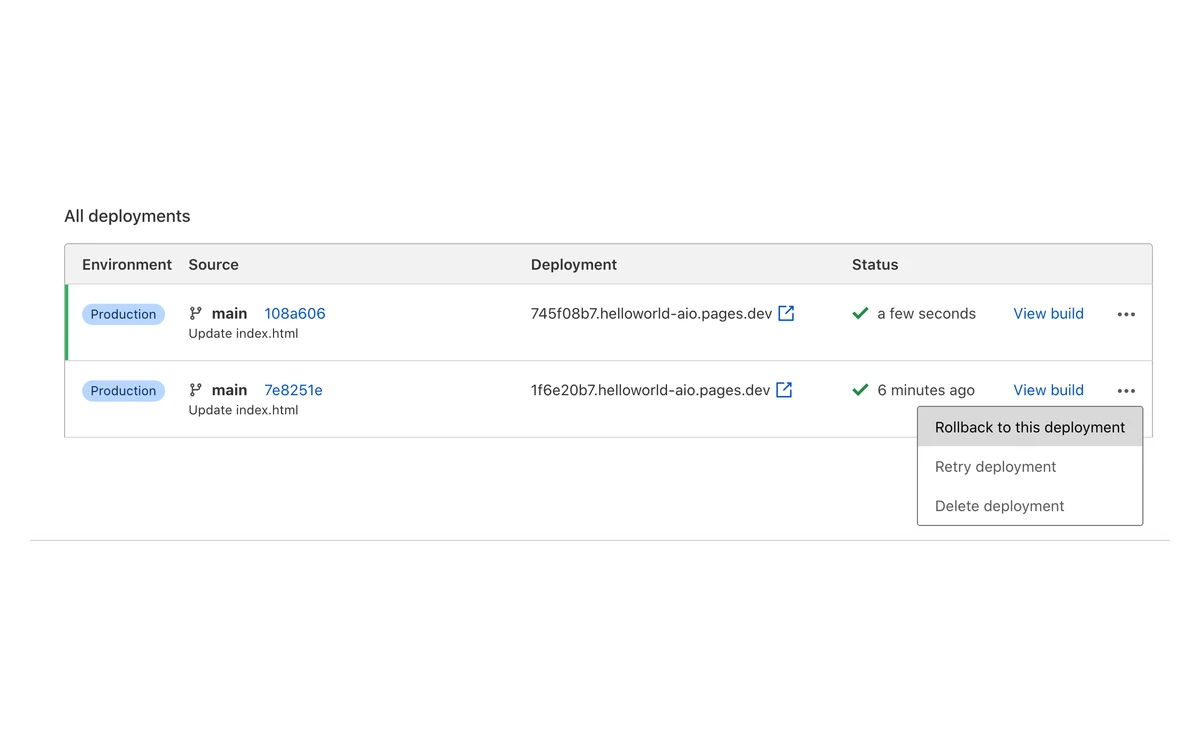
"Any production deployment that has been successfully built is a valid rollback target", and rolling back is a menu item on the deployment row, with no rebuild. Preview deployments cannot be promoted this way: "preview deployments are not valid rollback targets."
Pages Functions and bindings
Pages Functions are file-based routes in a functions directory that run on the Workers runtime. They can bind to most of Cloudflare's developer platform: KV, D1, R2, Workers AI, Hyperdrive, Vectorize, Queue producers and service bindings. Durable Objects are the awkward one: "you must create a separate Worker with a Durable Object and then declare a binding to it", and Cloudflare itself says "Using Durable Objects with Workers is simpler and recommended."
Observability is thin. Pages Functions logs are real-time only, viewed in the dashboard or streamed with Wrangler. Workers Logs, Logpush, Tail Workers and Source Maps are not available on Pages, so there is no built-in way to search yesterday's errors.
npx wrangler pages deployment tail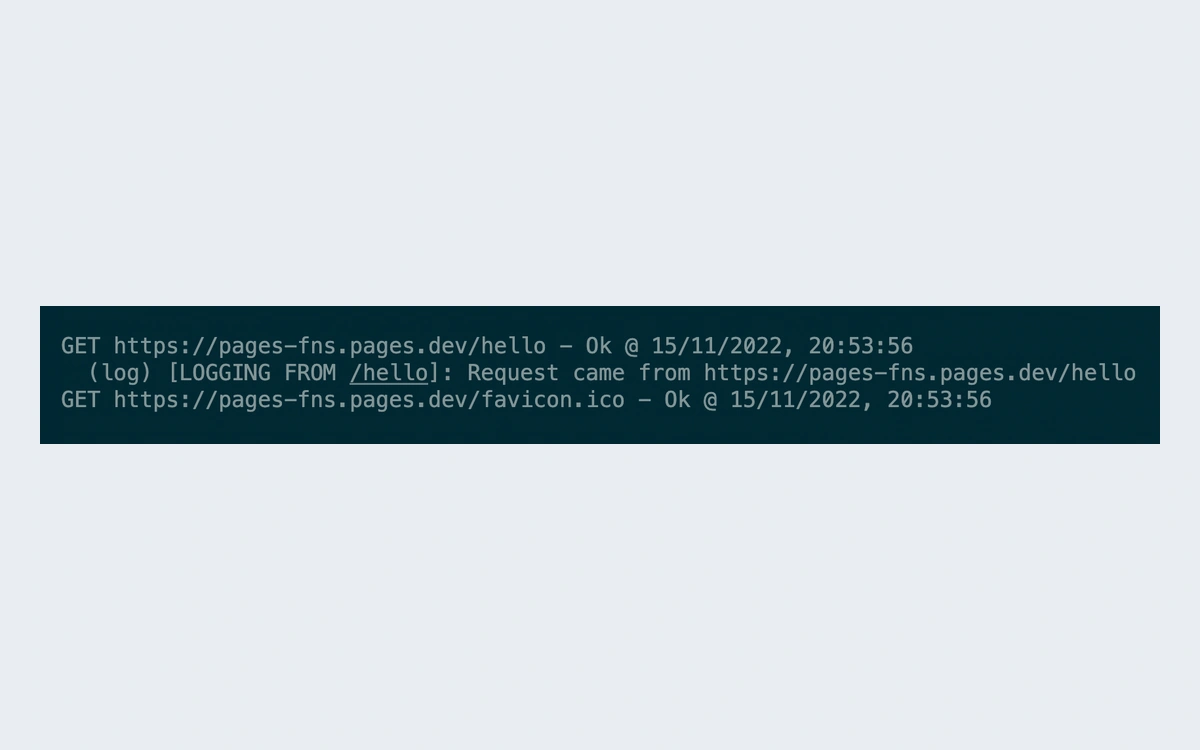
What Pages lacks compared with Workers
Cloudflare's migration guide includes a compatibility matrix, and it is lopsided. These features are available on Workers but not on Pages:
- Vite plugin, Remote Development and the Quick Editor
- Gradual Deployments
- Serving assets on a path and non-root routes
- Workers Logs, Logpush, Tail Workers and Source Maps
- Cron Triggers, Email Workers and Queue Consumers
- Image Resizing and Rate Limiting
Both platforms support rollbacks, preview URLs, real-time logs, D1, KV, R2, deploy hooks and build caching. Only one feature is listed as Pages-only: custom domains outside Cloudflare zones. That matters if your DNS is hosted somewhere else and you do not want to move it to Cloudflare.
Cost is not a reason to stay or leave. The migration guide says: "Like Pages, requests for static assets on Workers are free, and Pages Functions invocations are charged at the same rate as Workers, so you can expect a similar cost structure." It adds that Workers has "a distinctly broader set of features available to it, (including Durable Objects, Cron Triggers, and more comprehensive Observability)."
Known issues and reliability
Cloudflare's known-issues page lists several limits worth knowing before you commit:
- "Incremental builds are currently not supported in Cloudflare Pages."
- "Commits/PRs from forked repositories will not create a preview."
- "*.pages.dev subdomains currently cannot be changed." Pick the project name carefully.
- "Cloudflare does not support Netlify's Forms feature." Sites moving from Netlify need a Function or a third-party form service.
- Advanced Certificates cannot be used with Cloudflare Pages.
- You cannot add a custom domain that already has a Cloudflare Access policy enabled.
Incidents in 2026
Two Pages incidents in 2026 are confirmed on Cloudflare's status page. On March 2, 2026, from 20:45 to 21:48 UTC, "Workers and Pages builds, Pages API unavailable", with the warning that "Customers may experience 5xx errors, and builds may fail to start or complete." On April 21, 2026, from 15:46 to 18:07 UTC, Cloudflare reported Pages build issues and noted that "existing sites and traffic to those sites are not affected." Both were mainly build-side: the usual risk on Pages is a deploy that waits, not a site that goes down.
Who should still choose Cloudflare Pages
Pages is still a good choice if you already have a working project on it, if your site is mostly static and fits comfortably inside 20,000 files and 500 builds a month, or if your DNS lives outside Cloudflare and you want a custom domain without moving it. The free tier remains hard to beat for static hosting because bandwidth never becomes a bill.
Start on Workers instead if the project is new, or if you need anything on the Workers-only list: Cron Triggers, simpler Durable Objects, stored logs, Gradual Deployments or the Vite plugin. The cost structure is the same, and Workers is where Cloudflare's features will keep arriving. If you are weighing Cloudflare against other front-end hosts, our Netlify, Vercel and Deno Deploy reviews cover the alternatives on the same terms.
Frequently asked questions
Is Cloudflare Pages free?
Yes, for static sites. Static asset requests and bandwidth are free and unlimited on every plan, and the Free plan includes 500 builds a month, one build at a time. Only Pages Functions use a metered quota: 100,000 requests a day on Workers Free, shared with any Workers on the account.
Is Cloudflare Pages being discontinued?
No. Pages has no announced end-of-life date and remains supported. Cloudflare recommends Workers for new projects and says all new feature work goes to Workers, so expect Pages to stay stable rather than gain features.
How much do Pages Functions cost?
They cost the same as Workers. On Workers Paid, a $5 monthly minimum covers 10 million requests and 30 million CPU milliseconds, then $0.30 per additional million requests and $0.02 per additional million CPU milliseconds. Calls from a Function to KV or Durable Object bindings count toward the request quota.
Does paying $5 for Workers Paid give me more builds?
No. Build limits follow your Cloudflare zone plan: 500 builds a month on Free, 5,000 on Pro and 20,000 on Business. Workers Paid is a separate subscription that raises the Functions quota only.
Can I use Pages with a domain whose DNS is not on Cloudflare?
Yes. Custom domains outside Cloudflare zones are the one feature Cloudflare lists as available on Pages but not on Workers, which makes this a real reason to choose Pages.
Can I switch a project from Direct Upload to Git, or the other way?
No. The deploy method is fixed when you create the project, in both directions. To change it you create a new project and move your custom domain to it.
Does Cloudflare Pages support Bitbucket?
Not for automatic builds. GitHub and GitLab are the only supported platforms for Git-triggered CI/CD. With Bitbucket you build in your own CI and deploy the output with Wrangler Direct Upload.
Should I migrate an existing Pages project to Workers?
Only if you need something Pages lacks. Existing projects keep working and the cost structure on Workers is similar, so the reasons to move are features: Cron Triggers, Workers Logs, Gradual Deployments, simpler Durable Objects. Cloudflare publishes a migration guide for when that day comes.
Key takeaways
- Static requests and bandwidth on Cloudflare Pages are free and unlimited on every plan; only Pages Functions are metered.
- Free gives 500 builds a month, one at a time, 20,000 files per site and 25 MiB per file; build and domain limits rise with the Pro and Business zone plans, not with Workers Paid.
- Pages Functions share the Workers quota: 100,000 requests a day free, or 10 million a month on the $5 Workers Paid plan.
- Pages is supported but frozen: Cloudflare tells new projects to start on Workers and puts all new feature work there.
- Watch for the permanent Git vs Direct Upload choice, GitHub/GitLab-only builds, public previews and the v2 to v3 build image move on February 23, 2027.
- Pages still wins on one point: custom domains whose DNS is not on Cloudflare.
More in Cloud Computing
Browse Cloud Computing